Ellis Scott’s Night Terminus
Word count: 741
Paragraphs: 12
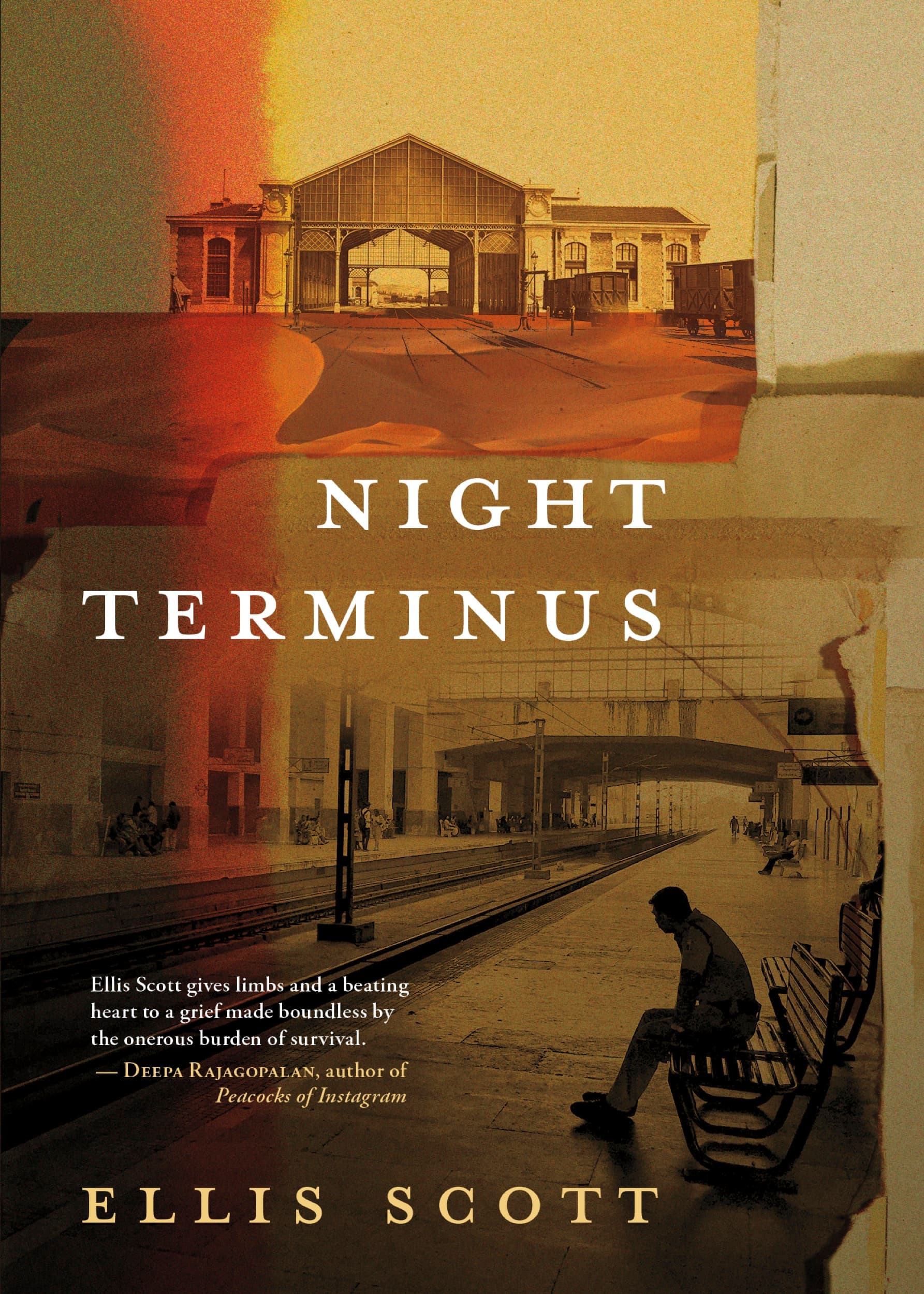
Night Terminus
Dundurn Press, 2026
Queer literature can oftentimes feel lonely. In perusing through the canon of queer stories—contemporary and classic—you’ll find no shortage of novels or short stories within isolation. Whether it be a narrow and glossy view of two people in love, a becoming narrator lost in themselves, or a microscope focused on a contained group of friends, queer storytelling tends to bend towards intimacy as felt within isolation. In some ways, this is the obvious approach. The form creates limits. You only have so much room on the page. Night Terminus, however, resists this.
Ellis Scott’s debut novel should, by all means, take after this tradition of queer solitude. The novel jumps from country to country with each new chapter—reaching across India, France, Iran, and Canada, among others. We meet new characters with the introduction of new places, diving into their stories, all while the narrator remains unnamed and largely anonymous. But despite the wandering, Night Terminus sketches a vibrant mosaic of what queer community is—revealing that it’s within diaspora that we can find home.
It’s the question at the center of Night Terminus, and our characters wrestle with it devoutly. The story takes place across a wide range of years, beginning during the onset of the AIDS epidemic and whose impact is felt in every written year that follows. Night Terminus does not shy away from the complicated impact that surviving leaves on you (especially surviving in a world that prefers that you didn’t). All of the characters in the novel are plagued by grief and the exhaustion of travel, having been rejected by the countries that they might’ve otherwise called “home.” However, the light within Scott’s novel lies within the fact that while the characters are on the move, they are not on the run. They do not seek to escape the memory of their dead lovers’ faces, but rather, they aim to find solace among the only community that might understand their loss.
“One may only bury the past for so long. It surfaces again, and one returns to that first time the shovel broke cemetery ground, when we weren’t aware of the cataclysm that, unbeknownst to anyone, had already settled on us like a fine dust.”
Solace does not come easily to those in Night Terminus. An understanding of what “home” is is as hard to find as the thing itself. This is the propelling force of Scott’s quiet novel: individual studies of a diaspora distorted by death and undergoing a complicated reckoning with what “home” means. It’s a reckoning that’s timely.
The concept of statehood is unavoidable in conversations of belonging. This is true in the reader’s world, just as it is in the world of the unnamed narrator at the center of Night Terminus. Characters in the novel find themselves longing for a tangible place to call home, imagining themselves “nourished by the sun and rain and protected by a bitchy wind. A holy mountain of victory from which to watch the sunrise every morning together, without fail.” And yet, this longing for home is not the same thing as an argument for borders. With each new soliloquy unearthing another character’s story, we’re gifted with a new insight into the state’s failure to protect queer people—and the incompatibility of home and statehood. The embrace of borders is not one of safety for these characters. Whether it’s the nature of policing and the cruelty of healthcare, or even the ever-shifting terrain of queer place (Scott, at one point, describes a gay travel guide that is almost immediately out-of-date following its publication), the only home—and salve—that the queer people in Night Terminus find is in each other.
“‘The state could be so cruel. Our deaths were preordained.’”
It’s in the vacancy created by their common loss that they begin to find community across borders and outside of the hold of any one country. It’s a difficult contriducton—absensce and presence, disorientation and clarity, sorrow and intimacy, all at once. And yet, Scott leans in.
“‘Without people, some think there is a sense of lack,’ he said. ‘A hollowness. But it’s the opposite. The empty spaces give the photos meaning, and it's the silences that have the most weight.’”
In focusing on the empty space, Scott writes a queer novel that is full of abundance—even in its solemnity. Night Terminus is a haunting, a prayer, and an exhale all at once.
Henry Hicks IV (he/him) is a Washington, DC-based writer and organizer. A graduate of Oberlin College and a Harry S. Truman Scholar, his work has appeared in The Guardian, Mother Jones, The Drift, In These Times, and more.