Robert Rauschenberg: Life Can’t be Stopped
Word count: 1066
Paragraphs: 11
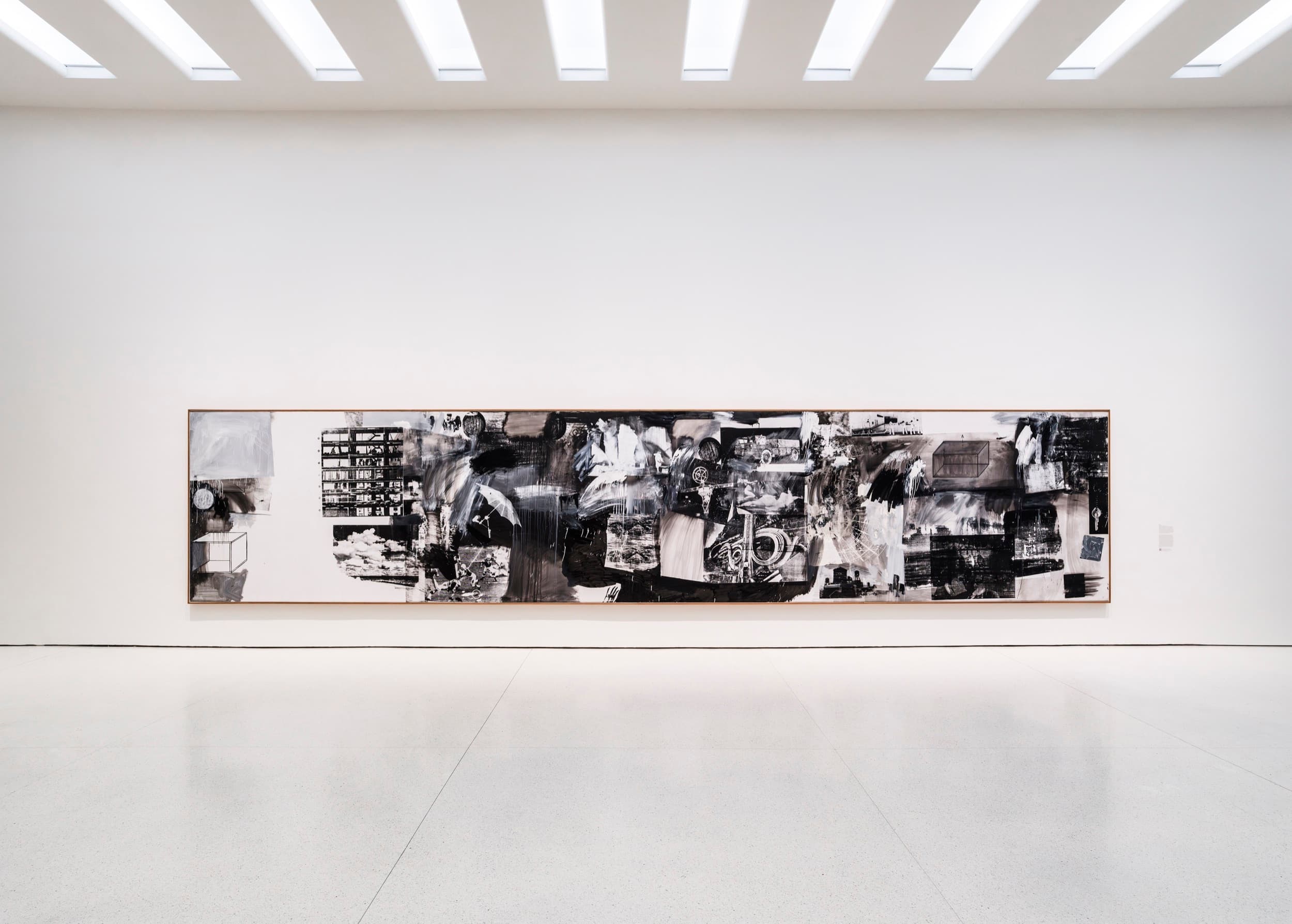
Installation view: Robert Rauschenberg: Life Can’t Be Stopped, Solomon R. Guggenheim Museum, New York, 2025–26. © Solomon R. Guggenheim Foundation, New York. Photo: Ariel Ione Williams.
Guggenheim Museum
October 10, 2025–May 3, 2026
New York
Robert Rauschenberg has returned to the Guggenheim in honor of his centennial year. Part of the museum’s Collection in Focus series, Life Can’t Be Stopped presents a sort of miniature retrospective (“over a dozen” works, but not more than fifteen) cuddled in the corners of the sixth floor of the Guggenheim’s tower. The exhibition, smartly organized by Joan Young, walks its visitor through and between time, encompassing notable mediums of paint and paper, transfers and silkscreens—all some means of collage. It is a fine job at a survey, a place for one to get familiar, undressed, though not quite known.
The show opens with one of Rauschenberg’s signature moves. Recalling the “Combines,” a 1963 untitled work is topped with a toaster, the middle of the canvas marked by a black-and-white horizontal picture of his friend and colleague the choreographer Merce Cunningham turned vertically, making it seem as though his silhouetted body is falling. Maybe he is. Objects become images and images become objects, neither ever totally either. Using the image-as-material, where sign and symbol are one in a word, our imagination is free to run wild with Rauschenberg’s. What else here is a body? A bike, a plane, a bug, a fetus in a womb—stars being born and dying but never dead. There is no beginning or end.
The pieces weave themselves in and out of invention and destruction. One is satisfied for a breath by the faint touching of two thin strips fashioned from cheese cloth caulked in print in an untitled 1974 work, where the artist lets four papier-mâché strands hang, attached to the wall only by a board, as the wall text puts it, “enabling the fabric tails to catch a passing breeze.” I think of sailing catamarans in the bays of my youth and all that brought to my being, similarly and so different from the artist who grew up informed by the Gulf Coast of Port Arthur, and who later spent so much time making work on Captiva Island. I take another lap around the show, and the pair once joined at the edges is already no longer.

Robert Rauschenberg, Untitled (Hotel Bilbao), ca. 1952. Letterpress, wood engravings, paper, fabric, and graphite on paper, partially mounted to paperboard, 10 ¼ × 11 ¼ inches. © Robert Rauschenberg Foundation / Licensed by VAGA, New York, NY / Artists Rights Society (ARS), New York. Courtesy Solomon R. Guggenheim Museum, New York and Robert Rauschenberg Foundation.
Rauschenberg moved to Captiva in 1970. Here, he continued to expand his practice and language. Brushstrokes are still visible, but changed, more modern, fast, and exact. An image itself becomes a contour line of a neighboring reference. Even in the later work of the 1980s and ’90s, when silkscreen methods took charge of the canvas, the planes did not remain totally flat. They beg us to wonder if the paint splatter in Easter Lake (Galvanic Suite) (1988) is still wet, because the lace curtain seems to have left behind its skeleton, spilling ink.
Bilbao Scraps [Anagram (A Pun)] (1997) is derived from inkjet dye transfers and inspired by a learned concern for the environment after the artist attended a conference in Rio de Janeiro. It references the readymade Untitled (Hotel Bilbao) (ca. 1952), fashioned from hotel address labels over forty years earlier and installed just across the room. It proves a sort of creative clairvoyance, how ideas get made behind the scenes, stories written before or without our noticing. Bilbao Scraps, processed with water rather than chemicals, feels like holding with accidentally wet fingers old photographs printed fresh from the color printer in my father’s basement office. It’s all as hazy as the memory which creates and contains it. I look at one of the girls whose image is framed in the surface, and I swear she looks so much like an old photograph of my Nana I almost think it is.
This condensed retrospective culminates with Autobiography (1968), three lithographs stacked vertically, which tell the story of the artist’s life without ever saying his name, and the much-anticipated return of the silkscreen painting Barge (1962–63), a black-and-white 32-foot-long example of his lifelong practice. Picture a scene like Jean-Luc Godard’s traffic shot in Weekend. Associations slide one into the next, each changing in respective relations. How many colors can exist between two? Each point of intersection explodes. Barge, built from multiples of his own photographs (like many others in his oeuvre), is filled with the artist’s personal motifs, so says the wall text, but I see so much of both mine and the world’s pressed into the canvas like silly putty. I sit on a bench in front of the work and listen to the stories people tell each other. A man points to a football fumble and laughs. Who hasn’t been there before? You rub up against so many things, and out of it, make a life.

Installation view: Robert Rauschenberg: Life Can’t Be Stopped, Solomon R. Guggenheim Museum, New York, 2025–26. © Solomon R. Guggenheim Foundation, New York. Photo: Ariel Ione Williams.
In the center of Barge is a transferred image of Diego Velázquez’s The Toilet of Venus [“Rokeby Venus”] (1647–51). The goddess, with her back towards us, looks into a mirror held by Cupid. We can only see her face in the reflection. But in the transfer, something is warped. It’s almost as if there’s a lens, right there above the mirror, emptily looking back.
I spend a long time watching people interact in and with the exhibition. Many approach the work with their arm out, a phone leading ahead of their eyes, to take a picture before they even see the thing they capture. Cot (1980), a solvent transfer of fabric and acrylic, is a friend’s favorite. She falls in love and prints it out in color, but it isn’t close to the same. There is no materiality distinguishable in the copy replicated by the cellphone. It’s all flat, everything physically adulterated by its digital perception.
In his review about the artist and the art world’s response to his one hundredth birthday, Hilton Als suggests we look at the world through Rauschenberg’s eyes, but to do this, we must first see with our own. These pieces, which may be held within the walls of an institution, do not consist of materials withheld by the same. It’s true: we live in a world of images, so perhaps we need a cacophony, to shock us back into the body. Rauschenberg, his work made out of a real and tangible world, committed to the insistence of a gesture, reminds us that the mundane always holds a vast potential for the profound and that where you see it depends on how you look at it.
Madelyn Santorelli is a woman who loves looking and tries to say what she sees.