MONUMENTS
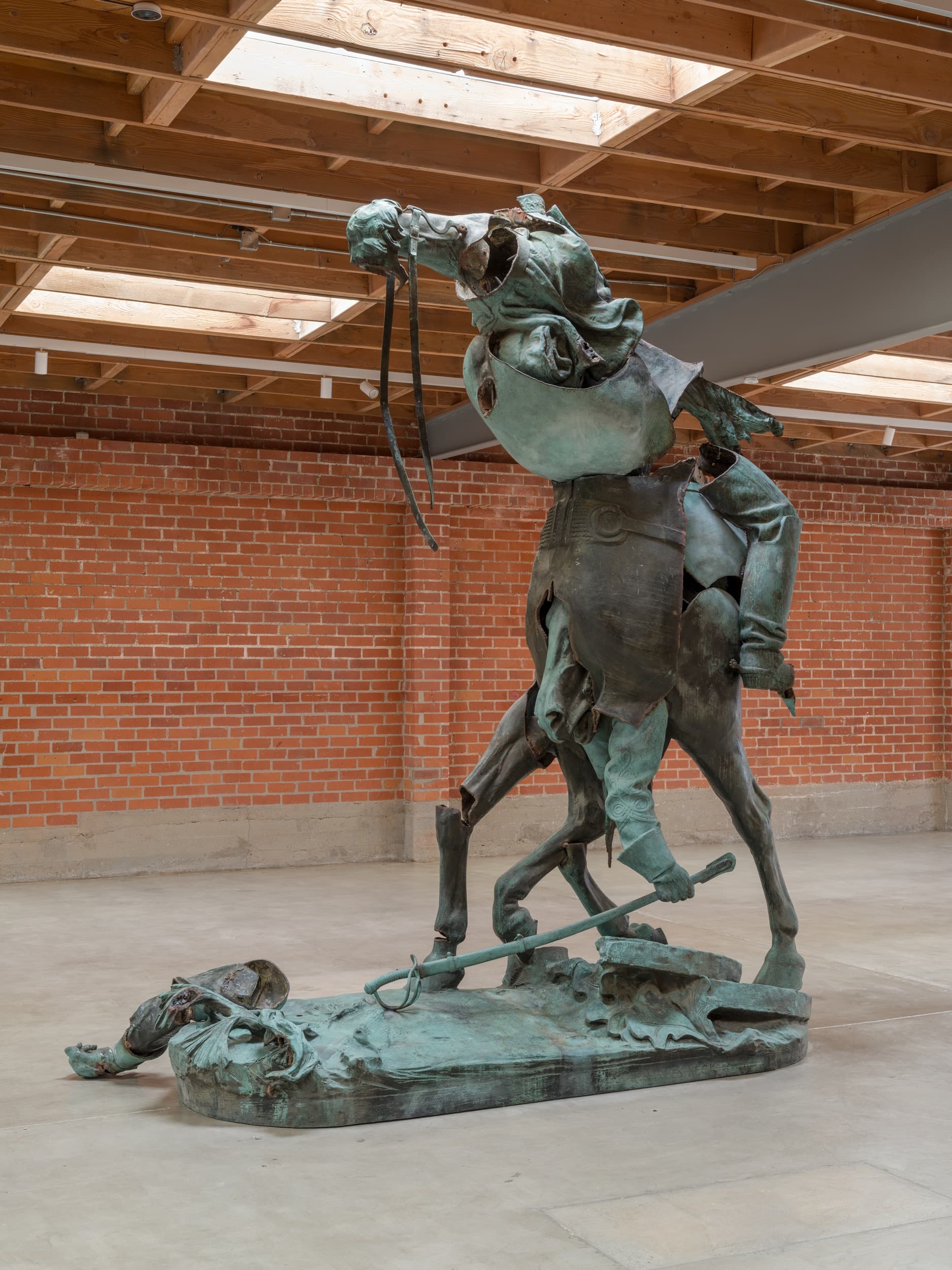
Kara Walker, Unmanned Drone, 2023. Bronze, 134 × 153 ½ × 55 inches. Courtesy the artist and Sikkema Malloy Jenkins.
Word count: 1100
Paragraphs: 7
MOCA Geffen Center & The Brick
October 23, 2025–May 3, 2026
Los Angeles
I’m writing this review from Vienna: just yesterday I took a walk in the local park, the Augarten, near my Airbnb, where there are two gargantuan flaktürm, or anti-aircraft bunkers built by slave-labor for the Nazis to defend the city against the Allies. The Germans intended, after a successful conclusion to the war—for their side—to clad the towers in marble and make them eternal tributes to the bravery of the fallen soldiers who had died in the service of Hitler and the Reich. What if the Austrians had gone ahead and made their bunkers into “Lost Cause” Nazi memorials? It seems perverse and unthinkably morally bankrupt, and yet this is what transpired in the American South after the end of Reconstruction. Thousands of memorials to a Lost Cause promoting human bondage and racial purity sprang up at the end of the nineteenth and well into the twentieth century, and it took over a century to begin to reject these coded objects intended to maintain an active resistance to basic decency and the rule of law. MONUMENTS—co-organized and co-presented by the Geffen Contemporary at MOCA and The Brick—presents a critical and at times effective response by artists of color to the still very present scourge of sculptural promotion of white supremacy in the United States.

Nona Faustine, On This Spit Of Land Massa and I Reside, Dutch Reform Cemetery, Brooklyn, NY, 2013. Pigment print, 33 ⅜ × 50 inches. Courtesy the Estate of Nona Faustine and Higher Pictures.
So how do you compete with almost indestructible marble and bronze monuments extolling the virtues of traitors such as Jefferson Davis and Stonewall Jackson? Torkwase Dyson’s Rate of Transformation, Distance (2018/2025) offers an equivalent counterweight to the Southern hero cult. Her glistening and precise black prisms, sunk into the floor as if they were crystals growing from the earth, push back against the narrative and sinuous contours of classic bronze statuary. Dyson’s monoliths’ Blackness rejects the gold-and-then-green coloring of the Confederate monuments. The massing is meant to convey Dyson’s ideas of Black movement and Black space, and her forms have an open side which offers a devouring maw that might consume the grandiose poses of generals and politicians in the face of the needs of a people. Kara Walker’s Unmanned Drone (2023) is a dismemberment of Charles Keck’s 1921 tribute to Stonewall Jackson, transforming it from a typical equestrian typology into simply a horse’s ass carrying a supine and flaccid Jackson whose sword drags in the dirt. Like a butcher, Walker has brutally cleaved the joints of the man and his horse, removing the neatness and perfection of the monument itself, which acted as a gloss for the horrors it overlooked while advocating the finer points of the supposedly utopian Southern social order.
Walker and Dyson represent the most effective means of formulating the anti-Confederate monument: blunt and total rejection. The alternate approach, that of criticality, falls flat—not due to the efforts of the artists specifically, but because it is an inherent weakness of the contemporary left to think that “unpacking” and satire can deflect the bald-faced hatred of well-armed men in white sheets who call themselves “wizards” and “grand-dragons.” In Hank Willis Thomas’s A Suspension of Hostilities (2019), an inverted replica of the General Lee car from The Dukes of Hazard plays on the inadvertent allyship of a young Black kid with Bo and Luke Duke, based on the seductiveness of pop culture. Unlike his Raise Up sculpture, which depicts desperate life-and-death moments of forceful oppression, the upside-down 1969 Dodge Charger is far too sweet and trusting. Karon Davis’s Descendant (2025), a realistic depiction of her young son Moses dangling a miniature Confederate General John Hunt Morgan by his horse’s tail, has the right proportion of dismissiveness and disdain for the pathetic-ness of Lost Cause rationalizations.

Stan Douglas, Birth of a Nation, 2025. Five-channel video installation, color, silent, 13:20 minutes. © Stan Douglas. Courtesy the artist, Victoria Miro, and David Zwirner.
The works in the show tend to fall into these two categories: forceful pushback or intellectual criticality. The six examples from Nona Faustine’s “White Shoes” series (the works on display range in date from 2013–18)—simultaneously elevating the beauty of the Black body and presenting that body in its forms of chattel, servitude, and resistance in various locations significant to Black liberatory narratives in New York City—are a disarming and powerful rejection of the staid, aloof, and ultimately unsustainable depictions of Southern life. Jon Henry’s fourteen examples from his “Stranger Fruit” series (the works ranged in date from 2014–20) are similarly arresting in his piéta poses of Black mothers and sons. Andres Serrano’s portraits of Ku Klux Klan members from his “The Klan” series (1990) are edgy, dark, and fascinating, but there are the tentative eyes of white men peering out, inviting us to wonder who they are. Frankly, the time is over for Hillbilly Elegies—we’ve really had enough of white hillbillies; we don’t need to try to understand their predicament: Fuck Them. Similarly, Stan Douglas’s Birth of a Nation (2025)—which reinterprets D.W. Griffith’s 1915 film of the same name—while an interesting take on a reviled cinematic monument, preaches to our side’s choir of deconstructionist film nerds and not a wider American public who only know Griffith’s film from a sentence in a textbook: why bother?
The exhibition MONUMENTS provides an invaluable lesson by presenting a wide selection of decommissioned, often battered, and disfigured Confederate statuary, fragments of marble bases, and even street signs, graphically presenting us with the enormity of the still very present malevolent forces in America. Tragically, as the Philadelphia-based nonprofit studio Monument Lab’s video An American Reflection (2025) points out, four out of five confederate monuments still remain in situ. Works like Abigail DeVille’s Deo Vindice (Orion’s Cabinet) (2025) conflates the devastation of Richmond, Virginia inflicted by the Confederate troops as they retreated with the contemporary intentional neglect of America’s urban fabric, and Kahlil Robert Irving has constructed a Lilliputian bronze cityscape of Ferguson, Missouri in New Nation (States) Battle of Manassas – 2014 (2024–25), conceptually substituting a site of Confederate pride with that of the killing by a white police officer of the unarmed Michael Brown. Both artists’ works take a stand against Lost Cause mythologizing. Probably the bunkers in the Augarten should be torn down, as should the remaining 80 percent of Confederate monuments, but that will likely never happen. The difference is that a majority of Austrian viewers see the Nazi towers as a blot on their nation’s collective consciousness or at least as a source of shame. To bring this level of self-awareness and shame to the American public requires more than criticality, investigation, and subtlety, especially as we watch our democracy falter; it requires direct and unequivocal rejection. For now, in America, that is what these confederate monuments demand.
William Corwin is a sculptor and writer based in New York. He has been writing for the Rail for fifteen years.