GIVE ME TWO
Word count: 990
Paragraphs: 8
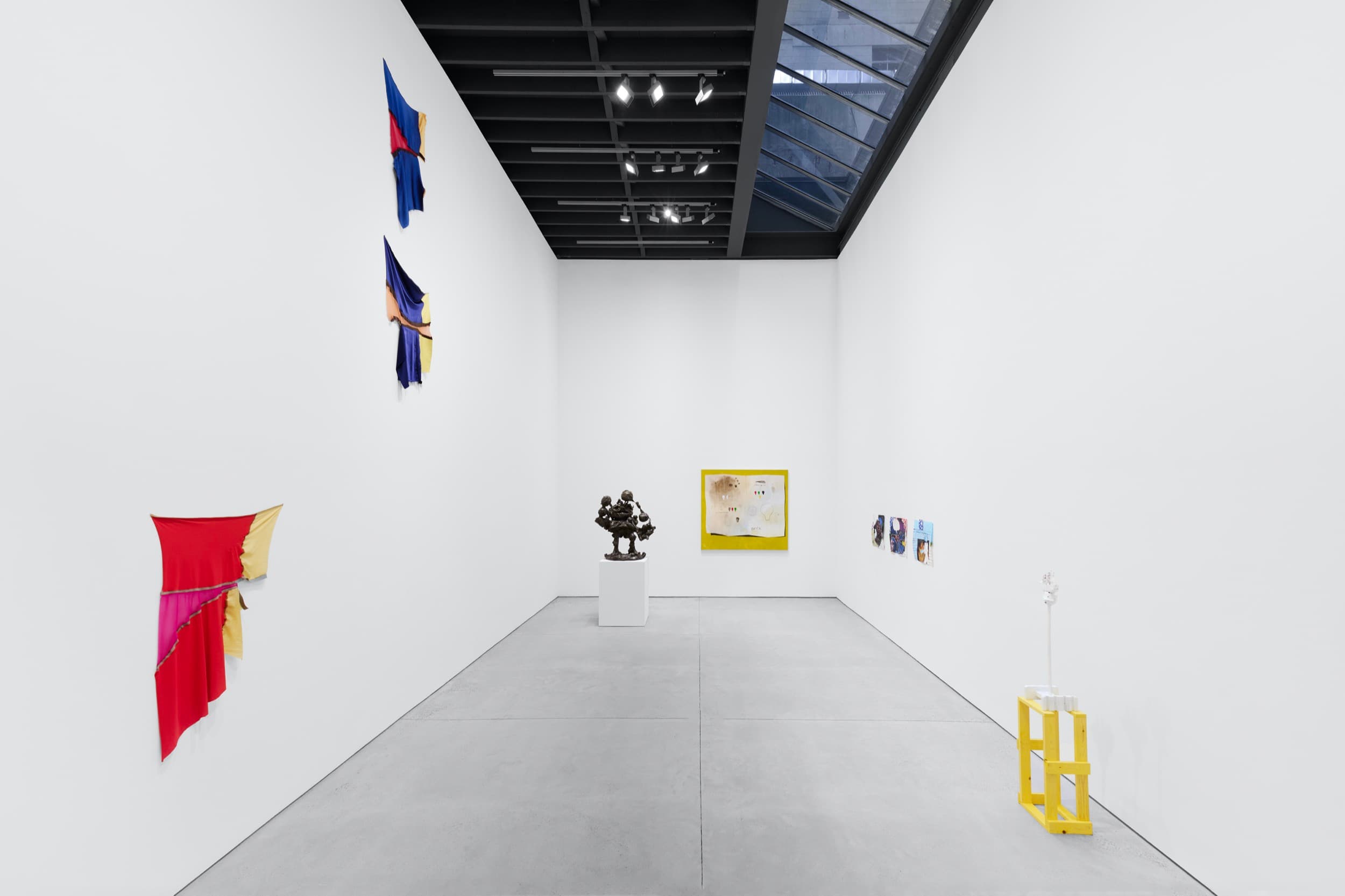
Installation view: GIVE ME TWO, Anton Kern Gallery, New York, 2026. Courtesy Anton Kern Gallery.
Anton Kern Gallery
January 14–February 21, 2026
New York
I know it’ll take a little more than art and words to heal our national fabric, but here’s a January group show for folks in need of a shot of collective optimism. GIVE ME TWO, curated by Marcus Jahmal and Giorgia Alliata, takes on the group show itself as its thematic conceit, placing twelve living artists across three generations in space together. The intended effect is musical, like a streaming playlist that leapfrogs from Chuck Berry to Nettspend and back again. The result is closer to the productive radical chaos of a one-day festival, where rhythm and melody ultimately foreground communal action and splendor, making way for new modes of free association that couldn’t have existed if not for the pairings at hand. The press release, written by Jahmal and Alliata, calls it “deliberate adjacency.” With respect to both, the word on my mind is “solidarity.”

In June Park, Overloaded, 2025. Acrylic on canvas, 49 ¾ × 46 inches. Courtesy the artist and Anton Kern Gallery.
GIVE ME TWO opens mere feet away from Anton Kern’s doors with a steel Donation Box (2025) from Isaiah Davis, fresh off a stunning solo show at King’s Leap. Mounted on the wall behind it are two sculptures from Alix Vernet, both crafted from scrap copper and aluminum AC condensers, each inscribed in gothic font with warnings: “HIGH VOLTAGE” and “UNDER THE.” Across from both lies In June Park’s Overloaded (2025), the back end of a Cybertruck on the verge of causing a serious accident, depicted in woozy, sun-lit acrylic. In front-loading these statements from young talent, Jahmal and Alliata’s generation-spanning ambitions are immediately realized. Where this block transcends is in the deft introduction of GIVE ME TWO’s broader visual language of appropriation (interpolation) and found materials (sampling), connecting an emergent thread in Zoomer-Millennial style with the uniquely American compulsion to endlessly re-create and re-contextualize in search of new meaning.
The end of the gallery’s first floor underscores this, with an uproarious, five-foot Katherine Bernhardt monotype from 2023 featuring Animal from The Muppets, placed in conversation with Dana Schutz’s warbly bronze gremlin Juggler (2019). I spent a long time with the latter—just a silly little guy, a kind of sideshow character to regale us between musical sets. Of the sets, two stand out: Eric N. Mack’s two delicate hanging forms of satin polyester, silk, and acrylic fabric that cast thin shadows on the walls, and Elzie Williams’s three acrylic-and-ink Popeye sendups, on grids of restaurant napkins. Williams’s works feel like direct attacks on the practitioners and dealers of “red-chip” cartoon art, using their luxury branding and—in the case of Monk by the Sea (2025)—Hulu promotional event scraps to convey a uniquely helpless feeling.

Kayode Ojo, Comfort, 2023. New Orleans 4-Light Clear Unique/Statement, Geometric Chandelier with Crystal Accents, 86 ½ × 78 ¾ × 15 ¾ inches. Courtesy the artist and Anton Kern Gallery.
Kayode Ojo’s Comfort (2023) dominates the second floor: a colossal dangling New Orleans chandelier that sheaths its smaller, shiftier cousin Overdressed (Emerald in the Sky) (2026). Overdressed is an assemblage that’s so of its time, it may well be beyond its time, with a material description that includes a chromed-out music stand, a faux-fur coat, and a “Civil War Era M1851 Engraved Nonfiring Silver Revolver w. Faux Pearl Grips” attached to a set of toy handcuffs. Together, and against a wall of reflective glass windows, the effect is hypnotic, almost seductive. Tucked into a corner beside the two, and positioned in such a way that one must turn their back to the rest of the room, is Kenny Rivero’s For Melissa Joseph (Huxley) (2024), an 8-by-8 oil-on-linen of a cat at rest. It’s a testament to Jahmal and Alliata that these statements, at incredibly disparate volumes, are both perfectly legible.
Across the way toward Kern’s balcony, another 2025 work by Davis rests between two staggering Henry Taylor constructions, both from 2020. The leftmost sets a small toy basketball hoop atop a wooden spire—another table leg, but it looks like a billy club—with a plastic King Kong figurine desperately on the ascent. Beneath him, in a patch of dirt, lies a micro-Confederate statuette and the bodies (plastic toy soldiers in various states of repose) of his foes, surrounded with cotton ball smoke puffs. It’s a stop-motion diorama that practically moves before the viewer, and a reminder of how—for many in this nation—the sole route to economic freedom lies in sacrificing one’s body to any number of industrial complexes. The rightward work suspends a ghost ship atop an African tribal mask on a long white pole set on an H-beam—all forms of industry and historic terror in fragile, teetering balance. These works from Taylor, who’s somewhat of an elder statesman here, are in an uncommon sculptural mode that thrills when placed in GIVE ME TWO’s conversation. In a coup de grâce linking Taylor forward in time to Davis, both of these works integrate some kind of box at their bases: on the left, a two-level wooden nightstand or end table, littered with vials, seems to suggest the result of an induced nightmare. On the right, a hollow rectangular form in shock yellow gives off a guillotine with the blade removed.
I’m not normally someone to bring the outside in when writing about art, but here it feels necessary. Given the month so far—be it the inauguration of a progressive mayor in New York, demonstrations against ICE all around the country, and the many musical memorials I’ve attended for Bob Weir—I’ve spent a lot of time singing and crying with folks of all possible different origins from my own over our shared interest in and desire for a brighter future. It could’ve been that my ears were still ringing at the opening, but I got the same vital sense with GIVE ME TWO: there’s real affirmative promise in foregrounding that—through unlikely commonality, or deliberate adjacency—the rhythmic collision of our feet to the street and the melodic harmony of disparate voices in the air can legitimately change our lives for the better. Makes for a hell of a party, at the very least.
Patrick Hill writes about art and music in New York. He is the Managing Director of AICA-USA.