Gabriele Münter: Contours of a World
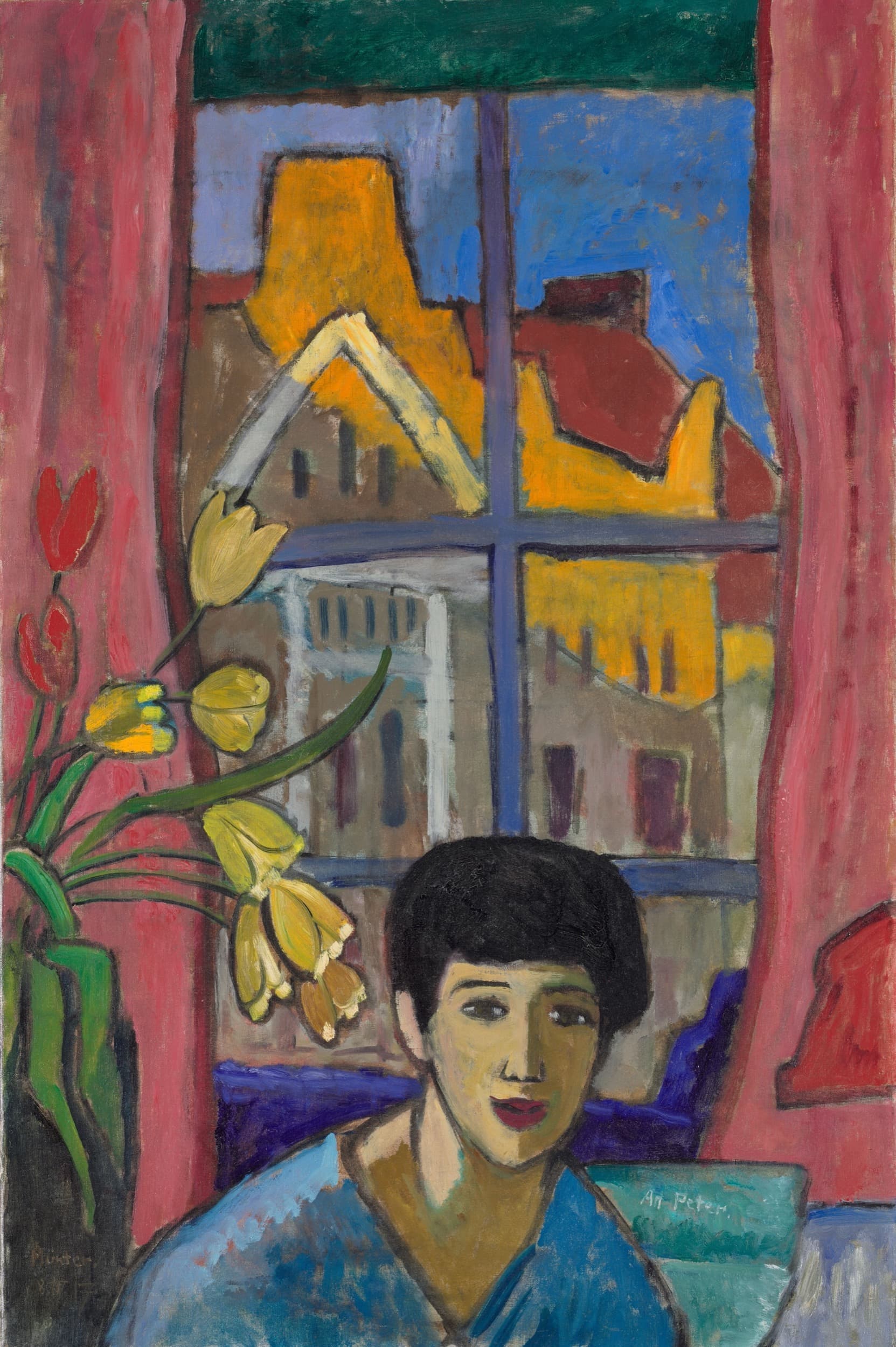
Gabriele Münter, Future (Woman in Stockholm), 1917. Oil on canvas, 38 ⅜ × 25 ⅛ inches. © 2025 Artists Rights Society (ARS), New York / VG Bild-Kunst, Bonn. Courtesy the Guggenheim. Photo: Courtesy the Cleveland Museum of Art.
Word count: 1167
Paragraphs: 9
The Guggenheim Museum
November 7, 2025–April 26, 2026
New York
I first learned about Gabriele Münter in my university’s “Women, Art, and Society” class. Münter’s sixty-year career was represented by a reproduction of Woman in Thought [Sinnende] (1917), which portrays a dreamy, Henri Matisse-inflected woman at the lower-left half of the canvas, staring up and out of the picture plane. Starring a solitary woman, it was an evocative way to introduce Münter, an artist who was trained in part by Vasily Kandinsky, a founding member of the group of Expressionist painters Der Blaue Reiter along with artists such as Paul Klee and Franz Marc, and who lived with Kandinsky prior to World War I. In the class, this slide was paired with an image by Kandinsky of Münter painting (1903), not only because it suggested the close artistic, pedagogical, and romantic relationship shared by the two artists—though her painting was made after they had parted—but also because, as I learned from visiting the slide library, there was just one image by Münter available.
Woman in Thought remains my favorite of Münter’s paintings, and alas it has not traveled to New York for Gabriele Münter: Contours of a World. All the same, the exhibition at the Guggenheim Museum seeks to correct the paltriness of the art historical record. Both the Tate Modern’s Expressionists: Kandinsky, Münter and the Blue Rider (2024) and the Guggenheim’s own Vasily Kandinsky: Around the Circle (2021–22) acknowledged Münter’s centrality in Der Blaue Reiter and as a significant participant in early twentieth-century European modernism, but in the current show, she is presented as an artistic voice in her own right.

Installation view: Gabriele Münter: Contours of a World, Solomon R. Guggenheim Museum, New York, 2025–26. Photo: David Heald © Solomon R. Guggenheim Foundation, New York.
Contours of a World offers us an artist of some means and surprising independence. Before she was born, her family lived in the United States, so Münter learned English as a child. Her parents died when she was a young woman, leaving her and her siblings with a small inheritance. Münter and her sister visited America after their parents’ deaths, stopping in New York before traveling west to see family members who had set up farms as deep into the country as central Texas (the chronology included in the exhibition’s catalogue notes that their stop in Abilene was “where the train line end[ed]”); in all, they remained for two years between 1898 and 1900. While in Texas, Münter began a photographic practice, initially with a relative’s camera, that continued in earnest after she bought two of her own.
Münter had already taken private art lessons in Germany, and she was remembered as sketching throughout her time in the United States, so the camera was undoubtedly understood by her as another means of visual expression. I would describe many of the photographs on view as vernacular or reportage, depicting her aunts, uncles, cousins, and life on farms and in small towns. A series of images, perhaps an unintentional archive, documents the 1900 Emancipation Day (Juneteenth) parade in Marshall, Texas, in what must be some of the earliest and most complete photographic records of this celebration (by comparison, the oldest photograph of a Juneteenth celebration in the Library of Congress’ online photographic database is 1905). These images alone would be well worth a visit to the Guggenheim.
A few of the photographs suggest the artist Münter was about to become by dint of their compositions or their focus. “Home sweet home at aunt Annie’s” (ca. August 1899–Febrary 1900) depicts the side of a small farmhouse with a single window and two doors (one entering a lean-to addition), starkly isolated on the dry brush of a Texas fall. The house seems almost to teeter on the hard ground and horizon, calling to mind other buildings in Münter’s painterly oeuvre, such as Fisherman’s House [Fischerhaus] (1908), The Blue Gable [Der blaue Giebel] (1911), or Snowy Landscape with a Red-Roofed House [Schneelandschaft mit rotedachtem Haus] (1935), all of which depict the houses perched on rather than within the horizon line. Similarly, “Willie” [William Graham] reading on the floor of his bedroom, Guion, Texas (ca. February–May 1900), portrays its subject in the middle ground (a door behind him opens onto a separate room), leaning against a bed. Though Willie’s body is in near profile, the floorboards beneath him zoom away from the camera at a sharp diagonal. We will see that pictorial strategy again in the painting Living Room in Murnau (Interior) [Wohnzimmer in Murnau (Interieur)] (ca. 1910)—the German house Münter purchased and lived in with Kandinsky and later her partner, the art historian Johannes Eichner—with a briskly receding carpet, its horizontal stripes cutting across the grain and the panels of the floor on which it sits.

Installation view: Gabriele Münter: Contours of a World, Solomon R. Guggenheim Museum, New York, 2025–26. Photo: David Heald © Solomon R. Guggenheim Foundation, New York.
These paintings were made by the mature artist, and undoubtedly Münter’s relationship with Der Blaue Reiter and later, when she fled Germany and the war and became familiar with movements such as Fauvism and the Neue Sachlichkeit, informed such maneuvers, but I found myself wishing that perhaps the photographs—which are installed in their own gallery—could also have been hung near to them so that I could observe her visual vocabulary firsthand. Likewise, while in her relationship with Kandinsky, Münter developed a passionate interest in the history of reverse glass paintings, purchasing examples and making them herself. This strategy, because we view the paintings through the glass, reverses the typical trajectories and even some of the fetishes of oil painting: what is closest to us is painted first not last, and single-hair brushes and subtle modeling cannot play roles. Instead, contour lines, local color, and heavy brushwork come into play. These are reverse glass and modernist painting concerns, and we see such borrowings from the traditional in Münter’s paintings such as House with Fir Trees in the Snow [Haus mit Tannen im Schnee] (1938), with its chunky brushstrokes and site-specific palette. I do not know if the reverse-glass paintings Münter made and collected are extant or able to travel, but it could have been instructive to see an example for comparison.
When reading about her, we may get the feeling that Münter was perhaps difficult to get along with. If this is the case, we might be understandably reluctant to get to know her better as a person, but her artwork and her role in the history and perpetuation of the avant-garde are undeniably important. In addition to forging a career for herself that must have seemed at several turns unlikely, Münter did display an act of outstanding bravery: after the Nazi regime began confiscating so-called Degenerate Art, she hid her considerable group of paintings by Der Blaue Reiter artists—her own, as well as those of Kandinsky, Klee, Marc, Alexej von Jawlensky, Robert Delaunay, August Macke, and others—underneath the Murnau house. Though it was searched several times, she did not reveal the paintings’ whereabouts and they were never discovered. Later, Münter and Eichner donated them to Munich, Germany; now at the Lenbachhaus, it is the largest collection of these works in the world.
Amanda Gluibizzi is an art editor at the Rail. An art historian, she is the Co-Director of the New Foundation for Art History and the author of Art and Design in 1960s New York (2021, paperback 2025).