Bill Armstrong: All a Blur
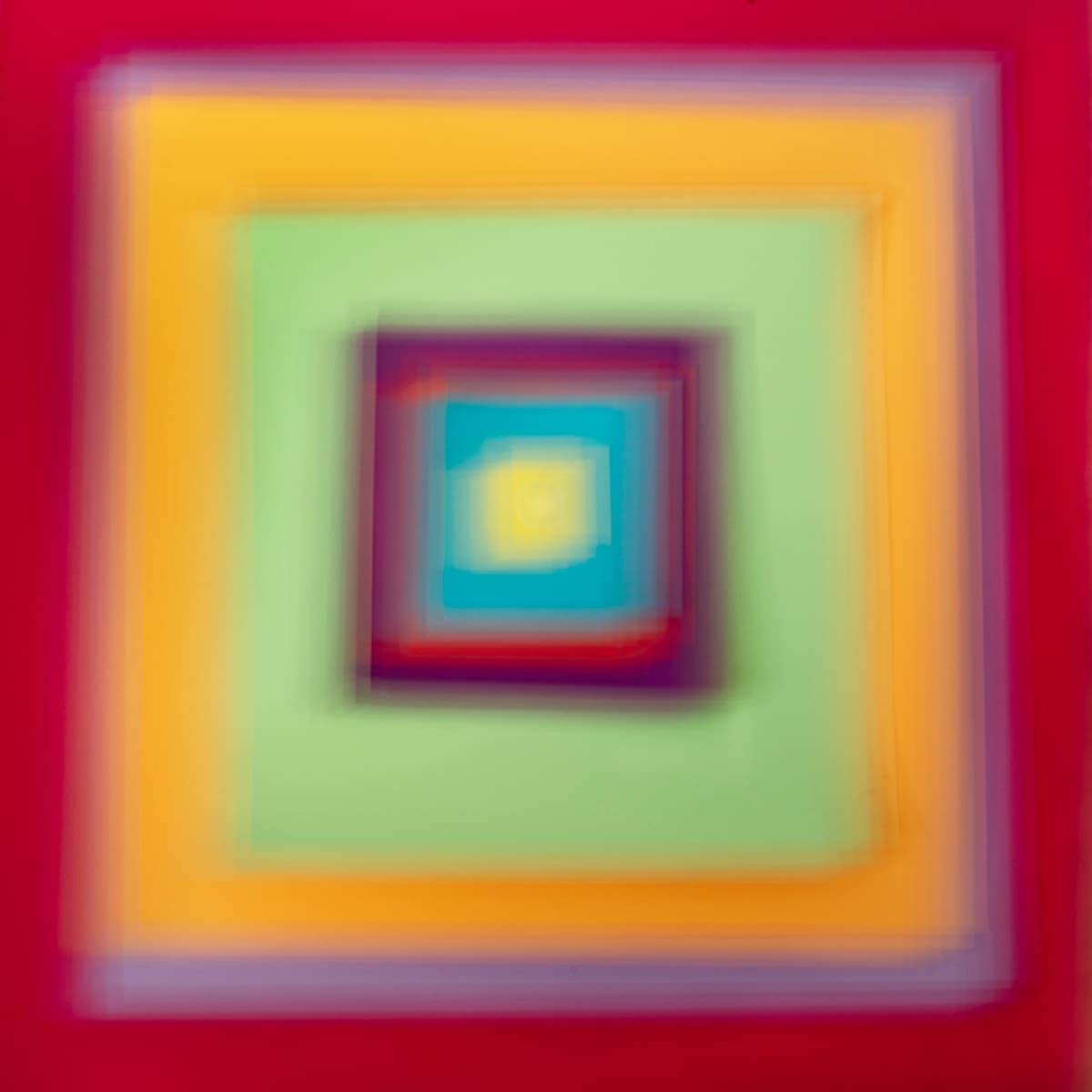
Bill Armstrong, Darshan #1901, 2023. Archival pigment print. © Bill Armstrong. Courtesy CLAMP, New York.
Word count: 788
Paragraphs: 8
CLAMP
January 8–February 28, 2026
New York
To appreciate what Bill Armstrong has done in this luminous mini-retrospective, we need to geek out a bit on the origins of photographic blur. Recall Louis Daguerre’s picture from 1838, famous in the history of photography, that shows a man on a Paris street having his shoes shined. He’s there in the distance, a bit vague, but the shoeshine boy is barely a ghost, and the streets are empty—no people, carriages, horses, or busy activity. That’s because at the dawn of the medium, the emulsion on a photographic plate required long exposure to register an image. So only what didn’t move—primarily buildings and trees in this case—made an appearance. Everything else was likely to be fuzzy around the edges at best.
From the outset, time was the problem and blur was the issue. Since then, the main goal of photographic technology has been to reduce the time of capture to zero and to increase the amount of information in the image to infinity. To update Henri Cartier-Bresson’s famous phrase, it is the pursuit of the decisive nanosecond.

Bill Armstrong, After El Greco, The Resurrection, 2019. Archival pigment print. © Bill Armstrong. Courtesy CLAMP, New York.
But what if clarity is not the goal and lack of focus not a pitfall, but an end in itself? Armstrong’s photographs have explored all the implications of such a choice, and they suggest an alternative history of the medium, deliberately subversive and unstable, that ranges from Julia Margaret Cameron’s soft-focus portraits in the 1850s to Uta Barth’s contemporary investigations of light and time. Until the 1990s, Armstrong was a so-called “straight photographer,” privileging crisp delineation and unmanipulated clarity. But while photographing paper collages he had been making from magazine photos, he found that poor focus made the images more mysterious, wiping out their origins as foraged material and bestowing a new level of coherence and narrative, but also mystery and a kind of timelessness. Setting the focus on infinity and shooting close-up gave him results that were more compelling than any precise rendering. When he applied the same strategy to portraits appropriated from various sources, the results were even more uncanny. They offered only the vague shape of the human, with wildly contrasting colors and no hint of expression: new and sourceless things.
All this can be disconcerting, even frustrating, to eyes conditioned by the precision of so much photography in the art world. We are used to looking through the image at something, even if that something is conceptually puzzling. Armstrong’s photographs refuse to resolve. I experienced this with the artist’s “Mandala” series twenty years ago, when I first saw his work. The show at CLAMP contains several examples and a related piece, the ethereal Blue Sphere #423 (2002). There is no place to stand that will get the pictures to behave. And that puts the ball—for looking, thinking, and feeling—back in the viewer’s court. This is the whole point of blur: on a cognitive level, the viewer is no longer passive but must collaborate. The circular “Mandalas” and the Josef Albers-like concentric squares of the “Darshan” series (also represented in the show) seem most obviously to be meditational pieces. Their forms and colors oscillate at the point of indefiniteness. They pulse, and that pulsation keeps viewers present—to the work and to themselves. In time, viewers become seers.

Bill Armstrong, Untitled (Renaissance #1003), 2006. Archival pigment print. © Bill Armstrong. Courtesy CLAMP, New York.
The series titles carry some spiritual freight, and they open the door to more complex symbolic and emotional experiences. The isolated figures in the series “Renaissance,” for example, make clear reference to all those floating and falling figures, usually masculine, in Italian art, especially the paintings of Michelangelo. Armstrong as usual plumbed previously printed source material, but he was also invited to carry out a project in the Vatican that involved photographing the Sistine ceiling. From his many photographs, he extracted figures to rephotograph in a blurred, abstract format. He most likely had in mind Aaron Siskind’s famous black-and-white sequence of men diving, “Pleasures and Terrors of Levitation.” But the Christian Renaissance suffered anxieties of its own, not least the tension between resurrection and damnation, and Armstrong’s figures suggest a kind of limbo, between despair and hope, freedom and freefall.
Of course, all photographs, not just blurry ones, traffic in ambiguity. Out of context, they offer information but cannot convey meaning, which is necessarily socially constructed. But precision sets limits on speculation. Armstrong’s photographs deliberately erase those limits, and in the process double the image. There are always two photographs, the attractive but mysterious one we observe, and the one we create, from association, emotion, memory, and intellect. This is Armstrong’s invitation, and the discoveries we make are as much about ourselves as they are about what is in front of us.
Lyle Rexer is the author of many books, including How to Look at Outsider Art (2005), The Edge of Vision: The Rise of Abstraction in Photography (2009) and The Critical Eye: 15 Pictures to Understand Photography (2019). The Book of Crow, his first work of fiction, parts of which first appeared in the Brooklyn Rail, has recently been published by Spuyten Duyvil Press.