Surrealism and Anti-fascism: Anthology
Word count: 902
Paragraphs: 6
Eds. Karin Althaus, Adrian Djukic, Ara H. Merjian, Matthias Mühling, and Stephanie Weber.
Hatje Cantz
2025
Anyone who has ever given serious attention to surrealism knows it: surrealism was not just an art movement; surrealism was not just about dreams and sexual fantasies; and surrealism was definitely not a mere mash-up of irrational absurdities. These are misperceptions carried by the word “surreal” as it is deployed in contemporary parlance. Surrealism was the most political avant-garde movement of the last century, committed in its core to total liberation in life, art, and politics. On its way to this, and as it spread throughout the world, surrealism revolutionized art and literature and permeated our imagination. The basis of this world-wide success can be found in the movement’s fundamental dedication to freedom, be it from a suffocating, strictly regimented bourgeois life, or from the rules of art, or from a narrow logocentric vision of the world, or from actual political oppression of any sort. Surrealism in all its permutations evangelized a politics of revolt, tailored to specific political conditions and circumstances across the globe, and articulated an aesthetics geared towards what could be, not what it is.
During the heyday of the movement, in the 1920s and 1930s, this general political positioning took the specific expression of battling fascism. As André Breton put it, “surrealism can only be understood historically in terms of the war.” It came out of the carnage of the First World War, as the hypnotic march towards the Second World War defined its political makeup. Paris became the capital of antifascism. The surrealists were at the forefront of this battle. In spring 2025, the exhibition But Live Here? No Thanks: Surrealism and Anti-fascism, which took place at the Lenbachhaus in Munich, identified antifascism as the linchpin for surrealism’s whole revolutionary stance. Looking at the historic rise and fall of fascism, the exhibition stretched back to surrealism’s early years, after October 1917, when revolution was the key word, and reached forward, into the post-war years, when colonial politics and unbridled capitalist consumerism emerged as new threats. With this move, the exhibition placed the fight against fascism at the heart of the entire 20th century and offered a panorama of surrealism as its forgotten facet.
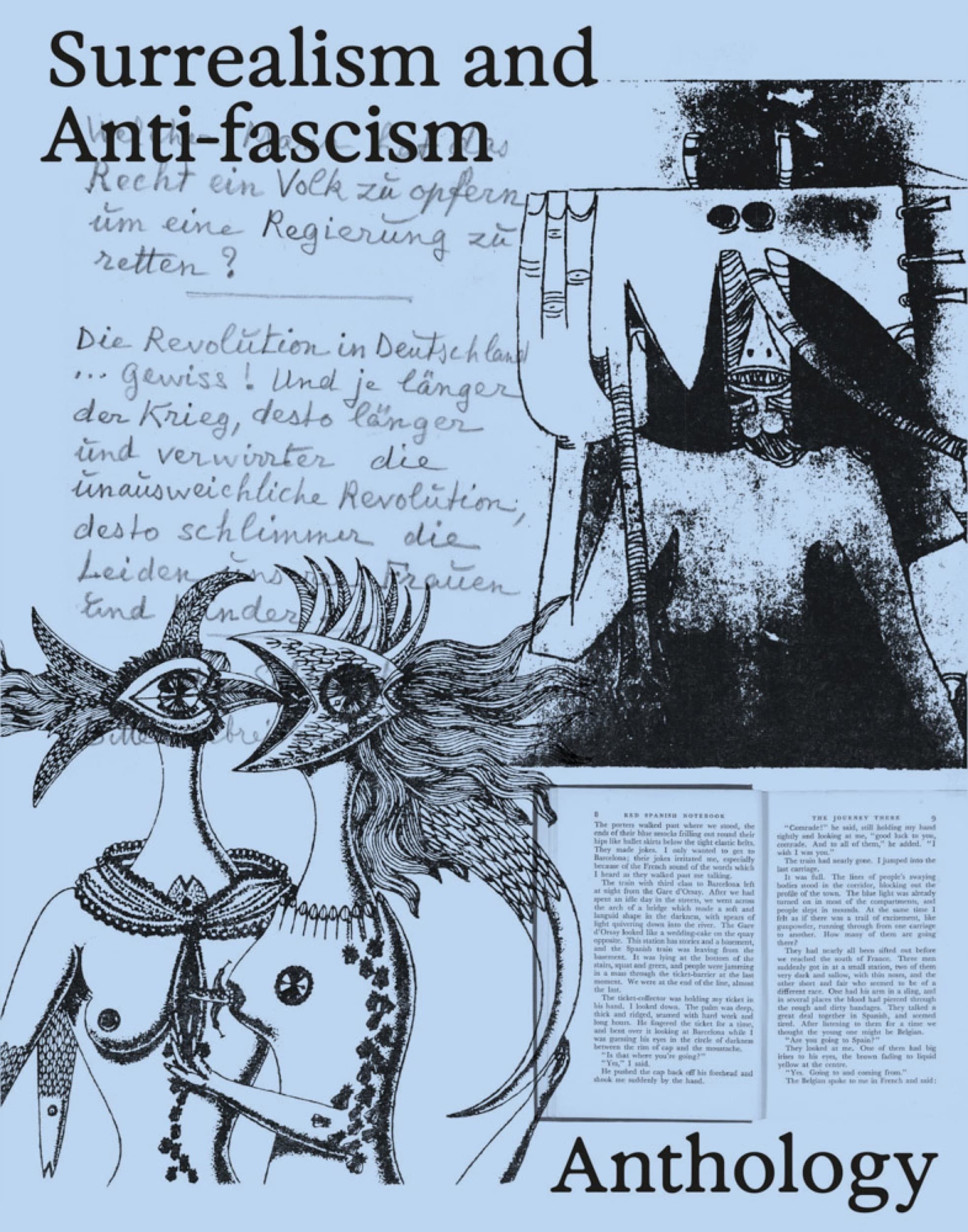
The volume Surrealism and Anti-fascism: Anthology, edited by Karin Althaus, Adrian Djukić, Ara H. Merjian, Matthias Mühling, and Stephanie Weber, was conceived as the exhibition catalogue, but it stands alone as a monument of surrealism’s battle against fascism. The book brings together texts that document surrealism’s political stance throughout its existence: magazine articles, declarations, manifestos, pamphlets, calls to action, illegal publications, newspapers. The various texts provided the scaffolding for the exhibition, which recedes to the back of the volume as the focus here shifts to the historic texts of the movement. These documents are reproduced in their original publication format, be it in a book, magazine, or hand-written pamphlet, like scraps found in a chest and glued on a notebook. Clippings range from 1917 (the earliest document included is a war letter from Jacques Vaché, a friend of André Breton) to the 1970s, forming an archive of surrealism’s political activism and commitment. The list is impressive, it includes: The 1929 Second Manifesto of Surrealism; the 1931 collective pamphlet denouncing the attack against the screening of Luis Buñuel’s L’Age d’or orchestrated by para-fascist, antisemitic groups in Paris; the Manifesto for an Independent Revolutionary Art, composed by Leon Trotsky, Diego Rivera, and André Breton, but signed only by the last two in Mexico in 1938; the manifesto “Long Live Degenerate Art” published that same year by the surrealist group “Art et Liberté” in Cairo; Claude Cahun and Marcel Moore’s hand-made leaflets, “paper bullets” meant to demoralize the occupying German soldiers during the war; the astonishing semi-clandestine publications of the group La Main à plume in Paris during the Occupation, blending fearless poetic texts with political activism; excerpts from Aimé Césaire and Suzanne Césaire’s magazine Tropiques in the Vichy-governed Martinique; and many more. They astound readers in their facsimile format, making those who engage with the text feel like historians diving into a neglected archive and discover a whole era. With English translations included (some of these documents are translated for the first time in English), the anthology permits a glimpse into the collective effort of writers, artists, and intellectuals who rejected passivity and sought ways to counter fascism through creativity and experimentation.
What these texts bring forth is the ethos and aesthetics of resistance which were at the heart of surrealism from its beginning. To borrow the words of Anson Rabinbach, antifascism was “a way of being in the world,”1 “less an ideology than a mentalité, more of a habitus than a doctrine.”2 Antifascism was a transnational cause, based on solidarity and faith, against barbarity, a new humanism for the modern era. All this could easily be a summary description of what surrealism really was, a way of being in the world that placed its faith in the individual and in a renewed sense of community based on freedom. This anthology brings into the present moment documents of resistance that paint a vivid picture of a historical era that has startlingly come again to the forefront of our collective consciousness, and provide a possible horizon of how to fight totalitarianism, how to understand freedom, and how to create communities one word at a time.
1. Anson Rabinbach, “Legacies of Antifascism,” New German Critique, no. 67 (Winter, 1996): 3–17, 7.
2. Anson Rabinbach, “Paris, Capital of Anti-Fascism,” in The Modernist Imagination: Intellectual History and Critical Theory, ed. Warren Breckman, Peter E. Gordon, A. Dirk Moses, Samuel Moyn, and Elliot Neaman (pp. 183-209).
Efthymia Rentzou is a professor at Princeton University, and Director of the Program in European Cultural Studies.