ArchitectureFebruary 2026In Conversation
JEANNE GANG with Nile Greenberg
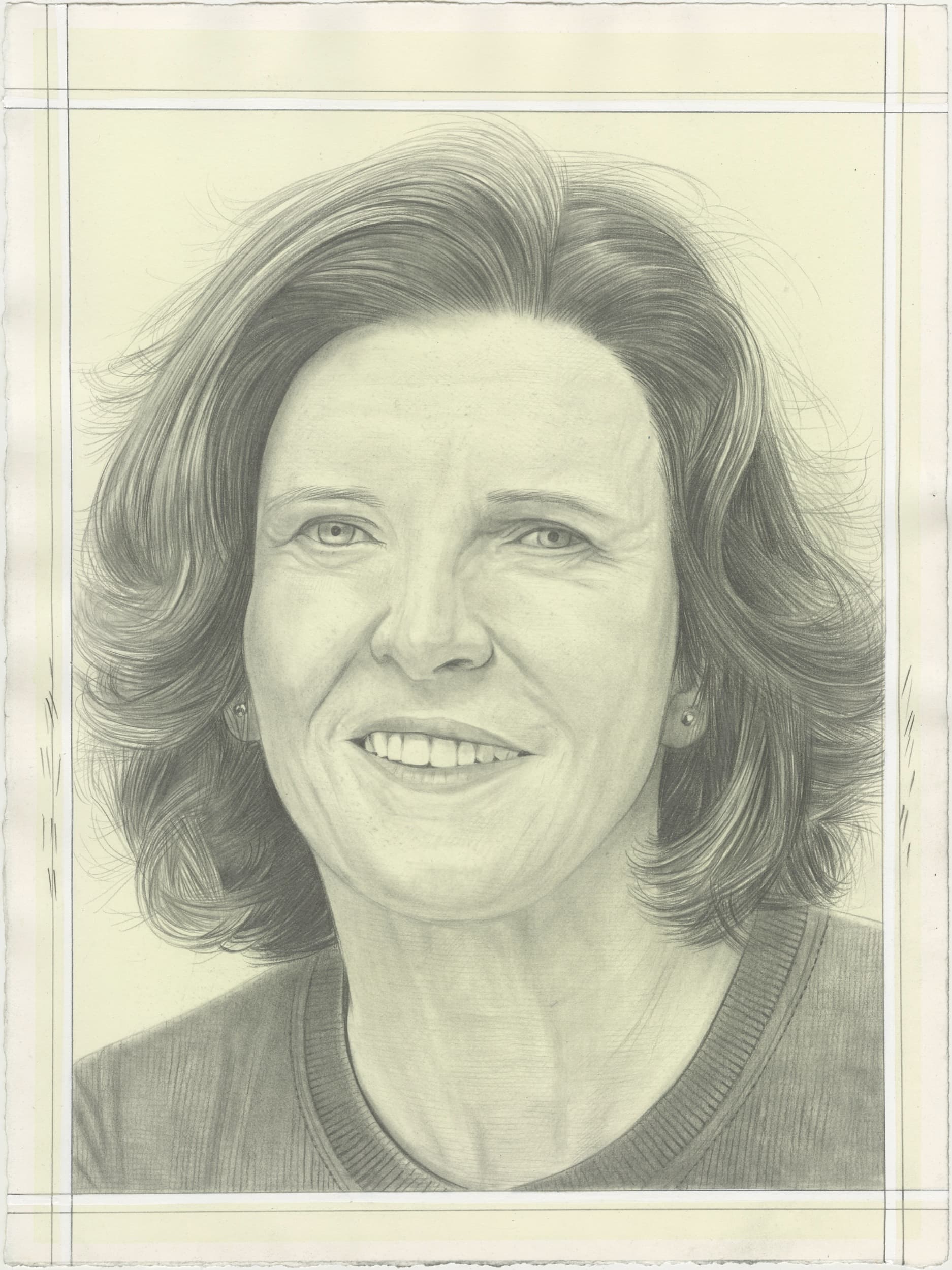
Portrait of Jeanne Gang, pencil on paper by Phong H. Bui.
Word count: 4513
Paragraphs: 80
Jeanne Gang is state-of-the-art. The work of her office Studio Gang is embedded in the contemporary world of building. Her clients are universities, museums, and housing developers. In 2023, Studio Gang completed a new extension to the American Museum of Natural History and the Arkansas Museum of Fine Arts. With her start in Chicago, Jeanne and her office have continuously developed new forms and its position on architecture is motivated internally to make things better. One unexpected realization of this interview is the dominance of architecture models in the design process—this explains the novelty and formal experimentation across projects that might otherwise be non-specific. She also offers a useful and novel re-characterization of the role of architect as a campaigner. Jeanne Gang is an optimist and she’s proving it.

Aqua Tower. Courtesy Studio Gang. Photo: Steven Hall.
Nile Greenberg (Rail): We’re sitting in the “Treehouse,” in your office Studio Gang in Chicago. The treehouse is a two-walled, bird-fritted glass room on the roof of the renovated historic bank building where we can see frozen outdoor gardens and bee hives.
One thing I’ve always paid attention to in your work, in the work of Studio Gang, is the difference between horizontal and vertical. There seems to be a position on the difference. I was curious, in your perspective, how do you think of vertical buildings versus very horizontal ones?
Jeanne Gang: Every building type has very different rules that guide what you can do, and this gives you different levels of freedom as the architect. With the vertical, there is a very strong set of inherent requirements you need to be attentive to—first structure, but also economics and materiality. There can be miles of handrail on a single building, for example, so that fact influences the way we think about its design. In contrast, the horizontal offers more sectional and choreographic opportunities as well as a better chance for experimentation and customization with materials. So, to me, they’re very different animals, different species. But we bring a common sensibility about natural light, materiality, and social connectivity to both. This is a very pragmatic answer to your question—that they’re just two different species. But I’m curious what you see as the difference.
Rail: I look at something like the Arcus Center in Kalamazoo, which I think has this very precise use of horizontal—it really emphasizes this kind of floating space. Even this room we’re in right now is a very good example of how I think Studio Gang and you treat horizontal space, it’s very emphasized. The roof experience is horizontal. And I think in the vertical projects such as Aqua Tower, you also emphasize horizontality, but in sequence.
Gang: Yes, there’s often this horizontal element, but it builds up into something that can be read vertically. With tall buildings, we’re often starting design with some fundamental element and assembling it to create the overall vertical, formal reading, as opposed to starting with the outline of the building shape. With Aqua Tower, for example, it’s the floor slab itself that is considered, and its repetition gives the overall topography. Or with Verde, it’s a corner balcony, and how it’s repeated or flipped. This play with alternation aggregates into a rhythm to create the tower’s form.
Even the St. Regis Chicago, which you saw in the archive, began with a truncated pyramid—which is a simple form you can find in, say, a popcorn box or a Chinese takeout container. It’s a packable form. Once assembled, the tower takes on a flowing appearance, but it’s made up of these smaller, pyramidal elements.
What I like about this approach is that it challenges the typical notion of a gestural shape in high-rise design and it challenges the compositional facade that is all about the curtain wall as part and parcel of the tower design. Our approach is much more elemental, and it produces something sculptural, but through the careful aggregation of smaller components.
Rail: It feels like it’s a struggle in a way. It’s something you’re really thinking about in every project, this relationship, which I think other people are less worried about.
Gang: That’s true. It is a preoccupation that’s particular to our practice.
Rail: One of the reasons I really started paying attention is because you gave this lecture at Columbia University’s Graduate School of Architecture, Planning and Preservation (GSAPP). I asked a question about Maison à Bordeaux which you worked on in a past life at OMA. You told a story about how you got appointed to the project, which was an early sketch version of the house that was all in one topo line. Seeing early models of Aqua as topo lines rather than a surface, I realized this is all connecting. That house became very much a statement on vertical versus horizontal space. Same with Illinois Institute of Technology’s McCormick Tribune Campus Center which is a dramatically horizontal space, which I know you were working on in a different way with OMA. So I just always paid attention to it in your work.
Gang: I was figuring out how to reconcile verticality for someone who’s in a wheelchair. There was a problem to be solved. I had a professor once in school who said architecture is not a problem to be solved, and I can see that point of view. But I still always find myself trying to find problems to solve. It’s just the way my brain works.

Arcus Center for Social Justice Leadership. Courtesy Studio Gang. Photo: Iwan Baan.
Rail: I often reference this dialectic, sorry if I sound too professorial, but Hannes Meyer and Ludwig Mies van der Rohe had very different approaches. Hannes Meyer was this insanely politically active architect. He was the socialist revolutionary. All his work really took social and cultural forces and made them into diagrams, which he turned into buildings. He was also an activist. Whereas Mies van der Rohe understood all of those dynamics, but his work never made legible the social/political world, yet his architecture remains a provocative political force.
I see your work in the former very much. How do you imagine architecture capturing social forces in this way? Does this question even make sense to you?
Gang: I can see how we fall more into the Hannes Meyer camp, but I’d say we’re not ideological in the same way. When it comes to social forces, our focus is on human behavior. How can you use design to gather humans and what they’re interested in, and encourage them to act or do something that’s bigger than just that one building? I think a lot about the bigger picture of a project, especially in the beginning. It’s not necessarily what’s included in the client brief. Say you’re hired to design a recreation center. What does that really mean? What greater context can it connect to? Or a boathouse—that was a project where self-initiated research we did on the Chicago River preceded the building. The study prescribed that we needed boathouses to help people develop a closer relationship with the river.
Thinking about this bigger system that’s out there, how that project fits in, and how it can move the needle somehow, is interesting to me and to us. A project is like a string—when you unravel it, you realize it’s connected to a lot of other things. In that way, architecture is similar to ecology, where the focus is not just on one species, but their relationship to other species and the environment around them. The more you can understand that, the more you can design things that make progress toward the better outcome that you’re aiming for.
Rail: What’s a better outcome? What’s a worse outcome?
Gang: Let’s use the boathouses as an example, since we were already talking about that. You have the polluted Chicago River, which, previously, no one could really access or use. The water itself is going downstream and polluting all the way down the Mississippi to the Gulf of Mexico, creating a dead zone. So, it’s a big problem. We asked ourselves: what can we do to start changing that with architecture?
By creating beautiful boathouses that give people access to the water and a way to enjoy it, you start to create stewards and advocates for the river, from the bottom up instead of top down. I don’t know if Hannes Meyer was connected to politicians, but if you can get the people on your side, then you can have a much more powerful voice. Architecture has the power to rally people together.
Rail: The boathouse is a recreation center where people can go and boat on the river, right? And the river is polluted and dirty. Your projects often reach into other territories—river ecology isn't in the building, but you suggest how recreation is a form of advocacy.
Gang: It’s about connecting people to the river itself, helping them become its voice. By giving people access, they come to care about it and protect it. Rowing clubs are one of the ways this happens. The number of these clubs, and the people who are part of them, has multiplied since the boathouses were built. They’re a way for youth in the city of Chicago—which is a very diverse city—to come together. Everybody shares the same river. It inspires a kind of environmental advocacy, but also equity in a certain way.
With the boathouses, just any box wasn’t going to work. The architecture not only had to be beautiful but also create a place that made people feel excited about the river, enough to want to be its steward. It is really the same reason why art has the power to mobilize people.
Rail: I feel like all your projects have a pedagogical perspective that has all these voices that can explain where you are, what we are doing here, why it is built this way. There’s some depth.
Gang: There is depth to every project. On one level, it’s doing something for the broader river system’s health, and on another level, it’s doing something for the community’s health. Rowing isn’t just exercise, it’s also a form of therapy and repair for many people.
And then there’s questions of why it is built at that scale. How is it protecting the wildlife that share the site? It keeps going deeper and deeper. If you were curious enough to go further into the project, you’d learn the design is based on rowing motions and rhythms. But some people will just see it as a boathouse that looks nice and as a place they want to go.
Rail: What do you think of housing? The need for housing is obviously such a big question right now on everyone’s minds. You do a lot of housing.
Gang: Housing is super important. It’s the kind of infrastructure that’s urgently needed. I’m excited about New York, where I’m trying to build two hundred thousand units in the next ten years, and having more government support for that, because urban housing in the US is most often market-driven.
I think New York is very special, though it’s very particular in the way it values its public housing. We’re working on affordable housing in New York currently, and while there are so many regulations around what can be designed, and constant attention to feasibility, I am still excited to explore how to reorganize and reimagine within these very strict boundaries to make housing pleasurable, beautiful, and connective.
My studio at the Harvard Graduate School of Design this spring will focus on housing in New York for that reason. We’ll take cues from artists’ housing in colonies, with the hypothesis that there’s something about the way that artists live that could inform a new kind of housing. We want to focus on people working in the creative and gig economy, which describes about a third of New Yorkers today.
Rail: I have a book called The Advanced School of Collective Feeling. It’s about the history of gymnasiums and domestic architecture, mostly in the twenties and thirties. It sets up this final theory on that time period being when physical culture took on the problem of housing, the dynamic between the individual and the collective, and how people understood that sport or recreation was a way to connect your body to the collective body. That became this theory of collective housing. Do you have a theory of housing?
Gang: Frankly, it’s evolving. First you have to qualify what we are talking about with “housing.” It’s the same as “nature” in that way. With multi-family housing, you realize that residents will be part of a community and you want to support that, but often everything asked for by the client is about focusing on a sense of privacy and individuality.
How do we think about the house differently? Maybe we bring more public-ness to the house, in response to more privatization in the city. This might start to shake up the idea of the dichotomy between public and private. Creating gradations between these realms is one thing that we’ve been working on.
Another point with multi-family housing is that we’ve also developed ways to design and build it faster, because the need is so great. During design we must ask ourselves, which technologies and construction techniques will help it move faster?
Rail: And we’re starting to use buildings that were not designed for housing. New York is somehow pioneering this in a low-key way, just through financial pressure to build massive conversions, without really big architects involved, very engineer-oriented housing in the Financial District. Thousands and thousands of units are being converted from office space right now. Do you see this as important?
Gang: Yes, keeping existing buildings and upcycling their use is important. It’s interesting because we’re now designing buildings that are one typology today, but could become something else later on, like housing, so they’re designed to be reversible. This is not easy, because there are very strong rules around the different typologies—such as how much daylight and which orientations are allowable. For example, you cannot design a purely north facing apartment in Germany. It’s not good for housing because it would make the interior too dark.
Rail: I like a north facing apartment.
Gang: New York and Chicago are basically on the same latitude as Rome. Go farther north and you get a very dark northern exposure. You have to think about that when you’re laying out an office building and you want it to be reversible someday. It’s a nice challenge.
Rail: One thing I’ve been interested in with my own Chicago research is how optimization is often failing us. We got so good at it that suddenly these buildings became unusable but for their one use. Forget making office buildings residential—failed shopping malls are insanely hard to convert.
Gang: Exactly. You’d have to cut holes or courtyards into shopping malls just to get access to daylight.
Rail: In a problem-oriented theory of design, you end up optimizing wrong unless you ask the right questions.
Gang: Well, the optimization conversation is usually centered around constructability and cost. In converting buildings to different uses, that’s usually outside the status quo. We hear a lot of “no,” and we have to knock down each one of those no’s, with solutions, one at a time, until we get to the answer we believe in. And then there are some things that will always be subject to change. Ideally, you can satisfy the demands for cost and constructability in some other ways and focus on the adaptability of the structure. That’s a lot of the work, probably a majority of the work on any of our projects.

WMS Boathouse at Clark Park, Chicago, IL. Courtesy Studio Gang. Photo: Steven Hall.
Rail: One of the main reasons I wanted to talk to you is because I believe you are state-of-the-art. Your office is international. Your contribution and collaborations with the industry of architecture, with the primary set of builders—universities, museums, development, people who really are the best builders in the world. I believe you may have some of the heaviest experience and success in this area. It’s rare. I listen to you when we talk about the problem with housing, or why it is hard to build. You’re saying the majority of buildings are fighting budget and construction constraints. And as many people are reporting on restructuring policy, your position is important, especially in housing where people really are feeling it the most.
Gang: I don’t feel like I’m an expert at housing per se, but we have done a lot of it and worked with the many professionals involved in these projects. In some ways it’s like any other building in that it has its constraints. Being a maker myself, my interest starts with thinking about how to build it. I’m very curious about the different ways of constructing housing.
There are also ideas that come from the collaborations. A building isn’t the product of just one person. You have to trust the people that you’re working with: the engineers, the builders, the specialty consultants. This becomes more and more rare as the whole profession is being chopped up into different bits.
Rail: What do you think the role of an architect is right now? I feel like you’re a prototype for an ideal practice that many people think they want to be.
Gang: There are so many different ways to practice architecture and they’re not mutually exclusive. The way that I do it is for the love and joy of making buildings, but also having them hopefully impact the world around them.
I don’t think that our practice is the only type that can do that. But I do think it succeeds at what we want it to do, which is trying to make the world a better place. It sounds cheesy, but it’s true. That’s what motivates us. It’s like leading a campaign, similar to what I was saying earlier about getting people to care about something from the bottom up.
I’ve been working on policy change in Chicago for twenty years around bird-safe architecture. Chicago is on a very important migratory route, so how can we implement building regulations that make it safer for birds?
These conversations haven’t been received well by many developers or politicians. So, now we’re tackling the issue from the other direction and generating visibility from the public. This summer, we’re curating an exhibition at the Chicago Architecture Center, which engages around five hundred thousand visitors a year, to raise awareness and show the solutions to the problem of bird-window collisions. We’ll show architecture that’s designed to be bird-safe, as well. We’re inspired to do this, because we see it’s the only way to make real change.
Rail: Architects are literally becoming politicians and moving into policy, both in big, widespread ways like HouseEurope!, an EU policy change, but also in advocacy ways like you’re describing.
Gang: Which we saw worked so well with the Chicago River. People have now embraced it in so many ways.
Rail: I like your description. I’m going to try to rephrase what I think I understood of what you said: an architect is like being a campaigner, and you have to get the hundred people involved in constructing something. The role of the architect suddenly becomes someone who’s very much an advocate of certain issues within this big collaborative organization. A big change in the architect’s job as being a campaigner for an idea within their own project.
Gang: Yes, and it’s the communication outside the professional circle as well. We’re in favor of engaging with a wider audience because we like it and we feel it supports a stronger project, not just because it’s the nice thing to do. A project is enriched by having the people who will use it take part in the planning and design process. It’s been called co-creation, which doesn’t mean that everyone is making the design. That’s your role as the architect—making the connections between deep ideas and research, talking to different people who have desires for certain outcomes, and having all these inputs come together into something that is formal, drawn, spatial, compelling.
What I think we at Studio Gang do well is respond to these contextual prompts. Who are the stakeholders? Who are the users? Who are the future stewards? We want to create something that can be relevant for them. This also makes the architect more indispensable.
They might want to know why we are using a certain form. What does it mean? How is it impacting the neighborhood? The essential thing about the architect’s role for me is this rallying, maybe a little bit of cheerleading too, along with the campaigning.
Rail: It makes sense. I like that you’re focusing on form, because I don’t think other people see that, other than an architect. Form gives form.
Gang: It sets it all up. It’s just the basis of it.
Rail: What is your relationship with art?
Gang: Art inspires me. My relationship with art makes me think of my relationships with artists, who I respect so much and who are dear friends. I feel I am someone who works on issues of form, similar to the way sculptors do, rather than say, painters—even though painting is probably my favorite medium to seek out in a museum. Painting is amazing.
As an architect I’m driven by form, creating, making, drawing, sculpting, assembling. It’s just very satisfying to make things by hand as part of the design process. There’s art in that to be sure. I think making studio art is where I thought I would end up when I began my studies, but then I found my true love, architecture.
Rail: To be a part of the zeitgeist, you have to establish a survey, a vision of the world that’s unique to the author. A big difference between an artist and an architect is the difference in authorship—there’s so many people involved in architecture. I feel there’s really a changing dynamic in architecture with authorship. I actually believe that suddenly, because of communication, Building information modeling (BIM), and team structures, authorship has actually become easier, not harder, for architects. If you had a pure vision, that’s all you wanted to do, there’d probably be a way you could see that through, in a way that Skidmore, Owings & Merrill (SOM) in the seventies would have a harder time as it needed to delegate through so many people.
Gang: But would you want to do that? If you would, then the project wouldn’t be owned by everyone. When you’re putting something into the public realm, I think the success of it is creating a feeling of ownership for others, as well. It might look like what you want it to look like, but it needs to fulfill peoples’ needs and desires for it to be successful. That’s my view. I wouldn’t want to go into my studio and draw something that came into my imagination and then plop it down in somebody’s city.
Rail: I understand, but an artist is asked to do that with a sculpture.
Gang: There are different kinds of artists, just like there’s different kinds of architects. Certainly, there are artists that are more engaged externally with the city and the people around them, and ones that are more internally motivated.

Verde. Courtesy Studio Gang. Photo: Jason-O’Rear.
Rail: I’m being provocative a little bit; we’re in a moment where the potential of super authorship is possible, and people are calling for the opposite.
Gang: What do you mean when you say authorship? Do you mean authorship that is assigned to one individual?
Rail: You can make a giant Carlo Scarpa building if you wanted, at scale with mass customization and all these weird techniques.
Gang: I guess authorship and originality are an interesting pairing to start talking about, because many artists’ practices are about creating art by mixing existing things. So that doesn’t really suggest singular authorship.
Rail: My own research on crisis comes from this view that young people are sitting here being like, “Why do we do this? This is all bad. We can’t fix it. Architecture can’t fix it.” I call it the apocalypse mindset, which is this stagnation and plateau because of the state we’re in.
I get the sense that you have a different point of view on this, and architecture needs to very urgently reconcile this issue. Because I think there is a real sense from people that architecture is a kind of net negative in some ways.
Studio Gang is this example where you don’t just make architecture. All of your work expands into the field around it, into policy, into ecology, into community. What do you think about this apocalypse mindset?
Gang: I’m glad you’re asking that now. It’s funny to think about apocalyptic views when we, as architects, have to think about how we are going to live. How are we going to survive?
Plants can live no matter what—in spite of droughts, natural disasters. They’re just so persistent, and that’s why I’m so inspired by them. They’re always finding a way to keep going.
I think architects can’t just fold at this point in time. There’s got to be a little crack, even the smallest opening, that you can find a way to sprout out from. That’s the challenge for us, to get into this mindset, because it’s not an easy path that’s laid out for us. For a long time, architecture had very clear boundaries as a discipline, but right now, so many changes are underway. We need to look under every stone and find the solutions that can help people get through this, help ourselves get through this.
Rail: We have to transition.
Gang: Absolutely. Always. The only challenge is when you love doing something a certain way, but those ways are going to change. You just have to find a way to incorporate the things that you love to do into your practice. For us, one of those things is physical modeling, even though so many offices have gotten rid of their model shops.
Rail: I’m green with envy looking into your model archives and model shop.
Gang: We’re not giving it up. We have four offices. Each one has some regional independence, but together we’re a network with one vision, a shared ethos and way of working, and approach to how we think about practice in life. And that’s the way we’re surviving this time right now.
It’s based on going with what you really care about, what you want to do. I promise I’m not trying to make a lecture for young architects right now. I’m just thinking that, since you brought up this aspect of our success, or our ability to work in this environment, it really has to do with doing what you want to do and feel is right, and not replicating other practices that are successful. You’ve got to find your own way to be that plant growing out of the crack and toward the light!
Nile Greenberg is the editor of the Brooklyn Rail’s architecture section and operates the practice ANY in New York.