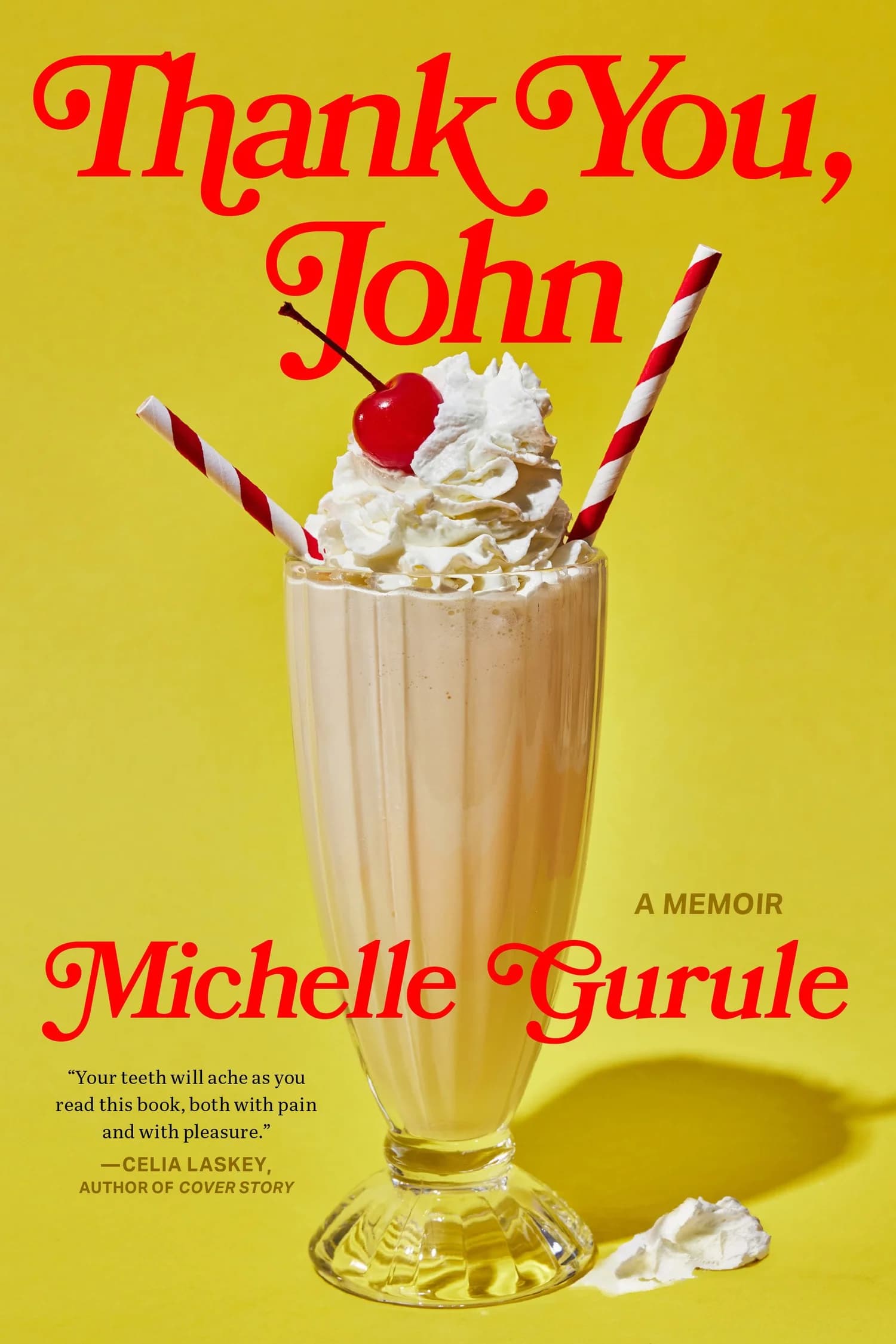
Michelle Gurule’s Thank You, John
Word count: 1179
Paragraphs: 15
Thank You, John
Unnamed Press, 2025
“We sometimes contradicted ourselves, but how could we not? We were flawed creatures that lived in a flawed world,” Michelle Gurule writes in her searing memoir, Thank You, John. Reflecting on her decision to perform femininity and comply with patriarchal ideals through stripping, Gurule does not seek absolution or empowerment—only clarity. In a world where the narrator’s body—and by extension, all women’s bodies—are seen as “bartering gold,” self-objectification becomes not rebellion or submission, but survival.
I read Thank You, John while dogsitting for a coworker whose husband works for ICE, netting six figures by calculating how the US government can most efficiently detain and deport undocumented immigrants. I learned this after agreeing to watch their dog—but I’m a broke Ph.D. student, and even if I had known, would I have said no? What we do to survive inside systems of coercion is rarely clean and never purely moral. It seems, increasingly, that society rewards sociopathy: the oil speculators, crypto-grifters, and clean-air auctioneers rake in millions, while those who operate with any degree of empathy—teachers, janitors, caretakers—barely scrape by. Before Gurule was a writer, she was bagging groceries at Whole Foods for the health-conscious rich—until she stumbled across an escape hatch in the form of a man she met while stripping. A john named John.
To call Thank You, John “feminist” is like saying the US is politically “divided”—technically true, but woefully incomplete. Gurule’s memoir is more scalpel than slogan. It cuts through the hazy morality plays often assigned to sex work and instead lays bare the brutal calculations poor women must make in a country that criminalizes poverty and romanticizes “choice.”
Coming of age in staunchly sex-positive feminist circles, I was taught to support sex workers and to help destigmatize sex work at all costs. “Consent is sexy” was one of the era’s guiding mantras—an earnest attempt at empowerment that was, in hindsight, more than a little bit cringe. Turns out, reframing consent as sexy, as opposed to fundamentally necessary, to appeal to men wasn’t exactly the revolution we thought it was. And while it's still true that sex workers deserve full respect and legal protection, how we talk about sex work matters. Perhaps the ways in which we discuss and organize around the issue are symptomatic of a much larger concern—one that Gurule isn’t afraid to pinpoint.
Michelle’s father—a charming hustler type—once told her: “Work, in all forms, takes something from you.” But society only moralizes certain kinds of labor. Drywalling houses until your back gives out? That’s “honest work.” Exchanging emotional and sexual labor with a man for tuition money? That’s suspect. Criminal, even. But what if, as Gurule suggests, both kinds of labor exact a cost—and neither should be taken as inevitable? What if the system that demands these trades—of body, spirit, and mind—is what should be on trial?
Gurule doesn’t point her finger at the ultra-rich. She knows they won’t cede power willingly. Instead, she lingers on the middlemen: the “pull-yourself-up-by-the-bootstraps”-believers, the immigrant-hating immigrants, the men who buy sex from women and call it climbing the ladder (as John proclaims, incorrectly, to Latina Michelle post-coitus, “I’ve never fucked a white woman before!”) These are the ones who’ve internalized power’s values so deeply they replicate its harm the minute they can. Entire oppressive systems are built and sustained by people who have been shat on for so long that once they rise, they don’t build toilets—they just find someone else to shit on.
In Thank You, John, the narrator turns to sex work not for designer bags or champagne trips to Tulum, but to pay dental bills and take a bite out of college tuition. The phrase “survival sex” is often used in these conversations, but in truth, nearly all labor—sex work or not—is survival labor. Most of us aren't working for yachts. We're working to stay alive. Gurule's story makes clear: under capitalism, very few people are free from coerced “choice.”
Before I dog-sat for that ICE household, I worked for a bariatric surgeon’s office. I earned a crisp thirteen dollars an hour to explain to patients why their insurance wouldn’t cover tens of thousands of dollars in surgery costs—and later, why the follow-up complications wouldn’t be covered either. The patients took out loans, refinanced houses, did anything they could to afford the procedure. The clinic’s advertising was targeted: postpartum support groups, church fellowships for single moms. Vulnerable women, desperate to be desired—some of whom weren’t even overweight—lined up around the block. It was legal, yes—but was it ethical? When the law sanctions profit over care, what becomes of morality? When a society collectively agrees to condone poverty, starvation, and genocide, should our moral compasses not require closer inspection?
In Omar El Akkad’s One Day, Everyone Will Have Always Been Against This, El Akkad describes his political awakening upon watching American soldiers shred his Egyptian father’s curfew pass—a moment that reveals, for him, “the ephemeral nature of laws and principles.” That is, “rules, conventions, morals, reality itself: all exist so long as their existence is convenient to the preservation of power.” Thank You, John lives in that same space. Gurule doesn’t just recount a story; she maps the space where law and morality diverge. Where some forms of survival, such as sex work, are criminalized, others—like building weapons of mass destruction to sell to imperialists who perpetrate genocide—are subsidized.
What makes this memoir exceptional isn’t just Gurule’s razor-sharp voice—which moves with ease from biting to tender—but her refusal to moralize. She doesn’t seek redemption. She doesn't ask you to admire her. She doesn’t even try to “reclaim” her choices in the language of empowerment. She simply documents them. She invites you into the backrooms of a life patched together by love, fear, ingenuity, and indignation—ferrying between hotel rooms and her family’s cluttered two-bedroom apartment, choosing which unpaid bill to cover each month, ducking through college with a double life.
Through it all, Gurule weaves in her family—not as background color but as threads in the same structure of power and survival. Her parents are eccentric, wounded, sometimes infuriating, but never caricatured. Her sister is ballsy and protective. Her nephew is endearing and innocent, on the cusp of becoming a young man. Michelle’s love for them is complicated, like everything in this book.
The crux of this memoir is that what we see—the story of a sugar baby and her john—is the lace curtain obscuring the abattoir. What lies behind it is a society that makes precarity feel like a personal failure, that turns young women into ATM machines and expects them to smile while being emptied out.
In a saturated market of memoirs that often smooth out the rough edges for palatability, Thank You, John remains jagged. And that’s what makes it necessary. It is not a confession. It is not an apology. It is a record—of labor, of cost, of a body stitched together by resilience, rage, and agency. It’s not here to make you feel better. It’s here to tell the truth.
Jennifer Tubbs is a writer and Ph.D. candidate whose work explores the fragile, often volatile intersections between womanhood and the natural world. She holds an MFA from the University of New Mexico and has taught literature and creative writing internationally. Her writing can be found in Palette Poetry, CutBank, and elsewhere; she is currently at work on a hybrid book exploring generational trauma, gendered violence, and the legacies of colonization.