ArtSeenDecember/January 2025–26
Spectrum of Desire
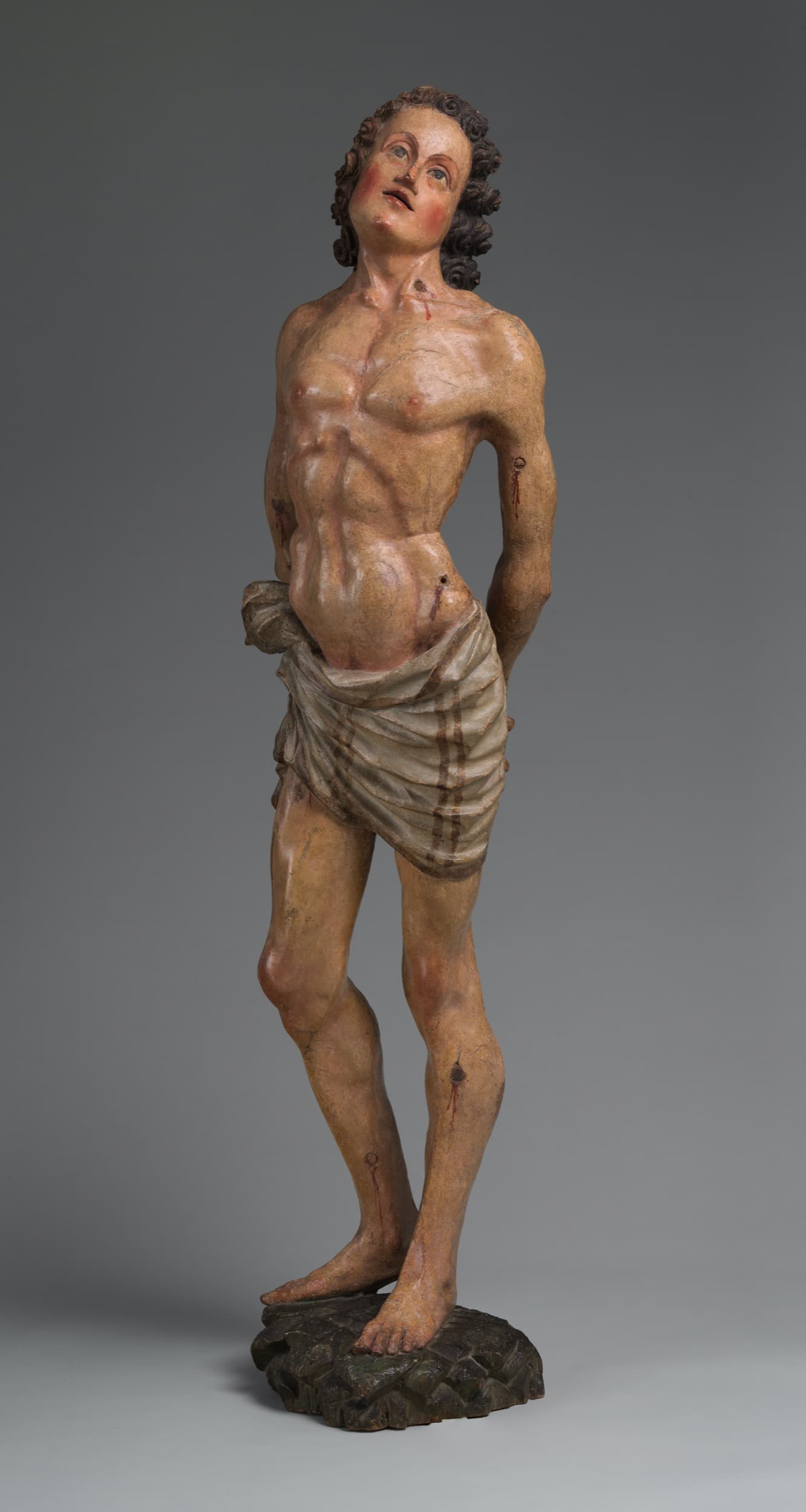
Saint Sebastian, Late 15th century. European poplar with paint and gold, 49 ¼ × 12 ⅜ × 9 ⅞ inches. Courtesy the Metropolitan Museum of Art.
Word count: 966
Paragraphs: 10
The Met Cloisters
October 16, 2025–March 29, 2026
New York
It’s hard to convey ecstasy after seeing Gian Lorenzo Bernini’s The Ecstasy of Saint Teresa (1647–52). Or maybe, it’s hard to do so before. It would be an overstatement to say that Bernini invented religious ecstasy, even more so to suggest he originated orgiastic religious expression. It might be more fair to argue that it is Bernini who translates such expression for a modern world. There is a reason for the “modern” in “early modern;” its cultural forms begin to look something like our own, even if we’ve lost that religious feeling. Bernini makes religious ecstasy sexy, if you’re in the mood for that. (I, for better or worse, took a far less sexy detour on a family trip to Ávila by stopping in to see Teresa’s purported and putrid green finger.)
The curators of The Met Cloisters’s Spectrum of Desire: Love, Sex, and Gender in the Middle Ages, treating the conjunction of sex and religion well before Bernini, confront the challenge of how to make premodern sexual desire and experience—often religiously mediated—legible. So many of the exhibition’s objects are strange. For example, Giovanni di Paolo’s tempera and gold picture Saint Catherine of Siena Receiving the Stigmata (ca. 1447–65) thematizes religious ecstasy, as Bernini will two centuries later. The hands of the saint are subject to divine penetration, but her receptive posture is unfamiliar. The curators, Melanie Holcomb and Nancy Thebaut, describe her pose, explaining: “In the throes of rapture, Catherine’s body mirrors that of Christ. Their wide-open eyes, directed unremittingly toward one another, convey the intensity of their connection.” It is indeed an intense gaze, but the wide-eyed looks suggest as much as religious communion, the first kiss of teenaged lovers who have yet to learn to mitigate the awkwardness of fast-approaching faces by closing their eyes.

Aquamanile (Water Pitcher) in the form of Aristotle and Phyllis, Late 14th or early 15th century. Copper alloy, 12 ¾ × 7 × 15 ½ inches. Courtesy the Metropolitan Museum of Art.
And yet, it is this weirdness, the alienating apprehension of a sexuality that is in so many ways incommensurate with our own—however diverse we claim ours to be—that is artistically exciting, if not quite titillating. The exhibition is at its best when it allows the viewer to struggle with discomfiting objects from a sexual culture whose expressions and terms elude easy understanding. This discomfort is occasionally and less usefully assuaged by curatorial language that reflects our sensibilities, including expressions such as the “history of gender nonconformity,” an expression that falsely suggests that conformity and its opposites have looked much the same across time, or “chosen families created within religious orders,” which should make us consider what “chosen-ness” means. We can neither forget Hamlet’s double-edged exhortation, “Get thee to a nunnery!” nor ignore the entire literary convention, not altogether fictional, of imprisoning women in convents.
Perhaps the most alienating element of the exhibition is its focus on the rich cultural expressions of chastity—“hierarch[ies] of non-sex”—while the most familiar is the delightfully bawdy sexual humor in some of the objects. But its strange pairings are especially deserving of attention in the way they emphasize sameness over difference, in a manner that exceeds the definition of “same-sex.”
We are early on confronted by a pre-Christian figure, Narcissus, entranced by his own reflection. In the displayed French illumination of The Romance of the Rose (1340) at the beginning of the exhibition, Narcissus loves his own disembodied face, and the pagan figure opens a panoply of pairings in which Eros lies in sameness, for example, in two twinned androgynous wooden Altar Angels (ca. 1275–1300), similarly dismembered by time, almost as if by design. A wooden statuette base (1470–80) shows an encounter between Lilith and Eve, the former serpentine and the latter stuffing her face with apples. The women are nearly identical. The idea of our fallen state coming from a pairing that is narcissistic in its insistent sameness gives Judeo-Christianity a kind of apocryphal sapphic and pagan origin story.

Base for a statuette showing Eve and a Female-headed Serpent, 1470–80. Boxwood, 3 ½ × 4 ⅞ × 3 ⅜ inches. Courtesy the Metropolitan Museum of Art.
The oddest iteration of sameness is the pair of nearly identical wooden statues by Master Heinrich of Constance, The Visitation (ca. 1310–20). In this work, the Virgin and her nearly identical cousin Elizabeth hold hands in a gesture the curators tell us indicates betrothal. They are both pregnant and characterized by rock-crystal “wombs,” placed a bit high (accurate female anatomy being too much to expect), one carrying the Christ child and the other John the Baptist, though both crystals are empty. Their wombs emanate from their chests as if they might burst forth with invisible powers. What to make of this? If nothing else, the pairing also attests to the utter uselessness of men—at least their earthly husbands, Joseph and Zechariah. It is women together who wield power that is explicitly located in their dislocated wombs.
In the entry to the apse of the room, where an altar might be, sits a sculpture (1300–20) of two men, one’s head on the other’s shoulder, painted oak. Here are Jesus Christ and Saint John the Beloved, who had allegedly abandoned a bride at the altar in favor of Jesus, the object label tells us. Christ’s arm is around the other man’s shoulder and the fingers from their other hands meet. The label tells us their hands reflect “the standardized pose of medieval married couples.” John’s eyes are closed.
Whereas so many objects in the exhibition require labels to make their strangeness legible, here, the legibility of affection is made strange by the religious context, particularly the significance of this pairing to female religious orders. The depth of feeling between the two figures is tangible across time, though the nature of their affection eludes facile labels. Their tender affection is as familiar as Saint Teresa’s ecstasy, and one doesn’t even have to be in the mood for it.
Natalie Prizel is a writer and scholar based in New York City. Most recently, she was Andrew Mellon Senior Fellow in European Paintings at the Metropolitan Museum of Art. She has taught at various institutions, including Bard College and Princeton University. Her book, Victorian Ethical Optics: Innocent Eyes and Aberrant Bodies was published by Oxford University Press in 2024.