ArtSeenDecember/January 2025–26
Richard Long: FULL MOON
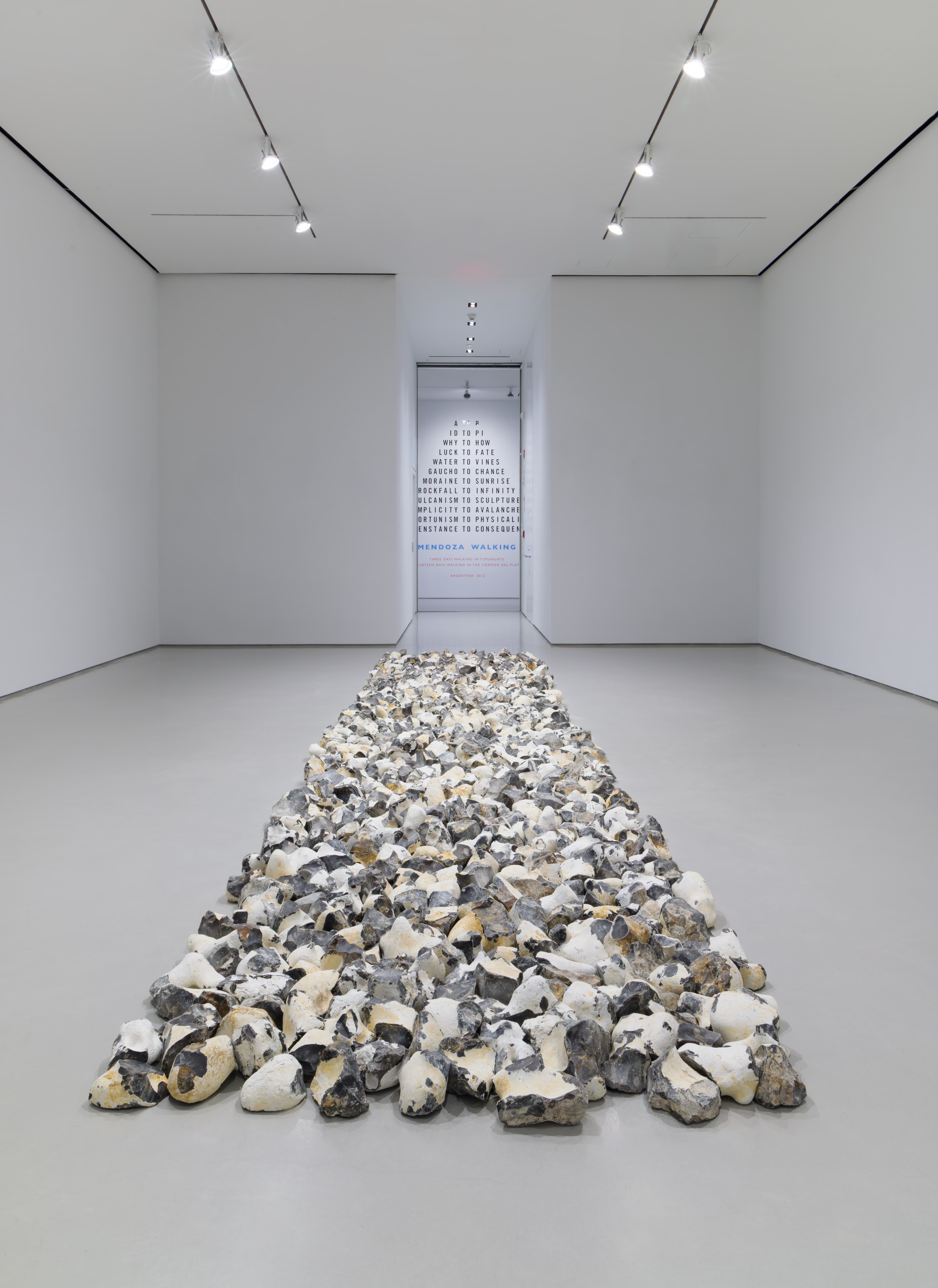
Richard Long, Flint Line, 2025. Chalk knapped flint from Norfolk, England, 284 × 60 × 6 inches. Courtesy the artist and Sperone Westwater.
Word count: 804
Paragraphs: 8
Sperone Westwater
November 7–December 13, 2025
New York
A grand finale: Richard Long’s show will be the last for Sperone Westwater, closing after fifty years of prominence in the New York art world. Long has shown seventeen times with the gallery, beginning in 1976, so this colossal exhibit is a fitting end point.
The show, curiously, is the kind anyone would want if they were inaugurating a new space, because it takes full advantage of the gallery’s odd configuration. The viewing area at Sperone Westwater consists of four rectangular floors, the narrow end of the rectangle perpendicular to the Bowery. The ground floor widens at its eastern end, but the other three are rather narrow spaces. It is as if the gallery were conceived to show Richard Long, much of whose work, like Flint Line (2025) is rectangular. Flint Line, on the third floor, consists of chunks of “chalk knapped flint from Norfolk, England” arranged in a rectangle 284 by 60 by 6 inches. “Knapping” is the shaping of flint to create a flat face so the stone can be used in construction. Cutting flint is an atavistic act carried out by humans since they began making tools and weapons out of stone, a kind of paleolithic act. But Long doesn't do any knapping, the flint is merely categorized as “knapped,” a linguistic relic from an earlier era.

Richard Long, Full Moon, 2025. Clay, 335 ½ inches in diameter. Courtesy the artist and Sperone Westwater.
The nature-culture dialectic shapes much of the show. When visitors enter the gallery, the first object they see is the show’s title piece, Full Moon (2025), a huge clay wall work representing the moon 335 inches in diameter that covers the northern wall and reaches up to the fourth floor. The moon is a satellite, but Long reminds us that we use this natural phenomenon to measure time. This is not a photorealist representation of the full moon: Long does not imitate nature; he transforms it by translating it into his own idiom. This notion is replicated in the wall inscription facing the moon: From a full moon to a new moon (2009). The full inscription includes the words “FOURTEEN DAYS OF WANING MOONLIGHT IN THE SIERRA NEVADA SPAIN 2009.” Walking, Long’s essential action, is yet another translation of nature into culture. A pace is a measurement of space as well as a rate of speed, so to walk from full moon to new moon is simultaneously to impose a human dimension on time and to delineate non-human space in human terms.
The east gallery space on the first floor contains three wall inscriptions that commemorate Long’s treks. Walking to a Solar Eclipse (1999) celebrates “STARTING FROM STONEHENGE / A WALK OF 235 MILES / ENDING ON A CORNISH HILLTOP / AT A TOTAL ECLIPSE OF THE SUN / 1999.” Long reworks the relationship of Stonehenge and the sun, a primordial attempt to turn the sun into a timepiece, into a reverse journey from human artefact to a mysterious phenomenon, eclipse, only explained by astronomy. Highland Time (2002) commemorates “A WINTER WALK OF SEVENTEEN DREAMS / CROSSING CREAG DHUBH CAIRN AT A MIDDAY / FROM A BLIZZARD TO A FULL MOON RISING / WHILE THE EARTH TRAVELS 5,740,000 MILES IN ITS ORBIT / SCOTLAND 2002.” The insignificance of human measurements compared to the immensity of the universe confirms the fact that all our observations of nature are metaphors, fictions we use to impose human comprehension on the incomprehensible. The third inscription resembles a Concrete picture poem, a series of thoughts written out in lines arranged to form a sunburst. Two experiences at the same time: a solar shape and Long’s random thoughts On Rannoch Moor (2025). A moment in infinite time captured and commemorated, translated into a metaphor for illumination. The solar image recurs on the second floor in Work in Progress (2025), set out on a balcony exposed to the weather. Rays of various lengths composed of slate rectangles emanate outward from a circular center: a solar metaphor facing the real thing.

Richard Long, On Rannoch Moor, 2025. Text in situ, dimensions variable. Courtesy the artist and Sperone Westwater.
The fourth floor contains a diversity of creature: chromogenic prints, “paintings” made of clay on panels of Douglas Fir plywood, and two fascinating slate blackboards. These learning devices inscribed with numbers from zero to nine and the alphabet constitute an educational nucleus. They also allow for fantasy, since any chalk marks made by a child or by Long, who uses River Avon mud to mark the slates, could easily be erased. They represent Long’s point of departure: the natural surface of the slate and the possibility of imposing order on the void through measurement, language, or simple mark-making.
FULL MOON is a dazzling performance and an opportunity to experience Richard Long in all his diversity. But the bitter mixes with the sweet when we realize the show is the end of an era.
Alfred Mac Adam is Professor of Latin American literature at Barnard College-Columbia University. He is a translator, most recently of Juan Villoro’s Horizontal Vertigo (2021), about Mexico City.