ArtSeenDecember/January 2025–26
Kader Attia: Shattering and Gathering our Traces
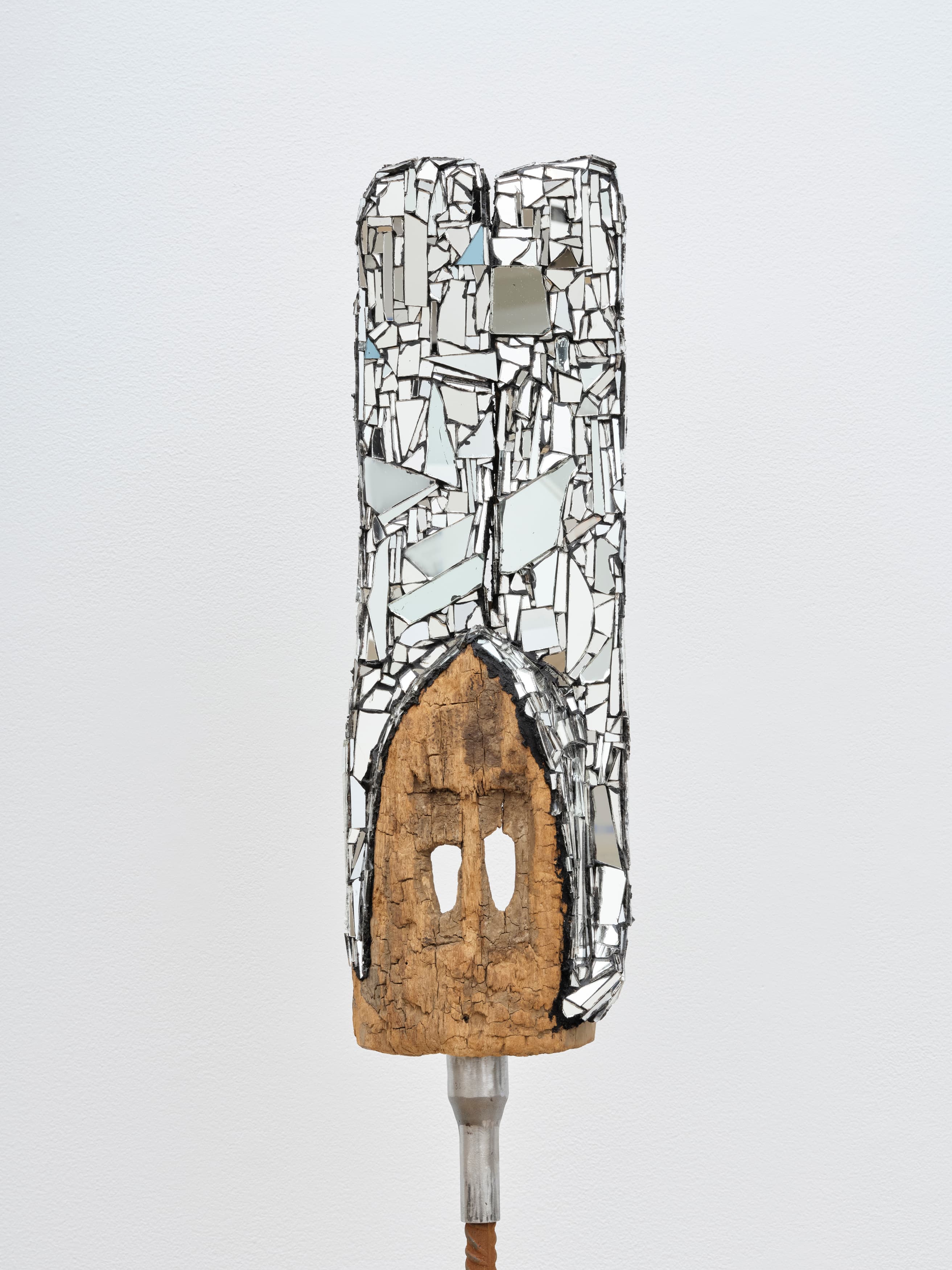
Kader Attia, Untitled, TBC. Mirror, wood, pigment, glue, metal, 87 × 9 ½ × 95 inches. © Kader Attia. Courtesy the artist and Lehmann Maupin, New York, Seoul, and London. Photo by Studio Kukla.
Word count: 876
Paragraphs: 7
Lehmann Maupin
October 30–December 13, 2025
New York
Resonance—a full, reverberating, and soulful sound quality—is the title of the sprawling installation anchoring Kader Attia’s Shattering and Gathering our Traces, his first New York show in over five years. It is also an apt metaphor for the exhibition and his work in general, which, though sweepingly interdisciplinary in its incorporation of glass, video, film, writing, and socially-driven engagement and research, is unified in its search for reflection and reciprocity across objects as well as human experiences. Shattering and Gathering our Traces is not only a testament to these pursuits, but also to his unwavering interest in how we articulate our ideals and ethos—as individuals and communities alike—through what we make and accumulate. Moreover, the exhibition evokes how cross-cultural exchange might bring the succor of resonance to our fractured world.

Installation view: Kader Attia: Shattering and Gathering our Traces, New York, 2025. © Kader Attia. Courtesy the artist and Lehmann Maupin, New York, Seoul, and London. Photo by Studio Kukla.
Attia (born in 1970 to Algerian parents in France) has centered his practice on the idea of “repair.” His biography in the text that accompanies the exhibition states that he sees the concept as ever-evolving, and “an infinite process of Repair, which is closely linked to loss and wounds, to recuperation and re-appropriation.” Making transformation tangible through his process is a hallmark of Attia’s work, which often involves disassembling materials only to arrange them into entirely new configurations, as seen in his sculptures featuring prosthetic limbs, mirrors, rebar, or railway ties. Attia lays bare how materials and culture change each other, often visibly and literally, for better and worse, as in his interventions with masks and busts. Oscillating between specific, straightforward references to objects and poetic, alchemical metamorphoses of familiar materials into abstract forms, Attia searches for wholeness throughout all his discrete works.
For instance, Shattering and Gathering our Traces opens with a series of untitled collages (2025), gathering archival images of African sculptures, European modern art, and related materials into a singular, flattened picture plane. Against these are three untitled brightly translucent, primary-colored glass casts (2025) of plastic carry-away bags, each installed on steel-gray pedestals, emphasizing the preciousness of each. The texture of each cast bag undulates in lumpy, sinewy waves that reach upward, the carrier’s handles empty but erect and ready to be held. The pedestals, irregularly placed, emphasize the particularities of each sculpture, the dimensionality of which is in contrast to the patterned neatness of the collages’ installation on the opposite wall. There, the collages are contained within glazed frames, and the specifics of each mask or sculpture comprising the images are presented as less distinctive from each other and more as likenesses. Angularity, geometry, and verticality are used across time, culture, and geography, Attia implies. His placement of the wooden carving of two untitled heads (2025), with features sanded into a smoothed surface and a diamond shape clear-cut on one forehead, likewise stresses the liminality of abstraction and realism or poeticism and specificity, implying that differences are often just constituent parts.

Installation view: Kader Attia: Shattering and Gathering our Traces, New York, 2025. © Kader Attia. Courtesy the artist and Lehmann Maupin, New York, Seoul, and London. Photo by Studio Kukla.
Nowhere is that clearer than with Resonance (2025) a sprawling installation of wire bird cages, each housing a bell, tethered by ropes at differing heights from the exhibition’s second gallery. The cages’ top ties are thin, while bulkier lengths of cable extend from their bottoms. Situated as nodes within a network, the cages and bells swing and ring as viewers walk through the installation. Their contrasting forms (angular as well as rounded cages, for instance) become a lens through which to see affinity, as color, shape, and detail converge into the completeness of shared structure and configuration. Viewers are invited to walk through Resonance; traversing its length means a possible brush of rope or cage, gently jingling the bell inside. Attia thus implicates his viewers as actors of the installation. Moreover, the tendon-like extensions of rope from the skeletal enclosures containing the bells recall a body. Resonance reminds us that we are all individuals and bodies made up of bones, organs, muscles, skin, or discrete parts that work together as a discordant chorus.
Elsewhere in Shattering and Gathering our Traces, Attia also traces the long arc of colonialism and the continuous process of decolonization, albeit more literally. A series of suitcase-based sculptures, alongside a video, gestures towards the simultaneous fracture, containment, and dispersion inherent to migration, as well as to untangling the cultural domination of another. In the former, three open vintage suitcases, each filled with sparkling shards of mirrors, shine a luminescence as ambient light hits them, the shimmer changing shape as the viewer moves closer to attempt refracted reflection. Green and red valises are placed alongside the single-channel video installation La Valise Oubliée (2024), in which Attia unpacks the intertwined stories of French artist and Algerian sympathizer Jean-Jacques Lebel, feminist decolonial theorist Françoise Vergès, and his mother. As Attia literally unloads a suitcase belonging to the three characters in the video, the collective story of the Algerian War (1954–62) is told through personal reminiscences. Untitled (Green Suitcase) and Untitled (Red Suitcase) (both 2025) are paired directly with the video, and the physicality of these next to the ephemerality of the video emphasizes how memories often metabolize in our bodies, trauma tracing generational scars. Here, as throughout the exhibition, these works coalesce into a resonant, if dissonant, harmony.
Leah Triplett is a curator, writer, and editor.