ArtSeenDecember/January 2025–26
Justin Bradshaw & Maria Robledo: Materia: Memoria
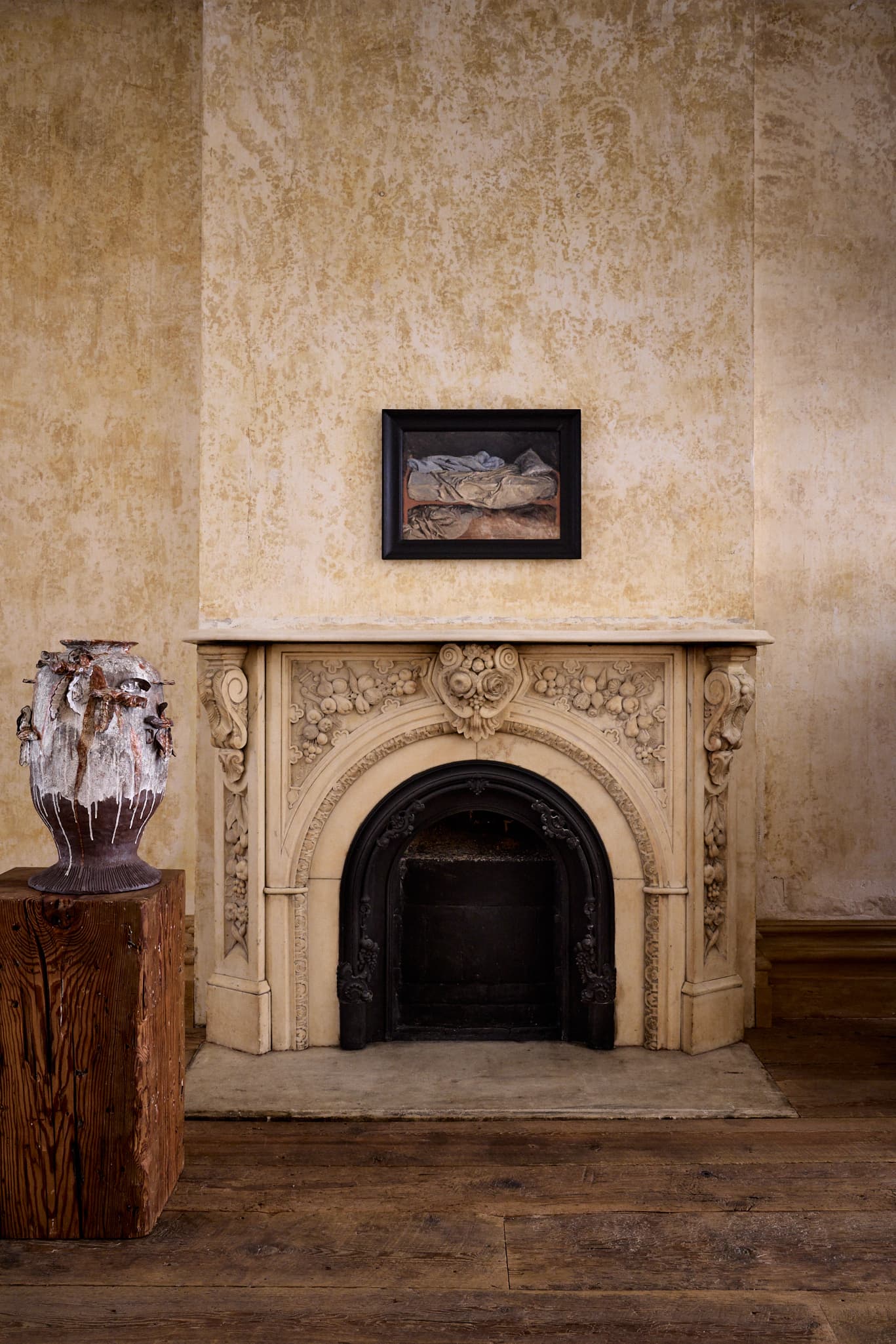
Installation view: Materia: Memoria, Galerie Sardine, New York, 2025–26. Courtesy Galerie Sardine.
Word count: 838
Paragraphs: 7
Galerie Sardine
December 11, 2025–January 31, 2026
New York
At Galerie Sardine, Materia: Memoria exhibits the work of Justin Bradshaw and Maria Robledo: two artists who treat their respective disciplines as a way of settling and sieving the elusiveness of the memories of others and the places we once knew. But there is something about the work that lingers, always, a step behind; a pang of delay that endeavors to get us back to something again, through their direct uses of material. Both Bradshaw and Robledo dwell within the empty space between experience and the void it leaves behind. Augustine said that’s the thing of it, that we are always arriving late to every experience—processing each sense through its poetic reverberations.

Installation view: Materia: Memoria, Galerie Sardine, New York, 2025–26. Courtesy Galerie Sardine.
Belatedness is contained within Justin Bradshaw’s unmade beds, unsettled and dispossessed of the bodies that they once held—bodies that are relaxed, loved, lost and ultimately irreducible, which Bradshaw understands. At times his beds weigh like a boulder. We lose the altitude of love and experience to the folds and sweat and linen that the imprints of our bodies leave behind. The bed contains the fragile records of movement and time, the unique time-space within half-dreaming mornings and their unique temporal lassitude. So in Letto Sfatto, Terracotta (2025), Bradshaw deals with the presence of life through a ricochet—through the material that surrounds us and the bed, painted here like an empty stage. The blue blanket could just as easily be a wrapped corpse. The bed could be a tomb—or a space that is robbed or depleted of something. Where is the light coming from in this windowless room? In Reposo, Sedia (2025) we see a body but as a fade, or an eclipse within the full light. The face is lost in shadow, and it is only the sitter’s legs that are pulled into light. Bradshaw is comfortable with leaving abyss to lie, and working in masterful subtlety. Cane (2025) may be the full force of his restraint, depicting a small dog fetched out of the shadows, spoken in such pure and unpretentious terms, and with such few marks.

Installation view: Materia: Memoria, Galerie Sardine, New York, 2025–26. Courtesy Galerie Sardine.
Each painting carries the weight and trace of seeing, the path the artist’s eye followed in observing the near spaces of his world. The flowers of Primavera Fiori (2025) spread out from stems in natural fractals, like a Baccarat glass, like a prism of growth. Within the chair of Striped Clothes, Sedia (2025), paints the absence of the body, simply by shaping the marks into the directions of the absent ravine. Rather than changing their hue to evoke the feeling of shadows and fold, Bradshaw modelled and arranged each mark in the direction of the folds produced from the absent sitter. The only figure brought into light is the artist himself, rendered in a self-portrait titled Autoritratto (2025). One eye reflects more than the other. Bradshaw captures an extra detail of highlight, possibly from a tear, as the title suggests the artist is willing to sacrifice to convey the world to us with as much honesty as he can handle to experience.

Installation view: Materia: Memoria, Galerie Sardine, New York, 2025–26. Courtesy Galerie Sardine.
Maria Robledo’s ceramics feint with funerary urns, but not easily. Their shapes become conical and cylindrical at the last turn off. At times they are bone-like and brittle. At others, they secrete white down their sides, evoking the last ebullient moments of autumnal times. As their forms shift around the funerary axis of remembrance, they continue their hold on a rich vein of oxide and ore. Each vessel questions what it can contain. Their handles are often purposefully pathetic, making them impossible to handle or carry. They suggest that they are meant to contain more of a hyperstasis of time than a physical thing, of wintering saudade or the last moments before the first frost of winter. Her vessels sustain a different void: preserving a reflection on how fleeting it all is, keeping a space that is sustained before we must go. Their surfaces take on the way our bodies feel, the way nature feels to us as it declines, and each vessel remembers the way we change while looking at them.
Bradshaw collects the pigments for his paints from his walks, holding each painting closer, and closing off the universe of possibility to the tangible circumference of what can be walked to. Robledo also prefers what can be explored within a universe of limited means. Together we are primed for pathos through their traversals towards memory, rendered in simple terms. Pathos, as Marcus Steinweg would say, “expresses the experience of unresolvable conflict.” But this is another way of saying that pathos is infinite. Pathos refuses death while studying its outline. It is what remains that both Bradshaw and Robledo are after: the interminable evidence of what cannot be undone, the deeper registers of love and loss that are difficult to transcribe. But art reminds us that it is the reflection on these experiences that gives us a brief and staggering access to the infinite.
Andrew Paul Woolbright is an artist, gallerist, and Editor-at-Large at the Brooklyn Rail, living and working in Brooklyn, NY. Woolbright is an MFA graduate from the Rhode Island School of Design in painting and is the director of the Lower East Side gallery Below Grand. He currently teaches at Pratt and School of Visual Arts in New York.