ArtSeenDecember/January 2025–26
Geoffrey Holder: Saturday Night
Word count: 792
Paragraphs: 8

Installation view: Geoffrey Holder: Saturday Night, James Fuentes Gallery, New York, 2025. Courtesy the Geoffrey Holder Estate and James Fuentes Gallery. Photo: Alex Yudzon.
James Fuentes
November 8, 2025–January 10, 2026
New York
Need a sign of the times? Look no further than what’s happening in nightlife. Saturday Night, a tightly curated show of twelve oil paintings made by the late Geoffrey Holder, captures a vibrant era in the history of New York’s Black nightlife scene, a world of dimly lit dancehalls, sublime style, and dancing—lots of it. Dance, of course, is what Holder is best known for, but painting was his true love: “I never wanted to be known as an actor/dancer who paints,” Holder once quipped. Saturday Night, the latest in a spate of Holder shows, is certain to leave no doubt about which came first for the artist. In many ways, too, it is the perfect curatorial conceit through which to bridge the gap dividing Holder’s varied output. After all, who better to evoke the sensuality and pageantry of dance than a man who was himself a groundbreaking choreographer?
Born in Trinidad, Holder arrived in New York in 1953 by way of an invitation from the iconic choreographer Agnes de Mille—niece of the legendary director Cecil B. DeMille—and quickly jumped into the city’s thriving arts scene. An early friendship with Stuyvesant van Veen, little-known today but a brilliant Federal Art Project (FAP) muralist and painter, introduced the young Holder to the likes of Jacob Lawrence, Louise Nevelson, and Alice Neel. This was also the moment when Holder befriended the eminent photo-documentarian of the Harlem Renaissance, an aged Carl Van Vetchten, as well as the sculptor Richmond Barthé. It was through Van Vechten and Barthé, in particular, that Holder would find entrée into the thriving cultural nightlife of 1950s Harlem. His own experience from that febrile period, the things he saw, heard, and danced to undoubtedly left a lasting impression on Holder’s practice as a visual artist in the years that followed.
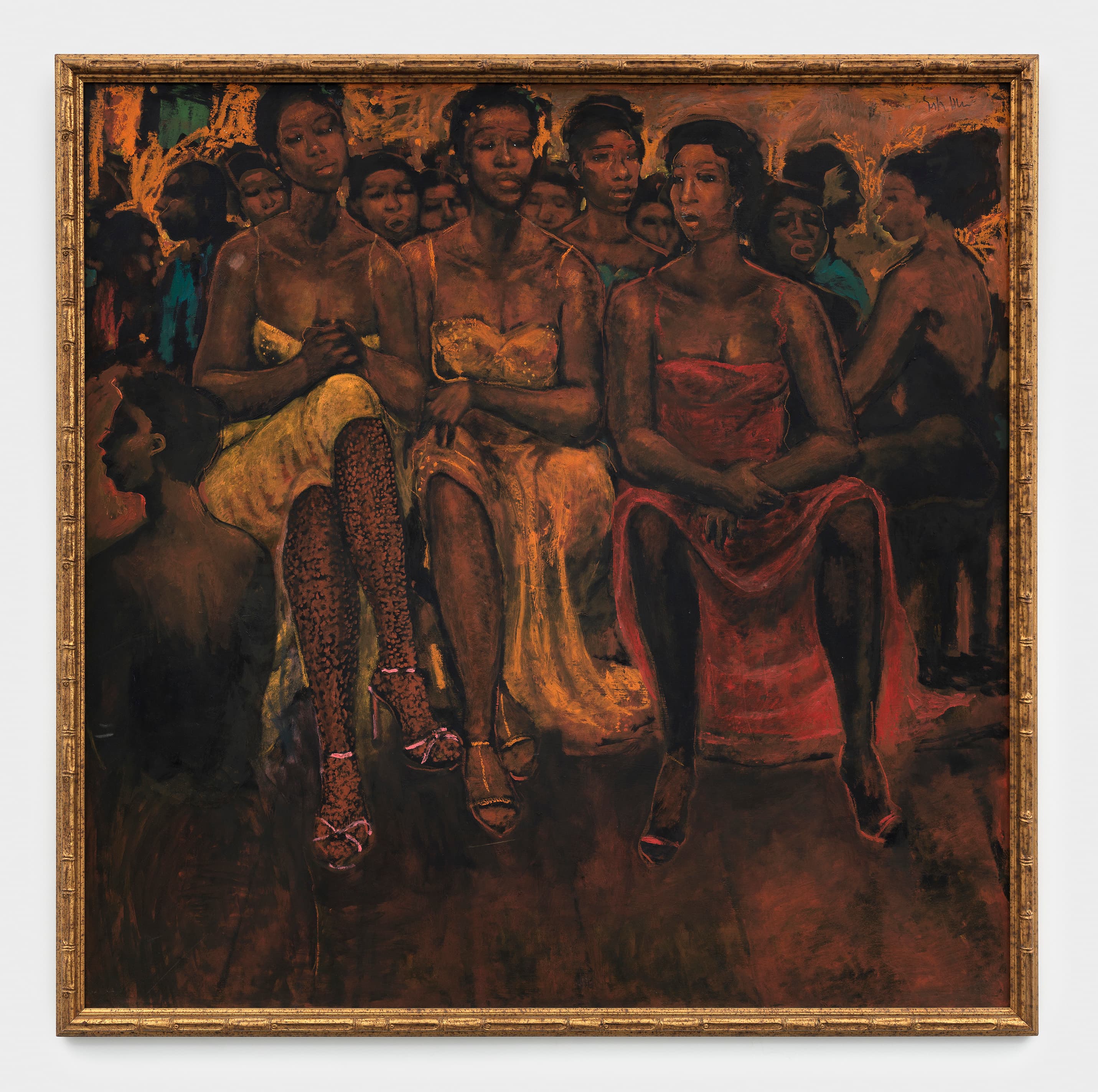
Geoffrey Holder, Waiting for the Dance, 2001. Oil, pastel crayon, and china marker on masonite, 48 × 48 inches. Courtesy the Geoffrey Holder Estate and James Fuentes Gallery. Photo: Alex Yudzon.
Importantly, though all the works included in Saturday Night were painted after 1980, the images they present feel dated. That’s not to say they’re out of touch or passé, but rather that their subjects are fixed in time. Highly expressive and impressionistic in his style, Holder’s paintings conjure a vibe, a feeling, from a bygone age; these are memories made manifest. In that sense, the exhibition can be framed as both a testament to Holder’s creative skill and a dazzling glimpse of the past.
Holder was a remarkably keen observer of others. The three women portrayed in the large-scale Waiting for the Dance (2001) are a masterful study of anticipation’s many guises. Seated, awaiting an invitation to dance, Holder’s trio evokes that sense of hope, patience, even anxiety, familiar to anyone who has ever endured a high school dance. Holder’s capacity to render emotion is also evident in Getting Down / Showing Off the Dip (ca. 1990s). A dancefloor to themselves, the titular dip shared between partners—this is Holder at his most electric, his most intuitive. Only a dancer would understand the curves a body can make when bent a certain way, how the weight falls on one leg while the other is flung out in abandon. Joy and ecstasy have their own body language.
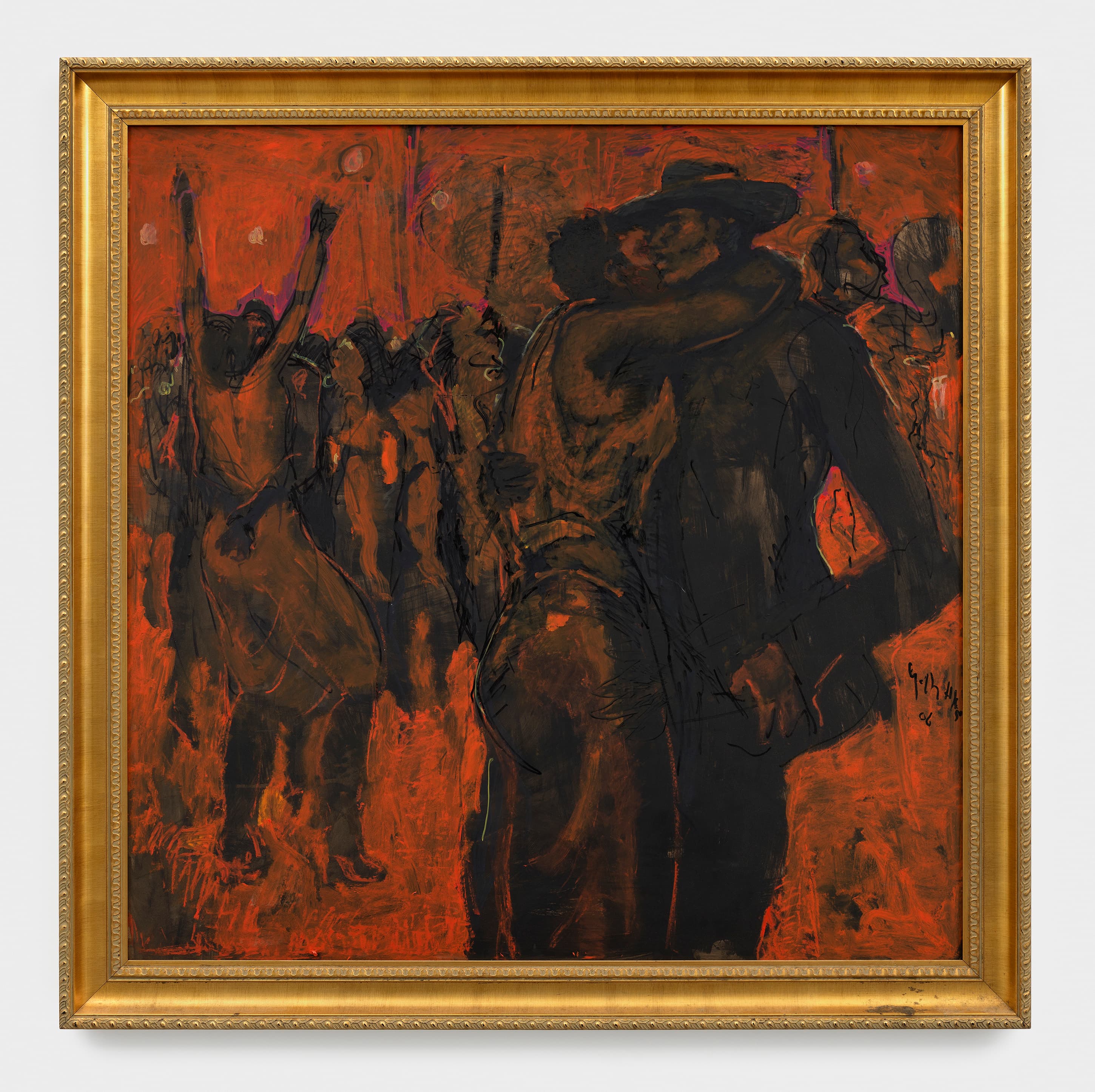
Geoffrey Holder, untitled, 2006. Oil, oil marker, and china marker on masonite, 48 × 48 inches. Courtesy the Geoffrey Holder Estate and James Fuentes Gallery. Photo: Alex Yudzon.
Holder’s brilliance didn’t just extend to his subject matter. Chromatic richness and saturation define his practice. This is evident in the fact that, though all the paintings in Saturday Night are set in dark interiors—club basements, bars, even adult revues—it is precisely these dim environments that allow Holder’s sense of color to emerge most clearly. In Dancing at Midnight / Saturday Night Party I (1994), Holder draws the viewer’s eyes to a dancefloor couple, an aura of luminous pinks nearing on magenta giving them the appearance of being on fire. Meanwhile in an untitled work from 2006, the entire scene is a near abstract field of vibrant carmine and fiery crimson, the dancers themselves this time cast into the shadows. It’s as if the dancehall itself were on fire.
Of course, in a way, everything was on fire. Holder would recall his arrival in New York as a time marked by talk of Joseph R. McCarthy’s reign of terror, a common topic of discussion at Stuyvesant Van Veen’s. The fight for equality, too, was reaching its violent, though ultimately victorious end with the Civil Rights Act signed just four years after his arrival in New York. But just as the forces of marginalization persisted, so too did a culture of celebration and invention flourish, not because, but in spite of it. Saturday Night embodies that spirit, evoking the ecstatic potential “getting down” possesses for all of us and the necessity of shared joy in warding off the darkness lurking at the edges.
Joseph Akel is a New York-based freelance writer and editor. His non-fiction writing and criticism have appeared in the New York Times, the Paris Review, Frieze, and Vanity Fair, among others. Additionally, he has penned several artist monographs, most recently for artist Doug Aitken. Akel is currently working on his first novel. He holds a master’s degree in Art History from Oxford University.