Art BooksDecember/January 2025–26
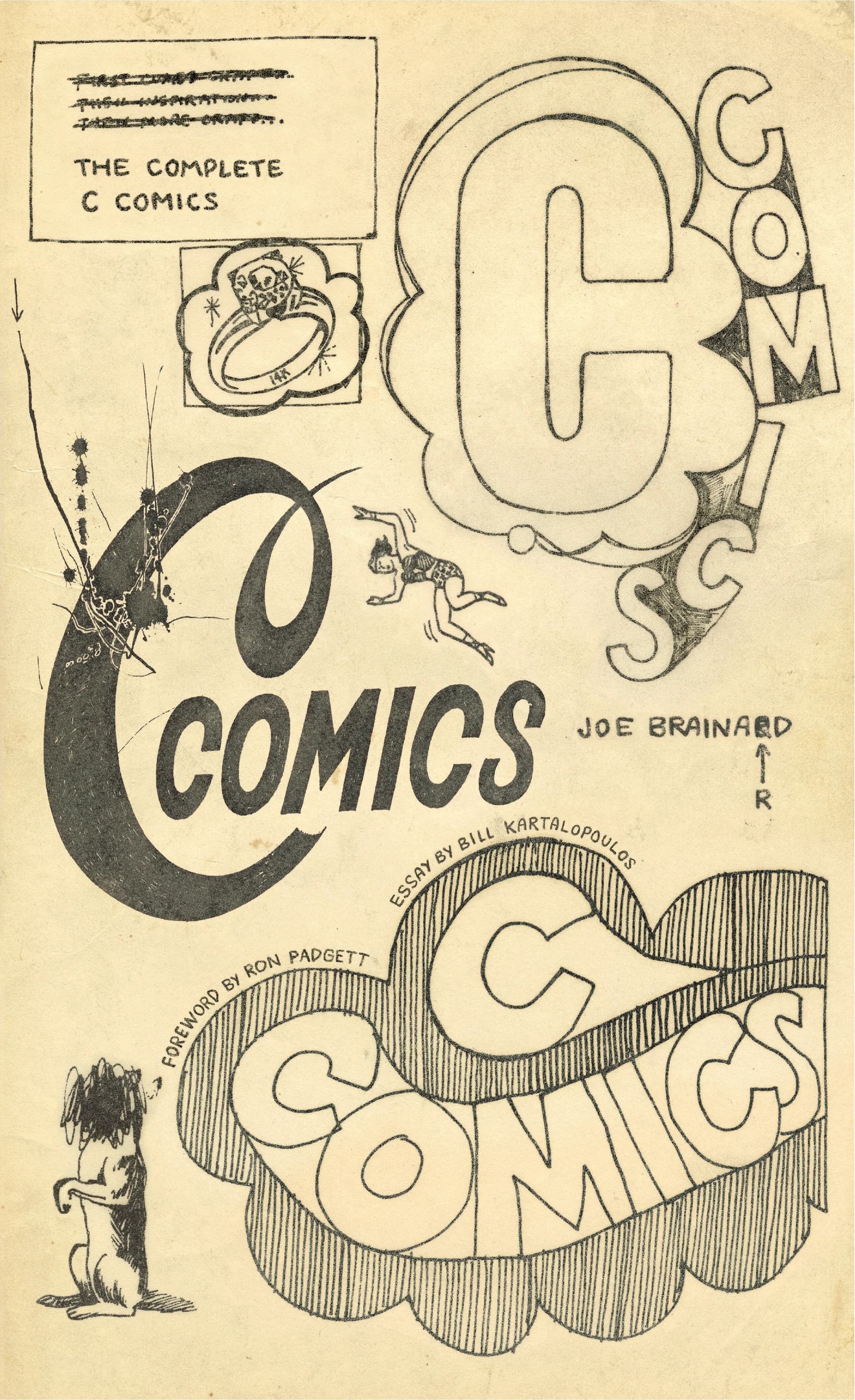
Joe Brainard’s The Complete C Comics
This collection shows the pleasure of passing work between friends, the ways that image and text, together, synthesize desire and identity.
Word count: 1142
Paragraphs: 11
Joe Brainard
Foreword by Ron Padgett
Essay by Bill Kartalopoulos
New York Review Books, 2025
Born out of Ted Berrigan’s C: A Journal of Poetry (itself born out of Ron Padgett’s single-issue mimeograph censorship protest, The Censored Review), C Comics was artist and poet Joe Brainard’s two-issue collaborative brainchild. Brainard gave sketches to his friends—among them poets Berrigan and Padgett, Frank O’Hara and John Ashbery—with open spaces to lay their own writing, in their own scripts, beside Brainard’s. Now, thirty-one years after Brainard’s death, both long-out-of-print issues have been collected and revived in a 200-page hardcover from New York Review Books, complete with a guest essay by Bill Kartalopoulos and a foreword by Padgett himself.
The back cover of C Comics No. 2 features a single-panel drawing by Joe Brainard titled “Hot Fudge Sunday.” The titular sundae: a wobbly form, mostly covered by black-ink hot fudge, with an even wobblier dollop of crosshatched whipped cream. An ocular cherry looks up at a thought bubble that seems to emanate from the Brainard-sundae’s proverbial head, saying, “Dear Diary, There is a boy I know who likes me. He likes me quite a lot and I like him.” At the end of its monologue, the sundae asks, “What can I do?” Guileless, rudimentary, and perhaps the most fitting conclusion for this issue—in which the previous pages all seem to grasp, obliquely, at the inarticulable parts of desire—now written with a naive simplicity so cloying it could be mistaken for parody.
On this same back cover, an arrow points to a block of text beneath the sundae. Brainard writes in his ever-clean block print: “WHO CAN TELL HOW ROMANCE WILL FIND ITS WAY INTO THE PRIVATE DIARY OF HOT FUDGE SUNDAY IN THE NEXT BIG ISSUE OF ‘C’ COMICS!” No one, though, would learn of the next saga in Hot Fudge Sunday’s love life. This second issue would be the final one.
In her essay “Joe, A Funny Nickname,” published in Yasmine Shamma’s Joe Brainard’s Art in 2019, poet Alice Notley writes, “I think of Joe’s work as being beautiful, first; it seems to me now my first impression, or feeling of it, was my being allowed, finally, to experience what I thought of as beautiful, as beautiful.” She goes on to note that Brainard’s work distinguished itself by eschewing a typically implicit conversation between artist and viewer, one that begs questions like: can this be beautiful?
The Complete C Comics makes clear how much pleasure Brainard took, not only in the form of the comic, but in the form of a magazine of comics: the collaborative methodology of passing work between friends, the ways that image and text, together, could synthesize desire and identity. The comic grid offered an equalizing force: a place to interpose and queer the icons and language of mass culture into new contexts. Brainard and Tony Towle’s “Wonder Woman” populates the pages with her indestructible wristbands and lasso of truth, but her speech bubble reads, “Only someone who’s experienced it can possibly know the heartbreak and humiliation of being rejected,” as she takes to—and falls from—the sky. Brainard and Bill Berkson’s first (of many) interpolations of Ernie Bushmiller’s Nancy immediately tells us, “I seem to be thriving on rejection these days,” before Brainard severs her iconic body between three vertical squares.

Notley’s assertion of immediate beauty can almost be read as an argument for a certain type of decontextualization in Brainard’s work, a way of coyly removing the work from centuries of conversations about taste, lineage, and merit, to allow a pure transmission of decontextualized beauty between piece and viewer. In his contextualizing essay for the collection, though, Kartalopoulos suggests a different relationship between form and context, piece and viewer: “In assembling these elements to produce legible comics, Brainard created something very different from Pop Art, which pillaged the visual content of comic book panels without engaging with the structure—and opportunities—of the comics form.”
There’s a final step in this relationship between form and content, however, that even Kartalopoulos fails to note. Not only is Brainard’s C Comics deeply engaged with the conventions of the comic form, but, by its second issue, it had become its own sort of form, with its own rules and usages to play with and pervert. James Schuyler provided parody-advertisements across pages of the second issue—one for a pseudo-product called “C Cream,” which advertised itself: “As of today, you need not be embarrassed by your nudity.” Repeated arrows pointing to ink blots, scratch-out marks, and corrected misspellings became formal conventions of a magazine that not only accepted mistakes but embraced them. Each time Brainard drew an arrow to direct our attention to an error across the pages, he was engineering the C Comics form, effectively making a magazine that entered into private conversations with its audience. He gave us a signifier we recognized as uniquely belonging to C Comics, a New York School inside joke we could be in on.
Brainard’s work, like that of many of his New York School contemporaries, has an endless playfulness that belies a particular cynicism, one hardened to certain realities but guilelessly enraptured by desire and the mischief it carries. Brainard’s contributions, in his C Comics and elsewhere, do raise questions of performance—perhaps best articulated in a 2018 conversation between author Andy Fitch and New York School scholar Andrew Epstein—in which Epstein posed, “[I] do wonder if what we’re doing is also, at the same time, a performance or pose of naiveté.” They speak about Brainard’s negative capability and his insistence on uncertainty as an act of queer refusal.
The cynics among us might scoff at the moment in Padgett’s foreword where he writes, “I remember that we did the work simply for the pleasure and adventure of it, with little or no thought of how it might be received by the public.” But Brainard’s C Comics characters do dwell in a visceral, veritable uncertainty, sometimes shameful in how they express their desires. One abstract mandala shape in Kenward Elmslie and Brainard’s “Looking Ahead No. 2” says to another, “I just can’t draw the way I feel about you.” An androgynous-faced, scantily-clad female form in their “Rosy’s Dilemma” fails to reply to the other with anything legible as language. Instead, her speech bubble says, “BA-RA VOOM KA-VOOM” in thick block letters, cut off by the edges of the bubble: a language that is at once image and text. Naiveté—performed or otherwise—was one way Brainard negotiated the tension between feeling and form; collaboration, play, and invention remain among the others. In his foreword, Padgett writes of C Comics, “It was happily free of theoretical ambitions, such as toward being avant-garde or radical or even funny.” In other words, Brainard continues to ask, “What can I do?” Beauty has always been the answer.
Madelyn Dawson is a writer and editor from Staten Island, NY. Her work has appeared in the Los Angeles Review of Books, Paste Magazine, and SPIN Magazine, among others.