Art BooksDecember/January 2025–26
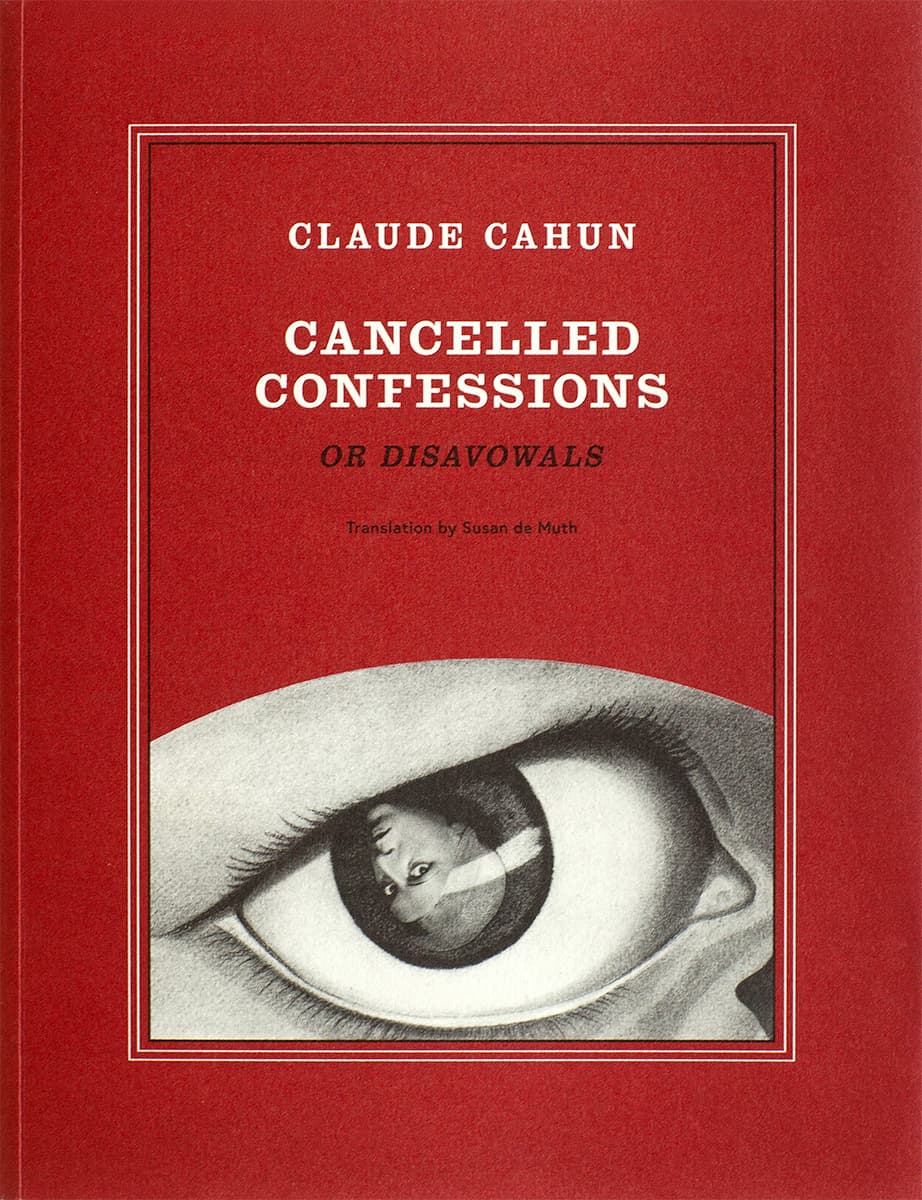
Claude Cahun: Cancelled Confessions (or Disavowals)
This redesigned “anti-memoir” asserts the sustained interplay and queer mode of collaboration between Claude Cahun and Marcel Moore.
Word count: 828
Paragraphs: 7
Claude Cahun
Translated from the French by Susan de Muth
Siglio, 2025
Where did Claude Cahun come from? The Surrealist artist and writer may have been born from the fusion of two slugs, the magical offspring of two male sorcerers on their wedding night, after having “lovingly observed the reproductive processes of various animals, from anemones to man.” Or, they may have crawled from the murky waters of a pond following a storm, an environment they identified as the “perfect playground for a poet.” Alternatively, Cahun may have simply blossomed in place, according to their own aphoristic instruction: “Human body. It should be stuck upside down in a vase so that it arranges itself elegantly, so that it blooms, so that it has four branches, four flowers and the bulb is hidden.”
According to Cahun’s “anti-memoir” Cancelled Confessions (or Disavowals)—originally published as Aveux non avenus by the Parisian Éditions du Carrefour in 1930 and reissued this year by Siglio Press—all of these fantastical origin stories might be possible. However, perhaps it is more accurate to assert that Cahun emerged from the sustained interplay with their lifelong partner Marcel Moore. Historians will indicate that the person named Lucy Schwob at birth—child of a Jewish literary family in Western France—and Suzanne Malherbe—her lover and step-sister—were active in the surrealist and lesbian modernist circles of interwar Paris. But the mercurial identifications of Cahun and Moore, respectively, emerged for both artists not from individualized biological narrative, but as their deeply queer mode of collaboration took root. In fact, as Amelia Groom outlines in the newly written afterword for the Siglio edition, there is an increasing effort to recuperate Cahun and Moore as crucial precedents to contemporary understandings of trans/non-binary/genderqueer subjectivity.

Like everything articulated in Cancelled Confessions, my choice of language here is important, yet it doesn’t land where it’s supposed to. “Words would be everywhere but never in the right place. Without ugly things, without pain, without opposites, I cannot remain standing.” The chapters of Cahun’s so-called “memoir” wander variably between a wide range of formats and voices—myths, fairy tales, and Biblical references; descriptions of dreams; dialogues between imagined characters; letters, written seemingly to Moore—yet the artist’s use of wordplay remains a constant. This poses a challenge for the text’s translator, Susan de Muth. A substantive series of endnotes parse through Cahun’s double meanings, particularly when their associative power doesn’t carry over from the original French. (For instance: “wild weeds,” from herbes folles, where folle also stands in for madness, gendered feminine.) The question of gendered language is another deliberate wrinkle in Cancelled Confessions: Cahun moves freely between masculine and feminine declensions, between first- and third-person voices, refusing to resolve themself for their readers. The Siglio edition captures this disjunction well: in the book’s additional material, de Muth refers to Cahun as she, while Groom uses they—both grammatical choices are left intact, not smoothed over in the name of editorial consistency. “Make myself another vocabulary, brighten the silvering on the mirror, wink, swindle myself, … multiply myself so that I can make my mark,” Cahun instructs.
This new reissue of Cancelled Confessions is an update of an out-of-print 2007 edition, also translated by de Muth, then titled Disavowals. The Siglio version was redesigned in order to better replicate the original 1930 edition, and, crucially, to assert Moore’s shared authorship in the text’s accompanying photomontages. Historically attributed to Cahun alone, the fractal and disorienting images introduce each chapter. Hands clutch circular mirrors and disembodied eyes; Cahun’s costumed torso and limbs are bisected and rearranged; their painted lips multiply and unfold like petals on a flower. A scrambled grammar of its own, the montage technique reflects the shifting identifications that Cahun asserts in their writing—“Life’s role is to leave me uncompleted, allow me only freeze-frames”—but these transformations also offer a way beyond the deep ambivalence Cahun articulates throughout the book, regarding the “graceless mutinies” of their physical body. It’s clear that Moore and Cahun’s images are not supplemental to the latter’s writing. Rather, image and text are twinned, co-constitutive processes: both the same and different, reflection and distortion alike.
There is much about Cahun’s life—their gender-nonconforming presentation, their sustained work (with Moore) of anti-fascist resistance in Nazi-occupied France—that will feel familiar today. It’s another striking moment of doubling, perhaps: an uncanny (and possibly affirming) look in the mirror as history repeats itself. But, as always, the artist remains too capricious to draw an easy comparison. Of Cahun’s shifting relationship to gender, historians will often cite a line in Cancelled Confessions that reads: “Masculine? Feminine? It depends on the situation. Neuter is the only gender that always suits me.” However, it’s worth noting the preceding line, often left out of these references, which asserts the question of gender as a playful one: “Shuffle the cards.” Cahun was not singular; they were many myths, desires, and contradictions. But above all, they were a game shared by two.
Daniella Sanader is a writer and reader who lives in Toronto.