BooksNovember 2025In Conversation
Marilyn Aronberg Lavin with Suzaan Boettger
Centenarian Art Historian Tells . . . Most
Word count: 1777
Paragraphs: 22
One Life for Two, The Autobiography of Irving and Marilyn Lavin
Deutscher Kunstverlag, 2025
Fashioning an autobiography or memoir offers the enticing opportunity to release grudges—and get even. Among recent high-profile examples, star restauranteur Keith McNally’s absorbing I Regret Almost Everything expresses remorse, but also frankly describes his fractious professional collaborations and personal difficulties with his almost-as-famous restauranteur brother Brian. Media mogul Barry Diller’s confident Who Knew? candidly calls out competitors’ missteps as well as his own. Sidestepping another pitfall of autobiography, hubris, celebrity editor Carter Graydon takes the less credible approach of relentlessly attributing his journalistic successes in When the Going was Good to his colleagues, assistants, and luck.
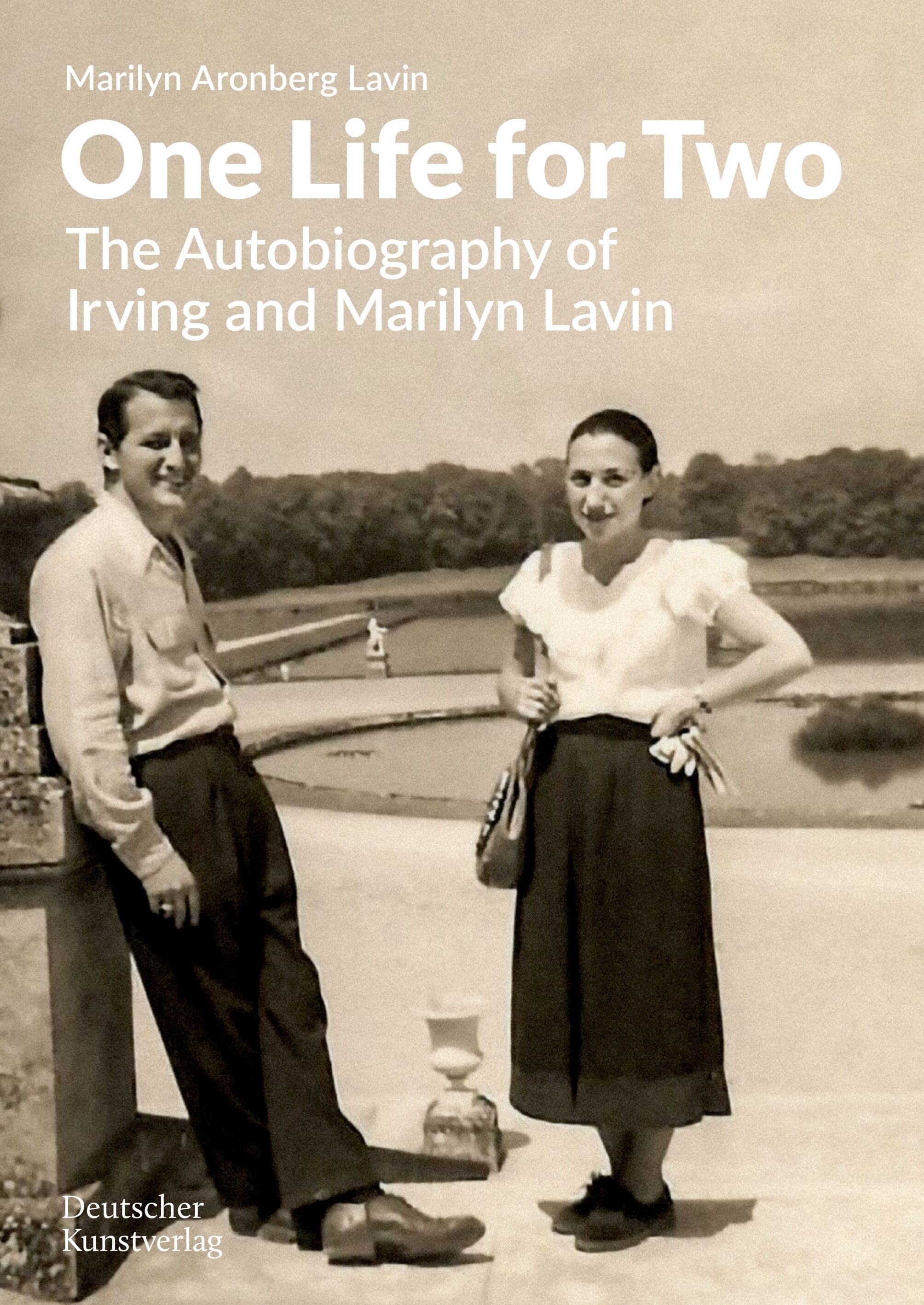
More unusual—and especially by an eminent scholar—in her One Life for Two, The Autobiography of Irving and Marilyn Lavin, art historian Marilyn Aronberg Lavin succumbs to the temptation to settle scores. Dr. Lavin’s very first sentence lobs the firecracker, “What do you do when your husband gets the best job in the country in a field he stole from you? Well, that’s what happened to me, and that’s what this book is about.” The antipathy of this startlingly disinhibited—and dubious—claim, even if an exaggerated tease, is implied by the book’s cover illustration. In the photograph, the couple stands apart and in what turns out to be characteristic body language: Irving in nonchalant repose, Marilyn with hand on hip as if querulous. The choice of that double portrait instead of one of the snapshots inside that show them happily joined counters the unity implied in the title’s One Life and hints at conflicts to come.
But in the following 400-plus diaristic pages the revenge narrative only erupts intermittently among fascinating anecdotes of their careers' ascension. Irving (1927–2019) and Marilyn (1925–) Lavin are both titans in the modern history of the discipline of art history, he famous for his discoveries about the Baroque sculptor Gianlorenzo Bernini but who also wrote about late antique, Medieval, Renaissance, and modern painting, she primarily a scholar of Italian Renaissance painting (Piero della Francesca, Giovanni Bellini) and also the originator of the use of computers for analysis of art historical data and imagery.
Soon after connecting as college students at Washington University—they had met as teenagers—their lives were entwined forevermore. Marilyn was a master’s student studying with H. W. Janson, who soon moved to New York University and became godly for his universally assigned survey textbook (until feminism dethroned him for his refusal to include women artists), and who applied his clout to propel both of their nascent careers. Armed respectively with doctorates from Harvard University and NYU’s Institute of Fine Arts, one or the other or both became professors at Vassar, NYU, the IFA, Princeton, and occasionally elsewhere. Following important publications, at the professionally early age of 46 Irving was appointed to the Institute for Advanced Study in Princeton in the chair previously held by eminences Erwin Panofsky (Studies in Iconology: Humanistic Themes in the Art of the Renaissance, 1939) and Millard Meiss (during our Covid Pandemic, Meiss’s 1951 Painting in Florence and Siena after the Black Death became newly popular). For scholars, being welcomed into the IAS amounted to entering the gates of professional paradise; the position requires no teaching, facilitating devotion to study, writing, and communing with fellow academic elites, and pays well enough that Marilyn, initially without title except “wife,” could also stop teaching and do her own research.
One Life for Two is the story of how two from middle America—both born in St. Louis of Jewish families, her grandparents and his parents emigrated from eastern Europe—formed a deep bond and became renowned art historians. By extension, it shows how not just intellectuals but the intellectual life of the profession itself from the mid-twentieth century flourished. Analysis primarily focused on historical western European fine arts up to the early twentieth century, with lesser study of Asia and the United States—quite narrow attention in comparison to this century’s global purview and predominant study of contemporary art in diverse media. The contrast between the Lavins’ high-flown lives merging “work and play in places of remarkable fascination,” socializing with the Who’s Who among academia, museology, and contemporary art (some characterized with amusing cattiness), being invited hither and yon to lecture and receive awards, and the profession’s presently enfeebled state of shrinking college enrollments and constricted departments, is stark.
Irving didn’t kidnap the profession of art historian from Marilyn; he switched from studying philosophy and became extraordinarily adept at stylistic, iconographic, and historical analyses of art. If her recognition was thwarted, it was by the prevailing sexism that privileged work by men. And by her period’s conception of what it was to be a wife: devotion to husband’s brilliance and undertaking “responsibilities of keeping Irving on track” (typing his writing, assembling illustrations, serving as travel agent and messenger of his forgotten passport to the airport, organizing their lives and those of their daughters, managing and subletting their residences, sharing their drive and delighting in their intellectual camaraderie) – while suffering what she recounts as the Great Man’s arrogance and emotional coolness. With One Life for Two, published at her age of one hundred, six years after his death, Marilyn gets their dialogue’s last word. And also here, after a few more.
Suzaan Boettger (Rail): Your recollection of the minutiae of your personal and professional engagements, publications, interactions, and multitude of continental and international peregrinations is impressive, even more so because of your advanced age. Did you consult a diary? How were you able to present those details?
Marilyn Lavin: I kept no diary; nothing from the early years. By the eighties I had a computer file where I kept a list of places we went year by year. Usually that was enough to trigger most of the details. Often, for context, I did a bit of research.
Rail: It appears that professional competitiveness with others propelled each of you. How much were you stimulated by competition, with colleagues and with each other?
Lavin: Along with trying to surpass my sister, six years my senior, my last [maiden] name began with A and I was the shortest in class so I was always at the head of the line. More than competitive, I was sure of myself. I didn’t compete with Irving; we knew different things and were interested in different subjects. We egged each other on.
Rail: You identify as Jewish and note behavior that you perceived to be anti-Semitic. But there is no reference to celebrating Jewish holidays or other religious observances. Is that because you were akin to prominent mid-twentieth century Jewish intellectual art historians such as Walter Friedlaender, Milliard Meiss, Erwin Panofsky, Meyer Schapiro, and Leo Steinberg (largely analysts of historical Christian art) who were more culturally Jewish than religious practitioners, typical of the time?
Lavin: The anti-Semitism was at my Protestant, all-blond-girl’s 12-year school. My father, from an Orthodox family, was a Christian Scientist, and wouldn’t hire anyone with an accent. We didn’t celebrate any Jewish holidays. I studied with almost all of the men you mention and the material they offered only dealt with Christian art. Issues of personal religion never came up.
Rail: What do you think is the latent or underlying aspect of Piero’s simplified volumetric figuration and mathematical settings that appeal to you? And in comparison, what in Irving drew him to Bernini’s passionate figuration and voluptuous forms?
Lavin: I was always interested in finding how Piero used his grave, static, and dignified figures set in mathematically constructed space to make mystical experiences look real. Irving’s fascination was with Bernini’s meticulous labor in creating sculptured forms at the height of spontaneous movement in order to express the depth of their feeling.
Rail: You convey both great admiration for Irving’s drive and acumen and your melancholic unburying of your resentment for what you identify as his aloofness, arrogance, and the responsibilities that fell to you as the practical tether to his impulsive actions and professional ambitions. We know little about the nature of your intimate connection beyond professional camaraderie. And it is a non sequitur for anyone to write another’s “auto” biography; in your history of Irving’s intellectual achievements, we don’t learn of his inner life. What can you say about his complaints about you, what you think he loved about you, and how he was as a father?
Lavin: He teased me as being a little rich girl with nothing to do and not a true intellectual. At the same time he loved me for my vitality and because he could never best me in a scholarly argument. Writing about him as a father would be different book.
Rail: Similarly, you write that your and Irving’s itinerant professional engagements, requiring frequent school changes for your daughters, had both cosmopolitan benefits and was destabilizing of family harmony, but “that story, although close to my heart, is a tale unto itself and not part of the present effort.” What is the reason you have set aside intimate familial history? How do you conceptualize your autobiographical narrative?
Lavin: I did not consider family history to be the subject of this book. The first two lines of my Preface declare that I will be speaking about our professional life. I start the text in medias res with the story of Irving’s art historical discoveries, the capstone of his success and then return to tell the story of how we got there. You have quoted the passage in which I freely state that my concept was professional, not personal. I was deadly serious when I said “it would be a different book.” As a scholar I knew I could not write about two subjects at the same time.
Rail: The embossed profile of Athena on the Victorian locket that Irving gave you on your 50th wedding anniversary captures your character as a resilient warrior for your work and even more for his, and even though you confessed anxiety, your fundamental confidence and adventurous spirit. You report that following his death, “After having been in a synergistic marriage for sixty-six years, the return of my youthful independence and self-assurance happened in a matter of days.” Do you think that that emotional strength and ability to put loss aside have been factors in your longevity?
Lavin: My emotional strength could well have been defensive, indeed, separating me from deep and difficult emotions. My mother had been a health nut—no white bread or animal fat—and that certainly played a role. I am a night owl and live on little sleep. I exercised all my life—dance, figure skating, tennis – and still do, PT [physical therapy] and walking. But work is what keeps me alive. I’m only happy when I’m at my computer, writing about solving visual problems, and finding meaning in created things.
Suzaan Boettger is an art historian and critic in NYC and author of Inside the Spiral, and The Passions of Robert Smithson.