Stephen Shore: Early Work
Word count: 955
Paragraphs: 9

Installation view: Stephen Shore: Early Work, 303 Gallery, New York, 2025. Photo: Justin Craun.
303 Gallery
November 5–December 19, 2025
New York
Stephen Shore (b. 1947) remains the preeminent practitioner of the American vernacular in photography. The consistency of his vision of the offhand everyday is explored in this exhibition and attendant book, both titled Early Work. The occasion presents an opportunity to expose the roots of the artist’s nascent vision and photographic influences.
In the street photographs of his precocious adolescence, Shore channels the sensibility of Walker Evans’s candid portraits of 1930s and ’40s New Yorkers: figures momentarily caught in their daily commutes or guarded preoccupations. Shore shot with both an awareness of photographic precedent and a youthful curiosity that imbues his subjects with a more tender, interior complexity than Evans. This series exemplifies how the young Shore was, in Harold Bloom’s literary analogy, a “strong poet” in his own right—not despite, but precisely because of, his straightforward engagement with the epoch-defining documentary poetics that constitute Evans’s American genius loci. The fact that Evans himself had previously cited European photographers such as Eugène Atget and August Sander—both artists for whom the generic category of documentary photography became a springboard for aesthetic profundity—suggests that Shore’s own instincts, shaped by his epoch, extend this lineage toward a broader, more global awareness of the commonplace as pictorially rich.

Stephen Shore, New York, New York, 1964, 1964. © Stephen Shore. Courtesy 303 Gallery, New York.
303 Gallery’s coincident show of the German artist Hans-Peter Feldmann wonderfully complements Shore’s in demonstrating how a wider tradition of generic aesthetics can engender a productively creative ontology. Feldmann was based in Düsseldorf; a show mounted in the same city from 2010 to 2011, entitled Der Rote Bulli, traced Shore’s transatlantic influence on what came to be called the Düsseldorf School of Photography, which included Bernd and Hilla Becher and Thomas Struth. The title of that show was based upon an image of Shore’s of a red Volkswagen bus parked on Church Street in Easton, PA, adjacent to the location of one of Evans’s most iconic photos, View of Easton, Pennsylvania (1935). Shore’s atavistic revisiting of Evans’s old stalking grounds proved a vision quest that both literally and figuratively retraced and then supplanted the older artist’s topographies. It’s an important genealogy to recount, given how impactful prior photographic precedence is evident in the younger Shore’s development.
One can see, too, the presiding influence of Evans in images reproduced in the book of New York storefronts in planar parallel to the camera’s position. In one he captures the proprietor of a photo studio standing in its doorway, in another the fugitive hand of a news agent in his cubby surrounded by tabloids and “girly magazines.” Such frank references to the proliferation of images via mechanical reproduction take on (despite their gritty realism) an enduring poignance given the acceleration of digitally augmented impermanence since. Yet one sees the artist coming into his own quirk in relation to the offhand oblique with which he is most commonly identified. Sharp angles, such as one capturing his parents on a street corner in Rhinebeck, NY, and another depicting a doorway loiterer of an urban coffee shop—begin to multiply. Such pictorial complexity is heightened in an image of a soccer practice taken at a boy’s boarding school that a twelve-year-old Shore attended in 1959, in Tarrytown, NY. Each player diminishes in perspective almost mathematically into the playing field’s distance. Another image that precociously nods to both photographic process and visual syntax has the school’s headmaster,Williams Dexter, taking a group photo while being photographed by the young Shore shadowed in the foreground. Dexter’s awkward, backwards gesture toward the photographer/viewer appears to “direct” his/their gaze to the prosaic work of the “set-up shot.”
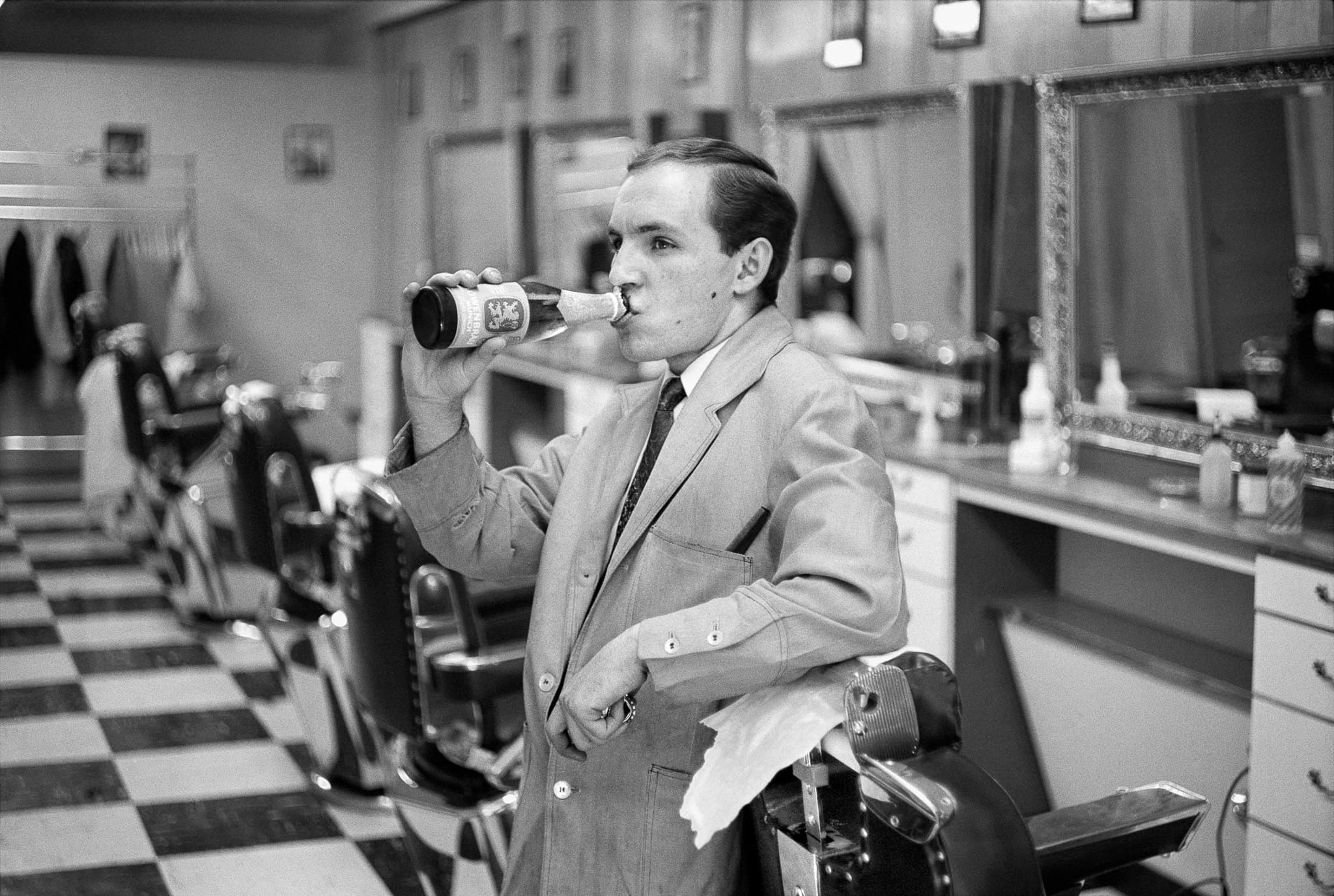
Stephen Shore, New York, New York, 1963, 1963.© Stephen Shore. Courtesy 303 Gallery, New York.
It's remarkable to consider that Shore’s work was already collected by the Museum of Modern Art’s curator of photography, Edward Steichen, when the artist was only fourteen years old. A contemporaneous untitled photo from about 1962, reproduced in the book, shows a middle-aged woman defensively hunched over her purse while biting her thumbnail and balancing a lit cigarette in her right hand. Her countenance is aged both by time and alert suspicion, perhaps at the photographer’s momentary capture. Considering Steichen’s humanist curatorial opus The Family of Man, mounted at MoMA in 1955, one can imagine such a psychologically charged portrait fitting right in.
A selection of photographs Shore took while involved in Andy Warhol’s Factory in the mid-sixties is included in both book and exhibition, a period of conceptual experimentation that Shore immersed himself in. He first met Warhol among the milieu surrounding Jonas Mekas’s Film-Makers’ Cinematheque in 1965. Warhol invited him to photograph at his studio and, despite what came to be considered the Factory aesthetic—Warhol’s stark technical objectivity in relation to his superstars/subjects— Shore’s images come off more as a candid family album of a warm gathering, perhaps unsurprising considering it was his very first day shooting there.
In a revealing essay included in the book, Shore outlines the early stages of his technical fluency. He recounts moving from a Nikon F single-lens reflex camera to increasingly sophisticated Nikons, and later investments in Leica M2 and M3 cameras. These, along with particular choices of paper and developer, were the tools he used in pursuit of his desired results. One strikingly abject image in the book captures a heap of detritus in what appears to be a tenement building. Shore returned to the subject of errant piles of garbage in a 2018 exhibition at 303 Gallery, this time armed with a state-of-the-art Hasselblad X1-D digital camera. These newer, extremely high-resolution images reaffirmed Shore’s restless fascination with the technical means of capturing the casually overlooked and candidly underseen, an impulse that the present exhibition and monograph show has come to define his life’s raison d’être.
Tom McGlynn is an artist, writer, and independent curator based in the NYC area. His work is represented in the permanent collections of the Whitney Museum, the Museum of Modern Art, and the Cooper Hewitt National Design Museum of the Smithsonian. He is currently Adjunct Assistant Professor at Parsons/ The New School.