Maureen McQuillan: Coloratura
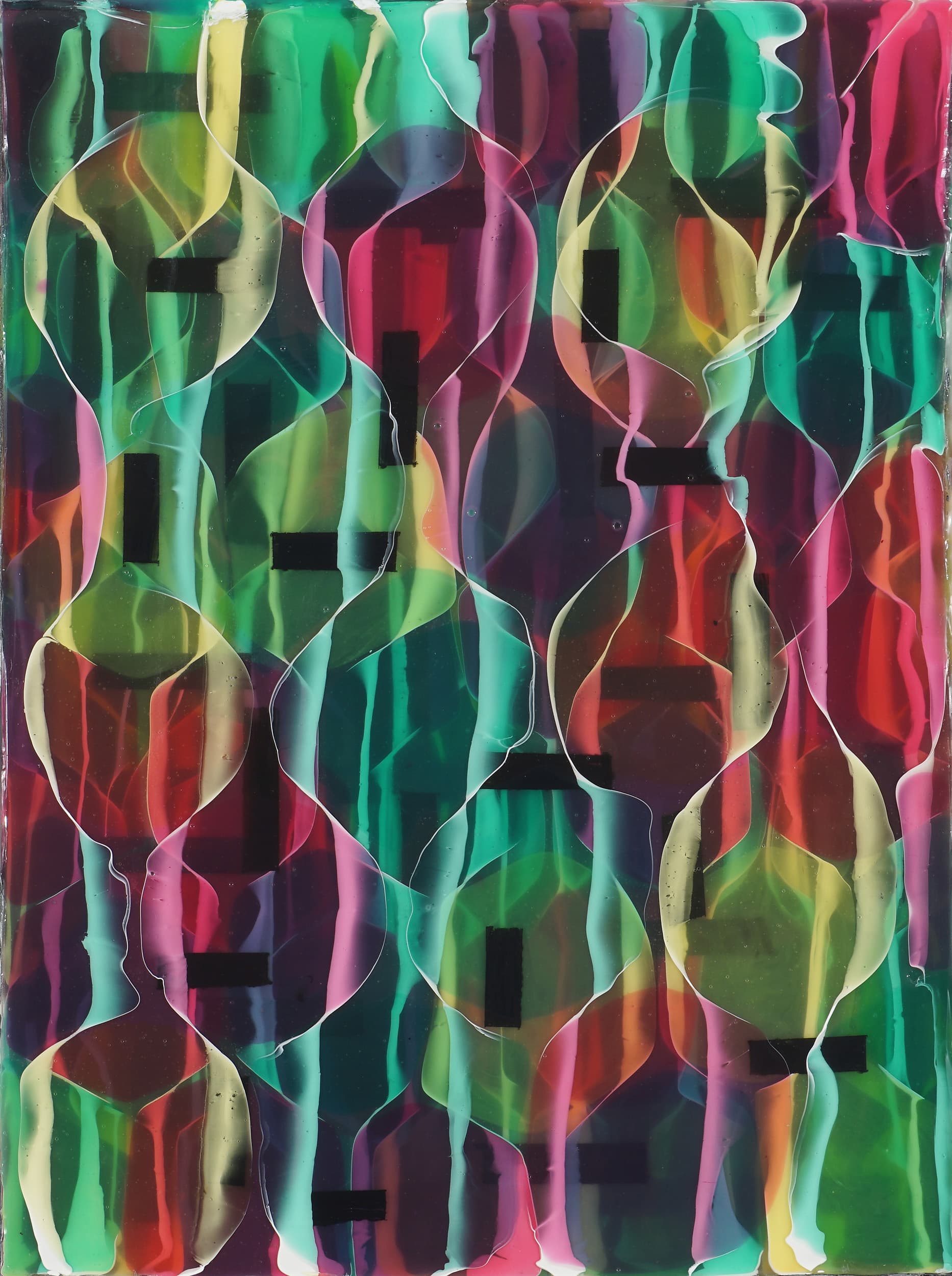
Maureen McQuillan, Untitled (C/V/M), 2025. Acrylic polymer, ink, and acrylic on wood panel, 24 × 16 inches. Courtesy the artist and McKenzie Fine Art.
Word count: 684
Paragraphs: 8
McKenzie Fine Art
October 16–November 23, 2025
New York
In a late career interview, the Color Field painter Kenneth Noland remarked, “The representation I’m interested in is of those things only the eye can touch.” Our language for describing color, he explained, is largely derived from tactile terminology—warmth and coolness, for example, or density and thinness. With this in mind, Noland sought to register color as a tactile sensation for the eyes. Maureen McQuillan uses color in a parallel manner, dissolving its physicality into luminous and thermal energies; the concordance her paintings offer, of visual phenomena traversing and connecting the senses, is a primary aspect of her art.
With the seventeen paintings in Coloratura, currently on view at McKenzie Fine Art, McQuillan continues her investigations into emphatically material surfaces and visually elusive space. Beginning on a wood panel—usually square and always painted black—she pours acrylic medium, drawing upon it with white paint and transparent ink, gradually building a thick surface comprising many accumulated transparent layers. In the past few years, she has integrated armatures of black or white bars throughout these layers, which demarcate space while rendering it ambiguous. Though this outline of her process may seem clear, the holistic integration of these elements is complex and the resulting paintings are elusive, materially and perceptually unlike any others with which I am familiar.
Maureen McQuillan, Untitled (C/MTY/BB), 2024. Acrylic polymer, ink, and acrylic on wood panel, 18 × 18 inches. Courtesy the artist and McKenzie Fine Art.

McQuillan’s current style evolved from a gradual, experimental process rooted in drawing and translucence, encompassing line drawings on canvas and on layered sheets of Japanese book-mending tissue paper, photograms, and drawings on acetate illuminated by lightboxes. In this context, her arrival at color-based abstraction in 2014 seems anything but inevitable and accounts, I think, for how unusual her paintings appear. Take, for example, Untitled (C/V/M) (2025). Its optical depth appears inexhaustible, the colors upon its surface bold and luminous, seemingly separate but everywhere blending, with bright white lines flickering and curling through the surface. An overall darkness is palpable throughout, especially in areas of densely accumulated color that appear dimmed as if by shadow, yet the painting glows as though it were backlit. The forms throughout these works are organic—reminiscent of waves, flames, petals, and smoke—as is their motion. Fluid and undulating, seemingly untouched by gravity, these qualities stand in contrast to the system-based approach that structures her practice.
McQuillan’s paintings emanate inner light. The luminosity of a painting like Untitled (C/MTY/BB) (2024) is neither constructed nor pictorial, without a smooth transition of color darkening into shadow, but seems instead to emanate from behind the surface as if the painting’s layers were masking a radiant light source, like the transparent gels used to color stage lights. At the same time, the patterning of chromatic energy in Untitled (C/K/D) (2024) resembles the pulsing field of a cathode-ray television, while its woven white lines flicker like sunlight glistening on the surface of water. These naturalistic aspects are complemented by the temperature emitted by their color, whether in warmly toned paintings like Untitled (C/RYO/3BB) (2025) and the exceptionally sweltering Untitled (C/RB/BG) (2024), or chillier works such as Untitled (C/HB1) (2025) with its neon ambiance, and Untitled (C/X/T) (2024), which casts a cool phosphorescent glow. Relieved of the function of defining forms and delimiting shapes, color becomes instead immaterial, like waves of spectral and incandescent energy.

Maureen McQuillan, Untitled (C/RYO/3BB), 2025. Acrylic polymer, ink, and acrylic on wood panel, 24 × 24 inches. Courtesy the artist and McKenzie Fine Art.
McQuillan notes the divide between digital color and color as a physical substance, and of how new technologies have recalibrated vision itself. Her paintings address our expanded visual ecology, synthesizing digital luminosity with the analog language of paint and surface. Her work is distinguished not only by the innovation of her process but also by the new perceptual possibilities that it affords. I am reminded of the composer Morton Feldman, who, musing on Piet Mondrian’s early transitional paintings, observed, “To a great extent we respond to a painting as a visual replica of how it was painted.” What was remarkable to Feldman was how those pictures seemed always to neutralize his efforts. “It is all there,” he wrote, “but where, or how to look at them, is not.”
Alex Grimley is an independent art historian specializing in postwar and contemporary art, particularly Color Field painting. His writing addresses intersections of visual art, criticism, and experimental music.