Barkley L. Hendricks: Piles of Inspiration Everywhere
This book illustrates the artist’s studio, the threshold of which no gallerist or curator had ever crossed.
Word count: 719
Paragraphs: 8
Susan Hendricks & David Katzenstein
Hirmer Publishers, 2025
Despite the wider contempt for clutter, it can be wonderful to live with memories made materially manifest, surrounded by things that you enjoy. The artist Barkley L. Hendricks (b. 1945, d. 2017) knew this, although the extreme context in which he lived and worked would give a certain type of scaled-back ascetic an aneurysm. The American artist was known for realist oil paintings of stylish Black Americans, staring out at viewers from the canvas with a direct gaze. Piles of Inspiration Everywhere explores the Victorian house in Connecticut, bought in the early 1980s, that Hendricks occupied for thirty-five years with his spouse, Susan. The space was photographed by Hendricks’s friend, David Katzenstein, across 175 color images. The merit of the project is in the access—understanding the ground zero of how an artist operated—and documenting it as such before everything was sorted and dismantled.

© David Katzenstein.
Most of the photos were taken two weeks after the artist’s death in April 2017. No gallerist or curator had ever crossed the threshold of Hendricks’s studio. Susan, who is also the managing director of his estate, explained in a short conversation with Katzenstein printed in the front of the book that her husband’s studio on the second floor “wasn’t, in his mind, open to questions or exploration.” During the conversation, Susan repeated that their shared home was “a cacophony of visuals.” The rooms were stacked to the gills with totems stretching from kitsch to cultivated. The high/low mélange is a fun one to behold, encompassing all the things that attract an artist’s attention, including certain fixations (women’s legs clearly being one of them).
The first images in the book feature the front hallway, replete with wigs, extra-large latex exam gloves, images of Delta Burke, gold open-toed heels, Gorilla Glue, toy pistols, sticky notes, eyeglasses, curlers, and a shiny Nora Roberts romance novel cover. “I would roll my eyes about having to walk through certain rooms sideways,” Susan said. “Probably the closest things were photographs I saw once of Francis Bacon’s studio, which was even messier than Barkley’s.” (The vibe is different, but it’s on par: Bacon’s 7 Reece Mews space was littered with art-related stuff.)

© David Katzenstein.
The first floor’s front hallway and sunroom include an ad for Courvoisier cognac, assorted American flags, wind chimes, an image of Prince, an NFL insignia, sunglasses, Mardi Gras beads, a huge array of baseball caps, and a red pin that fittingly states: “I want it ALL!” These join orchids, a stegosaurus clock, a landline phone, many framed photos, a Robert Crumb comic, seashells, candles, and glass beads. The music room is a conglomeration of drums, stacks of CDs, tambourines; the kitchen is a catalogue of fridge magnets ranging from Bettie Page to Portrait of Madame Moitessier Sitting, the 1856 painting by Jean-Auguste-Dominique Ingres, as well as magnets of vintage platform shoes, Bart Simpson’s silhouette, a square stating “I’m not aging I’m marinating,” and another one advising “Question Authority.”
On the second floor, the hallway, studio, bedroom, and office comprise an image of platinum-blonde Madonna, Bob Marley, boxes of eye patches, a life-sized cardboard cutout of Elvira holding a tray of Coors Light beers, alligator clips, elbow patches, and an array of young Vanessa Williams ads and editorials. A pile of publication spines spans Christie’s catalogues, a Teen People: Celebrity Beauty Guide, and a book about Francisco Goya. The third floor’s darkroom is entered by way of an X-Files poster, a Jackie Collins cover (The Bitch), and a Strait-Line wall scanner.
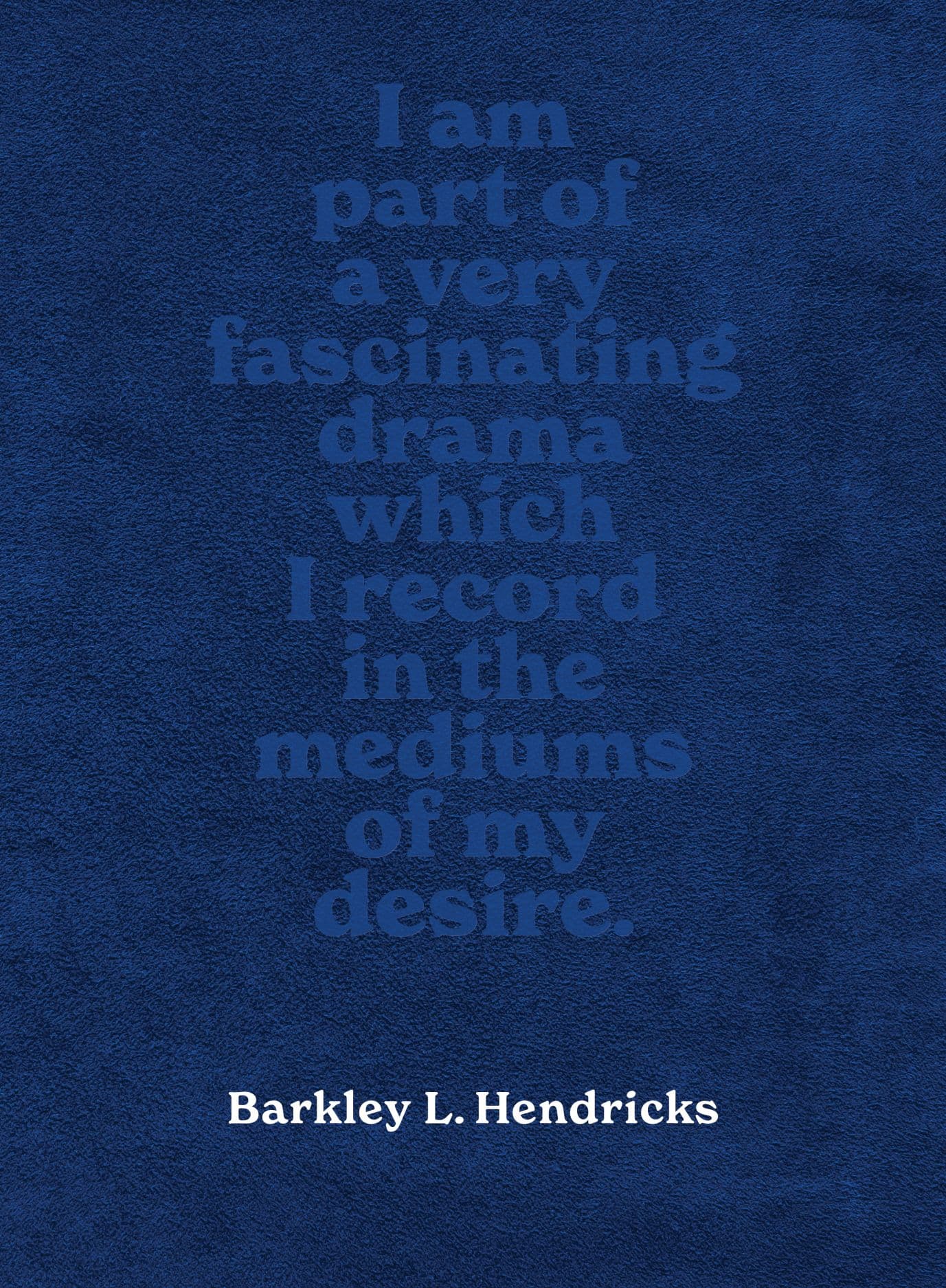
A selection of quotes from Hendricks’s notes intercut the images—which are rhythmically a good idea so the eyes can rest—but the actual extracts are not particularly profound, such as, “I want to watch from the audience at the same time act in the drama.” The composition notebooks and yellow legal pads from which they come are photographed individually at the back of the book; the handwritten scrawl is hard to read. They’re more of typology, as are Hendricks’s cameras, with Katzenstein plucking them from the mayhem and itemizing them. It’s the only sector of the book where an ethos of “less is more” applies. In Piles of Inspiration Everywhere, possessions remain anarchic but striking unfinished business.