ArchitectureNovember 2025In Conversation
FRIDA ESCOBEDO with Nile Greenberg
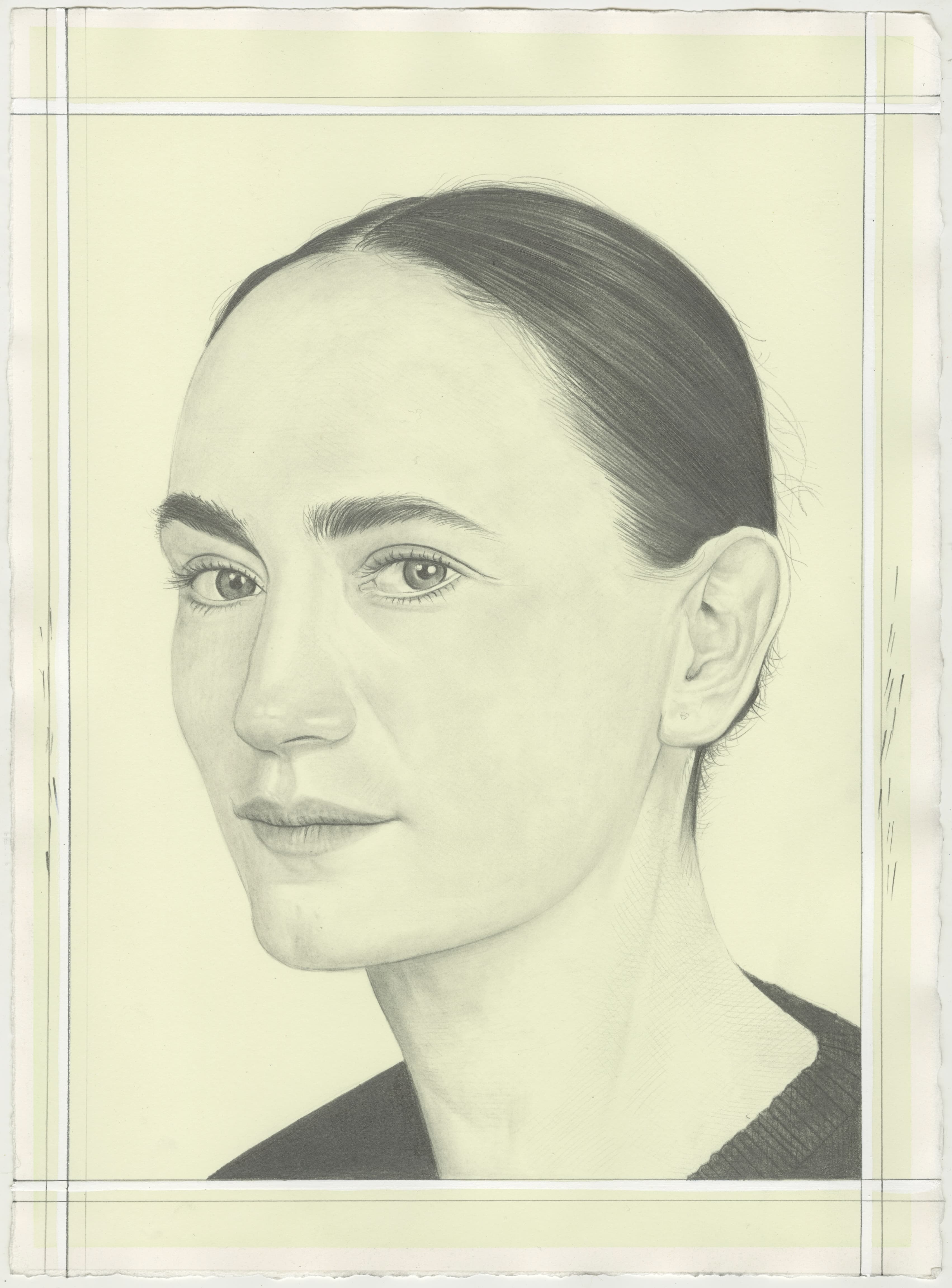
Portrait of Frida Escobedo, pencil on paper by Phong H. Bui.
Word count: 3830
Paragraphs: 42
Architect Frida Escobedo is the newly appointed designer of a major addition to the Metropolitan Museum of Art. Her work articulates a form of architecture that resists easy legibility. Drawing from language, textiles, and numbers, her work is notably recessive rather than heroic. It is exciting when major institutions opt for a new vision of architecture, so who is behind this careful and detailed language becoming a defining one for our moment? Frida Escobedo has found a new way to charge empty space. Her work tends to find meaning in space unprogrammed; it finds meaning in architecture unfinished, defining architecture without fixed form. I wanted to interview her to know how she is thinking about the role of an architect today.

The Metropolitan Museum of Art, Tang Wing, East Drive. Courtesy Frida Escobedo. Render: Filippo Bolognese Images.
Nile Greenberg (Rail): The beginning of my interest in your work was Pabellón Eco (2010), at the Museo Experimental El Eco in Mexico City. You offer, in this project and in others, a definition of architecture that’s quite different—an architecture that is anti-heroic and informal. What is architecture to you?
Frida Escobedo: On several occasions, I’ve described architecture as a language. For me, it’s a way of understanding and expressing the world and myself as a continuous exchange. Some people define it as an art, or as something that is a little bit more pragmatic than art. To me, it boils down to creating a conversation—with a historical period, a group of people, an individual, or with yourself.
Rail: If architecture is a language to describe the world and understand it, what specifically do you think you’re trying to describe or understand?
Escobedo: It depends on what I’m working on. It’s not just a description; it’s more a conversation. You need to understand the sequence of things. It’s about visualizing a specific condition rather than resolving a particular problem. For that, the only lens that you have is what you’ve learnt before. Of course, there’s also the practical aspects of creating space—like providing safety, comfort, and shelter—that require responsibility. That architecture is about voicing invisible questions of power relations, dynamics, and of behaviours that solidify aspects of culture. Architecture is able to solidify the most extended questions of culture simply because it takes so much time for it to change. It is a way of tracing and understanding static cultural processes and expanded social exchanges.
Rail: How do material and labor play into this conception of architecture? Material seems especially crucial in El Eco.
Escobedo: The interesting thing about pavilions is that they are more experimental, small-scale, rapid, and miniature architectures. They operate like a nuclear reactor and amplify questions about space. In a pavilion, everything is magnified. The Eco experiment is about architecture that is always evolving and is informed. Like any language, it changes tone, accent, meaning, and syntax in ways that can be very subtle or very strong. El Eco is a neutral ground that could be programmed or open-ended or finished momentarily by the user. It engages forces we might not usually recognize or see in projects.
There’s a moment of architecture that still is very elusive for me. What is the perfect moment for architecture? First, it is completed in the plans, then it’s constructed as the plans have determined, and then it needs to be preserved or maintained. Completion is a line that moves up and down. Maybe it is finished during the construction process, or maybe after construction when things are adjusted and modified. The Eco experiment suggests that there is no beginning and no end. It’s always in flux, but it is still recognizable as an object.
Rail: Your work suggests a type of architecture that has an unfinished quality. That all architecture is unfinished is a rare perspective that I think is really exciting and generative. Your stages and pavilion projects all imagine a certain unprogrammedness. What is the relationship of the architecture to people in these scenarios?

Civic Stage. Courtesy Frida Escobedo. Photo: © Nuno Cera.
Escobedo: In a very playful way, they reveal certain social dynamics. The Civic Stage we designed for the Lisbon Architecture Triennale in 2013 has a speaker only as dominant as the audience that they have, which is spatially reflected as a tilting platform. The speaker and their voice can be raised only as much as the audience weighs. It is didactic but also playful, considering that people can physically change the balance of the situation and dominance can keep changing. On the other hand, El Eco was very simple. The expectation is that people will move things around, but it will not lose its identity. It is flexible and able to reorganize. Buildings are intrinsically flexible. Unless people use it, it isn’t architecture. Space is only space if it’s perceived by someone.
Rail: What were your early relationships with this idea? When did you first encounter an understanding of architecture as a social construction?
Escobedo: My dad is a doctor, so I would spend very long hours in his waiting room when I was growing up. The window faced an apartment building, so I would spend a lot of time looking at the street and into the neighbors’ apartments, which were all the same layout. Still, there were wonderful differences between one unit and the other. From the interior you could learn about the family—its constitution, where they had traveled, their tastes. It was a story where the composition of the space revealed alignments and histories. In the same way, a city tells the story of a group of people that started living in a specific place at the same time. In all the overlapping layers and contradictions, space weaves a consensus of how we choose to live and interact with each other.
Rail: I’m working on a theory of hollowness in architecture. There is honesty and virtue in making emptiness in a whole—a solid object with its interior removed. This is also the theme of a studio I’m teaching. Hollow is an emerging expression of architecture. There’s a political economy to how your work takes empty space and wraps it. How do your ideas around living and empty space influence your housing projects like Ray Harlem or Bergen Brooklyn, and your other housing projects in Mexico?
Escobedo: New York housing projects are very different from what we do in Mexico, though there are both constraints and opportunities in every region. Here in New York, the “pre-structure” is determined very early on. There are already so many layers of information we need to work with and very little room to play. Everything is coded, either legally or by the developer: the area of the unit, the number of bedrooms, the layout of a kitchen, the width of a wall. This leads to an interesting phenomenon where design begins outside of the designer. In Mexico, things are different. You can play and experiment more, but you don’t have the same resources to develop a building. I’m learning now what is possible to achieve spatially between use value and exchange value—the present and future value of a design.
In New York City, someone wouldn’t buy property and think of living in it for fifty years. That would be very rare. Usually, people think about living in a space for maybe five or ten years, and then move when they want a family, or stop being a large family, or move away to college: all economic and social structures that factor into their decision making. Exchange value becomes very relevant here.
Rail: This idea of exchange value is in sync with your work. The space does not demand a single occupant, but assumes continuity with people coming in and out, or even finishing the work. This is different from a highly functionalist, specific place, which is a different type of architecture.

Bergen Brooklyn, interior. Courtesy Frida Escobedo.
Escobedo: There are two concepts that run in parallel here, and the rule applies to both of them, but in a different way. One is the constant flux of people that occupy the space temporarily without changing it. That’s how people sell housing in this city. It caters to a specific set of needs. For example, Bergen Brooklyn was about introducing a little more open-air areas to units that have traditionally been very interiorized in the city. We were working with just a couple of crucial inches that became so important. Now I’m seeing an opportunity to think about the increased value of exterior spaces with climate change, a desire for more fresh air after a pandemic, people beginning to be social in their homes. All these seem like wonderful reasons and opportunities to think about this problem. There is also a need to design areas that feel more focused on community and less on amenity, such as an art room rather than a gym, where there is an opportunity for real exchange with a neighbor.
Rail: On the subject of New York, I want to talk about your addition to the Metropolitan Museum of Art. The interesting thing with the Met is that it is an encyclopedic museum from the Beaux-Arts tradition, implying that you could know the entire world from it. While this is a failed idea, the Met remains a container of great works of art and a setting to reconnect the art to its origins. In proposing an extension, you are being entrusted with all of our relationships with art, and your project is mediating a vast history of global art for us. What is your relationship to art and how does the building respond to that position?
Escobedo: The boundary between art and architecture is a bit blurry, though I wouldn’t describe architecture as a fine art. I think architecture has more complexities. Both express a need for execution and social engagement, but architecture particularly serves as an expression of a specific set of conditions at a specific time. This was the primary interest with smaller pavilions like El Eco, the Civic Stage, or the Serpentine Pavilion, which were all projects conceived as platforms for other things to happen. The other artistic practices, like performances, or talks, or activations, create microatmospheres in the space. Now the goal is to extend this timeline, make a more prominent building with a bigger budget, but continue to have arts and people inhabiting this space. You shouldn’t lose the initial idea of creating connections and weaving them together. The Met has already been doing this for a long time by operating as a “collection of collections.” What’s different about it is that it was created by individuals with a very specific set of interests and ideas of collecting. While it’s an encyclopedic museum, it also contains and gathers myriad points of view. Now, there’s an opportunity to look at things in a different way: not chronological or geographical, but through similarities rather than differences. That’s what is most interesting to me about the Tang Wing. We don’t know what is going to happen with contemporary art in the next fifty years, but there’s a possibility that this wing of the museum can change, at least partially, how the rest of the collection is seen. We’re all trying to think about how to refresh perspectives that were solidified in the museum, and shift these perspectives without touching the rest of the museum.
Rail: What are the architectural relationships you’re imagining that can support this idea? How are you meant to encounter this wing?
Escobedo: The museum is like a condensed city, or a tapestry that has grown very organically. The plan is like a medieval town—a little plaza, corner cul-de-sacs, and possibilities of getting lost inside of it. A nice way of getting lost is when you can find a place to relocate yourself and emerge from the experience of being immersed in the art. The moment of coming back into your body and back to the physical space almost without noticing it is the true magic of the museum. The transition from Medieval to European, from painting to sculpture, is all very smooth. The problem with our wing was that it was very disconnected. There was a clear division—a corridor connected to a service area—between the Michael C. Rockefeller Wing and the Modern and Contemporary Art Wing. The goal is to clarify this circulation and provide more opportunities for people to visit the Tang Wing from different points of entry, and also to transition smoothly into more contemporary moments.
Rail: And once you’re in that space, what are you going to find?
Escobedo: You’re going to find a range of galleries that are all connected because of the complexity of other adjacent areas. Still, it’s not clean and organized—almost random. It is this randomness that creates possibilities, and spaces that range from the monumental to the intimate. There are moments that are compressed and others that extend seamlessly to the park. There are reminders that you’re both in the Met and also in Central Park, in New York City. The relationship of the wing to this very specific corner of the world is through architectural specificity, strong materiality, and a strong relationship to the exterior. This is not just any museum or white cube. Still, it is subtle and quiet, gentle to the park and to surrounding, existing architecture.

The Metropolitan Museum of Art, Tang Wing, terrace. Courtesy Frida Escobedo. Render: Filippo Bolognese Images.
Rail: What artists have stayed with you and influenced you? Who do you love looking at?
Escobedo: I grew up going to museums, and that became my way of understanding the world. There are certain things that art can express that nothing else can. It’s silly to try to explain a feeling that everyone has, a way of relating to other people and a sense of belonging to something bigger. There is so much potential for personal expansion when you see something and feel something more, and you understand that you just became a more complex, multi-faceted being. When you’re presented with the possibility of overlapping histories of the past and the current moment, it is a nice opportunity to recognize common threads between different timelines and geographies. We realize we’re dealing with the same emotions over and over again, but the possibilities of their expression are endless.
Rail: That’s really beautiful. Your research projects sometimes take on the character of art. They are useful methods of research based on materials and specific histories, and very different from those of a previous generation. How do you take on this other type of looking as a material practice?

Casa Negra. Courtesy Frida Escobedo.
Escobedo: We spoke earlier about architecture as a language. This comes with accepting that all you really have is a point of view. This might become more complex or more simple, depending on what you’re interacting with, but to me, both La Ruta de la Amistad (2017) and El Otro (2012) were about the idea of observation.
It could be a very simple facade in Mexico City that was telling all of these stories, and then the work was being able to de-contextualize it and present it to people to see if it resonated with them. And I think that worked. Growing up, I always thought these buildings were like monuments—super solid and robust, the same way I thought the politics in my country were. Then, I encountered the building as just as fragile as this political party, which was the facilitator for all these things to happen. There was an idea of the construction of the nation through my innocent childhood eyes. What are the structures of the world if we don’t look at them closely and question them? If we observe things more, we might find layers to them that are less obvious.
Rail: I want to talk about authorship and practice, which is such a personal thing. It’s your practice, and everything probably starts and ends with your decision. What are you trying to hold on to through the process of making architecture?
Escobedo: I hope I’m not trying to hold on to anything. There’s a risk in trying to hold on to something that is defining you in the present moment. Instead, I’m interested in multiplying my facets as much as possible, developing an identity that is a volatile pixelization rather than a shiny reflection. There is certainly a personal expression, but I hope it’s not one that relies on specific gestures. I’m interested in simplicity, modulation, material, but I don’t think I’ve explored any of these to the point of exhaustion. Rather, I feel fascinated by the idea of one single element being repeated and composed in many different ways to tell many different stories.
Rail: That’s architecture’s language. There’s a version of it that is literal—with blocks, modulation, a grid—that operates as a signature. Skidmore, Owings & Merrill (SOM) does it, Ludwig Mies van der Rohe did it. But you’re getting at something beyond the language of architecture, which is not just an aesthetic project, but a way to organize space to produce more elaborate sentences, or something that doesn’t even use the same language everywhere.
Escobedo: Maybe language extends to the idea of the symbol. I imagine that for certain architects, this might be a curved wall, or the juxtaposition of very specific geometries. I’m interested in the idea of the module because it can tell different stories, and because it’s a symbol in itself. You can see a brick, and in it a synthesis of very specific social agreements, like the fact that it needs to be the size of the bricklayer’s hands, and other consequences of industrial production, manufacturing, and construction. When you see a building, you can actually tell how many times a human has been laying bricks. In the same way, a massive Brutalist building tells a different story of its materials and making. Symbolism might be intrinsic, even though it doesn’t rely on these big gestures. It happens by looking at very simple elements to determine their origins and the condition under which they were produced. That’s what I am trying to experiment with.
Rail: Do you experiment with material or with construction? Your smaller projects especially contain a critique of how we build.
Escobedo: Yes. I think it has to do with understanding that humble materials could also be very sophisticated, and many of them still show the human hand. The sense of scale is important in a module. It’s not just the scale of the building itself, but the scale in the way that it was constructed. You see a building from a distance as a complete object that is part of the urban landscape. But when you approach it, you need to be able to understand how it was built by a human being.

Hotel Boca De Agua. Courtesy Frida Escobedo. Photo: © Cesar Béjar.
Rail: You have a lot of projects in non-urban contexts too. Most of these are on stilts or contain screens: gestures that indicate a distanced relationship between architecture and nature. I get a sense that there’s a very particular perspective about how architecture and the natural world should relate.
Escobedo: Maybe it’s a little bit voyeuristic, you’re right. Maybe it’s a projection of my personality. I’m very aware of the need for intimate spaces, and how temperature, light, breeze, and sound all help to locate yourself in time and space. Time is probably the most relevant element of architecture; it is a compass of how time is passing. Breeze blocks allow for that passage of time, but also provides opportunities for making more comfortable architecture without having to include a lot of sophisticated technologies. On the other hand, the stilts have to do with attempting to not touch the ground as much. Sometimes, it’s better to integrate the architecture into the land, so that it’s emerging from the ground and is a part of the topography. Other times, it’s better to just lift a little, beyond the canopy of the trees, to allow for things to continue their life and way of being below, and have as light a foot as possible.
Rail: There is a sense of protection, not as a heavy wall or similar, but from lightness that creates a sense of safety. It reminds me of Lina Bo Bardi’s Casa de Vidro—a big observational platform in the forest, where you feel protected. Did you have a relationship with modernism growing up?
Escobedo: Mexican modernism was not necessarily about functionalism—that was one aspect of it. There’s a different type of expression—elaborate murals from Juan O’Gorman, which you can also see on the Biblioteca Central of the National Autonomous University of Mexico. It’s a box, and a very functional repository of books, but it’s also super ornate, and so full of meaning. The material itself is telling a story of a country—the catalogue of colored stones show the geographical variations, all the temperatures, all the different types of soils, and you could even imagine the gastronomy that emerges from that. It’s telling you so much, and it’s not trying to become a perfect machine. It’s quite the opposite. It’s trying to become very complex and to allow for art to be integrated into it. I didn’t grow up in a building like that, but now I’m living in one. So you just see it every day.
Rail: I am curious to hear more about what’s coming up for you. You’re working on a project at the Met and a collaboration on Centre Pompidou, both of which have experienced change differently in their histories. It’s an exciting position to be in, doing projects of such cultural significance. It’s exciting seeing these institutions take a risk of sorts—which shouldn’t really be a risk at all—with a young architect. It seems like there’s no commissions, fewer competitions—the types of projects that often launch architectural careers.
Escobedo: I feel like I’m in a very privileged moment right now, but at the same time, I think many of the architects that have been doing cultural institutions of this magnitude did start at my age. I’m relatively new to the city, but I see it changing very much—the Brooklyn and Manhattan skylines, museum extensions and additions at the Frick, the New Museum, the Met. I think this is a city that will continue to change and evolve. I understand that there’s complexity in the world right now that, of course, is changing things. Maybe it’s a very American perspective.
I wish I could just say, “Yes, I feel extremely lucky and grateful for these two opportunities.” But I’m also thinking about what comes after that, and I don’t think it’s just about moving into the path of super visible museums or institutions with astronomic budgets. It’s trying to go back to where we can actually focus our attention that is meaningful. Lesson one: what is the next step? It’s not necessarily becoming a larger office, either. Rather, how do we start choosing our clients, and have more time to develop a project which sounds crazy? The idea of slowing down is very attractive to me, because I think we’re just speeding things up constantly.
Nile Greenberg is the editor of the Brooklyn Rail’s architecture section and operates the practice ANY in New York.