Liz Larner: MAYBE NOT
Word count: 1012
Paragraphs: 10
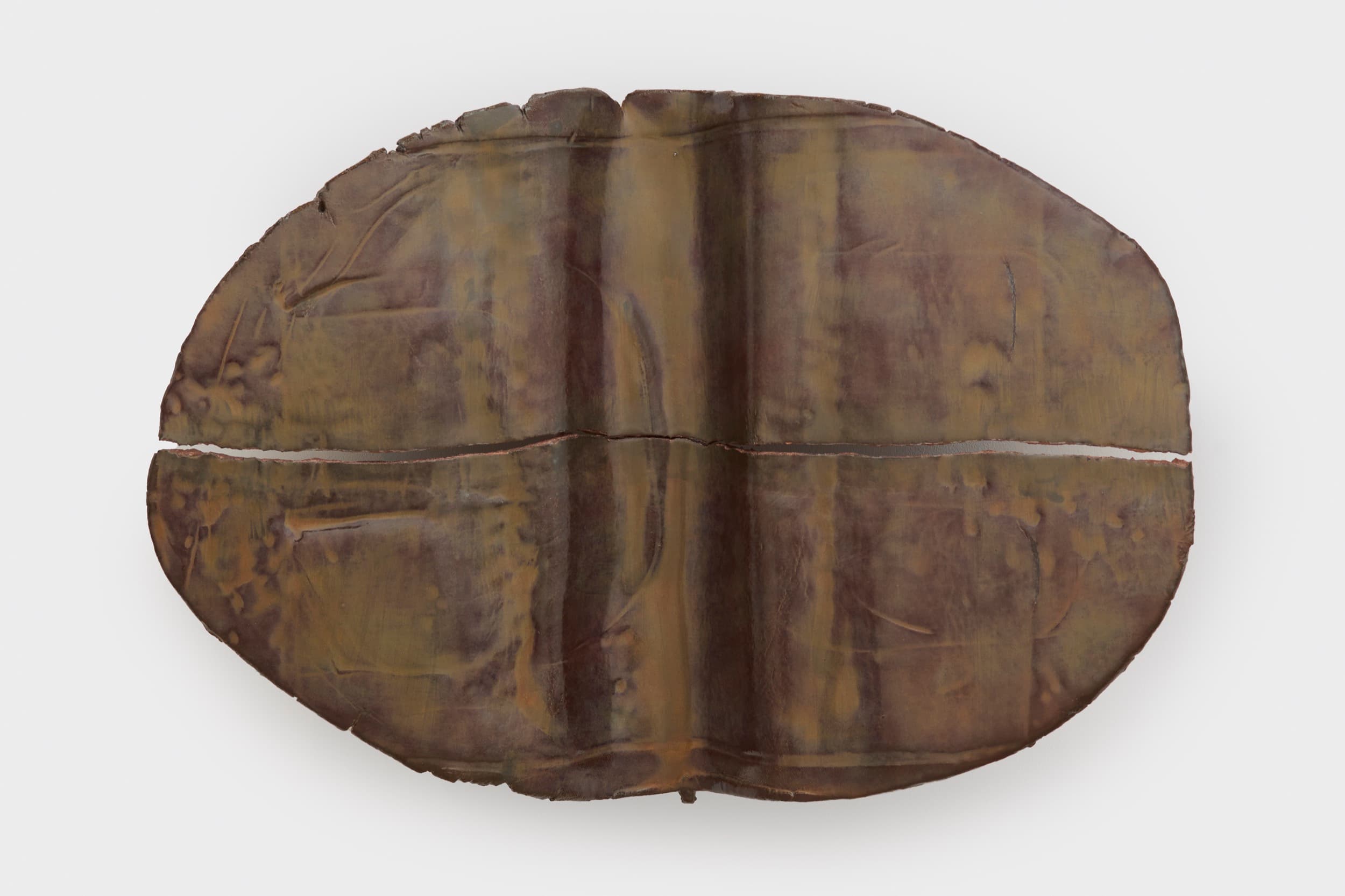
Liz Larner, Uncommon return of light, 2025. Ceramic, glaze, aluminum, stainless steel, 29 ½ × 41 ¼ × 11 inches. © Liz Larner. Courtesy the artist and Anton Kern Gallery, New York.
Anton Kern
September 3–October 22, 2025
New York
For her debut exhibition with the Anton Kern gallery, Liz Larner has installed an exquisite encounter with her signature polychromatic clay forms. Titled MAYBE NOT, the phrase suggests uncertainty, instability, and an implied forward motion: “maybe,” followed by a withdrawal, “maybe not.” Far from adhering to the well-worn modernist adage, “What you see, is what you see,” Larner’s ceramics read as coded metaphors of volatility, impermanence, and decay. To get it right, that is to absorb both the aesthetic pleasures of vibrant, reflective chroma and tactile surfaces while conceding that they lurch toward formal incoherence, is to recognize the power of Larner’s material poetry.
Thrust nearly two feet from the walls of the gallery at eye level, Larner has installed a dynamic succession of hovering front-facing near-ovals, thick slabs of clay generally 2 by 3 feet pushed to the limits of their ability to hold shape. As if drawn into the process of their making, one senses the ripping and tearing of edges while witnessing nearly in real time the accidents of firing that produce their irregular surfaces—mottled, embossed, overpainted and in-painted in swaths and plumes of pigmented glazes. Present, too, in this series is a sense of their double valence: hard yet pliable, lustrous yet matte, dense yet limpid, motionless yet motile, fixed for all time yet steadily eroding. Armatures consisting of a system of plates, bolts, and anchors in aluminum and stainless steel or copper and brass suspend these works in liminal space, drawing attention to Larner’s “maybe not/maybe” thematic. Integral to Larner’s presentational gestures, the horizontal trapezoid shape of these armatures is fused at one end to the back of the clay slab like forearms and hands positioned in a pantomime of ritual offering.
As in chromatic abstract paintings in which juxtapositions of hue can suggest edge or contour, cracks in the clay slab arising through the firing process produce an internal counterpoint, which Larner leaves as integral to the process: “letting the ceramic become what it is.” When a large slab breaks, rather than discarding the broken pieces or attempting to fuse them into a single surface, Larner mounts them as split surfaces, as fractures or faults within a single plane. At times, she accentuates the split by painting the resultant internal fissures with contrasting color, such as copper (Uncommon Return of Light [2025]), or perhaps lining each rift with built-up layers of plied clay (Divergent Boundary [2025]).
Already at the start of her ceramic studies, which she undertook with Ken Price at the University of Southern California in the 1990s, Larner was drawn to the expressive potential of clay, its pliancy as well as its fragility. As she said in an interview with Heidi Zukerman in 2016, “Once you start working with clay, even in the slightest way, it wants to become something. Because it’s extremely sensitive, anything you do is recorded immediately. Clay is alive, transformational.”
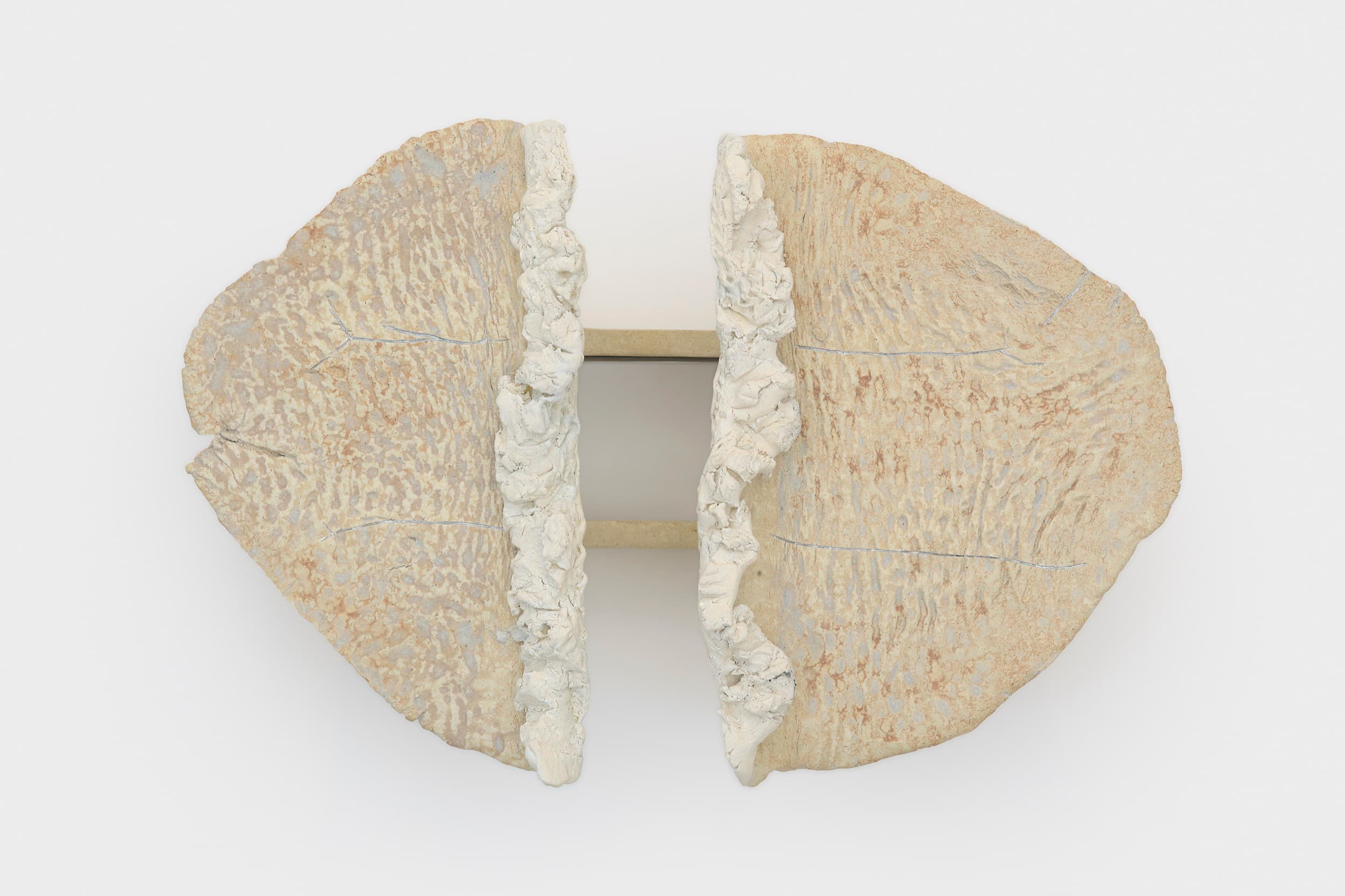
Liz Larner, Divergent boundary, 2025. Ceramic, glaze, aluminum, stainless steel, 27 ¼ × 42 × 16 inches. © Liz Larner. Courtesy the artist and Anton Kern Gallery, New York.
Larner’s colors are based on an intuition about the “character” of the form. Choosing from her collection of fired pigmented glazes, she bases her choice on a certain “presence” within the slab’s shape, using color and design to reveal its characteristics. When her glazes work their way into the depressions and cavities in the surface, their pooling is accepted gracefully. Larner works with “what the process gives me,” (Eric Minh Swenson Art Films, “Liz Larner | Walkthrough at Regen Projects” [2024]) as she often says, underscoring her belief that meaning lies solely in the physicality of the work: “I want ideas about what is happening physically to be what the art is about.”
The early clay works of the sculptor Peter Voulkos, whose overtly physical approach to shape and surface appeared to violate the functionality of the traditional ceramic vessel through layering and breakage, set a precedent for younger ceramicists like Larner, who similarly unleashes a freedom of handling that demands a certain withdrawal of control: Larner leaves traces of her gestural responses to her medium while at the same time eliciting the clay’s own self-fashioning. For example, her interventions include induced breakages, as when—in Divergent Boundary—she lays a clay slab over an inclined form in order to fracture it into two parts, but to present it as a single, if split surface. Such forms were given the title “caesurae,” marking this moment of rupture—“one entity that contains a pause.” Larner titled another formal gesture “subduction,” the scientific name for a convergence of tectonic plates that cause them to overlap, which she mimes in Coalesce (2025), in which an irregularly shaped horizontal blue fragment overlaps a smaller rose-colored form.
Larner’s fissures, erosions, exposed tunneled textures, and jagged edges read as artifacts of catastrophic geologic events, remnants of the earth’s crust that surge and split through an internal drive toward new forms. Wove Over (2025), for example, exhibits an exaggerated convex ridge, a surge of clay that nearly ruptures the course of running horizontal striations, their intervals broken by crisscrossing lines of a sage hue that extends to its support. And then there are the asteroids situated at intervals on the gallery’s first and second floors. Irregularly shaped spheres in ceramic, they seem weighted and inert in contrast to the excitation of reflective colors and textures above. These boulder-like forms, figuratively wrenched from their course around the sun, are gouged and pitted: partials, they signal geological events literally brought low.

Liz Larner, Wove over, 2025. Ceramic, glaze, aluminum, stainless steel, 26 ⅞ × 38 ½ × 15 ¼ inches. © Liz Larner. Courtesy the artist and Anton Kern Gallery, New York.
Larner has situated the viewer in geological time, specifically, in the Anthropocene. Recognizing the ways in which her ceramics “acknowledge our codependency with the earth and our complicity in what happens in nature,” Larner’s commentary on ecological sustainability addresses the ruptures and degradations perpetrated on our physical environment through human exploitation. Over the course of her multi-decade-long artistic career, Larner has always worked in the interstices of material transformations. Discovering as well as eliciting form, color, and texture, hers is as much an aleatory process as an intentional one, a dialogue with materials that is both masterful and poetic.
Patricia L Lewy is an independent art writer, curator, and artists’ estate manager living in New York City.