Lisa Oppenheim: Ourselves and the Expression of Ourselves
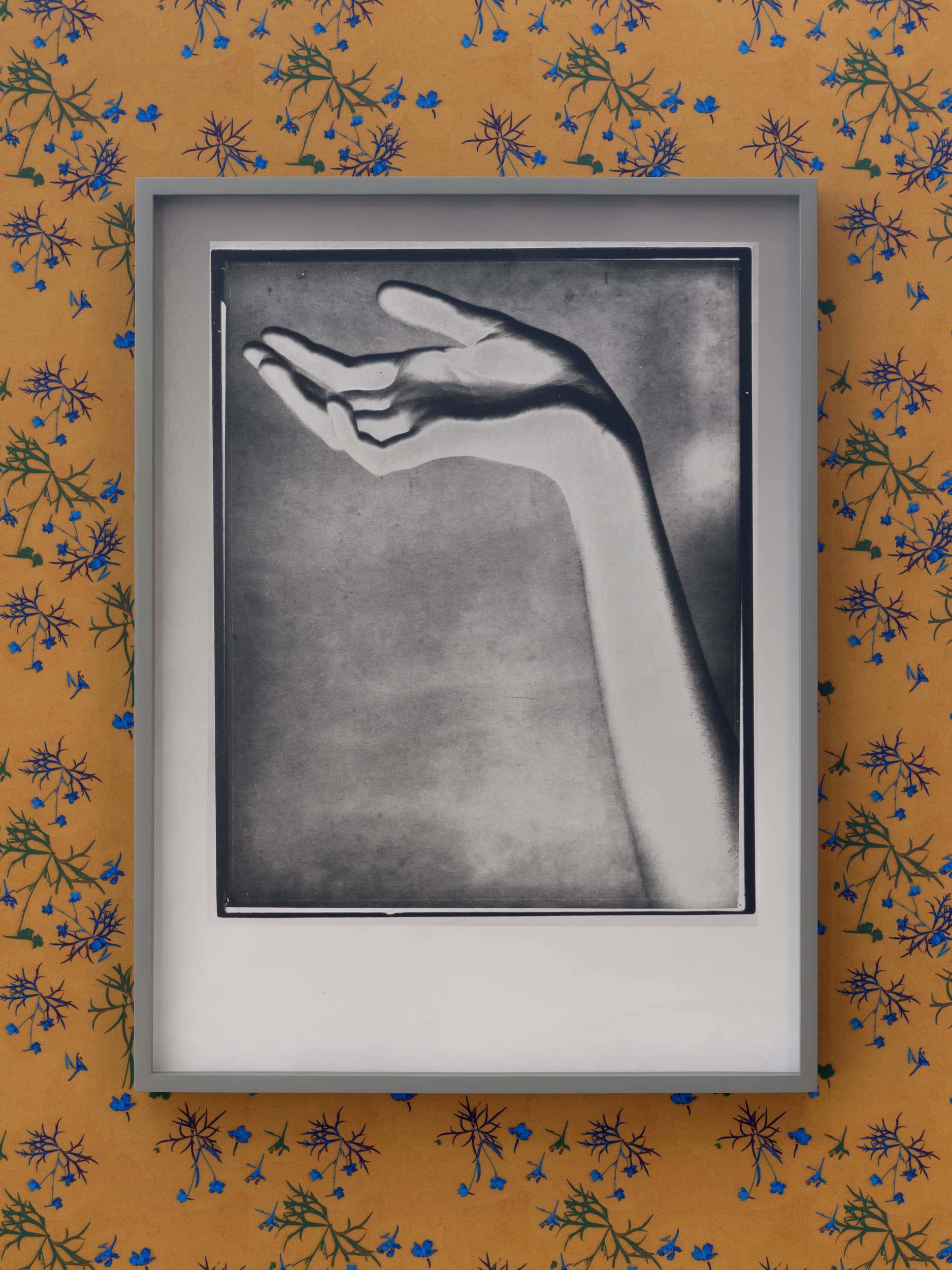
Lisa Oppenheim, Dana Desboro Glover’s Hands on Stehli Silks, Holding the “Connecticut Yankee” (detail), 2025. Three paneled paravent, 72 ¼ × 71 ¼ inches. Courtesy the artist and Tanya Bonakdar Gallery, New York.
Word count: 1782
Paragraphs: 21
Tanya Bonakdar Gallery
September 3–October 23, 2025
New York
In Ourselves and the Expression of Ourselves at Tanya Bonakdar Gallery, Lisa Oppenheim considers twentieth-century photographer Edward Steichen’s long fascination with flowers. Oppenheim came to Steichen’s work via an invitation from the Contemporary Art Museum of Luxembourg to work with archival materials maintained by the state of Luxembourg—Oppenheim has used archives in a similar way for earlier projects. For example, she added imagery to Walker Evans’s discarded FSA negatives, and in more recent projects worked with scientific and military sources to produce haunting images of the moon and clouds. For the show at Bonakdar, Oppenheim has created three separate but interrelated groups of work that examine how Steichen’s passion for botany spills from his archive.
Steichen began hybridizing delphinium in 1906 with the hope of producing the bluest blue delphinium cultivar. He continued this work for thirty years, first in France and later at his four hundred-acre farm in southwestern Connecticut. The project culminated in a one-week exhibition of his oversized delphiniums at the Museum of Modern Art in 1936.
Steichen was an older contemporary of Marcel Duchamp and like his French counterpart was a key figure in bringing European modern art to America. But unlike Duchamp, Steichen, for all his modernist leanings, came of age in the closing years of the nineteenth century. He was friends with Auguste Rodin, and his creative outlook developed before the emergence of Cubism and Dada. Steichen’s work could be characterized by an enthusiastic optimism; Duchamp’s irony and pessimism were never part of Steichen’s makeup, and in today’s art world, Steichen, unlike Duchamp, is treated as a dusty relic. Steichen’s seventy years of creative activity are not well appreciated and neither are his outsize achievements in other areas: in the 1920s he was the highest-paid commercial photographer working, and in 1955 he curated the Museum of Modern Art’s iconic blockbuster exhibition, The Family of Man.
Savvy photographers like Oppenheim understand that Steichen’s creative innovations, while perhaps not always very deep, merit more attention. Steichen’s underground reputation as a photographic innovator reemerged with the 2010 publication of Alison Nordstrom’s book, Steichen in Color, a fifty-year survey of color photographs from the George Eastman Museum’s holdings. While the book is full of trite commercial work that should all but disqualify Steichen as a serious artist, his early two-color portraits of his wife Dana Desboro Glover and his groundbreaking series of psychedelic dye-transfer prints, “Bouquet of Many Varieties of Flowers in Vase,” are of a very different order.

Installation view: Lisa Oppenheim: Ourselves and the Expression of Ourselves, Tanya Bonakdar Gallery, New York, 2025. Courtesy the artist and Tanya Bonakdar Gallery, New York. Photo: Dan Bradica.
But Oppenheim takes a different aspect of Steichen’s work as her starting point; because Steichen in Color, his 1961 survey exhibition at the Museum of Modern Art, and the various published collections of his celebrity portraits concentrate exclusively on his photographic activity, the fact that Steichen took a textile commission for Stehli Silks in the 1920s comes as something of a surprise. Oppenheim discovered this project in Steichen’s archive and took the title of the current exhibition, Ourselves and the Expression of Ourselves, from the press release that announced the launch of the Stehli/Steichen Americana Collection in 1926.
Toward the end of his life, Steichen bundled his unsatisfactory prints and negatives and dropped them into the pond next to his home in Connecticut. While researching the Stehli Silks commission, Oppenheim found unused archival photographs of flowers and abstract patterns made for this project that had somehow escaped oblivion at the bottom of Steichen’s pond. In collaboration with fashion designer Zoe Latta, Oppenheim took a handful of these unproduced photographs and turned them into new fabrics in orange, black, chartreuse, purple, and teal.
The new Steichen patterns are displayed on three, specially constructed six-foot-tall folding screens, or “paravents,” that Oppenheim has positioned in the center of the gallery. These paravents support eight black-and-white photographs titled “Steichen Studies” that represent different eras of Steichen’s creative life, now remixed, chemically altered, collaged, and cropped by Oppenheim.
A pair of what seem to be re-photographed large format negatives depicting Desboro’s upturned arms hang on one paravent. As everything is floral in the exhibition, here her arms resemble lilies. To make these photographs, Oppenheim exposed the prints to an open flame during development, and this break in the darkness necessary for development induces subtle tone reversals in the print. These partially solarized images render Desboro’s arms as if they were cast in silver—as they are, one might say, in these extraordinary gelatin silver prints.
A small photograph of two negatives printed side by side, collage-like, hangs on an adjacent paravent. This composite image shows a symmetrical interior with two large delphinium-filled vases flanking a door to what one imagines might have been Steichen’s office in the Museum of Modern Art. I glanced at the photograph quickly and then walked around the rest of the exhibition. When I returned, I studied the diptych more closely and saw that what I thought were left and right views of the office were actually duplicate negatives made from the same camera position. Because one image renders the flowers a lighter tone, it’s possible these two negatives might have originally been used to make a color print. Oppenheim simply and cleverly “flopped” one negative and printed it the wrong way around to create this spatially continuous view.

Installation view: Lisa Oppenheim: Ourselves and the Expression of Ourselves, Tanya Bonakdar Gallery, New York, 2025. Courtesy the artist and Tanya Bonakdar Gallery, New York. Photo: Dan Bradica.
On another paravent, an equally curious photograph stands out. As in the double image, delphiniums are featured here. The bottom third of this vertical image features a cropped section of a photograph showing rows of large delphinium cultivars. Horizontal strips of white, gray, and black occupy the top part of the work. These three monochrome strips suggest the ubiquitous Kodak Gray Scale chart, that indispensable calibration tool used to guarantee color fidelity in dye-transfer photographs. Perhaps this oddly cropped photograph was a section of a paste-up used for mechanical reproduction? In the gray section of the print a faint enlarged fingerprint is visible. Is it Steichen’s or from an assistant, left as they handled this camera-ready copy?
As I looked at the photographs, I tried to square the black-and-white prints with the fabric commission. Were the two projects simply presented together for the viewer’s free association? I don’t think it’s just that. Oppenheim always does more than rephotograph the material at hand. In this and other projects, she took her source images and re-energized them materially, chemically, and formally in the darkroom or the studio. She transforms and amplifies the source image. And the same could be said of the textile commission. Oppenheim pulled these long-lost photographs up from dark oblivion, bringing them into the light and warmth of the present so she and Latta could create fabric that can now be used for garments.
Steichen worked with every color process during his long career. In the 1930s, as commercial photography migrated from black-and-white to color, he adopted the dye-transfer process. Dye-transfer prints are made by soaking three photographic matrices in trays of cyan, magenta, and yellow dyes, and then carefully transferring them to a damp sheet of paper to make an assembled color photograph.
Eastman Kodak stopped manufacturing the all-important dye-transfer matrix film in the mid-1990s as digital inkjet printing replaced dye transfer. A shrinking number of color labs kept making dye prints with their finite supply of matrix film. And lucky for us, there was enough matrix film remaining for Oppenheim to make the twenty-one eye-popping dye transfer prints that circle the gallery, ringing the fabric paravents and their black-and-white photographs.
In 1910, a French botanist hybridized an iris to honor Steichen and named it “Monsieur Steichen.” In time, all surviving examples of Monsieur Steichen died, alas unphotographed. Determined to make a work about this “Steichen” iris, Oppenheim found images of the two “parents” that were hybridized to create the “daughter” plant. Using artificial intelligence, Oppenheim generated similar digital hybrids of the lost original. As the iris is a hermaphroditic plant, Oppenheim named her six cultivar hybrids with female and male honorifics: “Frau Steichen,” “Madamm Steichen,” “Mlle Steichen,” “Mme Steichen,” “Mons Steichen,” and “Här Steichen.”

Lisa Oppenheim, Mlle Steichen Version XIII, 2025. Dye transfer print, 19 ½ × 15 × 1 ½ inches. Courtesy the artist and Tanya Bonakdar Gallery, New York.
To make her dye-transfer prints, Oppenheim took a cue from Steichen’s psychedelic 1940 bouquet of flowers. Rather than soak the matrix in its appropriate primary color (cyan, magenta, or yellow), Oppenheim followed her own deviant, randomizing protocol. She spun the color wheel and channeled inappropriate dyes into the matrices to make this group of wildly inventive color photographs.
Judging from Frau Steichen Version V (2025), one of the few relatively “normally” colored dye-transfer prints, the original 1910 “Monsieur Steichen” looks to have been a squat bicolor iris with light “standards” (the upward-growing parts) and dark “falls” (the down-growing parts). I’ve noticed that artificial intelligence can only “create” cliched images, and in Oppenheim’s AI-generated photographs, the irises appear to have been photographed in the tasteful style of botanical photography—the flower in sharp focus and the rest of the photograph rendered in blurry, shallow depth of field.
How to describe the colors of these prints? Very strange, for a start, unless you are a moth and your primary colors are ultraviolet, blue, and green. Or you are a bee and read red as black. To us, Oppenheim’s prints shimmer and smolder. They coruscate with unimaginable, otherworldly tie-dyed color combinations, an acid trip for the eyes. Many of the pictures present a puzzle: is this photograph a positive image or a negative? I tried to count how many prints were “positive” and how many were “negative.” I counted nine positives the first time and eleven the second.
Take for example the group of four extraordinary dyes that hang together: Här Steichen Version IV, Madamm Steichen Version I, and Mlle Steichen Version XIII and XII (all 2025). All four are anchored by dark blue laced with black—an impossibility, as it turns out, because there is no such dye as black dye in dye transfer. Among these, only Madamm Steichen Version I reads as a “positive” photograph, with the sky light orange and the earth and grass the darkest dark, dark blue.
As I walked around the show, I gazed at the intense color of this alternative universe, Oppenheim’s artificial paradise. The colors glisten as if the dyes are still liquid. Otherworldly cascades of orange and blue dye run over and around Madamm Steichen Version IV and Mlle Steichen Version XIV (both 2025). With these spectacular dye-transfer prints Oppenheim opens the door to a new color photography. A color photography freed from verisimilitude, one where these dye prints pulsate between positive and negative, purple and orange, red and green. Here color can be both positive and negative, moving fluidly across this deepest of all color spaces.
James Welling is a photographer who lives in New York. He is a lecturer at Princeton University.