Mavis Pusey: Mobile Images
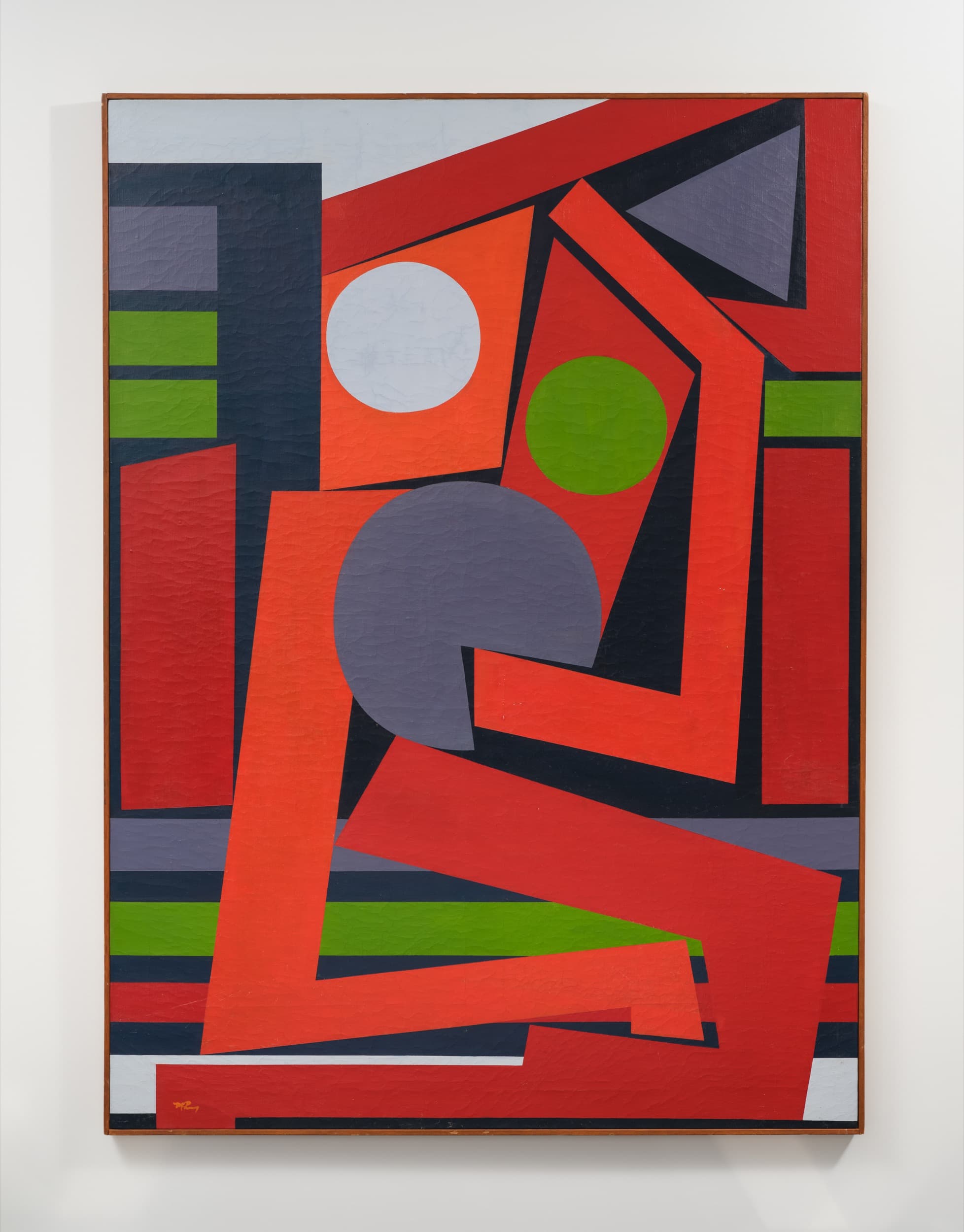
Mavis Pusey, Personante, n.d. Oil on canvas, 53 ½ × 75 inches. Courtesy Institute of Contemporary Art, University of Pennsylvania.
Word count: 968
Paragraphs: 12
Institute of Contemporary Art, University of Pennsylvania
July 12–December 7, 2025
Philadelphia, PA
By virtue of the title, Mavis Pusey: Mobile Images, movement is the goal of the exhibition at the Institute of Contemporary Art Philadelphia. Its namesake is a 1970 work, likely made during Pusey’s time in London given its foggy quality, at the end of the exhibition. The show ushers us into three sections—the body, construction, and music—but offers more than categories. It extends a generous intimacy and whispers a different narrative, one far more humanizing of a woman attuned to the rhythms of the world around her.
Mavis Pusey (1928–2019)—the Jamaican-born multi-hyphenate fashion designer, poet, painter, printer, Virgo—relished the geometry and improvisation of the urban landscape: its chaos and care, its poetry and possibility. That duality of order and disorder pervades her work and is even incorporated into her word-scrambled titles. Again, duality appears in the handwritten, marked-up work she gave to a printer, on display in the exhibition; she valued order but often intentionally embraced jumbled disarrangement. In an alphabetical list of desires, Pusey wrote, “I want my memory and the ability to concentrate fully and permanent[ly]. I want strong wavelength.” The list meanders from pragmatic goals to wild-card hopes—winning the lottery, inheriting money from an unknown source. She continues with equal fervor: “I want to be more aggressive in presenting my art and myself. I want to improve my personality and to become magnetic and attractive.”

Mavis Pusey, Within Manhattan, 1977. Oil on canvas, 73 × 96 inches. Courtesy Institute of Contemporary Art, University of Pennsylvania.
The exhibition captures an entire career with work that runs the gamut from paintings, lithographs, watercolors, gouache studies, fashion designs, archival news clippings and notes from the artist, and textiles—all embodying spirit of her practice: focused, but unafraid to dream wildly. Her works, abstract renderings of cities and selves, mirror that same clarity and multiplicity. I came into the exhibition looking to understand her translations of the city—line, shadow, and pattern. Instead, I learned something else entirely: I learned how she sees.
Her gaze was expansive. Satellites orbiting space, makeshift homes in Central Park, cosmological aura and street-level ingenuity fed her visual lexicon, and Pusey made space for it all. She composed with the vision of someone who’d seen the city from above and from below, and who knew its scaffolding and its soul.
In Rivgo (1965), an anagram of the word “Virgo,” she echoes mid-century modern aesthetics. The palette hums with earthy restraint: browns, teals, reds, flashes of mustard yellow—an earth sign’s vocabulary. Each shape in vibrant color pushes forward instead of flattening. The composition reads like an abstract glyph, language without letters.
Personante (1990) is full of verve. Curving cherry-red lines and deeper red rectangles create tone-on-tone depth, while three central spheres hover, suspended neither above nor below, like characters in a charged dialogue. Lines at the canvas’ base crisscross, breaking one another’s rhythm. In the top left corner, a rare breath of white space peeks through. The work resists a Western reading order with neither a clear left-to-right nor a singular center. Instead, the eye loops in a postmodern, Cubist dance.
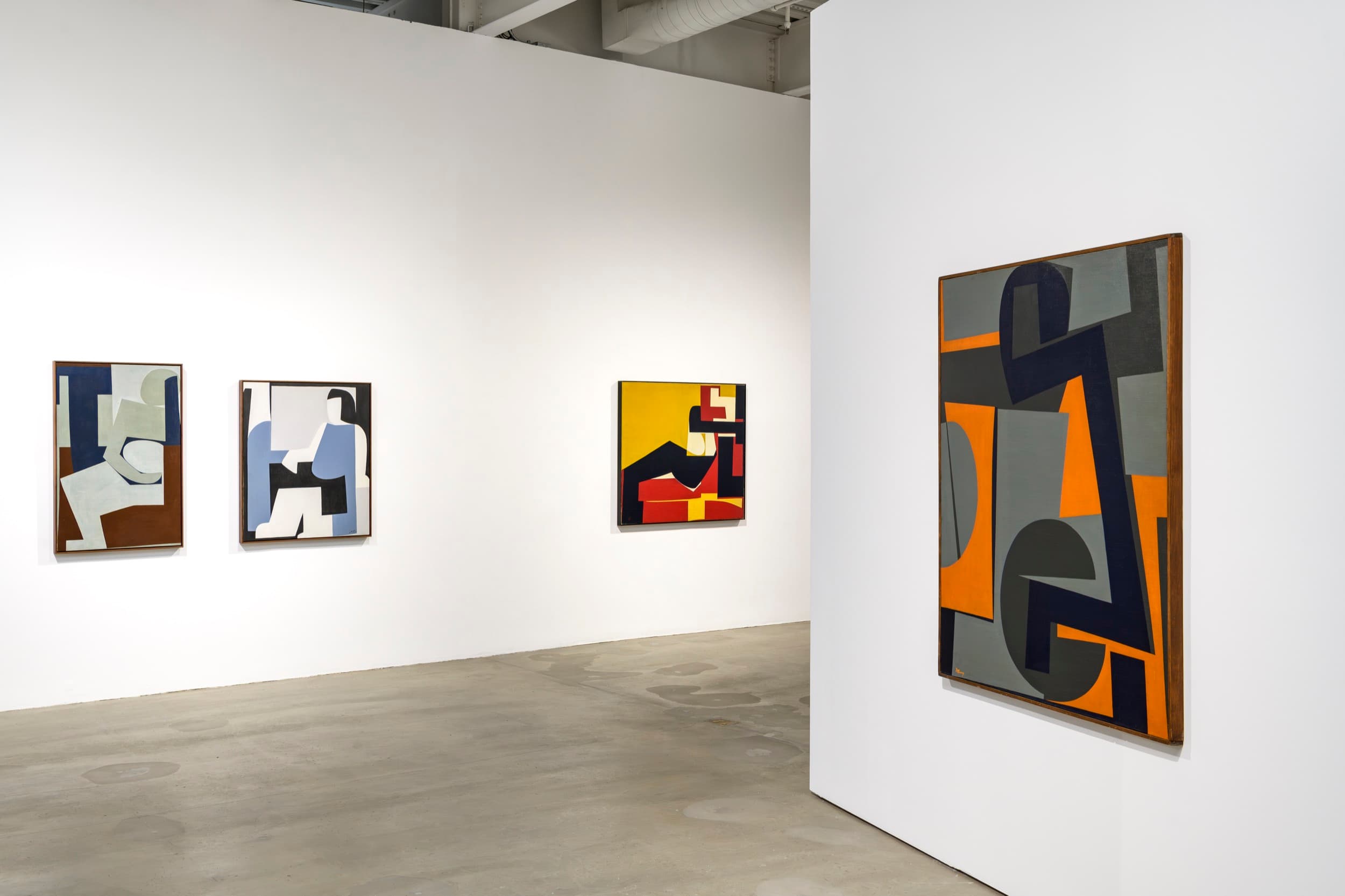
Installation view: Mavis Pusey: Mobile Images, Institute of Contemporary Art, University of Pennsylvania, Philadelphia, 2025. Courtesy Institute of Contemporary Art, University of Pennsylvania. Photo: Constance Mensch.
Eric (1968) recalls a walk through Paris where Pusey and a friend (the namesake of the work) encounter police. When she later asked if he’d been afraid, he confessed that he had, but kept it hidden. That quiet fear reverberates through the painting. The edges are sparse, void-like, directing us inward. The emotional core pulses in the center: a swirl of blue and black lines, like a musical phrase played at forte, humming with feeling and restraint.
Decaying 7 (ca. 1970) may have a title that feels almost too literal, but the work itself complicates that reading. Pusey pulls back from her typical vibrant color palette to place emphasis on form—lines and circles arranged with machine-like precision, echoing the harmony of gears set into motion. The composition is dense and fragmented, but also deeply rhythmic, pulsing with the vitality found in collapse. In the midst of breakdown, she reveals motion, tension, even grace. What might otherwise feel like entropy becomes, in her hands, a study in persistence, resilience, and the strange beauty of things coming apart.
The language of decay echoes across the exhibition, appearing in multiple titles like Silencer (ca. 1960s), Operation 7 (n.d.), Decaying 7, Re-Gentrification or Regeneration (1986), Demolition and Construction 5 (1989), and Decaying Construction (n.d). Within Manhattan (1977, a work that was my first encounter with Pusey, featured in a posthumous New York Times tribute) joins its chorus. These terms hang in the air like political rhetoric, abstract and charged, but Pusey moves beyond polemics. She composes a visual lexicon of scaffolding, ladders, and skeletal forms—structures in transition, captured in bold strokes of red, white, and blue.

Installation view: Mavis Pusey: Mobile Images, Institute of Contemporary Art, University of Pennsylvania, Philadelphia, 2025. Courtesy Institute of Contemporary Art, University of Pennsylvania. Photo: Constance Mensch.
One of the exhibition’s great joys is the inclusion of Pusey’s early fashion work, including purse designs, garment silhouettes, and even the tailored, clean-lined clothes she wore, full of dynamic geometry. Before she studied painting at the Art Students League under Will Barnet, she attended fashion school; the throughline is evident. As Kiki Teshome, co-curator of the show and Curatorial Assistant at the Studio Museum in Harlem, describes, Pusey had the aesthetic of a “self-possessed woman in fashion.” That same self-possession courses through her compositions. Throughout the show, it's clear: Pusey wasn’t interested in fixed meanings or tidy stories. She was a builder and a breaker, a composer of surfaces that vibrate. Her abstractions are alive with feeling, frequency, and vision. Rather than render judgment, she records change with formal clarity and emotional nuance. Her perspective is multiplicitous: she is at once witness, architect, and archivist of urban transformation, and in tuning into her visual language of grids and guts, of abstraction charged with feeling, we don’t just see her vision. We start to carry it.