Robert Mangold: Pentagons and Folded Space
Word count: 784
Paragraphs: 8
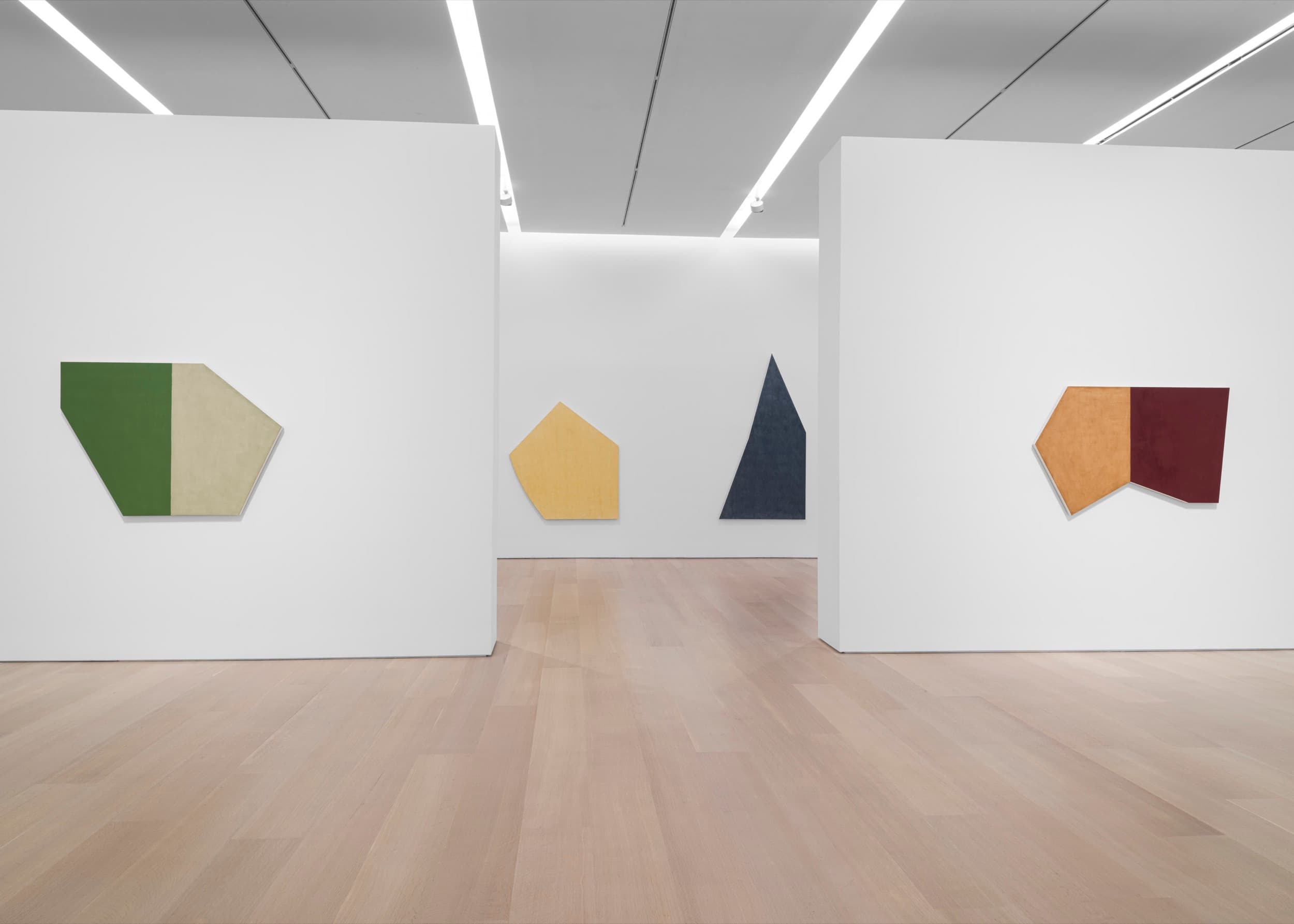
Installation view: Robert Mangold: Pentagons and Folded Space, Pace Gallery, New York, 2025. Courtesy Pace Gallery, New York.
Pace Gallery
May 9–August 15, 2025
New York
When Robert Mangold began showing his work in the mid-sixties, Frank Stella and Ellsworth Kelly occupied opposite poles on the abstract shaped-canvas spectrum. Stella’s 1965–66 “Irregular Polygons” are characterized by boldly colored shapes and outlines that undermine or suppress recognition of the canvas’s literal shape as they create an illusionistic space. In Kelly’s uninflected monochromatic panels, however, drawing appears not on the surface of the painting, but externally, as the outer contour of its shape. As demonstrated in Pentagons and Folded Space, his current exhibition of recent work at Pace, Mangold’s painting often falls between these two extremes. Like Kelly, he works primarily with monochromatic, planar forms; like Stella’s paintings, Mangold’s suggest spatiality. The works in Pentagons and Folded Space synthesize these qualities: though the shapes of the canvases remain legible, they nevertheless seem to move through space, warping, bending, and folding.
The cut-out segments and looping and curving lines characteristic of Mangold’s work from the 2000s and 2010s are absent from the paintings in the current show, which instead continue in the more pared-down manner of the “Plane Structure” series that immediately preceded these new works. Among the paintings in the show, five feature two colors placed side by side, bisecting the canvas vertically. Another four paintings, monochromes, are also bisected but with a thin line in black pencil. Finally, three works are comprised of several canvases, and of these, two are without internal drawing of any sort. Every constituent canvas in each of the multi-panel pieces is monochromatic. Mangold’s palette tends towards earthen tones, and all of the pictures are painted thinly.

Robert Mangold, Divided Image, 2024. Acrylic and black pencil on canvas, 42 ½ × 44 ½ inches. © Robert Mangold and Artists Rights Society (ARS), New York. Courtesy Pace Gallery, New York.
The paintings in Pentagons and Folded Space are reticent. I spent a bit of time walking slowly through the show, looking at each work, challenged by them, finding them inscrutable. Gradually, I began to sense the abstract dynamics of Double Pentagon Oxide 2 (2023). The meeting of its two sides, ochre and maroon, ends at a vertex on the bottom boundary. This angle alone yields an architectural effect, as if you were looking into the corner of a room. But this is a fleeting and incomplete sensation, quickly contradicted by following the dividing line to the painting’s top edge, which is straight and flattens the picture plane. The sense of spatiality is persistent, though ambiguous, and its tension is exacerbated by the contrast between the airy facture of the ochre side and the maroon’s richness and solidity, which expands from the pinched bottom edge and looms outward.
There is a visual grammar distinct to these paintings, a range of abstract sensations that, with concentration, seemed to recalibrate and refocus my senses, opening the paintings to me. The experience is like learning a language. Through the variety of these paintings, Mangold gives us the fundamentals through which we may become fluent in his spatial and sculptural syntax. Take, for example, Four Pentagons (2022), whose large monochrome canvases vary in shape, size, and color, but which all feature a ninety-degree angle in the bottom right corner. This consistent attribute allows the viewer to chart the different way that each painting traverses space relative to its right-angled corner. The tallest panel, blue and pointed, ascends and seems to tilt slightly away from the viewer, while the dark red painting next to it unfurls toward them. The space I’m describing in each of these canvases is not pictorial or recessive. It is, rather, a sculptural quality of planes folding, leaning, tilting, and projecting through space.
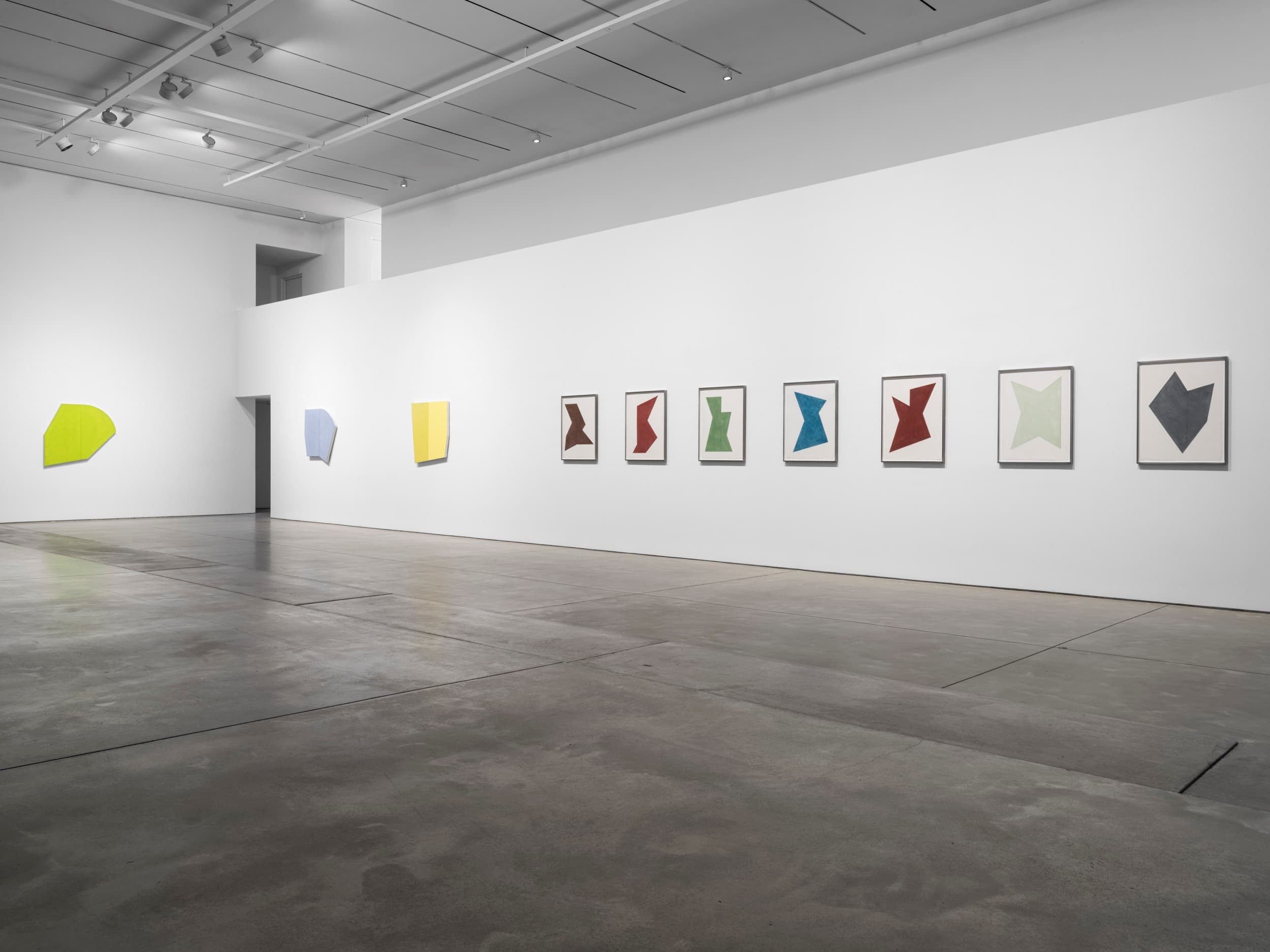
Installation view: Robert Mangold: Pentagons and Folded Space, Pace Gallery, New York, 2025. Courtesy Pace Gallery, New York.
The canvases that comprise Three Pentagons (2023) are smaller and more immediately tangible as shapes. They do not feel as sculptural as the paintings described above; rather, their contrasts emerge from the varying penetrability of their surface planes and the different depths that result. The green canvas on the left is uninflected, its surface smooth and velvety, creating a field that alternates between opaque frontality and infinite depth. The center canvas is finished with a metallic or pearlescent gloss that produces a translucent, film-like overlay. In the third, traces of the roller yield a shallow, cloudy ambience.
The seven “Folded Space” pastels, all of which date from 2024, are installed on the gallery’s seventh floor. With the exception of Folded Space 4 and 6, I found these works less effective than the paintings. Perhaps because they are rendered on paper, the shapes do not persuasively forge space around and within themselves. They instead feel flat, graphic, and schematic. As a group, the paintings and drawings in Pentagons and Folded Space offer a distilled version of Mangold’s concerns, rewarding sustained looking with quiet intensity and formal clarity.
Alex Grimley is an independent art historian specializing in postwar and contemporary art, particularly Color Field painting. His writing addresses intersections of visual art, criticism, and experimental music.