
Carmen Herrera, Way, 1950. Acrylic on Burlap, 39 1/8 x 33 1/8 x 1 1/8 inches. © Carmen Herrera. Courtesy Lisson Gallery.
Word count: 594
Paragraphs: 8
Lisson Gallery
May 1–August 1, 2025
New York
While working and excelling in the most elegant and formal styles of international modernism, the Cuban-born high-abstract artist Carmen Herrera distinguished herself by demonstrating the weight and strength of drawing as a device for building two-dimensional structures as well as for showing the power of the line as a means of connection. We see her in this expansive show as a striking geometric colorist, an architectural painter, a consummate theoretician, as well as a designer. She was trained first as an architect at the Universidad de la Habana in 1938–39.
As is apparent in this gathering, Herrera works across many abstract disciplines, calling to mind artists ranging from the Uruguayan master constructor Joaquín Torres-García whose symbol and color-packed paintings and box-like compositions call to mind Vasily Kandinsky and Piet Mondrian at one end of the spectrum as well as Kenneth Noland at the other. The surprise here is discovering the flamboyance of Jackson Pollock’s gesturing together with the softer warmth of Willem de Kooning's coloring. Most charming in this mix are the acrylic-on-canvas paintings from Herrera’s “Habana Series,” created in the early 1960s. In these works, the sense of spontaneity and experimentation are strikingly progressive and characteristic of Herrera’s moment. The line is freed up to explore and chase itself. What is particularly apparent is Herrera’s distinct worldliness—open yet guarded, it seems. There are her dynamic triangular shapes calling to mind the art of the Southwest—Navajo patterns—as well as the rhythms of jazz, French and American style, as triangles zig and zag into one another evoking the cadences of both cultures.
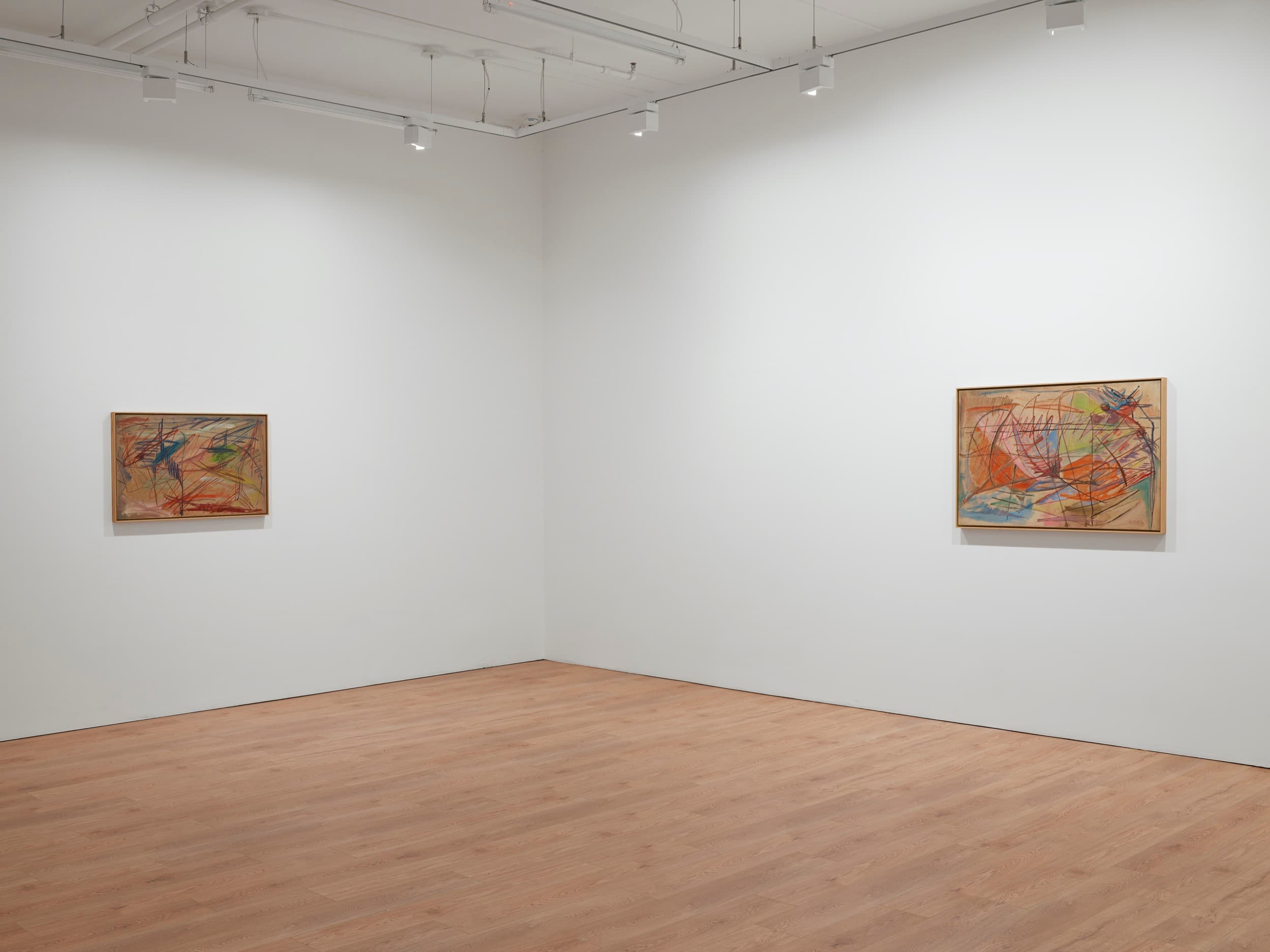
Installation view: Carmen Herrera: The Paris Years, 1948–1953, Lisson Gallery, New York, 2025. © Carmen Herrera. Courtesy Lisson Gallery.
At the same time, she constructed with paint—her own architecture—built to mirror her sculpture and design on paper in shapes and colors that equate with those of her three-dimensional objects. And somehow that includes, in an unlikely way, nature as it is built, the sense of landscape, in the natural geometry of hills and trees. The finest example of this, although not included in this exhibition, is Blanco y Verde from 1959, which, captivatingly, arrests the eye with the smallest geometric form—a green triangle set atop a slight hill in a vast field of white. The strikingly subtle image is a kind of star turn.
All of this is being evoked in this show, Carmen Herrera: The Paris Years 1948–1953, a fertile period of great diversity when the artist often traveled between Paris and New York, along with other stops along the way.
Here, in these works, mostly made using solvent-based acrylic paints, are the perfectionism and flatness of Concrete art, the reduced bodies of color that seamlessly establish a minimal if impenetrable surface in her paintings. One might associate Herrera’s sophisticated, smooth style with ballroom dancing in contrast to the frenzy of jazz, which she engaged in drawings such as her excited Conquete de l’air, from 1950, taking us into her Paris mind. She could move from biomorphism to agitation. In other words, she was a creature engaged in the sensibility of her own very long times.

Carmen Herrera, Realites Nouvelles, 1948. Acrylic on canvas, 31 x 39 1/4 inches. © Carmen Herrera. Courtesy Lisson Gallery.
Her art exudes both a coldness through her use of powerful colors and sleek, uncompromising hard-edged forms. In red, black, and slices of green, she demands we pay close attention to geometric structures and the spaces between them, and then, elsewhere, in fine strands of brown and orange and blue, she takes us through a kind of interior landscape. She shows us the product of a disciplined mind allied to a romantic sensibility.
Barbara A. MacAdam is a New York-based freelance arts writer.