
Harold Wortsman, Wave, 2024. Wood fired clay, 17 x 13 x 4 inches. Courtesy the artist and Paris Koh Fine Arts.
Word count: 816
Paragraphs: 5
Paris Koh Fine Arts
May 2–May 30, 2025
Fort Lee, NJ
Plato’s Timaeus describes the creation of the universe simultaneously as a spiritual event, and as a carefully orchestrated exercise in mathematics, geometry, and the manipulation of forces and ideas. In Harold Wortsman’s exhibition of ceramic objects, reliefs, and prints we see a similar combination of ambiguous ceramic form combined with a diagrammatic energy that both convinces and baffles. These inscrutable earth-toned forms are fired to extreme hardness and are detailed to various degrees of specificity, sometimes with careful color distinctions and patterns, but conversely with amorphous blotches or ragged penetrations and edges, breaking the glaze and revealing the dull or grainy raw material. Always though, there is an implied regulating geometry: incised lines, making a cross-hairs composition around a circular perforation, as in Wave (2024); a black alphabetic form emerging from a deformed grid, in the wall-hung plaque Dragonfly (2020); or from the regularity of the entire form itself, as in Ghostly Apparition (2023), a gray cylinder standing on three tiny feet, on one side sliced from top to bottom and on the other side having an “H” shaped penetration, yet the cylinder is always at the forefront. Reminiscent of Plato’s scientific mythology, the lines and clearly visible forms in Wortsman’s works indicate a possible use for these vessels as containers, devices for measuring cosmic events, or miniatures of sacred monuments, whilst their rough side imply an eternally existing formlessness or chaos. This occurs in the aforementioned Wave, where the neat lines and circular hole at center are at the center of a matching pair of hemispherical miniature standing stones.

Installation view: Harold Wortsman: Shapes for the Future, Traces of the Past, Paris Koh Fine Arts, Fort Lee, NJ, 2025. Courtesy the artist and Paris Koh Fine Arts.
The Timaeus is also replete with indecipherable measurements, recipes for things like “soul” and complicated proportions that determine the difference between the eternal and ephemeral. Wortsman’s wonderfully indecipherable talismans embody a similar secret knowledge. In 2 + 1 = 0 (2024), a flattened cylinder is elaborated with a vertical line of twelve dots, enclosed between two tall gashes acting as parentheses. The flattened edges of the cylinder are heightened with yellow glaze while the region around the gashes and dots is reddish in hue, giving the piece the flavor of the underside of a reptile, but the title and careful numeration of the dots compels us to wonder what the meaning or use of the object might be—perhaps even as a magical vessel for the artist himself. The Sand Man’s Dream (2024) expands on this trajectory: Wortsman now has a stelle with not only mysterious vertical and horizontal dashes, but an egg-shaped niche and an excavated column of repetitive ovals; a tiny purpose-built altar for who-knows-what. These archaic architectural ambitions culminate in pieces such as Monument (2025), set to the side on its own taller pedestal for closer viewing: it is a Lilliputian Neolithic arrangement of smaller uprights in square formation around a tall menhir. It comprises architecture and sculpture in model form—the thin flat and crisp verticals play against a thick square base inscribed with three zones of implied sacredness, decreasing in size: gray-brown-mottled white.
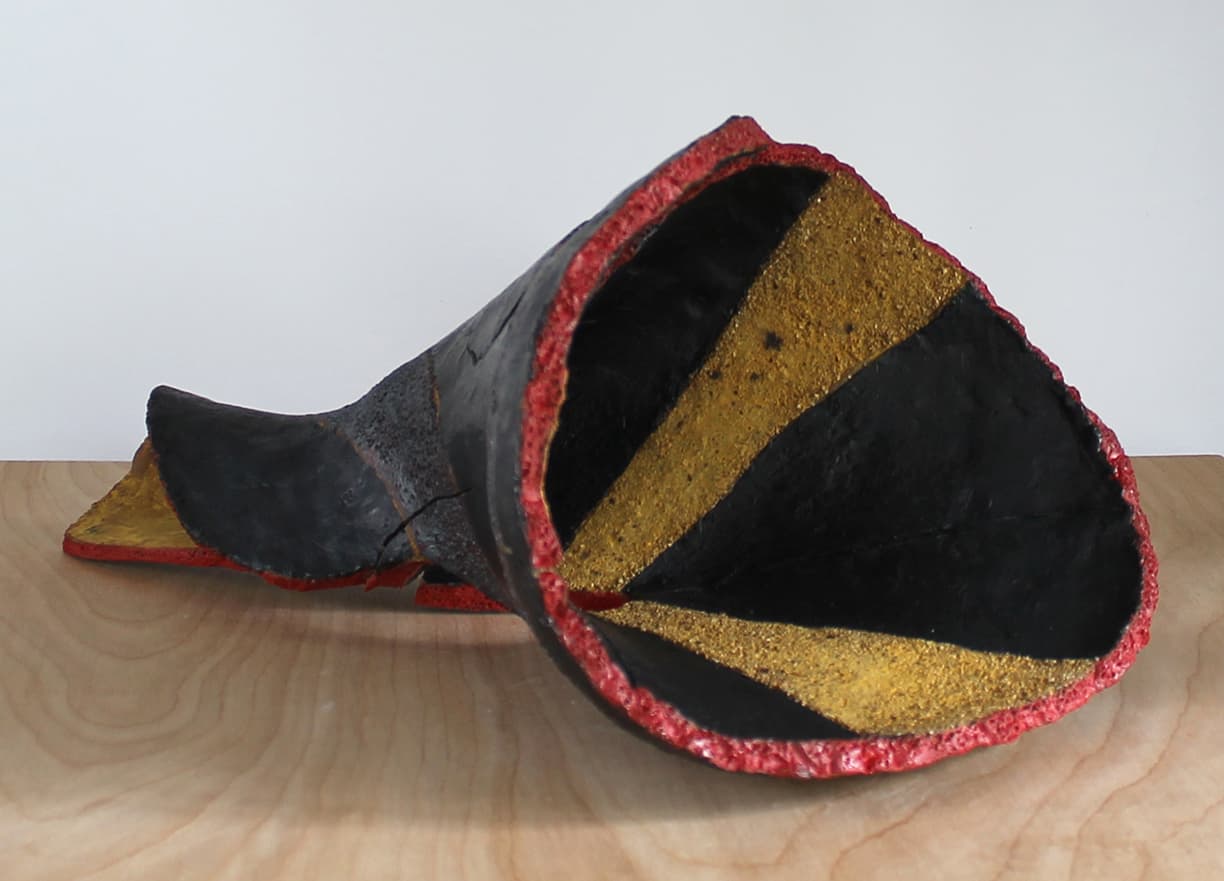
Harold Wortsman, Vortex, 2025. High fired clay pigmented with oxides, 9 x 11 x 16 inches. Courtesy the artist and Paris Koh Fine Arts.
The works further serve to jar our perception of sculptural versus practical, or even magical object. The three-dimensional pieces for the most part rest on low wooden pedestals, which insist on forcing the viewer to look down. Thus a piece such as Doorway to the Night (2025) which at eye level might resemble one of the sarsen and lintel structures of Stonehenge, but instead looks more like an accoutrement of a bronze Shang Dynasty tea set when viewed far from above—it’s a clever way to compel the eye into giving the works a second look. Wortsman seems to delight in playing with his ceramic medium by hanging on to some of the rules while breaking the rest. We get objects like Vortex (2025) which have the curves and fragility of a vase or cup—ceramics are supposed to be useful, right?—yet it lies on its side and lacks the ability to contain. And the interior is painted in bold gold stripes; Vortex is both a ceramic object and its negation. In the intaglio print Balancing Sphere (2022), the artist happily flattens his ceramic vessels, while again engaging the diagrammatic. There is a black circle with an open center, contained within a green and brown armature. While the print is obviously flat, the circle is still the mouth of one of Wortsman’s pieces, and as if to indicate the dimensionality of the assemblage, the background is a piercing egg-yolk yellow causing the image to float and vibrate. In the Timaeus, the creature moves from nothing, to sphere, to a series of regular polygons, slowly inventing the geometry of the world. Wortsman’s Shapes for the Future, Traces of the Past captures this process of elaborating form into meaning, offering some answers but keeping many secrets as well.
William Corwin is a sculptor and writer based in New York. He has been writing for the Rail for fifteen years.