Word count: 1140
Paragraphs: 11

Installation view: Co Westerik: Later Paintings: 2002–2016, Fergus McCaffrey, New York, 2025. Courtesy Fergus McCaffrey.
Fergus McCaffrey
March 8–May 17, 2025
New York
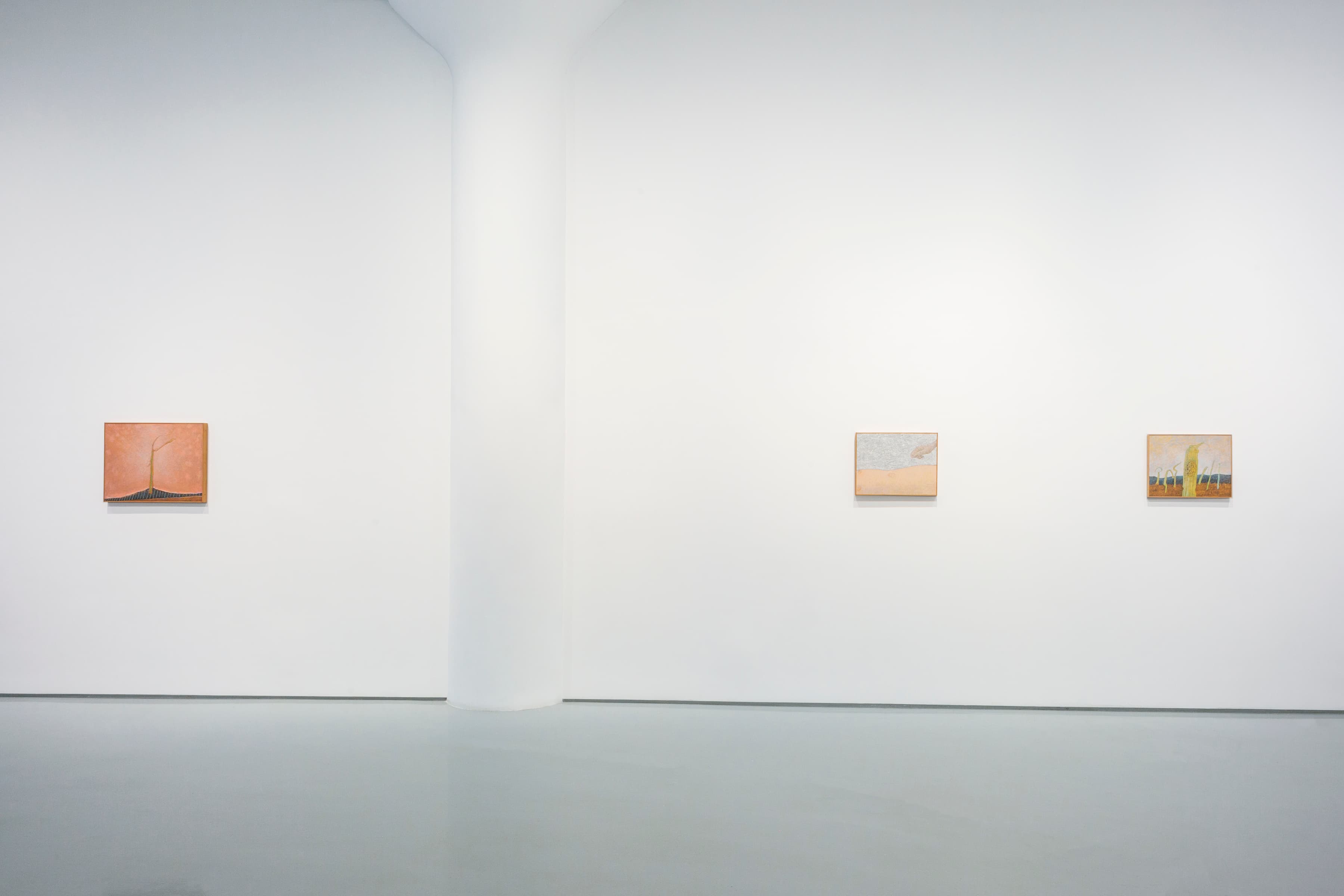
Fergus McCaffrey’s exhibition Co Westerik, Later Paintings: 2002–2016 consists of eight medium-sized works from the final two decades of Co Westerik’s artistic career. This was a period in which Westerik focused on images that, at their best, provoke shudders and a sense of wonder. However, the selection of late paintings on view is decidedly tamer. Although these milder images do not strike viewers with the grisly heights of the uncanny, they allow us to appreciate Westerik’s less commonly noticed formal techniques and, in particular, his askew treatment of perspective. The most overtly gruesome work is Pointing at the wound (2016), where a shriveled index finger dances above a closely viewed patch of sutured skin. Laddered with stitches, this anonymous plot of flesh glows pink. Reedy fibers of body hair stand, raised in slight contrast to the amber-sand background. Here, Westerik has effectively turned flesh into a desiccated parcel of dry land in a subtle nod to his origins as a landscape painter.
Born in the Hague in 1924 and trained at the Koninklijke Academie van Beeldende Kunsten, Westerik began producing Symbolist-inflected landscape paintings in the airy manner of his instructor, Willem Jacob Rozendaal, during the fifties. In 1951, Westerik helped found the Verve, an artist collective that came out of the New Hague School,opposed to the geometric-expressionistic abstraction deployed by CoBrA (and Helhesten before it). Westerik's sweeping tracts of vast verdant polders from this period betray the influence of the Barbizon School and its forerunner Jean-Baptiste-Camille Corot’s penchant for narrowing the space between a sketch and a finished picture.
Installation view: Co Westerik: Later Paintings: 2002–2016, Fergus McCaffrey, New York, 2025. Courtesy Fergus McCaffrey.
Over the subsequent decades, Westerik continued working in a meditative mode, painting in tempera and semitransparent oil glazes and increasingly hewing towards less classical and more eerie, even absurdist, imagery. In the latter quarter of the twentieth century his use of linear perspective collapsed and soon, foreshortening followed. Westerik’s pictorial space clustered into impossibly compact, warped pockets—ones which turned even outdoor landscapes into claustrophobic hovels. During the three decades before his passing, Westerik executed tempera alkyd oil paintings of egg-headed, bulbous men and women, caught in unnatural poses—their splotched skin a hide, their limbs mangled and disproportionately elongated. Yet Westerik, painting patiently and producing only a handful of works each year, also remained committed to shading and glaze-based laminate layering, endowing his figures with a sense of depth.
In his mature career, Westerik refined a specific suite of leitmotifs. These include gleaming beads of water on emerald leaves that refract ivory diagonals across the picture plane—diagonals too angular to signal rain and too thick to betoken sunlight. Soon, these remnants of linear perspective began to puncture the sweat-slick pores of his sickly, off-kilter, toothy figures. Eventually, they became standalone rods extending from parcels of pastureland. Although Westerik’s work remained relatively insular, the artist developed an esoteric pictorial language—one more haunting than Pavel Tchelitchew’s stripe of Russian Surrealism and more subdued than William Blake’s Romanticism.
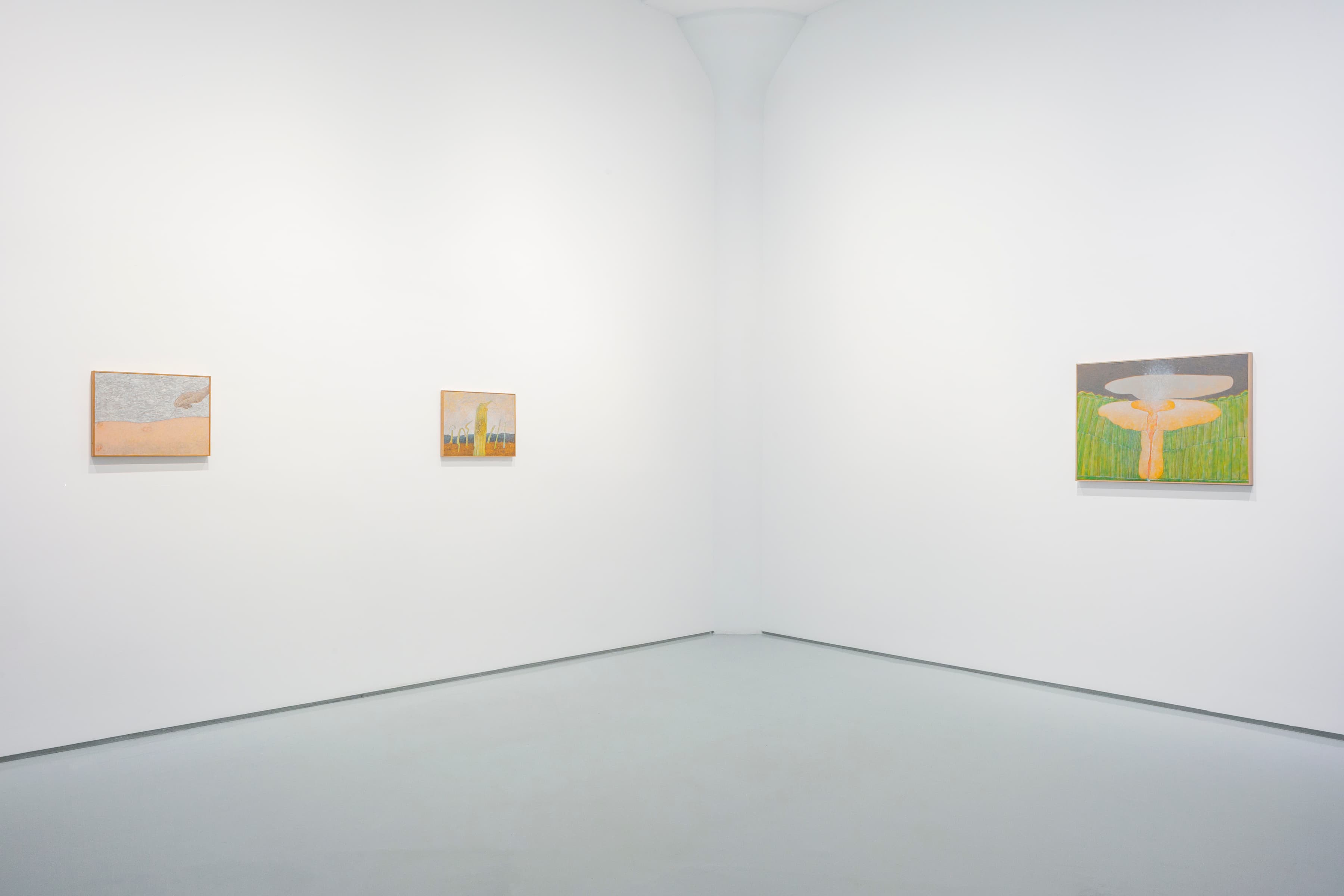
A number of the paintings on view at Fergus McCaffrey achieve a harrowing sensibility through surprisingly mild means. In Grasses and hand (2013), a withered palm arches backwards, the hand’s crooked angle paralleling the forked shoot of an unnaturally thick grass blade. There is a modest oddity here, detectable in Westerik’s alien angles and the petrified mirroring motions of the bent blade and the hand. Other works, such as Hand kiss with green background (2015), do not quite achieve such an uncanny effect. This painting finds a pair of hands, one sun-kissed and the other a paler peach, wrapped in an embrace. Stone-purple veins trickle from the captured hand’s knuckles, but their inflection does not provoke the kind of unease that Westerik, in his more askance, quietly unnatural imagery or closely-observed expanses of stippled skin, successfully conveys.
Installation view: Co Westerik: Later Paintings: 2002–2016, Fergus McCaffrey, New York, 2025. Courtesy Fergus McCaffrey.
Although the exhibition shows the subdued side of Westerik’s late career—a period that otherwise found the artist goading the uncanny to new heights—it allows for viewers to appreciate Westerik’s manipulation of angles and his combination of images that one intuitively feels belong apart. In Seven grasses (2011), Westerik’s arrayed threads of wilted lime-green grass droop into crooked bows. One such grass blade is scrawled with marks along its center, prompting wonderment as something as insubstantial as a blade of grass is dramatically enlarged enough to fold over itself and be engraved upon while the accompanying whips retain standard proportions. But the two strongest works in the show are Spat on plant (2002) and Five grasses with portrait (2013). The former isolates a single blade of grass framed by a buster collar and sheath. Two ligules stir in the wind while the internode nests a drop of spittle. From the bead’s center, four diagonal rays radiate across an arid mud background. In Five grasses with portrait, the titular green blades curve towards a smog-clouded sky. With the exception of the center blade, whose crown is incised with the number “5,” the other blades, also numbered, are banded with crème-colored rings. In the middle shoot’s center, a watery tondo portrait reveals a man’s visage. His staid face and small coal eyes, framed by thin circular spectacles, are fixed in a cold stare. The juxtaposition of imagery here amounts to a masterfully executed haunting.
Westerik’s roseola-pocked fingers and drooping vegetal shoots are depicted in mystifying ways remote from our everyday expectations. Ultimately, the most interesting images are Westerik’s mite’s-eye-views of grass. On the occasion of his 2014 exhibition at the Museum Boijmans Van Beuningen in Rotterdam, Westerik wrote in the catalog foreword that:
“The guiding principle of my work has been to create a sensible image that would encapsulate a state of mind, averse to any decorative intent … Yet I have persisted in calling my work realistic, having always made (recognizable) use of elements taken from the real world … [t]he main aim of my work, its overriding compulsion, has been to create and unveil something that has never before seen the light of day.”
Presumably, Westerik did not simply mean that he wished to create novel pictorial content, for it is a mere empirical fact that most every painting presents imagery previously unrealized. More likely, Westerik meant that he wanted to propose a new class of images. Indeed, in his late paintings he deploys a cluster of idiosyncratically unsettling imagery, trafficking in mangled fingers and splayed grass shards that genuflect at odd angles against the arid earth. Of the eight paintings in this exhibition, it is with his grass imagery in particular that Westerik has made good on his “main aim,” for while many other artists have contorted the human form, none have balanced spittle on vegetation and incised grass towers, treating them as subjects with the same unsettling and skewed expressive potential as the body.
Ekin Erkan is a writer, curator, and researcher whose writing has appeared in the Journal of Value Inquiry, the International Journal of Philosophical Studies, and Hyperallergic, among others.