Brutal Days, Orchid Nights
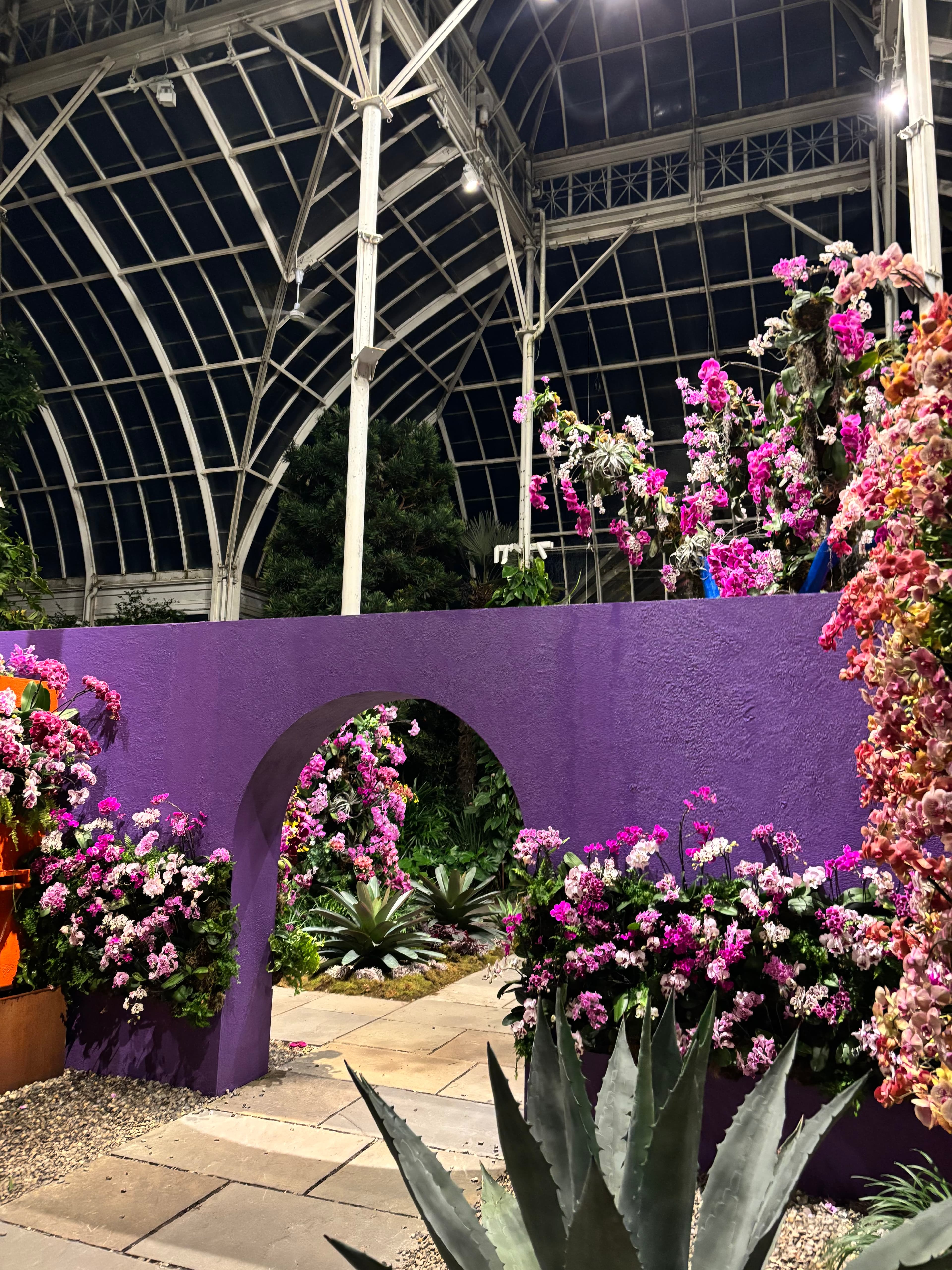
The Orchid Show: Mexican Modernism at the New York Botanical Garden. Photo: Siena Ballotta Garman.
Word count: 785
Paragraphs: 8
New York Botanical Garden
February 15–April 27, 2025
New York
On one recent night in the Bronx, spotlit orchids bloomed out of darkness. Visitors lingered over them, pausing for photos in perfumed air. Placards in English and Latin displayed the common and scientific names of the plants; elsewhere, bilingual text in English and Spanish gave context for their surroundings. Among the orchids were archways, walls, and fountains in colors rivaling the flowers themselves. These vibrant structures paid homage to Mexican architect Luis Barragán, whose work is the theme of the New York Botanical Garden’s 22nd annual orchid show. On select “Orchid Nights,” as when I visited, the Enid A. Haupt Conservatory remains open after its usual operating hours, enlivening a mercurial New York spring.
Born in Guadalajara in 1902, Barragán was a beloved practitioner of modernism who joined the ideas of Le Corbusier (flat roofs, clean lines, and horizontal openings among them) with colonial Mexican objects and brilliant colorways. His vibrant walls of solid color imply two-dimensionality even as they initiate viewers into depths of light and shadow. His gardens provide sites of uplifting communion with nature. Running water is a focal point in his landscape architecture, as it is throughout the New York Botanical Garden. Bubbling fountains offer an immediate and welcome sense of separation from the outside world, where the Bronx River Parkway races just beyond its namesake waterway.
One water feature protrudes from a fiery orange wall and empties into a pool, nodding to Barragán’s Fuente de los Amantes (Lovers’ Fountain) outside of Mexico City. A perpendicular white wall interrupts the orange; both surfaces bloom with embedded orchids in shades of hot pink and paprika. Walls of fuchsia and purple evoke Barragán’s Gilardi House, and a blue reinforced steel sculpture stands in for its famous jacaranda tree. Yellow lattice grids reference a partition at Barragán’s Capuchin Convent Chapel in Tlalpan. Orchid specimens perch in their negative space. The Orchid Show revels in the sanctuary afforded by Barragán’s walls, which create spaces of meditative stillness and sometimes allow nature to permeate their bounds.
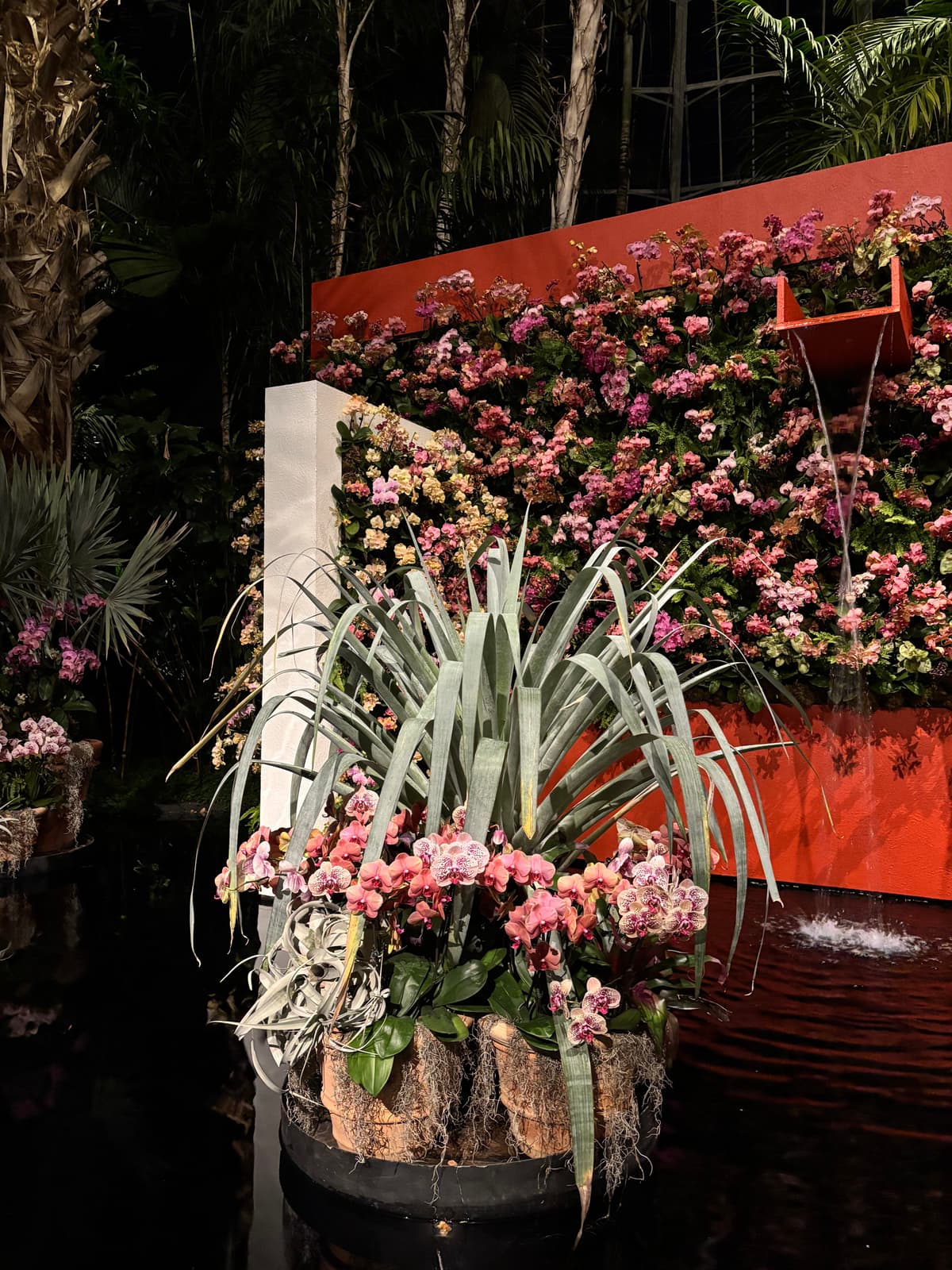
The Orchid Show: Mexican Modernism at the New York Botanical Garden. Photo: Siena Ballotta Garman.
Barragán’s walls are also effective photo backdrops, and his architecture easily finds purchase in today’s experience economy. Images of The Orchid Show proliferate in the run-don’t-walk world of NYC content. Daytime visitors to the conservatory encounter a playlist of traditional and contemporary Mexican music. At night, I listened to a mix curated by local DJs hellotones and Chihuahua. In an adjoining tent, couples danced cumbia and sipped cocktails beneath banners of colorful papel picado. None of this runs counter to Barragán’s artistic practice—he was savvy as well as spiritual. In The Architecture of Luis Barragan, architect Emilio Ambasz places Barragán’s work in a tradition of stage architecture, characterized by compositions with a foreground, middleground, and background, in which “the element of tension is always introduced by the user … or more subtly, by his absence.” Today, the user of Barragán’s walls might position them in an iPhone camera and find opportunities within them for reflection or even subversion.
An executive order introduced in Trump’s first term and revised this past January is titled “Promoting Beautiful Federal Civic Architecture.” It stipulates that federal buildings should “respect regional, traditional, and classical architectural heritage.” To the order’s many analysts, including Aaron Zitner’s in the Wall Street Journal (“Trump’s New Targets in the Culture War”), the mentions of classicism and tradition, coupled with the president’s vocal distaste for Brutalism, seem to oppose the modernist style that has guided federal architecture since World War II. Viewed in this context, and in the context of the virulent anti-Mexican rhetoric issued by the same administration, the decision to elevate an architect who is both modernist and Mexican takes on a bolstered significance. The New York Botanical Garden is not a federal organization, but it does receive government funding; it is refreshing to see public resources deployed in service of brightness.
The toasted oranges and radiant pinks of this year’s orchid show happen to follow a winter characterized by cruelty and austerity. They mount a playful challenge to those tendencies and to the misguided idea of modernism as a grey architecture incapable of elegance or joy. Barragán’s modernist architecture repels any attempts to connect sentiment with weakness or beauty with fragility. Its monumental planes shelter private spaces in which sustained reflection becomes possible. The Orchid Show evokes the privacy and sanctuary of those spaces in a setting available to the visiting New York public. “My house is a refuge,” Barragán asserted, “not a cold piece of convenience.” As Ambasz notes in his book, Barragán’s designs and the principles that they embody call for our participation.
Siena Ballotta Garman is a contributor to the Brooklyn Rail.