Stage4Beverley’s Winter Festival
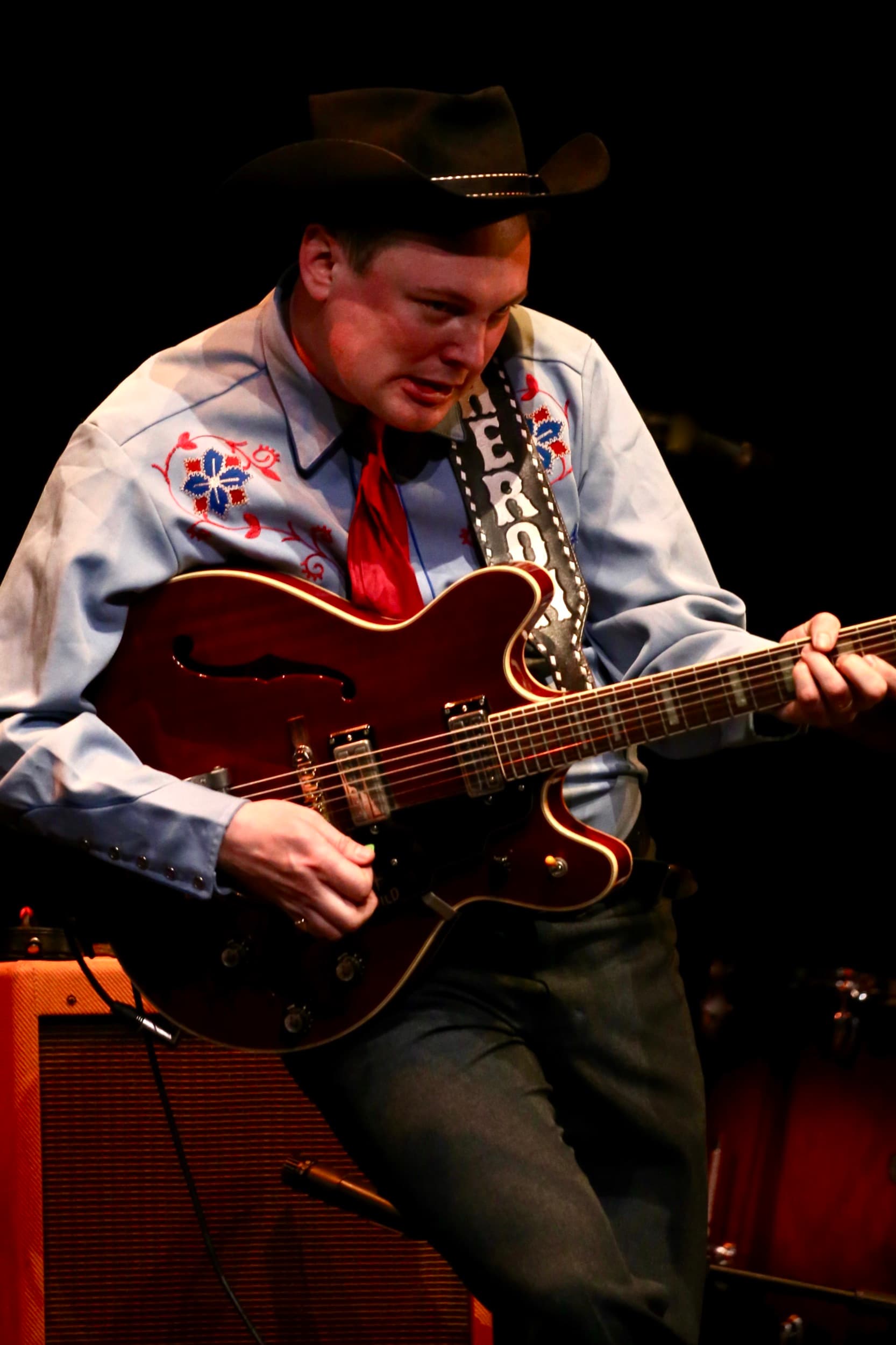
Rob Heron. Photo: Melvyn Marriott.
Word count: 1042
Paragraphs: 12
East Riding Theatre
February 9–16, 2025
Beverley, England
The quaint market town of Beverley is the “capital” of the East Riding of Yorkshire, with Hull and Old York being its closest city neighbors. It’s a setting where we would expect traditional folk music to thrive, and indeed a highlight of Beverley’s musical year is the Winter Festival, steeped in English ditties but also reaching right across the Atlantic to address the travel of songs and tunes to North America. Even the musical legacies of Scotland and Ireland are included.
The East Riding Theatre (a converted 1910 Nonconformist chapel) provides the venue hub, in its main seated hall and its smaller, more informal hang-out of the adjacent café bar. Given its medium size, there’s no surprise that virtually every gig is at capacity. Organized by Stage4Beverley, two of the weekend’s most striking shows happened in the afternoons, and both of these stretched far from local folk.
Representing another kind of folk feedback, singer and guitarist Rob Heron leads his Tea Pad Orchestra in a drive toward authentic good-time (or frequently misery-time) Americana, schizophrenically choosing to Frankenstein-stitch together rockabilly, blues, country, Western swing, jazz, soul, rock, and doo-wop, but never to a bewildering pitch. Fed through the unified band style, and a repertoire dominated by his original songs, such stylistic elements are cannily grafted together as if organically grown. Until Heron talks (and boy, does he talk), we could be fooled by their aural US passports and their universally slick Southern garb. In fact, this gang hail from further up north and east, from Newcastle upon Tyne, a most unlikely source for Stateside authenticity.
Initially, the spread features guitar, clarinet, mandolin, bass, and drums, but most of this outfit are multi-instrumentalists, so the palette switches throughout (not least via recent addition Ben Powling’s tenor and baritone saxophones). Group vocals are enthusiastically present all the way, underlying the dry humor twinkle lurking in most of the numbers. Tom Cronin’s electric guitar is reined in at modest volume, but still sonically steeped with an exciter-aura, for the country trot of “Holy Moly (I’m in Love Again)”—also with prominent harmonica and tenor. Heron has specialized mouth cavity settings, altering teeth and lip shapes to suit American vocal twangs. After singing about coffee, wine is next, although Heron now promises not to imbibe prior to 4 p.m., so we get to witness the stark-sober set, which is certainly lively enough. “Blood In The Water” matches doo-wop with hillbilly, Dion-style, and then Heron sings about “Good Lovin’” but in reality it’s the opposite. “I Pawned My Guitar Today” is a weepy lament from The Pits, with a resonant baritone guitar solo, chased by a burred tenor statement, Heron’s house and heart also forever lost. The throaty baritone horn is slung on again for “Swinging Like a Brick,” Heron’s imaginary country b-side rarity. The reeds-man plays in viper-time, quips Heron. “Six Month Sleeper” stands out from the new LP, an ode to opting bedward for each year’s troublesome times.
Heron’s opening act was a pair of old cronies from The Whiskey Dogs, concentrating on a warty Appalachian songbook delivery, to endearing effect. Pete Bolton (banjo) and Brian Swinton (fiddle) turned up again in the evening, for an informal folk session at the Monks Walk pub, just around the corner. On an alternative level, this was another festival highlight, in an old school joint, frothing out formidably strong local hand-pulled cask-brews, such as Black Mass and Sultanas Of Swing.
Upstairs, in the cozy session room, three acts cantered through a wide selection of materials and sources, to very warming effect. Bolton and Swinton proffered “Hesitation Blues,” after the Charlie Poole version, with a trouncing hop-beat and a literally horn-headed fiddle (home-built for old timey amplification), straight from a 78 rpm platter. Swinton sports a hearing aid, of course. Tampa Red’s little-heard reading of “The Duck Yas-Yas-Yas” shone through the beer-light, again with the phono-horn chimera. Then there was “Banjo Pickin’ Girl,” via Lily May Ledford, to finish. She was hopping from Arkansas to Chattanooga to Cuba, then North Carolina to China. What a song!
The session also featured the quirkily time-mixed duo of Sam Martyn (harmonium) and Wolfy O’Hare (violin), both singing, the latter fashioning himself from five centuries earlier, the former displaying more modern post-punk fleckings. And to open, there had been a trio of Liam Robinson (squeezeboxes), Carol Dawson (fiddle), and Steve Le Voguer (acoustic guitar), infectiously driving and enthusiastic, and with a casually communicative attitude completely natural in their visible love for this closely-gathered session. Le Voguer appeared again on Sunday afternoon, joining fellow guitarist Lewis Kilvington for a short set of gypsy jazz exchanges, dominated by the legacy of Django Reinhardt.
From even further afield comes the renowned veteran Spanish flamenco guitarist Juan Martín, although he’s probably to be found around London almost as much as he’s back home in Málaga, tending his roots. “I’m used to saying good evening, and I’m usually having my siesta,” he says, by way of introduction to this afternoon concert. Fortunately, Martín sounds wide awake, as fingers dance through what must surely be most of the flamenco melody and rhythm forms. Sometimes this can be distracting, as the tarantas, soleares, and bulerías are announced, as is common practice within flamenco. Perhaps it would be better to just submerge into the naked themes, without feeling that form identification was required.
Martín fills his playing with freeform flurries and soft strikes, not being as percussively theatrical as many other players, not even in his younger years. Unusually, his material took him up to Asturias, in northern Spain, with a trebly refrain, sparsely essayed. “Rumba Nostálgíca” closed a short first set, which had chased the heels of Kilvington and Le Voguer’s own brief opening. Martín soon returned for a more substantial second run, getting into a deeper dancer’s piece, with light strafes and spiral pickings, tapping on his resonant axe. More complex rhythms emerge, with melodic variations, as Martín concentrates on works to be found on his recently compiled best-of box, Guitar Maestro, as he humbly explains that its title wasn’t his own choice.
Martin Longley is frequently immersed in a stinking mire of dense guitar treacle, trembling across the bedsit floorboards, rifling through a curvatured stack of gleaming laptoppery, picking up a mold-speckled avant jazz platter on the way, all the while attempting to translate these worrying eardrum vibrations into semi-coherent sentences. Right now he pens for Down Beat, Jazzwise, and Songlines.