Jessica Sequeira’s Jazz of the Affections
Word count: 1006
Paragraphs: 13
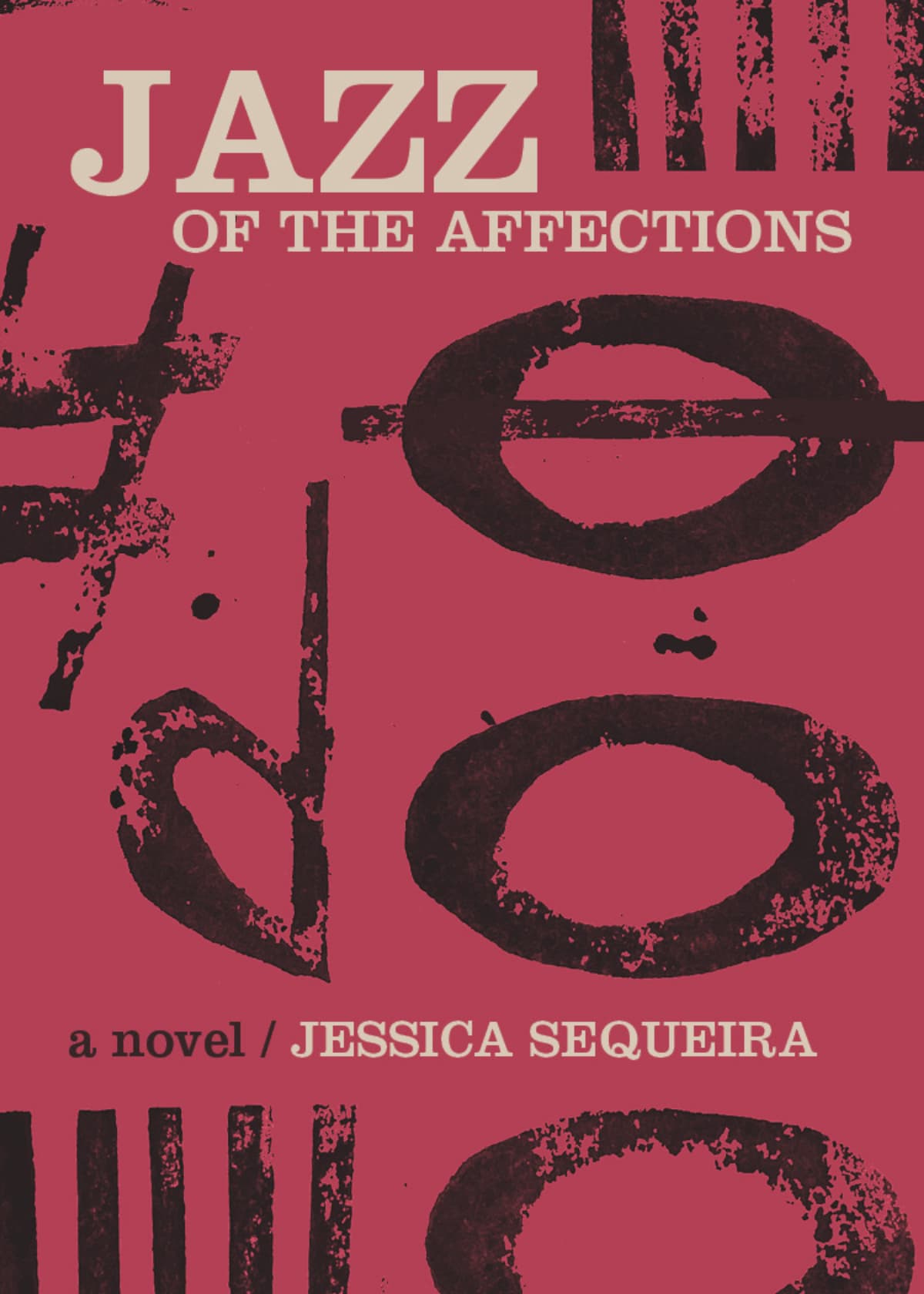
Jazz of the Affections
Sublunary Editions, 2025
Haruki Murakami, in a 2007 essay for the New York Times, confessed that “Practically everything I know about writing … I learned from music.” Now, the music occupies an unusually large space in Marumaki’s life—he runs a club that might be the Tokyo Smalls—but his claim gets at something definitive about his other love, the long prose narrative. The novel has proven improbably flexible, and in this openness to fresh shapes, it makes a natural companion to the inventions of Duke Ellington and Thelonious Monk and Miles Davis. Murakami is hardly the only example⎯nor the only proof of such fandom crossing ethnic lines. The music’s all over both James Baldwin and Jack Kerouac; Toni Morrison followed up Beloved with Jazz, and my favorite jazz novel would be Coming Through Slaughter, Michael Ondaatje’s imagining of Buddy Bolden. The bibliography runs far longer, to be sure, and it keeps on growing, now with a new construct both colorful and brainy: Jazz of the Affections, from Jessica Sequeria.
Based in Santiago, Chile, the still-young Sequeira has established herself as a poet and translator and while this first novel delivers a narrative, it might be best appreciated as alt-poetry, a sustained exercise in theme and variation. The text spirals out into improvisation, exploration, and then takes it back to the head. That unifying element, however, isn’t some great tune like “‘Round Midnight” (the title of one chapter), but rather two linked plotlines. This Jazz first sounds the notes of an environmental crisis in Chile, where avocado plantations threaten the aquifer, and second sets up a coming-of-age for a Chilean woman doing advanced study in Europe. This protagonist-narrator is never named but on a familiar trajectory, discovering first profound love and then herself, her calling⎯combining arts work with protecting her homeland.
Thus, the two-pronged narrative never entirely leaves Chile (where the focus seems to be the semi-arid Coquimbo, to the north), and a key instrument in the ensemble is the endangered river. In recurring passages titled “the river says,” a page or two each, Sequeira uses a poem’s typography but expresses the concerns of a historian and environmentalist:
the river…
remembers the ice that birthed it
the animals that waded through it
the boots that tramped through it…
the chemicals that put drugs in its lifeblood…
Those boots and chemicals evoke the second-wave colonialism of the avocado boom, and in its opening pages, Jazz also sketches a grassroots pushback, a performative protest called “the diabladas.” Having established this much, however, the author lets the spotlight linger on her primary player.
The young woman is engaging, as is Finnegan, the Indo-British musician she takes up with. We know the type: bookish, poly-cultural, Gen Y. Both get the Joycean reference in his name and feel equally at home in a Berlin museum, an Oxbridge library, and an underground rave somehow connected to the Venice Biennale. The music takes up more and more of their lives, him on fiddle and her singing, even as the venues grow curiouser and curiouser, lacking a clear itinerary. So, too, the love story does without the usual signposts, the smashing plates and making up. Early on, the narrator reveals, “With him I felt my looseness condense and gather force, and I liked to think of his longish dark hair and his well-defined eyelashes,” a fine balance of abstract and concrete. Still, that’s about as far as Jazz takes the physical affection. The band with whom the twosome perform remains ghostly.
Rather than get into caresses and confrontations, the narrator takes off into solos: erudite and encyclopedic digressions. These cover everything from music therapy to the science of algae, from south Indian dance-theater to medieval tales of the devil, all of it sprinkled with twenty-first-century savvy. The turns of thought can be kicky, like this one inspired by the late French philosopher René Girard: “If Satan and God had, say, phone sex, what would they say to each other?” Then, too, a handful of later sub-sections, taking their titles from “affections” like “Envy,” deliver satisfying flash fiction. Those may recall Invisible Cities, but overall, W. G. Sebald’s The Rings of Saturn makes a more congenial comparison, as the narrator meanders among talkative strangers and endless bookshelves. Not that Jazz offers the impact of Rings⎯Sequeira can be sketchy, more list than thought⎯but at her best she works up “an enraptured saintly calm, in which everything connected.”
Inside her busy head, meanwhile, a sense of vocation is emerging: “I began to write down notes for a song of my own … in which I wasn’t merely the vessel and body but the creator.” Then, once she’s arrived “closer to a full and resonant being,” she needs to test it in a return to the homeland.
She needs, that is, the rural Chile of her upbringing, “a dry place” where the corporate farms are poisoning the water. Finnegan, to his credit, comes along⎯also the right move in dramatic terms, so far along in the story. Still, the narrator’s partner fades into the background as she renews old connections and throws in her lot with the “diabladas.” The protests recall One Hundred Years of Solitude, the uprising against the banana moguls, but Sequeira’s uprising has more of a festival feel, nothing like the bloody climaxes in Márquez. She does come up with an imaginative triumph over Big Ag, a miracle in the wilderness, but her protagonist continues to find greater solace in deep thought. She’s fascinated by the mythic costumes and musical potpourri, including of course plenty of jazz:
There is the jazz of blacks in the United States, but complex rhythmic forms exist all over the world. There is the music of… many indigenous peoples. There is tango, trova and sawt. There are congas, timbales…
This Jazz, in other words, can’t be confined to a dive in Midtown; rather, reveling in “a taste for description over plot…detail over narrative propulsion,” it aspires to the music of the spheres⎯a love supreme.
John Domini is a regular Rail contributor, with eleven books to date. His next will be a critical work that includes many of his Rail pieces, Caliban’s Cry: On a Literature Unhoused.