Tavares Strachan: Starless Midnight
Word count: 726
Paragraphs: 5

Installation view: Tavares Strachan: Starless Midnight, Marian Goodman Gallery, New York, 2025. Courtesy of the artist and Marian Goodman Gallery. Photo: Tom Powel Imaging
Marian Goodman Gallery
March 7–April 19, 2025
New York
Tavares Strachan’s goal is to create an alternate and functioning iconology for our times. On entering the exhibition Starless Midnight, one is faced with two objects: a piano, which plays itself, Split Consciousness (Samuel Coleridge-Taylor) (2025); and a book, Encyclopedia of Invisibility (Pocket Guide) (2024) is the blueprint for the artist’s gestures in the exhibition. It is a compendium of mostly lesser-known and overlooked figures and concepts throughout history that form the basis of the exhibition, which takes the form of tributes in a variety of artistic outputs, from ceramic sculpture, neon, paintings, and tapestries, to robotic installations. The success of the exhibition is also its downfall; for while Strachan has created a wunderkammer of marvelous forms—such as a luminous skeleton striding towards us, in Daughter of Ra (Mary Jackson) (2025), and a self-playing adungu, Venus (Rosetta Tharpe) (2025)—the forms are so varied that it is tough to discern the artist himself. The only linkage among the works is the Encyclopedia, which, richly illustrated with many of Strachan’s previous works, provides a magic key to the menagerie of objects conjured up for our edification.
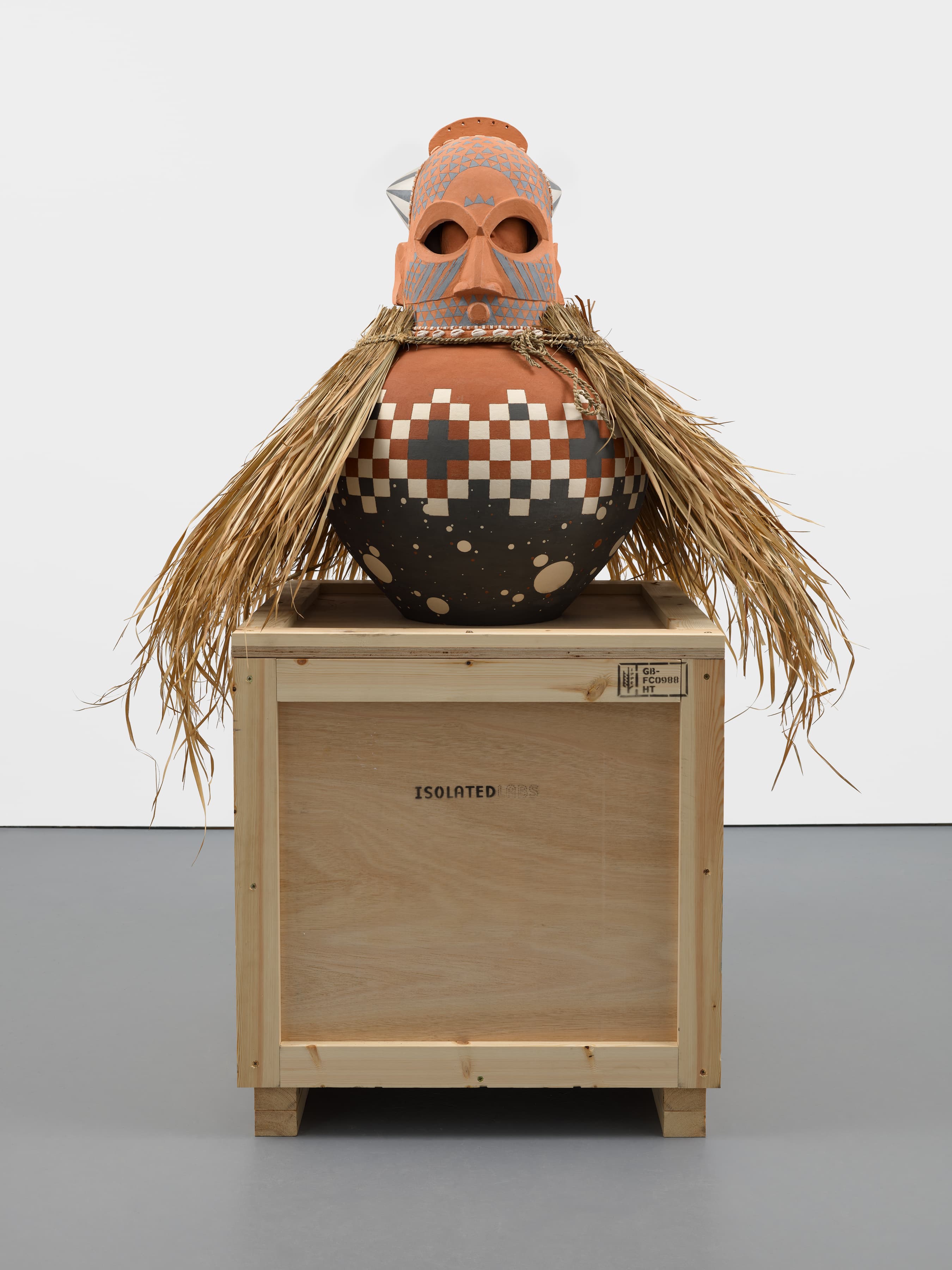
Tavares Strachan, Self Portrait (King Kuba), 2023. Ceramic, thatch cape, 35 x 48 1/2 x 40 inches. Courtesy the artist and Marian Goodman Gallery. Photo: Tom Powel Imaging.
The ceramic sculptures work most effectively to execute Strachan’s aim of memorializing the forgotten. They consist of clay busts, often utilizing the Inuit transformation mask format of one face, split down the middle, opening on to a second. In Shu and Horus (Coleman and Harriet) (2025), the head of Bessie Coleman opens revealing the face of Harriet Tubman. The composite head is placed on a black-and-white patterned, glazed ceramic vase festooned with thatch. This assemblage is succinct in its expression of liberatory activism lineages, as well as poetic ancestor worship. Most of the ceramic works are placed on their shipping crates, a visually jarring choice that lends a wonderful spontaneity to the works as if they might need to leave in a hurry (which at this point is a concern for all of us). The Birth of Exuma (Eagle Talon) (2024) is a cenotaph to the Bahamian polymath, a musician and magician, who stands erect in a shaped rice paddy. The juxtaposition of materials, of matte and rough clay surfaces against the feathery stalks of the rice field, entertain the eye. We experience this again in A Map of the Crown (Fulani Red) (2025) wherein a glistening porcelain bust is outfitted with a soft and tightly knitted carmine-colored hairpiece. Strachan achieves a similar wealth of unexpected visual stimuli in several of his musical sculptures—between traditional instruments and robotic components—in the aforementioned Venus, as well as Stubble Field for Anubis (2025), a self-playing drum perched high atop a wooden plank, and Apollo’s Teacher (Blind Tom Wiggins) (2025), an East African balaphone of dusty gray wood.

Tavares Strachan, Son of Andromeda (Malcolm X), 2025. 2 panels; oil, enamel, pigment, fiber, acrylic panel, ceramic, neon, transformer, 84 x 84 x 2 inches. Ceramic: 23 5/8 x 9 7/8 x 10 5/8 inches. Courtesy the artist and Marian Goodman Gallery. Photo: Tom Powel Imaging.
While the ceramic memorials play on both the inherent power of a sculptural representation of the human face and the addition of traditional containers that trigger thoughts of ritual and spirituality, Strachan’s paintings are abstruse. Three of these, Son of Andromeda (Malcolm X) (2025), Zeus and Olodumare (2025), and Jupiter’s Fist (Haile Selassie) (2025), seem like a two-dimensional unpacking of what is readily intuited in the sculptures; in fact, Son of Andromeda and Jupiter’s Fist both include ceramic busts of Malcolm X and Haile Selassie respectively, as if to hammer home a hard-to-distinguish point. The presence of miniscule, but readable, text seems to indicate a semi-hidden subplot, but unlike the artist’s Encyclopedia of Invisibility, which demands investigation, the presence of text in these paintings seems to argue against the necessity of reading, instead implying almost inscrutable text as legitimization of received wisdom. In Gemini I (Woman King) (2025), Gemini II (Althea Gibson) (2025), and Gemini III (Queen of Sheba) (2025), Strachan plays with unreadability, mimicking the engrossing energy fields of static produced by archaic cathode ray tubes. This has the opposite effect of the first series of paintings—pulling us into the canvas—where we realize that the energy field is one of text, albeit an unreadable grid of letters, but presents the word as a force of immense power. Starless Midnight functions as an exploration of the many possible means of linking information to image through light, sound, texture, and text. But it is the simple media of book and sculpture that hold the disparate parts in place.
William Corwin is a sculptor and writer based in New York. He has been writing for the Rail for fifteen years.