Taryn Simon
Word count: 807
Paragraphs: 6
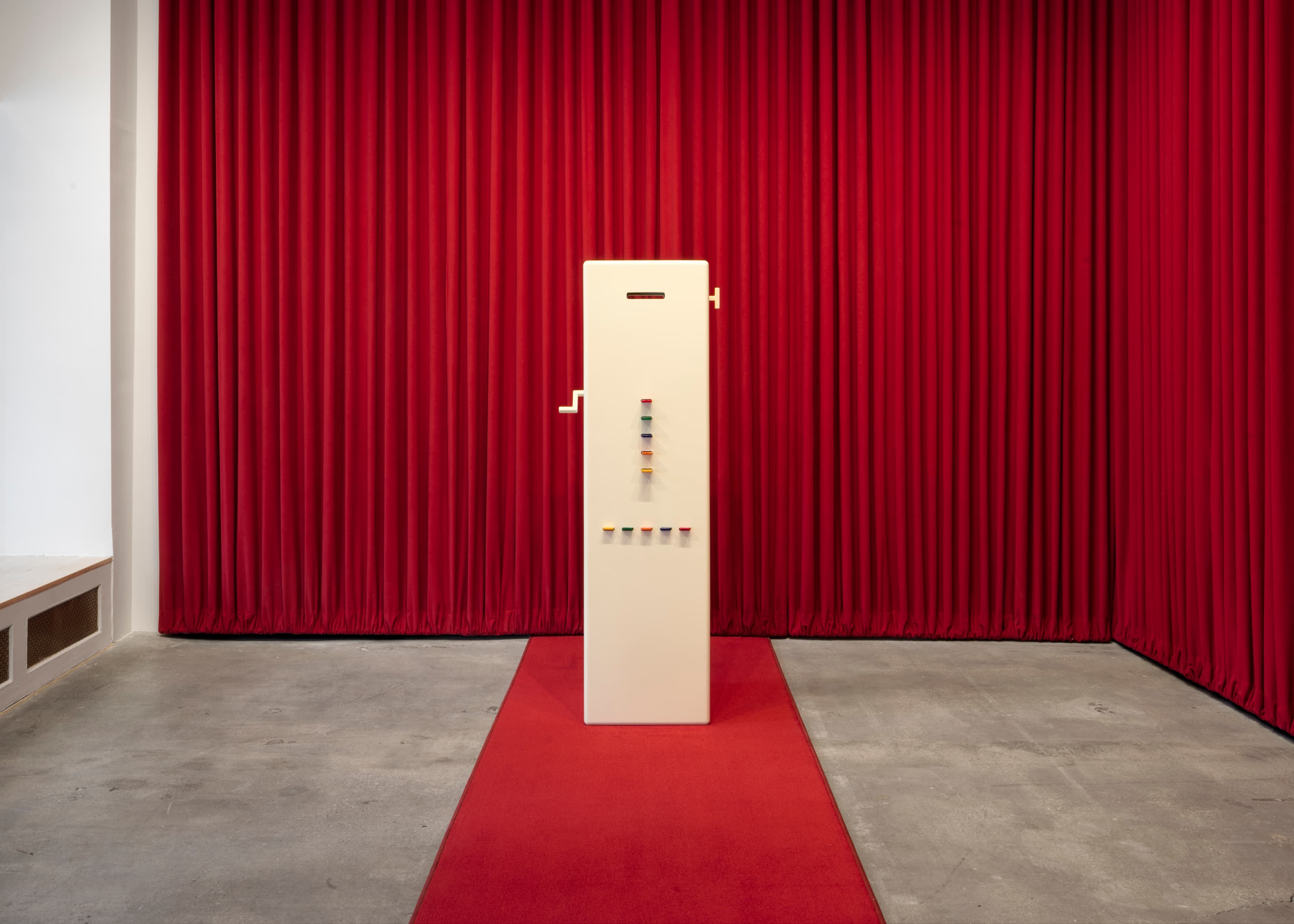
Taryn Simon, Kleroterion, 2024. Cast resin and metal, 67 × 18 × 16 inches. Courtesy Gagosian.
Gagosian Park & 75
March 20–April 26, 2025
New York
Taryn Simon is a didactic artist. In all her work, as photographer, performance artist, or sculptor, she seeks to inform viewers about their world. Previous projects have included “The Innocents” (2000–03), a series of photographs of people wrongfully convicted. The 2007 photographic series “An American Index of the Hidden and Unfamiliar” captures places and objects Simon considers essential to the American experience, but which remain unknown—the CIA’s art collection, for instance. Taxonomies; systems of organization (and the authority that sanctions such ordering); teleology; built-in inevitability as a function of any principle of organization; and random accumulations which, when metamorphosed into collections, constitute an order are Simon’s stock-in-trade. She is like the narrator in Jorge Luis Borges’s 1941 tale “The Lottery in Babylon,” whose society is organized around lotteries and games of chance concocted by a mysterious, all-seeing Company: “it makes no difference to affirm or deny the reality of the murky corporation, because Babylon is nothing more than an infinite game of chance.” Simon’s paradox, then, is that we can’t live with systems, and we can’t live without them. But her paradox is an indictment: She sees evil and attacks it, reminding us that the distance between didacticism and propaganda is infinitesimal. Both use the rhetoric of seduction to convince us of the righteousness of their cause.
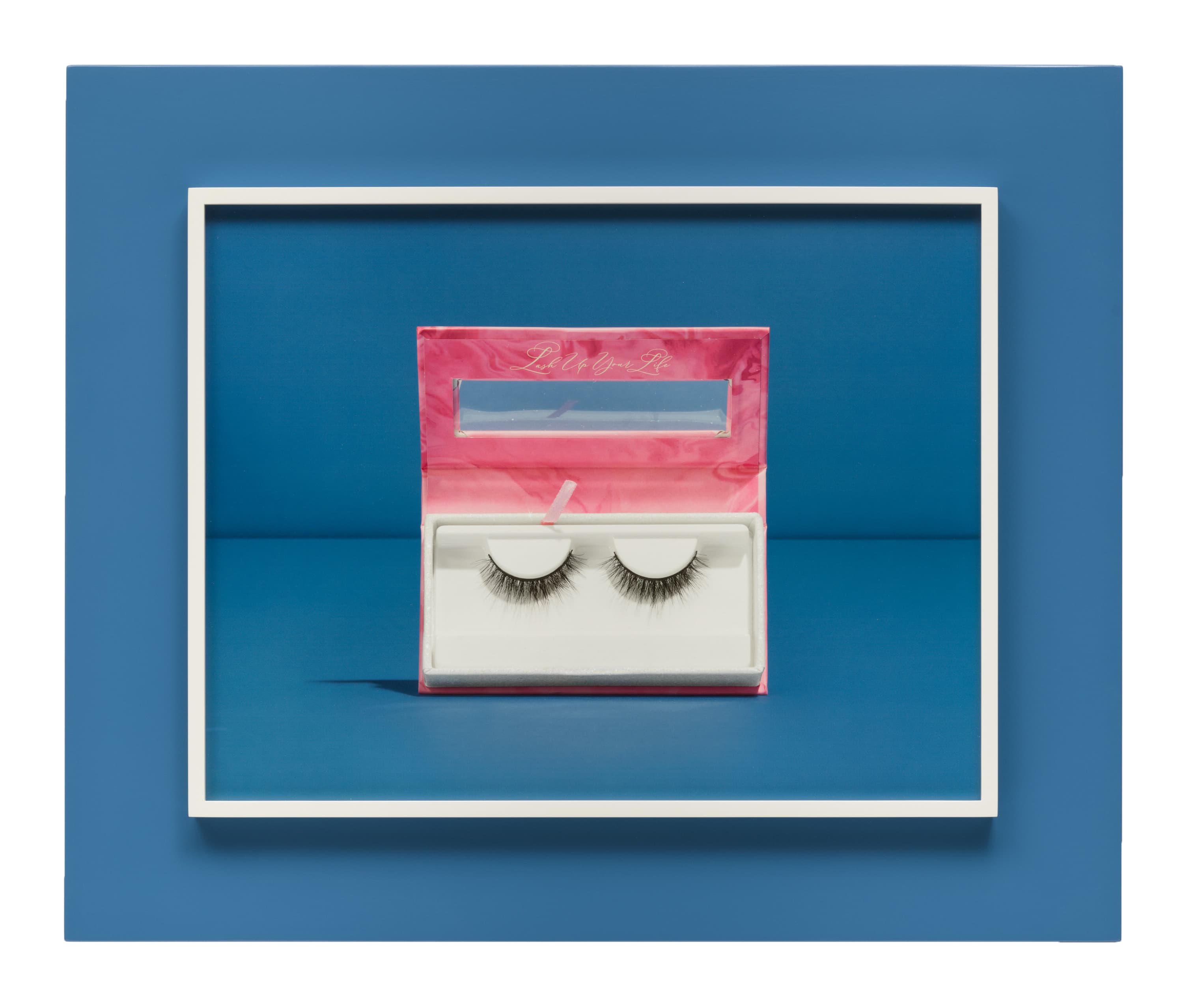
Taryn Simon, Representative Jasmine Crockett’s Eyelashes, 2024. Archival inkjet print, in artist’s frame 27 1/2 × 33 × 1 7/8 inches. Courtesy Gagosian.
Simon’s show at Gagosian is overtly political. In 2024, at Storm King Art Center, she showed an interactive sculpture, the Kleroterion, her version of a device used in ancient Athens to select among eligible citizens for public service. The machine randomly picked one from a group thus avoiding any possibility for corruption. Simon’s recreation, which looks something like a classic PEZ dispenser as Donald Judd might have reconfigured it, stands alone in one room of the gallery. The space is curtained in red drapery, with red carpet on the flooring forming a pathway to the kleroterion. To run the device, each of five viable candidates for office would be assigned a colored lozenge. The lozenges would be inserted into a slot and a crank turned until all but one lozenge were ejected from the machine, declaring the winner. A theoretically fine way to keep anyone from interfering, unless of course some outside power handpicked the five eligible candidates—a possibility that remains unaddressed.

Taryn Simon, Miss Sassy, Springfield, Ohio, 2024. Archival inkjet print, in artist’s frame. 27 1/2 × 33 × 1 7/8 inches. Courtesy Gagosian.
The rear half of the exhibition space is given over to six archival inkjet prints. All dated 2024, the US election campaign year, each photograph is linked to a specific political moment in that fateful year. Miss Sassy, Springfield, Ohio portrays the infamous Miss Sassy, the house pet supposedly eaten by Haitian immigrants that became a talking point of the Trump campaign and used as a symbol of the danger immigrants constitute to Americans. (Miss Sassy was subsequently found by her owner, hiding in a basement, uneaten.) Simon poses her in a gray corner, perhaps to render the cat abstract, to strip away the political accretions. Election Warehouse, Philadelphia, suffused in muted red light, shows some of the security seals used to protect ballot boxes in Philadelphia County—where 727,595 votes were cast—sorted, tagged and piled in a basket, emblematic of yet another case of hysteria, this time about the reliability of vote-counting. The most amusing print is Representative Jasmine Crockett’s Eyelashes, the subject of an argument between Republican Congresswoman Marjorie Taylor Greene and Democratic Representative Crockett. Greene had publicly mocked Crockett for her false eyelashes, suggesting they were causing sight-impairment. Crockett’s eyelashes appear in a small vanity case inscribed with the words “Light Up Your Life,” referring both to the built-in light in the vanity and the idea that makeup can make your life more joyful. That Greene, with her mane of false blond hair, would accuse Crockett of vain excess is yet another instance of political theatrics.
Taryn Simon, Representative Jasmine Crockett’s Eyelashes, 2024. Archival inkjet print, in artist’s frame 27 1/2 × 33 × 1 7/8 inches. Courtesy Gagosian.
The final three prints highlight the winning side of the 2024 election. Republican National Convention Milwaukee captures netted the red, white, and blue balloons that would be released at the culminating but predictable moment of the convention; McDonald’s, Feasterville-Trevose, Pennsylvania shows orderly bags of french fries from McDonald’s, a metaphor for the devotees of the Republican candidate, who favors fast food. SpaceX Dragon Launch, NASA Kennedy Space Center, Merritt Island, Florida captures the moment of liftoff, when, the night before the presidential election, Elon Musk launched a rocket to deliver supplies to the International Space Station crew, an act of politically timed charity. Simon tempers the sardonic irony she deploys in attacking the absurdity of American politics with poignance. Once Simon’s photographic subjects are separated from the verbal explanations that accompany them, they will acquire whatever meaning viewers bring to them. Miss Sassy will return to being just another cute cat.
Alfred Mac Adam is Professor of Latin American literature at Barnard College-Columbia University. He is a translator, most recently of Juan Villoro’s Horizontal Vertigo (2021), about Mexico City.