George Condo: Pastels
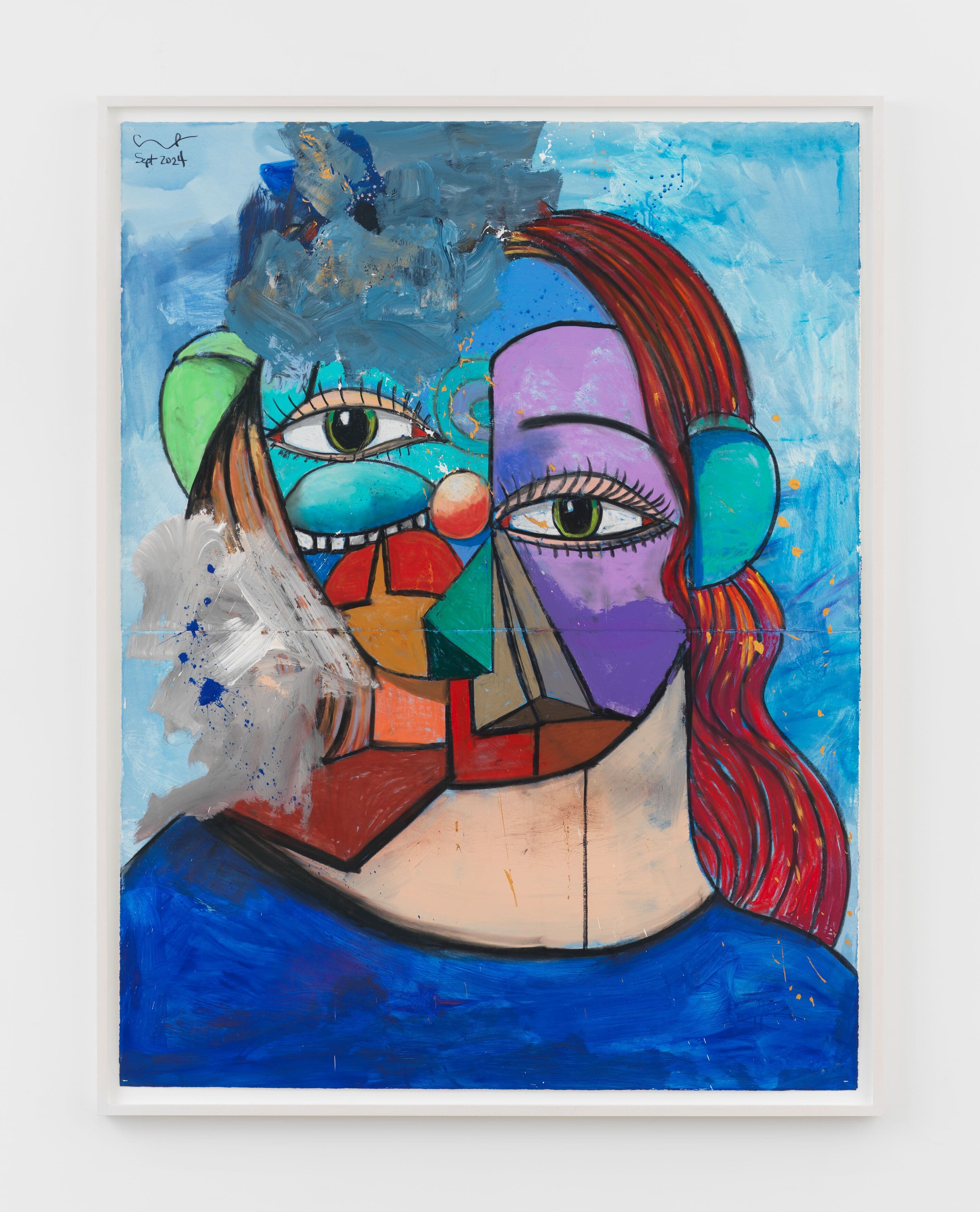
George Condo, The Redhead, 2024. Acrylic and pastel on paper, 78 x 60 inches. © George Condo. Courtesy the artist and Hauser & Wirth. Photo: Matt Grubb.
Word count: 667
Paragraphs: 7
Hauser & Wirth
January 29–April 12, 2025
New York
Pastels, George Condo’s latest show, is a knockout. A muscular display of Condo’s gestural physicality, matched only by his febrile dance with color, Pastels hits you smack over the head with a revelatory new body of work from one of our greatest living artists. Evidence of Condo’s hand is ubiquitous—visible brushstrokes, acrylic paint splatters, pressed, almost pulverized pastels—underscoring an expressiveness verging on the combative. But if Condo is indeed slugging it out in Pastels (“When a work wants to put up a fight, I’m happy to get in the ring,” he proclaimed at the show’s preview), the question begs: who is the real opponent?
Featuring twelve large-scale works on paper, Condo’s Pastels, as the show’s eponym suggests, finds the artist in thrall of the mercurial medium known for its chromatic luminosity and friable fragility. A cinquecento invention and later favorite of the Impressionists, pastels were once referred to by Denis Diderot as “the precious powder,” which could “fall off as easily as scales from a butterfly’s wings.” More pencil than brush, pastels were prized by Edgar Degas since the unruly, unstable medium offered a freedom that made it capable of providing optical brilliance and swift improvisation.

Installation view: George Condo: Pastels, Hauser & Wirth, New York, 2025. © George Condo. Courtesy the artist and Hauser & Wirth. Photo: Sarah Muehlbauer.
As with Spectrum and Multiple Personalities (all works 2024), Condo’s own tangle with pastels yields dazzling results. At first blush, portraits rendered in Condo’s signature style—a Cubist-infused mélange of abstraction and figuration to exaggerated, sometimes disfiguring effect—reveal upon close viewing the energetic marks of a rapid hand. Scribbles of color pastel fill the varied geometric planes of a face. A subject’s silhouette is sketched in a solitary line, at times thinning as the pastel stick is worn down. If velocity, then, is central to Pastels—Condo noted most of the works included in the show were completed in one sitting—improvisation is what allows him to take off.
Like the jazz masters he namechecks as influential to his work—Miles Davis’s vanguard 1972 album On the Corner, chief among them—Condo’s Pastels evince an artist working on the fly, adopting a spontaneous approach to his compositions. Such is the case with Brown Expanded Head. Contrasting the turbid hues of its acrylic background wash, sketched lines of red, white and, most vividly, yellow pastel animate the contours and facets of the subject, lines curving, circumscribing, and defining the boundaries of the portrait. Just as the greats Ornette Coleman and Sun Ra riffed on a chord’s harmonies to create novel melodies, Condo is making it up as he goes. But if improvisation is the technique, liberation is the desire animating it. In the case of Pastels, Condo is in search of emancipation for his subjects. Talk of bodies and their representation has always accompanied discussion of Condo’s work, but in the era of Trump redux, such conversations have taken on a freighted urgency. Speaking at the preview event, Condo inveighed against the current “dystopian age,” a period marked by increased repression and censorship in which people, he mused, were self-reflexively asking, “Am I allowed to be me?”

George Condo, Collision Course, 2024. Acrylic and pastel on paper, 78 x 60 inches. © George Condo. Courtesy the artist and Hauser & Wirth. Photo: Thomas Barratt.
Combating the powers arrayed against self-expression, those forces that seek to repress—political, religious, economic, take your pick—is Condo’s true quarry, a match that plays out to riveting effect in Collision Course. A portrait of division, Collision Course calls to mind the Dario Argento-esque denouement to Coralie Fargeat’s body horror film The Substance. On one side, Condo’s subject is a freakish visage assembled from brightly colored shapes, a solitary bug eye, and square-toothed gaping maw; on the other, looking out from behind the chaos, is a sultry almond-shaped eye, lashes, brows and all. Heightening the overall sense of an internalized frenzy, splashes and smudges of neon orange and fuchsia acrylic punctuate the composition. Make no mistake: Condo isn’t fighting with his subjects, rather he’s wresting them free from the bonds holding them back. And like any good fight, you need to land just one good punch. Lucky for us, Condo isn’t sparing any.
Joseph Akel is a New York-based freelance writer and editor. His non-fiction writing and criticism have appeared in the New York Times, the Paris Review, Frieze, and Vanity Fair, among others. Additionally, he has penned several artist monographs, most recently for artist Doug Aitken. Akel is currently working on his first novel. He holds a master’s degree in Art History from Oxford University.