Dieter Roth: Islandscapes
Word count: 824
Paragraphs: 7

Dieter Roth, SURTSEY, 1973/1974. Eighteen prints in cassette; collotype printing (one–eight colours) on white paper on cardboard, 19 5/8 x 25 5/8 inches. Courtesy Hauser & Wirth.
Hauser & Wirth
February 25–April 19, 2025
New York
Writing on Guillaume Apollinaire in 1946, Jorge Luis Borges quipped, “Among the obligations authors can impose on themselves, the most common and, without a doubt, the most prejudicial is that of being modern.” Borges damns the early-twentieth-century avant-garde, saying it only conceived of itself in relation to the history of art or literature and thus condemned itself to fade into oblivion. Contradicting Borges, Dieter Roth (1930–98) yoked himself to the whirligig of time and made himself into a one-man avant-garde, a choice that allowed his practice to constantly reinvent itself.
Our problem with the avant-garde, taking the term in its military sense as an attack force, is that there are no more establishments or academies against which to revolt. Marcel Duchamp’s notion of anti-art no longer matters because each new day brings us something new—or at least something that thinks it’s new, since even the artificial continuity of traditional art history has practically disappeared. Dieter Roth’s greatest gift was constant self-renewal, the ability to be a Proteus in a world of one-trick ponies. The man who could famously draw with both hands simultaneously was not a Jack locked away in his box, but instead the mole in Whac-A-Mole, always popping up where you least expected him.
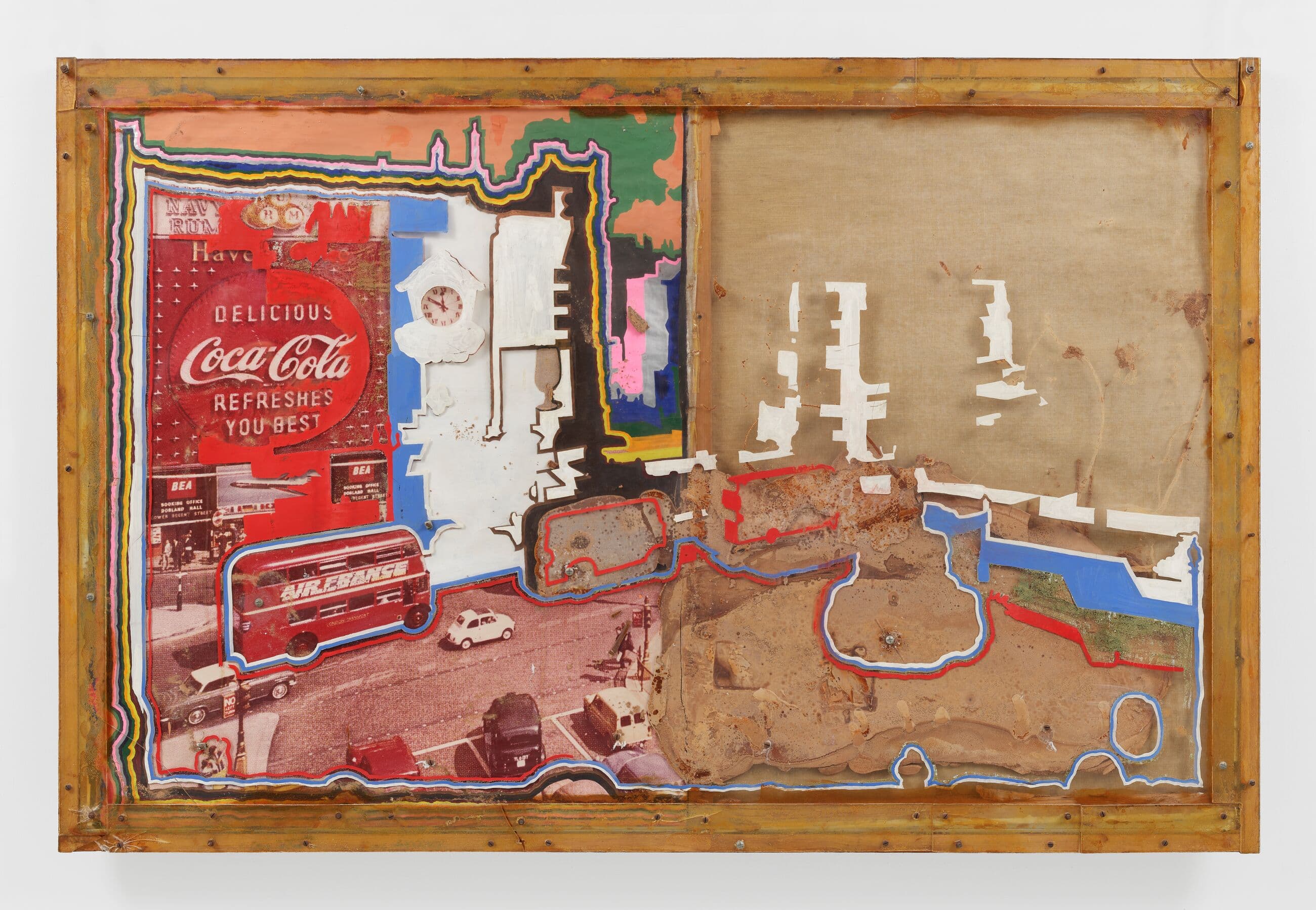
Dieter Roth, Giant Double-Piccadilly, 1969–73. Chocolate, acrylic paint and/on photographic colour print on canvas (double-sided), 63 x 86 5/8 inches. Photo: Sarah Muehlbauer.
The current modestly sized show at Hauser & Wirth, predominantly made up of graphic work, covers roughly a decade of Roth’s production, from 1962 to 1974. Its title, Islandscapes, refers to Iceland, where Roth moved in 1957 with his then soon-to-be wife, the artist Sigríður Björnsdóttir. But any resemblance between Roth’s experiments with Icelandic landscape and a prototypically romantic quest for the picturesque in nature is purely coincidental. In fact, the first landscape to greet the visitor here may not even be Icelandic in origin. Aus der Hand in den Mund (Pram) (1972)—the expression literally translates to “from the hand to the mouth”—shows, in receding perspective, two figures pushing a child in a pram along the crest of a hill. The print (“collotype printing (5 colors) under screen printing (2 colors) on white card”) reflects the complexity of Roth’s graphic technique, layer upon layer: a frame, vaguely resembling a television screen, then ghostly framing of the figures in receding boxes, all to allude to a banal movement—taking the baby out for a ride in its stroller. But the point is not trick photography. Instead, this work is a meditation on the dynamic forces that all landscape depictions represent. The sharp division between sky and land, with the figures pushing the stroller functioning as a demarcation, establishes the distance between the cosmos above and the world we inhabit, both ultimately transient phenomena.
Nowhere is this fatal link between motion and death more evident than in SURTSEY, a collection of “18 prints in cassette; collotype printing (1–8 colors) on white paper on cardboard” created in 1973 and 1974. Surtsey is a volcanic island on the southern coast of Iceland, which erupted into existence in 1963 and is predicted to disappear by 2100. The idea of a landform with such a compressed and thus comprehensible lifespan must have appealed to Roth, who depicts the island variously as a steaming rock and a steaming bowl of food. The prints, appropriately, hang on the gallery’s southern wall, to provide a contrast with Roth’s prints of scenes in northern Iceland, which hang on the north wall. Although it is the dynamism of the universe that triggers a reaction in Roth, he nonetheless reminds his viewers that what they are seeing is graphic work, with color options framing the image of the island. These prints may represent the invisible action of nature, but they are in no way attempts to copy nature.

Dieter Roth, Am Meer (By the sea), 1970–74. Sugar mixture, particle board, wood, and paper; fifty-four particle boards with thirty intact umbrellas and twenty-four broken umbrellas, one signed particle board, 10 1/4 x 60 3/8 x 26 1/8 inches. Courtesy Ursula Hauser Collection, Switzerland. Photo: Jon Etter.
The show also contains several delightful escapes from Iceland. Gewürzfenster (Spice Window) (1971) takes the form of a wooden frame enclosing five windows that open onto abstract flows of layered spices. The edible metamorphoses into the geological in this wall sculpture since viewers might easily confuse the layers of spice with a cross section of sedimentary stone—all to emphasize the processes of nature, the formation and decay of natural structures. Giant Double-Piccadilly (1969–73) is double-sided “chocolate, acrylic paint and/on photographic colour print on canvas.” Appropriately, given Roth’s early work as a commercial artist, this large 63-by-87-inch piece hangs like a free-standing advertisement sign and constitutes a summary of his themes: the chocolate that must decay, evanescent products (a Coca-Cola sign appears prominently on the left side of the composition), and motion in his allusion to Piccadilly Circus. And finally, Am Meer (By the sea) (1970–74), a construction of miniature beach umbrellas arranged in ranks, six in breadth and nine in length. The umbrellas are made of “sugar mixture,” so they too will eventually decay and fall apart. Nothing lasts, not even art, so Roth quixotically dedicated his career to documenting that process.
Alfred Mac Adam is Professor of Latin American literature at Barnard College-Columbia University. He is a translator, most recently of Juan Villoro’s Horizontal Vertigo (2021), about Mexico City.