Beauty is a Blast: for Jeremy Gilbert-Rolfe
Word count: 1372
Paragraphs: 18

Installation view, Beauty is a Blast: for Jeremy Gilbert-Rolfe, Art Cake, New York, 2025. Courtesy Art Cake. Photo: Vera Miljković
Art Cake
April 6–27, 2025
Brooklyn
This extensive exhibition celebrating the artistic and intellectual influence of the painter and writer Jeremy Gilbert-Rolfe, contains approximately 250 individual pieces by nearly as many artists. All works are hung salon style or placed around the floors of two large rooms of Art Cake’s warehouse-like space located just below Sunset Park in Brooklyn. Curated and organized by the artist and curator Christian Haub, his close friend, abstract paintings appear to predominate and are interspersed by a good number of Gilbert-Rolfe’s paintings which are mostly of a size larger than the contributed works by the other artists.
Walking around the show at the opening, what immediately became clear, if one can trust sweeping impressions, was that there was very little performative painting on display. By this I mean work that is above all concerned with its immediate effect on the viewer, an agenda that most regular gallery-goers are so accustomed to by now that we take it for granted. But this was work mostly of a different order: the chosen artists, friends, former students, subjects of his writing or of his particular interest, seemed to have a commonality of intention in working out some internal problem that they discovered in their chosen medium as opposed to presenting a burlesque of some pictorial convention produced amid the present meritocracy of the visually talented. The former may possess less immediacy but may have more staying power. The critical and artistic generation of which Gilbert-Rolfe was part of, some of whom are represented on the walls or pre-date him, (there were great paintings by Norman Bluhm and Michael Goldberg) never even had the word ‘talent’ in their vocabulary. It was quite beside the point.

Installation view, Beauty is a Blast: for Jeremy Gilbert-Rolfe, Art Cake, New York, 2025. Courtesy Art Cake. Photo: Vera Miljković
I think what I am trying to say is that I was happy to be there looking at all this serious work. There wasn’t a lot of busyness present, more of a concern with structure and an ongoing speculation as to what exactly a painting or a sculpture might be. This reflects well on Gilbert-Rolfe, who I only knew slightly near the end of his life but was loved and admired by people I love and admire.
Of course, I had known his writing since art school in the seventies. He was a tangential presence but a substantial contributor among the infighting art critics who were mostly identified with the rigorous yet glamorous Artforum of that era, where a standard was set for art writing that for many of us has not been surpassed.

Installation view, Beauty is a Blast: for Jeremy Gilbert-Rolfe, Art Cake, New York, 2025. Courtesy Art Cake. Photo: Vera Miljković
I have read Gilbert-Rolfe’s long Artforum essay, “Brice Marden’s Painting” occasionally since it first came out in the October 1974 issue. It remains a landmark and a masterpiece of its kind, and I am always surprised at recognizing the little chunks of judgement and observation that I have taken to heart, not realizing until again confronted with them that these insights were first discovered there, then. One was where he wrote that:
“… one is reminded that painting seems to be an inherently conservative activity. But one is also reminded that—as Walter Benjamin remarked—advanced thought is necessarily conservative in its attempt to develop the argument it inherits without collapsing into an illusionary clarity.”
The other one:
“…as Victor Schlovsky said, in “Art as Technique,” art is primarily a means of defamiliarization, less concerned to invent than to slow down—or concentrate—the audience’s perception of the familiar, the system we ourselves inhabit.”
The article was accompanied by images, including a shot from Jean-Luc Godard’s 1965 film, Alphaville next to an image of Édouard Manet’s In the Conservatory (1879) nearby two Marden paintings, keying in the student, me, into a realm of painting complexities, art historical, cross-cultural, institutional, physical, that kept me reading and puzzling out the subject into the present.

Installation view, Beauty is a Blast: for Jeremy Gilbert-Rolfe, Art Cake, New York, 2025. Courtesy Art Cake. Photo: Vera Miljković
I am not able to summarize his philosophy or influence beyond his emphasis on the confluence of the sensual and the intellectual. We read a writer or artist/critic, want to talk to them, be around them, for those invaluable glimmers of observation and bits of information that continue to come up as their inquisitive nature expands while it might inevitably contradict itself, or in the case of Gilbert-Rolfe, embraces much more than one expects.
As is evidenced in his writing and certainly in the present exhibition, in his painting, he would lose then again find his way through the sensory inheritance and the labyrinthine two dimensions of the form. It happened every time. The oldest of his paintings present, Open Warfare (1991) oil on linen on five stretchers, has a slightly beveled movement among the attached panels, like a folding screen, that is broken up by three striped verticals or moldings that interrupt a vigorous but controlled brushed surface in bright yellow spread across it.
What is unusual is how one can’t quite settle on the initial conception, in this painting or any of them. If one could define his territory, it would be geometric abstraction, in that it, in general, adheres to a clear painting program, has internal clearly marked subdivisions, etc., but Gilbert-Rolfe, either through intention or default, needed to wander through other modes, here a quasi-Impressionist facture, to bring it home.

Installation view, Beauty is a Blast: for Jeremy Gilbert-Rolfe, Art Cake, New York, 2025. Courtesy Art Cake. Photo: Vera Miljković
Emanuel Shinwell Goes to University (2009) the title, referring to a famous left wing government official from Scotland who never made it past the eleventh grade, nationalized the coal mines, and established the forty-hour work week, lived to over one hundred and ended up in the House of Lords, is perhaps another way of saying “an apotheosis” and perhaps every Gilbert-Rolfe painting is a kind of glorified ideal. This one is ostensibly a grid painting but goes from light to dark through a diagonal middle, where some of the grid boxes are broken up into smaller units of patterning, some diagonal stripes, or long vertical rectangles.
Without being didactic, he seems to want to demonstrate, while he finds out for himself, how long he can delay before completing the transition from one section of the painting to the other one, how many capricious noodles and byways can the structure accommodate before the endlessly arbitrary reasserts itself. His paintings are a series of remarks contradicting a general notion that everything has been done, that there are interesting painting issues still out there, that not all is completed. I was particularly reminded of Yve-Alain Bois’ writing on Piet Mondrian and his term borrowed from Joseph Masheck of “the spatial weave”.
The primary agent in all Gilbert-Rolfe’s works, its primness continually destroyed, meaning the Mata Hari that keeps a check on his earnest Einstein, is color. These fleshy pinks, acrid yellows, curious browns, seem very local, close to him, a kind of coded confession and often beyond the merely sensual. As much as they are modern paintings, and more essayistic than most, there is also more, deeper content, painting erudition, in conversation with pre-modernist easel painting, in his willingness to stick with smaller brushes and create a picture that refuses to reveal all of itself immediately.
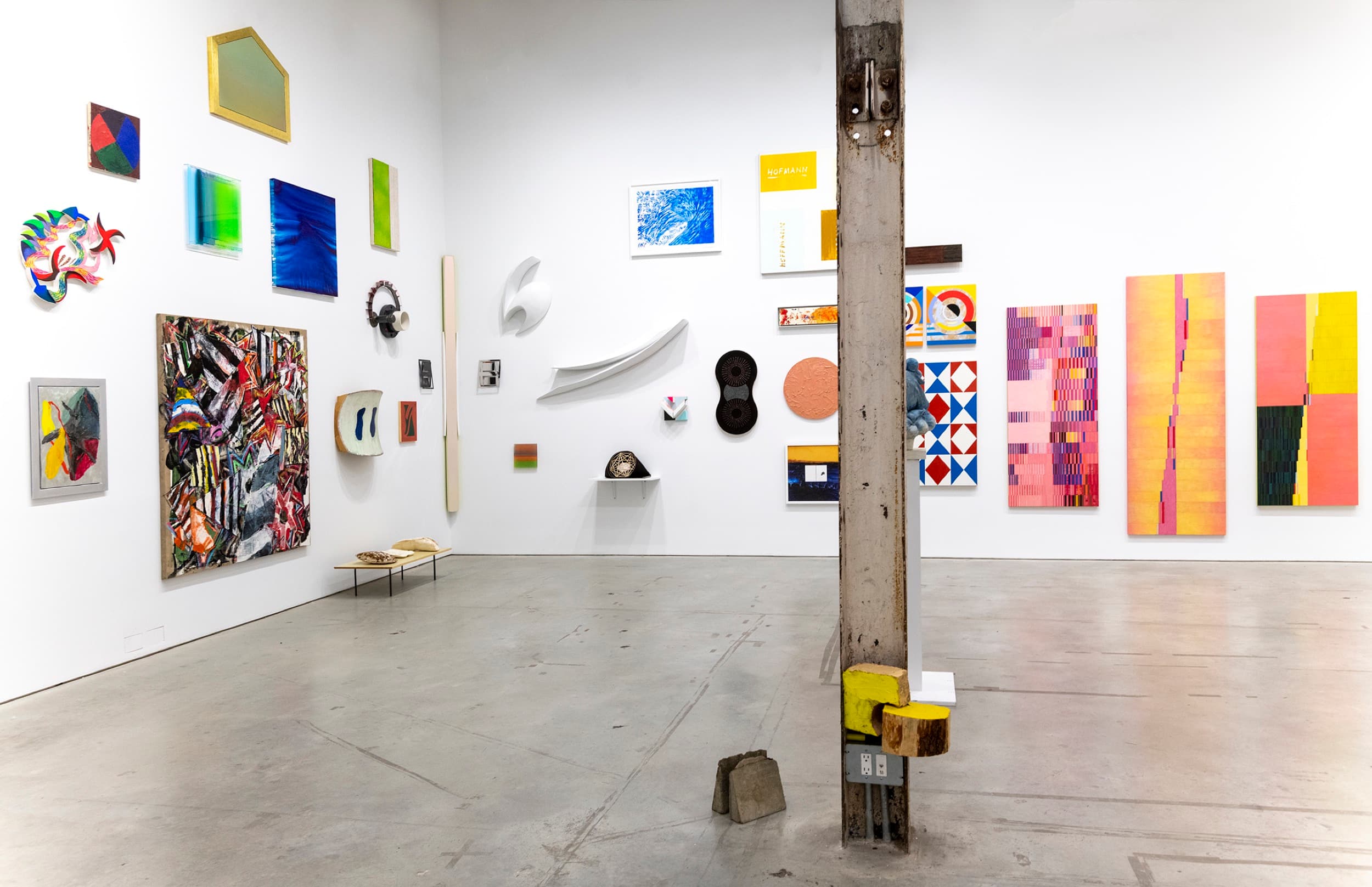
Installation view, Beauty is a Blast: for Jeremy Gilbert-Rolfe, Art Cake, New York, 2025. Courtesy Art Cake. Photo: Vera Miljković
The best metaphor for his work might reside in an occasion a few years ago where we received a gift from him, as I am sure many others did, of a box of specially made chocolates, a collaboration with one of his former students, the artist Rebecca Norton (in the show). They designed the box and folds, a miniature grid of vertical rectangles made up of varied, characteristic colors. It was smaller than the usual American candy gift box, closer to the size of a paperback book. Each of the candies were not peculiar but unusual enough, by a custom chocolatier and freshly thought through, though all were variations on the chocolate-covered square. It was a surprise and a treat to receive, and seems now to signify his mission, that of an independent mind that ultimately seeks inclusion and to give pleasure to the senses, but slowly, a little at a time, within known arenas that he yet makes strange and new. One wants to spend longer with his paintings now, and see more and more of them.
Joe Fyfe is a painter and a writer who lives and works in New York.