ArtApril 2025In Conversation
TYLER MITCHELL with Rhea L. Combs

Portrait of Tyler Mitchell, pencil on paper by Phong H. Bui.
Word count: 5468
Paragraphs: 113
Gagosian
February 27–April 5, 2025
New York
In 2024 Tyler Mitchell traveled to coastal Georgia to create a new body of work. He scouted a number of locations, but when he returned to make photographs he gave his subjects minimal direction. Mitchell’s intent was to discover moments occurring naturally, spontaneously, and in that way to create photographs that communicate in a layered, complex fashion. On the occasion Ghost Images, Rhea L. Combs spoke to the artist as they toured his exhibition. In the conversation that follows, Combs and Mitchell discuss the origins of Mitchell’s new work, avoiding the flatness of nostalgia, and how the idea of ghostliness informs his thinking.

Tyler Mitchell, Lamine’s Apparition (After Frederick Sommer), 2024. Gelatin silver print, 40 x 50 inches. © Tyler Mitchell. Courtesy the artist and Gagosian.
Rhea L. Combs (Rail): It’s nice to be speaking with you, Tyler. First, please tell me about the exhibition. How did the body of work in Ghost Images come to be?
Tyler Mitchell: It started with a question: Can my subjects not only confront the viewer and be seen, but also be felt, inhabiting space as spiritual presences? Can photography capture what is unseen but deeply felt?
When I was in Georgia making this work, I felt the presence of others. I know others have too. André Leon Talley, for instance, who lived in Savannah, wrote about finding solace beneath a three-hundred-year-old live oak known as the Majestic Oak. I came across an old coffee table book of his photographs, where he captured friends gathered under that tree. In it, he describes feeling grounded, at peace—connected to his ancestors through its towering presence.
I’m also inspired by artists like Robert Gober, who bring to the surface the sociopolitical undercurrents of American life in subtle but profound ways. His work, like much of what I’m drawn to, reveals what lingers beneath the surface—histories, identities, and the ghosts of a place.
Rail: There’s an ephemeral quality to your work, a sense of subtle beauty, even a dreaminess. You’ve worked in the South a lot; you’re from Georgia. I’m curious: for this project you traveled to the coastal area of Georgia—what does that place or particular location mean now, in this moment that we’re in, which feels very fraught in the United States? Has it impacted the ways in which you remember, recall, and place the South so prominently in your art practice?
Mitchell: There’s always this divide we talk about, the coasts versus the rest of the country. There’s a tendency in metropolitan hubs like New York or Los Angeles to perceive the South as retrograde: detached from the values, politics, and the social intricacies of contemporary, metropolitan life. But what Imani Perry so brilliantly draws out in her book, South to America, is that the South isn’t some peripheral place, in fact it’s the foundation—all of the complexities of race, social dynamics, and politics within the South are entirely bound up with the history of our country. It’s actually at the root. And to understand where we find ourselves, we have to look there.
I’m from Georgia, and I’m interested in mining my own upbringing. But it’s only now with distance and hindsight that I feel I can do that. I don’t think I could have made this work if I still lived in Georgia. It’s the distance that is making the work complex. It’s not about documenting a place—it’s about interpreting it, reflecting on it through the lens of time and memory.
Rail: Do you feel that you are creating a sort of nostalgia?
Mitchell: The work engages with nostalgia, but it’s not the foundation. Each photograph moves across temporalities, partially because there aren’t many clear markers of time within the compositions.
Rail: In that sense, you’re playing with time, bending it, making room for distant historical realities as well as the present moment.
Mitchell: Exactly. Nostalgia on its own is too flat of a concept for what I hope my work is doing. I certainly deal with it. Especially when I am mining my own memories of growing up in Atlanta to create some of these moments, to think about possibilities for pictures. But I’m not relying on nostalgia to make the work. I like when you can tell the work is contemporary, yet it still feels suspended out of time.
Rail: I am particularly struck by Old Fears and Old Joys (all works 2024). One of the things it reminds me of is the Charles Burnett film, Killer of Sheep. I may be wrong, but it gave me that cinematic sensibility.
Mitchell: I hadn’t consciously thought of Killer of Sheep, but what I’m realizing is instinctually when I’m making something, so many of those influences are burned in my memory. It’s like nature versus nurture. I would say Killer of Sheep is part of my nurture. I mean, I was raised and educated on the films of Charles Burnett.
I think of that iconic black-and-white image of the boy jumping from one roof to the other, and his legs, the way his body forms this amazing graphic outline. It’s just so striking, and it’s so human. A lot of my work begins with visual research, so I’m often trying to fuse my language with things I read and encounter in the world. In a way the whole show is speaking to a lineage of visualizing the South, but I’m carving out my own approach within that tradition.
Rail: Can you describe how you made Old Fears and Old Joys?
Mitchell: So it is, literally, a picture of two boys laying on top of a baseball dugout with the sun behind them. I’m below the boys looking up towards the sky. The idea of looking up—of shifting perspective—is a recurring theme in my work. I often think about bodily suspension as a theme in my photographs. I made a film called Idyllic Space, which was designed to be projected on the ceiling, so the viewer had to recline and look up. That entire film was about the act of looking—both upward and downward.
Rail: Did you set them up to be positioned in this way? I can’t help but to think about the fragility of Black bodies, particularly male, and laying prostrate—there is a whole history associated with that visual, which is not usually good.
Mitchell: I want that baggage—the weight of history, of images, of how we’ve been conditioned to see the Black male body. It’s something we all carry. But in my work, I want that difficulty to be met with suspension, with freedom, with joy.
Rail: Tension.
Mitchell: Exactly. Tension is what I’m interested in. Basically every picture I make is loosely staged. I go in with some preconceived ideas, but I’m also letting something natural emerge.
This image in particular came to me like a dream. I had this vision of two or three boys lying down, maybe they took a nap, or maybe they were just sunbathing on a baseball dugout. I kept thinking about that. I’d seen some baseball dugouts in Georgia, while driving around, and they’re usually perched super high above the field. And I thought, “Interesting… I wonder if anyone’s ever climbed up there?” Which reminded me of climbing fences—that playful kind of mischievousness.
Rail: It’s interesting, to fuse play and memory in a way that seems to engage both your personal history and the broader histories of African Americans.
Mitchell: I’m always exploring photographing the Black male body in a dynamic that allows fragility to coexist with joy. That feeling is more in my heart, more in my gut, than in my mind. So I have a hard time intellectualizing it.
Rail: Can you explain the small photograph paired with the large image of the boys on the dugout?
Mitchell: It’s a swamp bubble, which is quite literally a picture of just that. The image of the boys looks towards the sky, but here this one looks down at the ground. I like that perspectival contrast. And I like Deana Lawson’s description of a still life she made as a “portal.” I wouldn’t necessarily call mine portals, but I do think they capture a detail that tells you more about the whole than seeing the whole itself—if that makes sense.
Rail: Interesting. You mentioned the boys on the dugout as a dreamscape, but this image of the swamp bubble—did that come as part of it? Or were you in the studio, thinking about the show when this element came to you?
Mitchell: Both—before and after. This is a language I’ve been developing for five or six years. I’ve always been drawn to perspectives that shift between high and low. I’m interested in the tension, as you said, of the body being suspended between two states—both captured and free, transcending the frame while being caught and contained within it. I call this arrangement or style of hanging an “attached diptych,” and I like how it sets things in juxtaposition. In this instance the swamp bubble offers a counterpoint to the feeling of transcendence.

Tyler Mitchell, Jekyll Driftwood Tableau, 2024. Archival pigment print, 64 x 79 1/4 x 2 1/2 inches. © Tyler Mitchell. Courtesy the artist and Gagosian. Photo: Owen Conway.
Rail: How did you get interested in coastal Georgia? Did you visit there often when you were younger and living in Atlanta?
Mitchell: I didn’t. My interest was sparked by films like Daughters of the Dust and Eve’s Bayou—even though neither one is set in Georgia. I started wondering, “What’s this other part of the state that I don’t know? What’s the history? What’s my connection to it? How does it feel feel to be there?” I went to Savannah on several trips between 2021 and 2023, when I was doing my show at the SCAD Museum of Art. That’s when I started becoming obsessed with the idea of making a project down there.
Rail: I’m curious about your process. Tell me about the works you made on the mirrored surface.
Mitchell: I think a lot about how to work with images in ways that expand their possibilities while still keeping their essence intact. The image is always my starting point, but I’m interested in how it can evolve—how it can become something more layered, more immersive, without losing its fundamental presence.
With these mirrored works, I’m UV printing the image onto the back of a piece of glass. The reflective effect comes from how I manipulated the file—where you see your own reflection, I’ve rendered that area fully white. Photographers would call it “blown out.” In UV printing, color is created with ink, but the white areas remain empty space—no ink at all. This allows the viewer to become implied in the work, shifting how it’s experienced depending on where they stand.
Rail: So in the whiteness comes the color—
Mitchell: Literally, the viewer enters the work. Or maybe it’s the experience of seeing itself.
Rail: It also feels like a nod to the selfie world and selfie culture, and how many folks you see using mirrors in bathrooms, or the reflection from elevators to snap photographs of themselves.
Mitchell: For me, it begins with the act of looking. Of course, I’m aware of that impulse in today’s culture, and I think we should embrace those layers rather than resist them. It’s human nature to want to see yourself preserved within moments of your choosing. In that way these works are engaging with the story of Narcissus—how mediated images ultimately function as mirrors.
Rail: Right. And your practice is really trying to either complicate or dismantle these notions of high and low.
Mitchell: Absolutely.
Rail: I know that this idea around draping is something we’ve previously seen in your work. I would love to understand a little bit about how it’s shifted and changed over the years.
Mitchell: Five years ago, I was doing a show curated by Isolde Brielmaier at the International Center of Photography here in New York. There was this long hallway, and I realized that most of my photographs couldn’t really be experienced properly within such a narrow space. So I had to ask myself, “How do I deal with this space?” The idea of the draping, it actually came out of a constraint.
Laundry lines had already been a recurring motif in my pictures. I’ve always been fascinated by them. Whenever I think about Gordon Parks and LIFE magazine, those depictions of care and domesticity and laundry, or Mark Cohen’s Dark Knees, which are difficult photographs, often with working class families in Pennsylvania—there’s laundry lines, always as a motif. It’s such a visceral, poetic symbol of care, of family, of maternity, of history, and of the cultural significance of fabric—it has all these layers in it that I just was obsessed with. So I thought, “Could I do a laundry line installation down this hallway?”
And I did. It was a good starting point, but the form of the line and the content of the images didn’t fully align. The images were just portraits printed on fabric, and while it was a visually striking installation—one of those things that once you see it, you can’t unsee it—it wasn’t fully realized. I hadn’t originally made those pictures with that format in mind. So I wanted to go further on the journey of making pictures with that specific intention. That’s how we arrive at these works.

Tyler Mitchell, Simply Fragile II, 2024. Archival pigment print, 40 5/8 x 32 5/8 x 1 3/4 inches. © Tyler Mitchell. Courtesy the artist and Gagosian. Photo: Owen Conway.
Rail: Simply Fragile II is an absolutely striking photograph. Your perspective, the depth of field, this beautiful—I don’t know if that’s a lightning bug? Talk to me about how you set this photograph up.
Mitchell: Now that we’re dealing with a straightforward portrait, talking about casting is important. I’m always looking for people who have a certain poetic quality—something ineffable draws me in. I usually cast quite locally. This is a young man from South Carolina. I’m always looking at families or individuals in or around Georgia. And I look far and wide. I ask friends, work with casting directors, I look on the internet, I drive around. Lamine had in him some sort of quality that I was drawn to, just visually. We traveled down to Cumberland Island to make this portrait. For me, it’s really a moment of sitting with him. He’s sitting with you. There’s a serenity to his gaze. It’s called Simply Fragile II, because it iterates on a work I made several years ago called Simply Fragile, which is in reference to Gordon Parks’s photo Boy with June Bug.
Rail: And I would say that there’s also simplicity in this. It’s a nod back to what we were talking about earlier, in terms of that notion of freedom and play, and just literally having that kind of everyday moment of being able to relax and rest, and that within that gesture of non-gesture is power. And that gets reinforced and reinscribed by his gaze, that direct gaze. His gaze draws you in. He brings you with him, but it also allows a certain timelessness.
Mitchell: I love these moments of serendipity that you couldn’t really make up. You know? He’s ignoring the bug and, like you said, he’s sitting with you, but there’s this sort of confrontational path on his little shoulder.
Rail: Very much so. I’m wondering, are you familiar with RaMell Ross?
Mitchell: Absolutely, Hale County This Morning, This Evening is sort of a transformative film for me.
Rail: For me, this work conjures RaMell Ross, Hale County.
Mitchell: What Ross does so brilliantly in Hale County is let the film sit back—he doesn’t impose a narrative or tell you how to feel. Instead he allows the everyday poetics of Black life to unfold on their own terms. The cut, the frame, the perspective, the implied narrative—it all breathes. And in achieving that, he lets Blackness breathe.
We had a conversation where he spoke about his idea of the “epic banal,” of celebrating the banality of life—of little summertime moments—and I feel a deep connection to that.
Rail: Within that moment, when you’re looking at the Black body, you’re understanding how contested it is, and what it means to say that someone can be in an everyday, quotidian moment, and there need not be more to it.
Mitchell: Yeah, I find there’s an incredible appetite to narrativize our existence. “Where did they go? Are they in danger? Are they here? Are they happy?”
Rail: Yet, they’re just being.
Mitchell: Photography is good at allowing that sort of existence to breathe.

Tyler Mitchell, Cumberland Island Tableau, 2024. Archival pigment print, 63 x 78 inches. © Tyler Mitchell. Courtesy the artist and Gagosian.
Rail: Considering the tableaus, how long did it take to set up a shot like Cumberland Island Tableau or Jekyll Driftwood Tableau?
Mitchell: Process is sometimes hard for me to talk about, so I’ll try to be direct. I’m always thinking, always playing.
I traveled down to Cumberland Island with this family—it was a very special trip. When you’re on Cumberland Island, there are no vehicles, so we’re walking and we’re exploring together. And in that process, I’m setting up moments. I’m looking for frames or spaces that excite me, a bit like a film director.
I had been to the island before, scouting the locations and forming ideas, but I never walked into these photographs with the explicit intention of staging them exactly as they turned out. There’s always an element of discovery. I like working in group environments where anything can happen—where different kinds of moments emerge naturally. There were probably thirty other moments that didn’t make it into the show that unfolded. Maybe someone was tired and sat down, or wandered to a water fountain, and I followed and took a couple portraits.
So what I’m saying is it’s always a collaborative experience, especially when working with a family. People have deep relationships to one another. Things start happening organically. People just start conversing, as all people do, but especially in the way Black people do. You just let things fall into place.
Rail: People have their own roles in terms of their persona when they’re with family.
Mitchell: Exactly. I’m the brother; I’m the sister. Hale County is really good at that. I have to shout it out again, because Ross is there with his camera and you have this distinct feeling that life is playing out in front of him, because people are being who they are, who they believe themselves to be, their archetype, or their position in the community. A little bit of that takes place in a microcosm on shoots with these families.
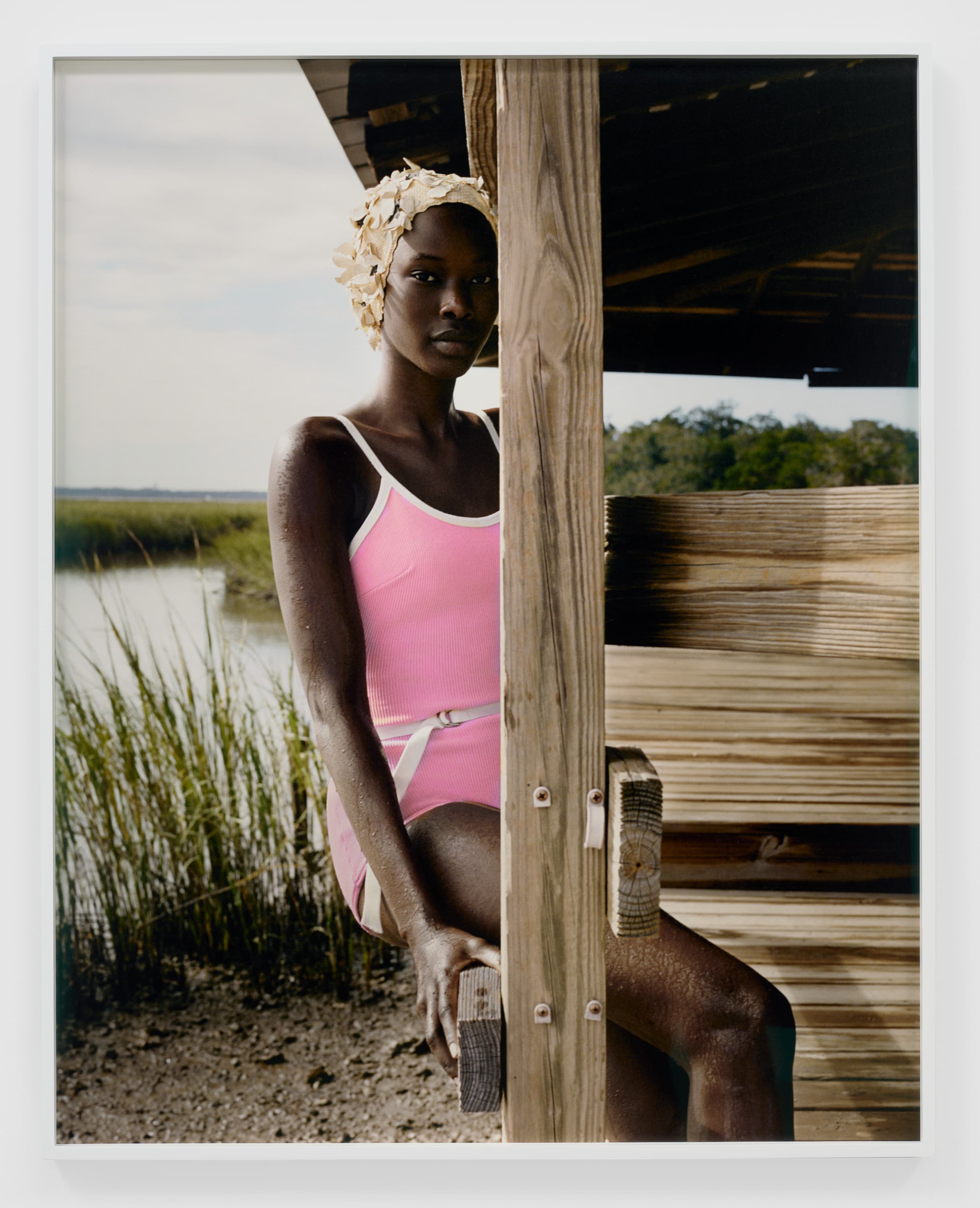
Tyler Mitchell, Bather, 2024. Archival pigment print, 40 3/4 x 32 5/8 x 1 3/4 inches. © Tyler Mitchell. Courtesy the artist and Gagosian. Photo: Owen Conway.
Rail: So for example, in Bather, did she just happen to have that fabulous pink bathing suit?
Mitchell: That’s styling. And it’s a good example of what I’m saying. I was probably taking another picture of a bug or some wooden wall that I found interesting. And she was just sitting there. I look to the left and I’m like, “Wait, wait, don’t move! This is too good.” And we come back to the studio, we edit, and that moment felt right within the full sentence of the show. So yeah, we stage, we style—but where she ended up, that was a found moment. A lot of other stuff was happening outside the frame that was total chaos.
Rail: Are you doing the styling?
Mitchell: I work with Yohana Lebasi who comes down with me and brings a few things, but we keep it very loose and open. Sometimes we shop locally. We’re never really looking for very highbrow or fancy things. We’re looking for things that feel real, feel as delicate a touch as possible, particularly the touch of pink. I knew these photographs would have a lot of green from the trees and the moss, and a lot of blue from the sky. So if I wanted any pop of anything, I thought, let’s just make it a very delicate pink. So there is always a little bit of color storytelling happening with the style.
Rail: Speaking of style, who are the women in Convivial Conversation?
Mitchell: There’s a conversation happening between them—both literally and visually. And again, this is what I mean about family. People just get to chattering, falling into their natural rhythms.
There’s an element of staging, but also moments you simply couldn’t orchestrate if you tried. These are generations of women. There’s a mother, a grandmother, and a friend in the middle. You can see again that motif of laundry appearing again, and there’s this real gestural movement in the drape of the fabric. It feels alive, unfolding in real time.
Rail: How did this idea come to you? Because I see a bridge, I see an extension, I see ancestry. The use of the light is spectacular here as well because it creates an ephemerality, but there’s also a grounding. The photograph shows the women in a moment when they appear to have forgotten the presence of a camera. That’s the sincerity in this image, I think, which is beautiful. In terms of the layering, it gives a very dramatic and theatrical experience as well. But what were you going for when making this image?
Mitchell: It started with the first question I asked myself before even conceptualizing this show: Can portraits not only assert presence but also leave behind traces? Can figures both appear in the frame and simultaneously recede?
I was drawn to this idea of ghostliness—not in the straightforward, spooky sense we associate it with in pop culture, but as something more lingering, more felt. I’ve been in conversation with Tina Campt about this idea of Black haunting—how it’s not about absence, but about presence in a different form. It’s a haunting that is specific, yet deeply grounding.
Rail: It’s something closer to a knowing. There’s a knowing, I think.

Installation view: Tyler Mitchell: Ghost Images, Gagosian, New York, 2025. Courtesy Gagosian. Artwork © Tyler Mitchell. Photo: Owen Conway.
Mitchell: Right. It’s a kind of acknowledgement, that there are others with us from the past. I do believe in that to a degree, and I find it comforting. When you’re in the South, you see the way the moss hanging from the trees moves in the wind, and you feel that it holds strange memories of horror but also of joy. That’s where this show began: Can my portraits create that same feeling—of haunting a space in a way that feels grounding, the way I feel grounded when I’m in coastal Georgia?
And then, of course, there was the process—layers of experimentation in the studio, which was really fun. I just started draping things, letting it be intuitive. It quickly became a kind of play, the way I imagine a painter or sculptor works with material. At first I thought, “Maybe this will be a straightforward single fabric work.” I found an interesting drape on a frame, and then I layered another piece over it.
I want to push the form as far as I can, while always honoring what’s happening in the photograph. If the image didn’t already contain those layers—those elements that lend themselves so well to another drape of fabric—I wouldn’t have done it.
Rail: I love that you’re remaining open to what the situation might present you. That curiosity which we see in the portraits and in the eyes of the sitter, in the exchange of body movements, or the positions of the sitters—I think we’re seeing that play, that curiosity, and it’s nice to know it’s such a prominent part of your practice.
Mitchell: I think it’s new territory for me. Every photographer I know, personally, and that you may know as well is quite—well, we’re control freaks.
Rail: You said it, I didn’t it! [Laughter] But let’s lean into that. What does that mean for you?
Mitchell: I mean, we’re not used to uncertainty. In photography, we want precision, we want to know the exposure,—exactly, not an approximation. We want it to be perfect. We need to know where the light is coming from, how strong it is, how to control it. That kind of control is inherent to the medium. It’s why we do what we do.
And that’s what I mean by being in new territory. In the studio, I’m draping over and over, playing and looking back and having so much fun. Trying different things, like, “What if I put it over a framed photograph? What if I layered it three times? Nope, that’s less successful. What if I go back?” It feels more like I’m sort of moving with gesture and always trying to let the image lead, because I am a visual person in that way, but also allowing the form to heighten that experience in a way that feels just right.

Tyler Mitchell, Ghost Image, 2024. Archival pigment print, 63 x 77 3/8 inches. © Tyler Mitchell. Courtesy the artist and Gagosian.
Rail: Ghost Image is striking. I love the scale of it. Here again, this idea of haunting is quite direct, especially knowing that it is in the South. It also gives me a sense of tension, or apprehension.
Mitchell: This is one of the hardest pictures in the show for me, because it is so direct, so head-on. I felt like I needed one image in the show that fully evokes this idea—of him being at one with the Spanish moss. For lack of a better term, there’s a sense of drape, of enclosure with the netting, a layering that plays with hiding and emerging, capture and transcendence, fugitivity—but also leisure. I want all those layers to unfold. And this one is difficult because it leans so directly into that tension.
Rail: There is also a sort of camouflaging. What does it mean to camouflage as a Black person? It gets to questions of safety, protection, or erasure. There’s this tension between something being protected yet also free within that protection.
Mitchell: I think a word that could come in is “refusal.”
Rail: You see that in his gaze.
Mitchell: Yeah, it’s that moment between confrontation and transgression, that moment of an evocation of a haunting or a presence that is arriving, but not fully there yet. The word refusal comes to me when I look at this picture. Maybe because he’s not fully giving himself over, whether through the light, the net, or his own presence.
Rail: There is the color composition and the intimacy of the lens, even his posing is very Tyler-esque, if you will. By that I mean he presents a vulnerability. I also appreciate that the emotion is complicated. I think one of the things people often comment about your work is this sense of joy they see in your images. Making a conscious choice to represent joy doesn’t mean it’s at the exclusion of other notions, too.
Mitchell: I don’t necessarily—and I think most artists feel this way—want to exist on a binary plane, where I’m pushing the narrative of joy in a flat, one-dimensional way. I want this show to embody a sense of lightness, of uplift, of presence and agency.
Rail: Yes, absolutely. Because you could have a crap day but still have a joy in your heart. As they say in church, “a joy in my soul.” You could have that even when the world is swirling with negativity.
Mitchell: I think it sounds so simple to be saying everything we’re saying, that the layers and complications of emotions are so real within all of us. Why should art not do that same thing?
Rail: One hundred percent agree.
Mitchell: The last room is a real jewel box—a space that celebrates some of my inspirations, like Clarence John Laughlin. He was a great architectural photographer, but his work wasn’t just about documenting buildings. He photographed plantation houses to evoke presences, to suggest something beyond what’s physically there. This room also deepens my exploration of the idea of tableau.
With the tableaus I am always asking myself, “How can I fit as many moments of expression, joy, interaction, play, rest, and confrontation into one frame?” I love family portraits where so much is happening at once, and there’s a lot of little details and moments to get lost in. That’s what tableau does so well, and art always has done that very well—it allows a multiplicity of moments to coexist.
I think of Shine as almost a coda—a final touch that sends you off. It’s a moment that transcends language, a last gesture of peace. He is clearly reclining, but also shrouded in shadow, the foliage casting a kind of veil over him. It continues my visual language, but there’s something slightly darker about it, a quiet tension. Potentially the fact that you’re seeing just a detail of his face, but you’re fully let into what he’s feeling.
Rail: Or see what he’s seeing.
Mitchell: Right. What he’s seeing is just out of frame.
Rail: And it leaves the viewer to question. You could look at it metaphorically—he’s gazing to the future, moving beyond this moment and going to another, sort of an elsewhere.

Tyler Mitchell, Shine, 2024. Archival pigment print, 4 3/8 x 30 5/8 x 1 1/2 inches. © Tyler Mitchell. Courtesy the artist and Gagosian. Photo: Owen Conway.
Mitchell: I love the implied element of photography, that there is something just outside the frame. We don’t talk about that enough. What information you leave out is as important as what’s included.
Rail: Indeed. It sets up a tension between absence and presence, which can be both subtle and a provocation. One of the things I find so remarkable about photography is that it is a moment, but it’s never the full story, which allows the viewer to dream, to imagine and move beyond any particular singularity. Exceeding the frame is how I like to think of that. How are we looking beyond this moment? How are we using it as a point of entry, a “portal,” to take us to other thoughts or locales? With that in mind, how do you see the throughline between this exhibition and your fashion photography? Or, do you see a throughline? If not, how would you describe the distinctions?
Mitchell: My work has always been about visions of possibility, visions of joy, visions of agency and self-determination—even visions of paradise against the backdrop of history. And those ideas often come forward with clothing at the center. Clothes create a character—they say a lot about who a person is, or projects who they want to be. While Ghost Images doesn’t foreground clothing, it’s still deeply in conversation with history, self-determination, and agency.
Rail: Your work in the show isn’t foregrounding fashion, but insofar as fashion is a project of aspiration, it’s still playing into that idea of being aspirational vis-à-vis thoughts around possibility. In other words: looking at these beautiful images allows the viewer to think about the possibilities beyond the frame. Because ultimately you’re styling the body in beautiful ways, and because that body is a Black body, it has resonances, a punctum—it creates a special, lasting moment.
Mitchell: That’s really interesting to think about—how beauty functions as a throughline in both my commissioned work and my artistic project. Beauty isn’t something to shy away from; it’s something to deploy with intention. And the power of a beautiful photograph is limitless. It raises questions. What kind of beauty? Who is it for? There are so many ways to explore it. I definitely don’t have an aversion to beauty.
Rail: It’s the difference between being beautiful and being pretty.
Mitchell: Exactly. It gets back to that idea of flatness. Flat renditions might be pretty, but beauty has layers.
Rail: This makes me think about something you said earlier about portraiture. You pointed out that you’re a portrait artist. Why do you want that sort of distinction to be established? What does portraiture mean to you?
Mitchell: I actually wouldn’t say I only want to be considered a portrait artist. Portraiture has been my foundation—it’s where I started, and it remains central to my work. But as I continue to grow and strengthen my craft, I see myself expanding into materiality, experimenting more with still life, and even moving toward abstraction.
What first drew me to portraiture was the sheer possibility within it. A portrait exists beyond language—it allows space for projection, for the viewer to see their own fears, desires, wishes, and aspirations.
When I look at some of my favorite photo books, like Wolfgang Tillmans’s work or Viviane Sassen’s work, portraiture is often a focal point, but it’s not necessarily confined to traditional ideas of the form. There’s an openness to how they engage with the medium, and I connect with that. For me, it’s never been just about portraiture, it’s about what an image can reveal. Sometimes that’s through a person, sometimes through an environment, an object, or an unexpected detail.
So, while I have deep reverence for portraiture, I also see my work evolving beyond it. I’m interested in pushing form, in allowing my images to open up new ways of seeing, whether through material experimentation, layering, or the abstraction of familiar subjects. If that sounds simple, it’s because it is. I fell in love with the image by looking at the image, and I want to keep expanding what that can be.
Rhea L. Combs is the director of curatorial affairs at the Smithsonian’s National Portrait Gallery in Washington, DC.