Dark Music Days
Word count: 1080
Paragraphs: 12
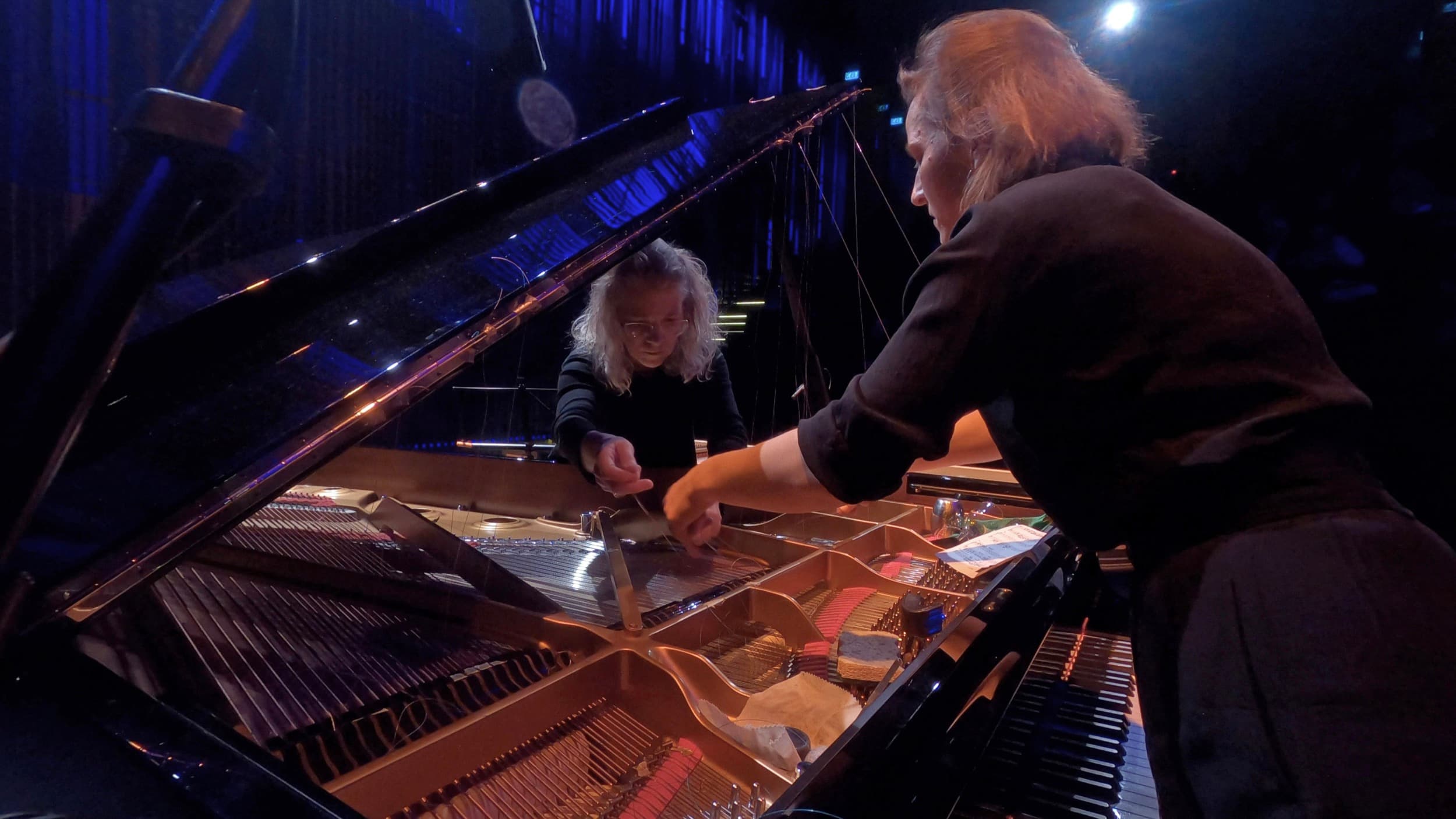
Guðrún Óskarsdóttir and Heleen van Haegenborgh. Photo: Brian Fitzgibbon.
Reykjavík, Iceland
January 24–26, 2025
Although now forty-five years old, Dark Music Days remains a strangely clandestine festival outside of Iceland. If we wake at ten, it is still not sunrise. Your scribe first visited Reykjavík in the summer of 2023, so is pleased to be experiencing the full snowfall winter during his three days at the colossally impressive Harpa concert hall (or halls, as it’s possible to discover a new, different sized space each day of the weekend). Ranged with oblong glass portals, something like revived telephone boxes, the rationed light of the day is refracted, colors shifting according to the angle of the visitor’s approach. Electric illumination after dark.
Harpa squats on the edge of the North Atlantic Ocean, benefitting from its wintry surrounding viewscape. Inside it is glowing with the moderne music of Iceland. There are not so many performing visitors from other lands, or even selected foreign composers. This concentration is perfect to assist a complete immersion in the local scene, stacked with premieres-a-go-go. Even Björk is wandering around at seemingly every concert, with inflated white anorak and stack heels.
The Iceland Symphony Orchestra is resident at Harpa, providing an impressive beginning to the festival, its ranks enlarged by percussion banks and massed strings and horns, along with this opening evening’s programmed sensitivity to composers with broad and subtle sonic spreads. The three recent pieces held a wholeness that caressed via gentle susurrations, occasionally unveiling full force. Ears were pulled wide by the composers: Ingibjörg Ýr Skarphéðinsdóttir, Marcos Balter, and Páll Ragnar Pálsson, respectively. The tiniest wood-percussion sounds survived in the Balaena forest, until tympani and clarinets rose the volume. Sensitive arcs were negotiated, as slippery strings emerged. Orun had a more conventional sonic stage, with swathes of strings, harmonious winds, and a logical construction, crisply delineated by well-harnessed power. The closing three-part PLAY featured the Estonian bassoon soloist Martin Kuuskmann, the orchestra framing him completely with layers of growth and intensification. He was solo for much of the time, but then answered by bass clarinet and other selected instruments in the ranks, including a wing of bass fingerers, with one striking instant where they all plucked heartily as one.
On the second evening, the Caput Ensemble excelled even further, providing one of the weekend’s best concerts, shooting out three world premieres and one Icelandic. All of them were riled beasts of focused intent. Clarinet, bassoon, French horn, cello, oboe, and flute gave Haukur Tómasson’s Hjáleið converging stark-spiking steely tones, peppering the plane with Louis Andriessen severity, casting stray dapples in the chase. The full Caput emerged next for Ýr Skarphéðinsdottir’s Earthsong, percussion added, along with flute, trombone, piano, guitar, and piccolo soloist. The front row strings held a weighty thrust. Low tones encroached, with an episodic nature, other horns echoing the flute lead, clarinets repeating, trombone feeding inwards. Halldór Smárason’s Nú was powered by cello soloist Sæunn Thorsteinsdóttir, starting softly, joined by other sympathetic strings, then whispering horns, in a Gavin Bryars mood. The cello became increasingly expressive, as horns then percussion activated a sharper nature. Suddenly there was a folkish, dynamic attack and a she-wolf scream from our soloist, settling down into group vocal humming and a stroked large gong. The closing work provided an intended contrast, with a quartet circle, low lighting, and a central spotlight from up above for Bergrún Snæbjörnsdóttir’s Axis Spirat, with bass, flute, cello, and bass flute. All four of these compositions were dramatic, bold, complex and earthy.
Another extremely striking set came on Sunday, from the unusual duo of Heleen van Haegenborgh (piano) and Guðrún Óskarsdóttir (harpsichord). The pair performed the Belgian van Haegenborgh’s recent Music For Strings And Keys, uniting the exposed insides of their instruments, bending further toward their actual keyboards, and sensitively introducing extreme bass electronics into a mostly fragile acoustic cradle of faintness. (Your scribe first experienced the world of van Haegenborgh in Gent, 2023, where she presented a work for large-scale percussion and rupturing electronics, released by the local el Negocito label, largely known as a home for free jazz and improvisation.)
Initially, Óskarsdóttir (a member of Caput) stands over her open strings, softly sliding objects across, while van Haegenborgh has some of her strings stretched up from base to open lid. Both players are inside, and both are interested in slight scraping, sympathetic resonances, and extended foreplay. Eventually, slow key progressions appear, the twosome now seated, some of the runs operating on a quite aggressively propulsive level. Out comes the steel goblet and the e-bow, tingling drones subsequently growing, slippage abounding, electronic bass tones building to feedback under this skeletal scraping. Spider clusters scuttle from the harpsichord, and Óskarsdóttir becomes the first elbow-and-fist player witnessed by your scribe on this delicate instrument.
Something might have been untoward here, technically, as van Haegenborgh seemed slightly troubled, but having such an unexplained improvisatory uncertainty within this piece led to a curious tension, a sort of soft ongoing dread that radically intensified the musical experience. This pair are early providers of 2025’s necessary commitment, completely taken over by their music, and boldly sending this globally palliative aura out around the audience.
John McCowen promised much but didn’t quite deliver, probing deep space via his contrabass clarinet. Power drones were hoped for, a slow curve up to apocalypse, but this American-in-Iceland favored a slower, highly incremental exposure, heavy on controlled, careful technique, with stretched presences or extended tones, but frustrating even for we slow beings in the audience. McCowen was too precious in his silences, but did eventually rise toward a Colin Stetson state, although higher-thrust volume would have lent more gut-meaning. The deep tubular vibration was within him, potentially—McCowen is a dedicated technician rather than a blow-out behemoth.
Other highlights in a crammed schedule included Masaya Ozaki (sculpted Japanese noise in the basement car-park), the Riot Ensemble (their British string-based small-scaleness being anything but riotous), the Cantoque Ensemble (offering the chance of Hjálmar H. Ragnarsson’s modern choral resonance in the mighty uphill Hallgrímskirkja, itself the essence of finely-honed Lutheran church-modernity) and, to close, the Reykjavík Chamber Orchestra (whose final selection was a powerful mix of blast-trombone, bongo fury, swift string-scything and needling oboe, from composer Haukur Tómasson, gleaming out of murky waters for a last run of solo trumpet, piano punctuations and hard-struck bass). Dark music indeed, for these now darker days.
Martin Longley is frequently immersed in a stinking mire of dense guitar treacle, trembling across the bedsit floorboards, rifling through a curvatured stack of gleaming laptoppery, picking up a mold-speckled avant jazz platter on the way, all the while attempting to translate these worrying eardrum vibrations into semi-coherent sentences. Right now he pens for Down Beat, Jazzwise, and Songlines.