Jim Condron: Collected Things
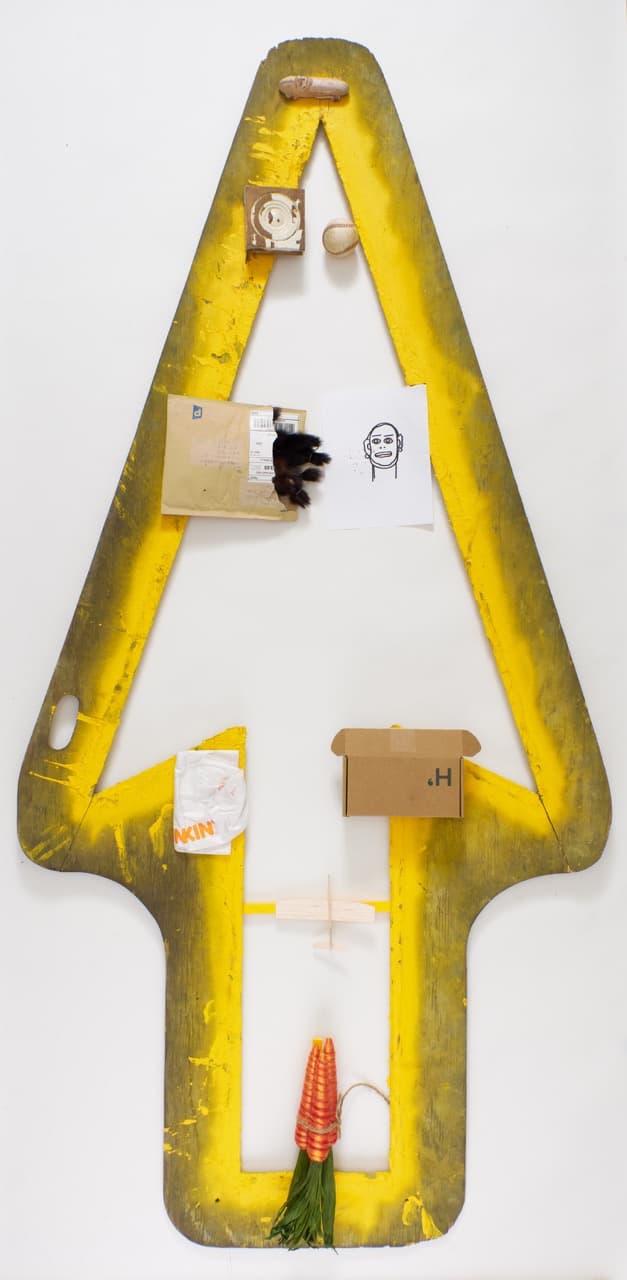
Jim Cordron, Glenn Goldberg’s Things, 2023. Oil, paper, wood, steel, fur, rubber, and leather, 94 x 48 x 5 inches. Courtesy the artist and New York Studio School.
Word count: 805
Paragraphs: 6
New York Studio School
January 30–March 30, 2025
New York
Jim Condron’s sculptures are a tribute to the quieter side of our humanity, our proclivity to keep, treasure, and love odd objects. That Grace Hartigan’s Things (2023) looks very much like John Heliker’s Things (2024), or that Carl Hazlewood’s Things (2023) resembles Ben Pritchard’s Things (2023), speaks to Condron’s personality as a sculptor. His works could be likened to portraiture, an equivocal genre that asks: do you want the sitter, or do you want the artist? Condron’s project is portrait-esque in an ex-voto kind of way, making his sculptures from objects he has collected from a specific individual, chosen by them, or objects similar to those his subject once possessed. This could easily have devolved into a suite of artists’ tributes, but the objects in Collected Things—curated by Karen Wilken—are often distinctive and personal, become embedded in a deeper investigation into the act of possession, ownership, memory, and nostalgia. I was reminded of the scene in the film Throw Momma from the Train in which Owen (Danny DeVito) shows Larry (Billy Crystal) his coin collection. The coins are simply pedestrian nickels, pennies, and quarters, but each is linked to a specific moment in Owen’s life, which makes the scene gut-wrenchingly tragic and sentimental. The workaday items Condron selects for his sculptures are similarly imbued with magic and life.

Installation view: Jim Condron: Collected Things, New York Studio School, 2025, New York. Courtesy New York Studio School.
Condron’s sculptures possess this intensity of the linkage between a “thing” and its story: were the specific objects merely placed in a case with a descriptive label, we might glean some notion of the “sitter” from them, but the artist constructs an armature around them, or uses one of the larger components of the sculpture as an armature. In the case of John Heliker’s Things (2024), a well-used, paint-spattered chair ties the object to life, not necessarily “a” life. Heliker’s chair is the exception: I did a quick survey of the works, and found the majority of the armatures Condron has constructed—a motley crew of ladders, stencils, bins, and disassembled furniture—are interstitial forms that provided a regulating geometry for the sculptures and were sourced by the artist rather than the “sitter.” They had some reference to the individual named in the title, but Condron himself had determined the blueprint with which to construct a person, or a person’s habits, for us. In Ken Tisa’s Things (2023), the small trinkets representing the artist are placed rhythmically along a length of antique climbing rope. Dominating the back wall of the first room of the gallery, the rope resembles the meandering path of the intestine, stopping at photographs, false teeth, bracelets, and eyeglasses. In the sculpture Betty Cuningham’s Things (2024), the art dealer’s items are inscrutably affixed on a boat’s anchor. This of course could birth myriad interpretations, but the anchor itself is a magical form and activates the pulpy images that Condron has adhered to it. The aesthetic rationale for Sangram Majumdar’s Things (2022) even acts at cross-purposes to the objects donated by the “sitter.” Paintbrushes are smooshed together under thick blobs of paint, completely denying them of their use value, and the printmaker’s brayers (rollers used in printing) are pressed together so they almost look like a bit of architectural molding; it took a moment, and a reading of the wall label, to figure out what they actually were.

Jim Condron, Ken Tisa’s Things, 2023. Antique rope and various objects from Ken Tisa collection, 58 x 76 x 6 inches. Courtesy the artist and New York Studio School.
Condron is as invested, as we are, in this discourse of artist-plus-sitter-equals-portrait. In Shakespeare’s history plays, the bard’s descriptions of historical characters have become received wisdom: Henry V was courageous, Richard III was a bad guy. Condron has several moments of similar sublimity; artist Glenn Goldberg should be forever remembered as an upward-pointing, oversized yellow arrow, for instance. Though all are beautiful objects, Condron occasionally pushes his oeuvre too far into the witty, where it doesn’t need to be. Sharon Butler’s Things (2023) was a bit too much of a tribute to Giorgio Morandi, and Bruce Gagnier’s Things (2024) too Joseph Beuysian.

Jim Condron, Graham Nickson’s Things, 2023. Vintage book, palette, brush holder, antique aviary, and wood, 40 x 26 x 26 inches. Courtesy the artist and New York Studio School.
With good reason though, the sculpture that took center stage was Graham Nickson’s Things (2023). Condron attended the Studio School, and Nickson, who died this past January, ably steered the institution for thirty-six years. Nickson occasionally painted birds, and Condron chose a birdhouse to contain Nickson’s things. Birds represent souls, and the birdhouse shelters these souls. Before he died, Nickson gave Condron his copy of Charles H. Caffin’s book How to Study Pictures, in which he had painted in his own images. The book is perched on the roof of the birdhouse, turning it into an impromptu lectern. But Nickson’s wee paintings do not overwhelm Condron’s sculpture, nor vice versa. In this piece, and the rest of Collected Things, the artist finds balance between himself and the sitter, the definition of a great portrait.
William Corwin is a sculptor and writer based in New York. He has been writing for the Rail for fifteen years.