Gary Kuehn: In Situ
Word count: 2687
Paragraphs: 25

Installation view: Gary Kuehn: In Situ, Cantor Fitzgerald Gallery, Pennsylvania, 2025. Courtesy Cantor Fitzgerald Gallery.
Cantor Fitzgerald Gallery
January 24–March 7, 2025
Haverford, PA
Other than myself, I know of two artists who are the sons of roofers. One is Watteau. The other is Theaster Gates. I spent my year in between high school and art school working for my father’s roofing and sheet metal company, from the coldest January to the end of a broiling August, laboring on acres upon acres of flat roofs in the freezing winds, all over the rapidly corporatizing and industrializing New Jersey landscape. I was out before dawn driving company vehicles emblazoned with the J.P. Fyfe, Inc. logo—pickup trucks, vans, dump trucks, sometimes with kettles—tar-caked vessels on wheels that held heated liquid asphalt or pitch, or fifty-foot long slag conveyors on two wheels. When I got to the job site, usually a block of warehouses or a factory under construction, I climbed joined sections of a wobbling ladder set amidst a terrain of mud, pipes, and cinderblock up onto a flat expanse of ribbed sheet steel.
There would often be rectangular holes made ready for skylights that were covered with sheets of plywood. You had to be careful lifting one up because you would naturally and unconsciously walk towards the opening. Were you not warned against this, it was easy to fall fifty feet down and impale yourself on a bouquet of rebar sticking up from partially finished columns. I was saved from this fate once by three-fingered Dutch, as he was called, who yelled “Joey!”, grabbed me under my arms, and dragged me out of a fall at the last moment, saving my life. Other, lesser dangers and annoyances included the hot asphalt that might splash and burn as you applied layers of waterproofing material, the toxic fumes from pitch, or the filaments from glass or asbestos or FoamGlas insulation—sponge-like blocks of bits of glass that smelled like rotten eggs when any friction between them took place, which it always did, getting under your skin and making you itchy, or getting in your eyes in the blowing wind.
Although until now this view has remained unexamined, I learned from my father—who started as one—that roofers were the miscreants of the building trades. They left stubbornly sticky tar-like trails wherever they went and would always leave a mess behind on job sites. My father tried to counteract this onus by developing a reputation as the tidy, responsible roofing contractor. During earlier high school summers, fighting torpor through the humid August heat, I collected for disposal what was jettisoned by the men above: scraps of tar paper, fragments of fiberglass insulation, beer bottles, emptied tubs of mastic, aluminum flashing scraps. Roofers were notorious for tossing anything from above without a care or a glance. Not long ago, staying briefly at a house in Greenport that was under roof repair, I strolled out as a hammer whizzed by my head, reinforcing an inherited stereotype.

Installation view: Gary Kuehn: In Situ, Cantor Fitzgerald Gallery, Pennsylvania, 2025. Courtesy Cantor Fitzgerald Gallery.
As I was the boss’s son, I undoubtedly caused resentment, and they were a rough bunch: backbiting, light-fingered, bigoted, endlessly salacious. They would tell me how they were going to fuck my girlfriend—“bring her over my pool, she’ll get a snake in her, heh heh”—and at the same time would try to get on my good side by getting me drunk at lunch. I remember telling my father years later that it was like working on a pirate ship. He seemed to think that was hilarious.
I would occasionally bring this most continually miserable period up with my therapist and wonder why I was grateful for it, when it had barely started and I already felt defeated. I was living in the present, a little apprehensive: I had been accepted at art school but had no idea what to expect, and was working for a company I was supposed to take over but had no interest in—the horrible hours of dawn to dusk occupied by heavy construction work, and awful cold or brutal heat. It was a big experience, whatever it was.
One time we were working on a new building at Rutgers University when the foreman, Ray Rajewsky, said to me, “You’re an artist, huh? We had one working for us a couple of years ago, he made crazy stuff. Now he’s teaching here.” I seem to remember a description of a tar-soaked bathtub. I thought no more about it: I couldn’t imagine an artist at all interesting coming out of this, though the materials had their appeal. Theaster Gates, in loving homage to his father’s occupation, has recently devised a huge number of theatrically pictorial collage-like paintings that are made from roofing materials. But back to my narrative. Thirty years went by, and I was at a party at Tom Nozkowski’s and was introduced to Gary Kuehn, who said, “Oh yeah, I used to work for your father’s company.” So here was the guy. That was interesting—to know another artist that had shared the roofing experience, and with this same cohort, no less.
I had known Gary Kuehn’s work only very slightly. Once in the ’80s, I saw a group of his heavily painted, geometrically shaped reliefs. He has not shown regularly in New York in decades but has had a long and well-represented career in Germany. In his retrospective exhibition at Haverford College that is closing on March 7, numerous thick catalogs of his German museum shows are in evidence. At the beginning of his career in the US he was in two landmark American exhibitions: the critic Lucy Lippard’s Eccentric Abstraction at Fischbach Gallery, New York, in 1966; and the curator Maurice Tuchman’s expansive survey exhibition, American Sculpture of the Sixties at LACMA, Los Angeles, in 1967, where he was one of the youngest included artists. In Europe, he was among the select group that participated in Live In Your Head: When Attitudes Become Form at the Kunsthalle Bern by the Swiss curator, Harald Szeemann in 1969, that introduced the anti-form, process-oriented, post-Minimalist generation, the signal exhibition of that era.
By the time Gary Kuehn was working construction, he had a wife and child and was enrolled in graduate school at Rutgers, at that moment the most advanced art department in the country. He had Allan Kaprow, Roy Lichtenstein, and Robert Morris for teachers. Keith Sonnier, who also later appeared in the Szeemann show, was a year behind him. While still in high school, he came under the mentorship of the sculptor George Segal. Kuehn’s body was cast in several Segal sculptures, including The Tar Roofer (1964), in the collection of the Walker Art Center, where a white plaster Kuehn applies tar with a roofing mop and bucket, next to a gallows-like wooden hand hoist tower with another asphalt bucket attached. The mop, buckets, and platform are all black, like the asphalt that was always referred to by the roofers in adjective form as “hot”.
Kuehn was brought up in an enlightened, leftist family that was under continual surveillance by the FBI. He said he grew up being careful, under suspicion. Working with the same hardened bunch as I did, I can imagine him more sympathetic than I was; also, I suspect, with an intellectual and aesthetic detachment that came with his concurrent education as he surveyed his situation. He states that:
In the ’60s I worked as both a roofer and an iron worker on large-scale building projects. In the course of a day’s work, I became interested in the commonsense fact and behaviors of materials and the rationale of how buildings are put together. The logic of construction had an expressive potential that became the focus … I would go home after work and in my studio replicate some of the things I witnessed on construction sites.1
Clearly, sharing these same or similar experiences I have described cannot but help inform how I understand Kuehn’s output. I was curious to see his current retrospective that was organized by Sid Sachs, who is an American curator of note and was Kuehn’s TA fifty years ago. The exhibition is heavy on the early work. If one made the gallery rounds in New York and then came to this show, this work would still be the weirdest and maybe the deepest stuff seen. The principal metaphor derived from roofing would be in Kuehn’s stated emphasis of “layers” in his work, corresponding, I think, to the layering process of roofing.

Installation view: Gary Kuehn: In Situ, Cantor Fitzgerald Gallery, Pennsylvania, 2025. Courtesy Cantor Fitzgerald Gallery.
A roof is both a conductor and protector as well as the Achilles’ heel of a building, constantly exposed to the elements, trying to keep water out and heat in. At that time in the 1960s and ’70s (the technology has since changed) there was first a vapor barrier like Tyvek, put down on the metal deck, then a layer of insulation, then asphalt or pitch (since outlawed), then hot asphalt and tar paper of some kind in at least three ply layers, then most often a course of slag, a mining waste product like aerated pebbles, combined with more “hot.”
I only go into such detail to underline how Kuehn conceives of sculpture, in many instances as a hermetic composite, or as a compounding of procedures toward some obscure endpoint, contrasting with others of the “Anti-Illusionist” group of that moment, such as Richard Serra’s cast-by-throwing-hot-lead sculpture or Bill Bollinger’s cyclone fencing installed verbatim, to give two examples that foregrounded process and material.
One of the earliest sculptures here is a tabletop-sized Untitled (1964) that comprises two wooden open cubes, à la Sol LeWitt, with a vertical opening between them by way of long aluminum bolts. A 2.5 pound single mop hank—a thickly wrapped bunch of string commonly used to spread “hot”—has been pushed through that opening, its two ends drape over either side of the lower cubic form, like a gathered garment or hair. The sculpture isn’t that clean, and in its quasi-archeological dustiness it evokes an inventory of classical sculpture as it demotes it. Sachs notes that Robert Morris wrote his master’s thesis on Brancusi and no doubt there is a consciousness of a sculptural tradition here in dialogue with the present.

Gary Kuehn, Black Painting, 1972 Acrylic on canvas 64.5 x 72 inches. © Gary Kuehn. Photo: Sara Bereza.
Harald Szeemann described going out to rural New Jersey in the 1960s to see Kuehn’s sculptures. He thought the best ones were the “collapsed boxes soaked in tar [that] unfortunately could not be shipped.”2 A photograph of a similar work, Tar Piece (1967) is in the current catalog. No dimensions are given, but it appears to be about ten individual boxes covered or made from tar paper, stacked three high to perhaps over nine feet. Maybe Ray the foreman was referring to this work.
Kuehn stated throughout his career how big an influence construction work was. He’s commented on this period as when he had gone from his academic training as an artist, then out into the real world where they made real things, then back to being an artist. It must have been a bit like Tony Smith’s famous nighttime ride on the darkened, unfinished concrete strip of the New Jersey Turnpike, wondering how an artist would “frame” it. Looking at these huge geometric forms, this common industrial architecture in its temporality, Kuehn was witnessing a scaled up, simplified minimalist box amidst the controlled chaos of creation, with all its imperfections on display.
Kuehn often described an incident where a wooden mold for casting a concrete wall broke loose and flooded the construction landscape with it in liquid form. He made several Minimalist-like closed boxes that replicated this on-site flooding of material, the concrete pouring out, as he wrote in his notebook, “like butter in the sun.” One such sculpture is in the exhibition, Welfare Combination (1966), a rectangular box evenly studded with eight bolts hovers over a fiberglass-hardened puddle that spills beyond the cantilevered upper form. Kuehn has admitted to an anti-authoritarian position and stated that he was “intentionally trying to subvert the power of pure forms … there is a troubled psychology that runs through all my work.”3
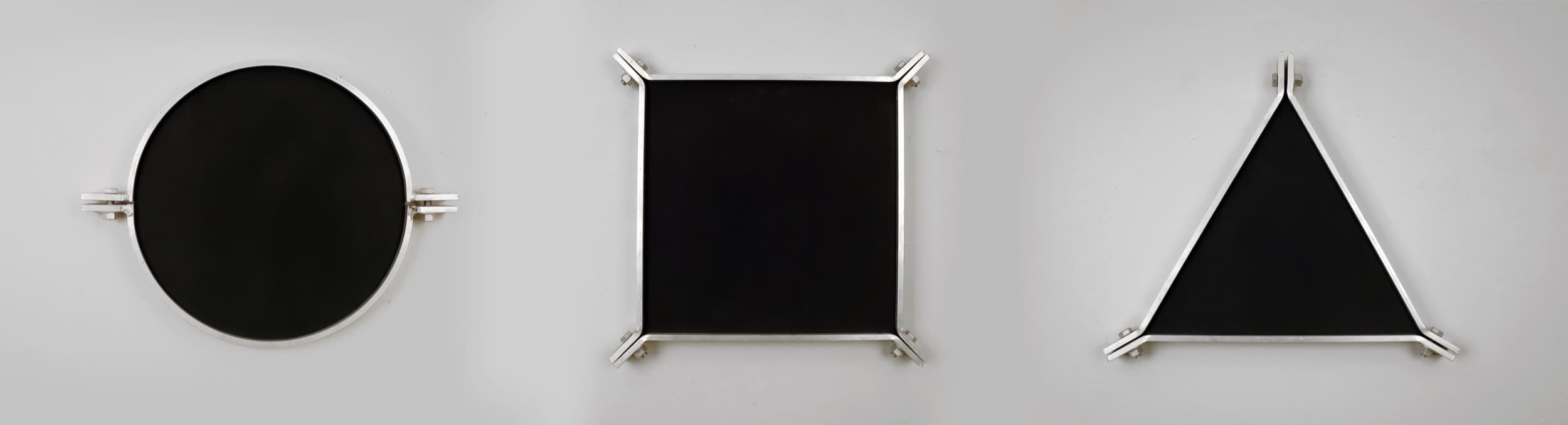
Gary Kuehn, Eternal Figures, 1976. Acrylic on canvas, aluminum 19 x 80 x 2 inches. © Gary Kuehn. Photo: Cindy Hinant.
As Kuehn has noted, his was the artist generation that looked for materials and processes that were intrinsically expressive. But in Kuehn’s case there was always as much content as form, and an anti-idealist imperfection that continued to involve him. In an interview at the opening, he referred to an interest in “change, humility … diminishment.” Elsewhere, “Human states … [like] surrender, defeat.” He has also commented that to be an artist you have to be something of a masochist, and I thought again of those roofers, with their constant verbal streams of sexual reference, and their need to continually summon up some ideally voluptuous state as they as performed their thoroughly unpleasant work.
Some of Kuehn’s sculptures seem to attempt to unite or resolve these two disparate states—physical pain and psychological fantasy—to again “layer” the unconscious perversity that surrounded him on the job. His coated surfaces are the result of hot tar-like pouring and evenly settling numerous applications of pastel-colored enamel from found or discontinued cans of it that have a flesh-like depth and finish. Bolt Piece (1965), a vertical, cabinet-like structure comprises two flattish squares of compressed fiberglass bolted to a hard, wooden L-shaped form. The two frontal squares have been painted a lustrous soft flesh pink. The equidistant bolts that hold them to the wood backing appear like a regular series of rusted nipples. I asked him if, when he spoke of the psychology in his sculpture, he meant sex. He replied “yes.”

Gary Kuehn, Bolt Piece, 1965 Wood, steel, synthetic straw 7 x 12 x 11 inches. © Gary Kuehn
There is an undertone throughout the exhibition. The quietly astonishing Twist Piece (1987) consists of three 135-inch-long steel rods, mounted around waist height horizontally, all twisted together in the center and gradually separating out at either end. Plank Piece (1967) has often been compared to an alternative John McCracken, a rubbery plank slouching against the wall, made from layers of fiberglass, sealed with coats of enamel to a dully semi-transparent orange/yellow skin that invites as much as it repels any anthropomorphism. But once again, the compacting and overcoating, the collection of drips on the edges—its self-protectiveness—is like a thick chunk of roof. What Kuehn brought to the moment of post-Minimalist sculpture was a new kind of compression, an intense entwining of materiality, a murmur of intractable presence. In his words:
“The perfect sculpture…
Gives off nothing
Receives nothing4
Kuehn continued to make new and unusual choices, including making puzzling paintings that are more sculpted than painted, emphasizing gravity and weight. Black Painting (1972) unites a broad horizontal rectangular canvas to a lower, narrow one, on which three distended ovoids rest on the bottom edge. Using his pouring technique, the white ground covers the surface with palpable thickness; the black ovoids are the result of damming their edges to receive a generous pour of thick black acrylic paint—his stand-in for tar. Above this, on the larger rectangle, are three of the most rudimentary freehand approximations of circles. Eternal Figures (1976) utilizes tar-like black acrylic on canvas in a wall-mounted series of three shapes—a circle, a square and a triangle, left to right, in that order—that are held by corresponding shaped aluminum brackets at their corners or two diameter points by large bolts. These shackled geometric figures come at the beginnings of an interest in “alchemy … mysticism … sun cycles”5: sculpture as an implication of secret knowledge
There is much to admire here. Though I was brought to this work by a connection to my personal history, being exposed to it was no less than a revelation. Sachs states at the end of his essay the Kuehn is a historically significant artist, but Kuehn’s work doesn’t seem dated, either. Not because so much of it is not well-known but because he refutes the modernist ideal of purity and transparency that even lurks in the work of the post-Minimalists. Kuehn understood that there is no such thing as raw or neutral material, it all has history, has associations, has subjectivity. He anticipates more recent abstract sculpture by artists like Vincent Fecteau, Liz Larner, and Ross Knight.
1. “Gary Kuehn: Art of Opposing Forces” by Cindy Hinant, Provincetown Arts, 2016/17, vol. 31, p.67.
2. Quoted by Sid Sachs in Gary Kuehn: In Situ originally Szeemann’s notes published in the 1969 catalog of Wim
3. Quoted by Sid Sachs in Gary Kuehn: In Situ, p.19
4. In Situ, p. 30
5. In Situ, p. 34
Joe Fyfe is a painter and a writer who lives and works in New York.