Nick Cave: Amalgams and Graphts
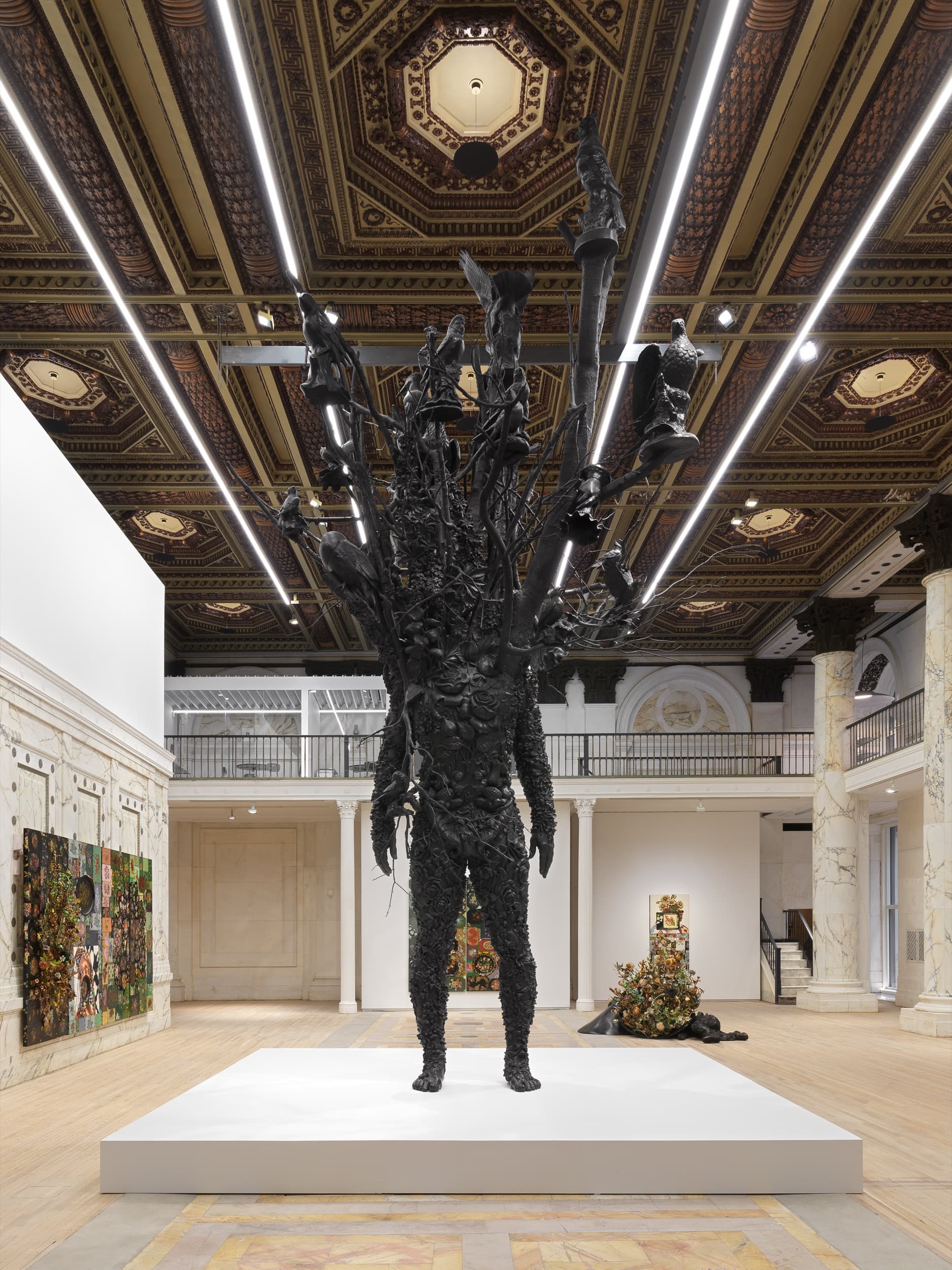
Installation view: Nick Cave: Amalgams and Graphts, Jack Shainman Gallery, New York, 2025. Courtesy Jack Shainman Gallery.
Word count: 967
Paragraphs: 6
Galleries have long been exemplars of adaptive reuse, and Jack Shainman is no exception. The School, the gallery’s upstate project in Kinderhook, NY, repurposed a former high school, opening in 2014 with an inaugural show by the artist Nick Cave. So, it is fitting that the gallery’s new Tribeca location—which takes on and restores a monumental ca.1898 bank built by McKim, Mead, and White—should be christened by Cave and his dynamic bricolage practice.
The show begins with Wallwork (2024-25), a digitally printed vinyl mural made with Bob Faust that spans nearly thirty vertical feet and runs from the ground floor up to the high-ceilinged second. It is positioned at the base of somewhat provisional-seeming metal stairs that are hidden by a white wall, its photomontage layering of paint-by-number birds and foliage, enameled serving trays decorated with flowers, and repetitive embroidery stitches foretelling what is to come.
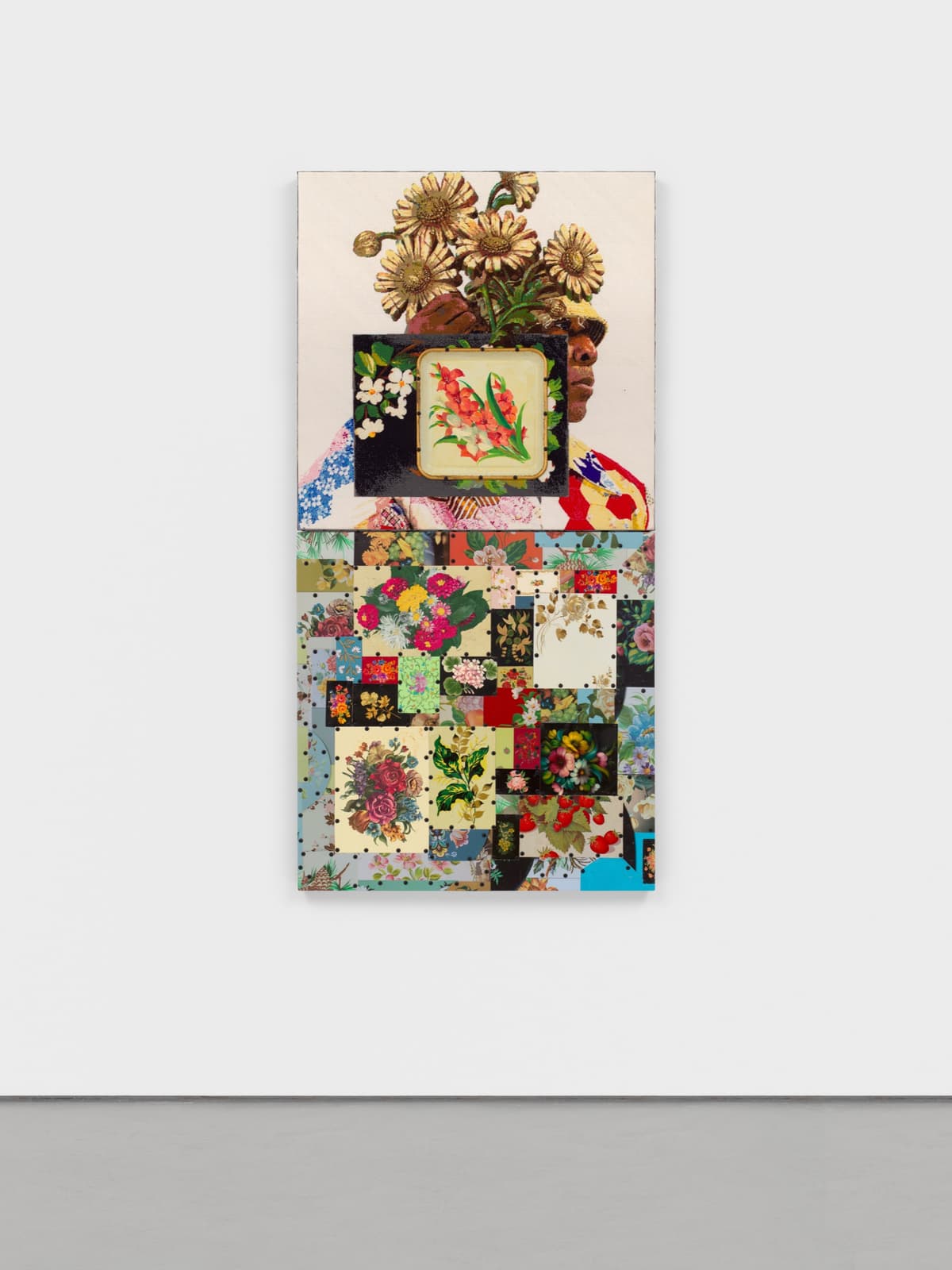
Nick Cave, Grapht, 2024. Vintage metal serving trays and needlepoint on wood panel, 36 1/4 x 36 1/4 x 2 inches (each panel), 72 1/4 x 36 1/4 x 2 inches (overall). Courtesy the artist and Jack Shainman Gallery.
The blind, white staircase and hallways do the work of concealing, until we are at its very threshold, the original bonkers polychrome Beaux-Arts interior that holds the main gallery, with its double-height columns and extravagantly coffered ceiling. Cave occupies the space with two distinct bodies of work. The wall-mounted “Graphts” (all 2024) and the “Amalgams,” sculptures in the round. The artist has built the surfaces of the “Graphts” from the vintage enamel trays—some flattened, some left whole to form crevices that recede into the surfaces—riveted together and pieced with embroidered panels depicting the birds and flowers hinted at earlier, as well as self-portraits of the artist. The metal or fabric panels are not placed side-to-side in neat rows but are instead permitted to turn, overlap, and to supersede the edges and imagery of other materials so that the faces of these pictures appear like crazy quilts of color and shape; in one, I thought I started to detect a centripetal spiral, built in from the outer edges of the composition from larger pieces and winnowing to the center with smaller shapes, but then I became uncertain. The faces of the “Graphts” are exceptionally complex. The embroidered sections, too, present dizzying numbers of stitches, even in length and slant. In the press materials, Cave described the relationship of the enamels and embroideries as one of domesticity and servitude: who has free time to make such things? They are that, and remind us, as well, of the handmade decoration of the home, ways that we make space ours. If someone were to hand embroider an image like those included here, it would require such repetition and care as to become like a ritual, like prayer. Perhaps not surprisingly, the “Graphts” are polyptychs, existing in two or three “wings,” like altarpieces. In one, a knitted rainbow scarf worn by Cave becomes a cyclone of churning color, as threads depict threads, while in another, he holds a bouquet of faux sunflowers or daisies above his head like a crown or a halo. These intuitive moments reinforce the ecstatic movements of repeated stitches, agitated colors, and revolving flowers.
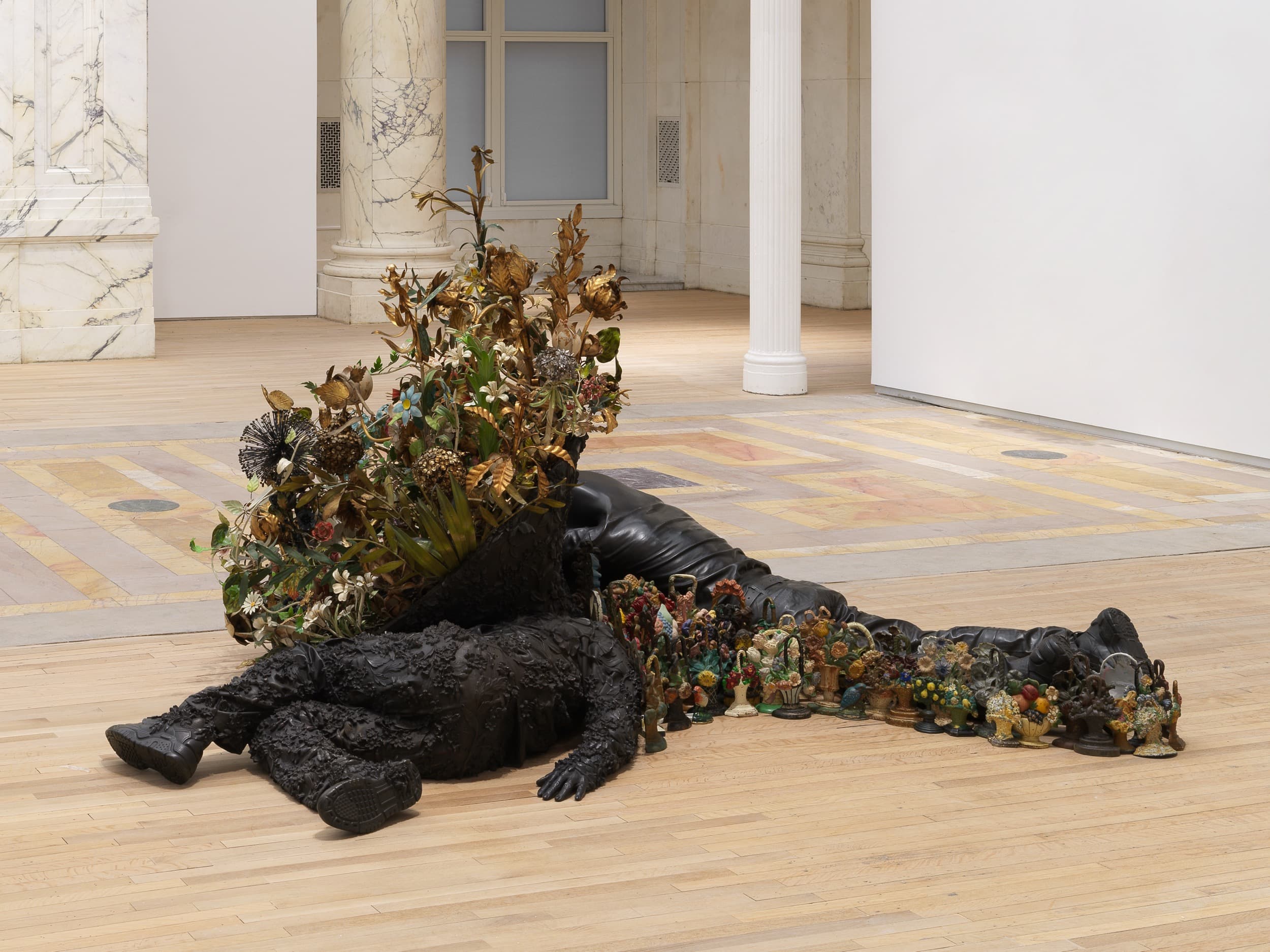
Nick Cave, Amalgam (Plot), 2024. Bronze, tole flowers and cast iron door stops, 23 x 100 x 47 inches (face-down figure), 63 x 68 x 65 inches (face-up figure), 63 x 120 x 125 inches (overall). Courtesy the artist and Jack Shainman Gallery.
The “Graphts” also have vintage tole-worked flowers and leaves—an enameled tin decoration—erupting from the panels, furthering the dimensionality and facture of the planes; the artificial bouquet held by Cave might be tole-work. These flowers link the “Graphts” to the exhibition’s freestanding bronze sculptures, the “Amalgams.” Amalgam (Plot) (2024) features two prone figures, lying at right angles to one another, taking on the defensive positions—from the police? from a shooter?—with which we are now unfortunately so familiar. Each figure’s head is covered by the hood of his jacket. One pools out onto the floor, suctioning the hood to the ground. Around his legs, cast-iron doorstops decorated with flowers pin him in place and travel around the left side of his body to link him to his companion whose hood forms a cornucopia barely containing a spray of tole flowers; the flowers on the second figure’s legs have been consumed by bronze and are now fully a part of his body. The “plot” here could be so many things: the narrative that explains how they found themselves in this situation, a plot against them, a grave, and/or the ways we denote what is ours, the X-shape made by these men’s bodies marking the spot.
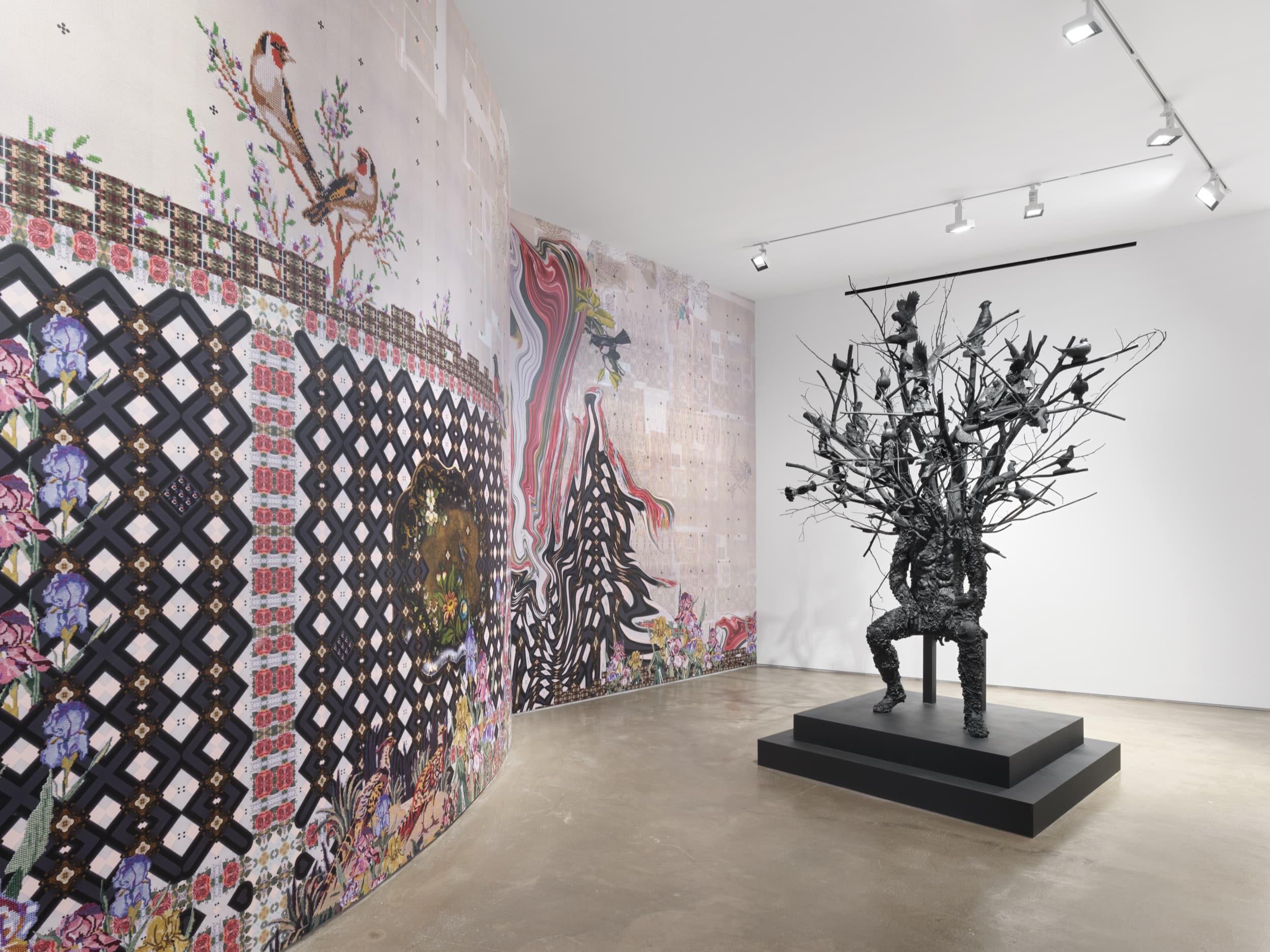
Installation view: Nick Cave: Amalgams and Graphts, Jack Shainman Gallery, New York, 2025. Courtesy Jack Shainman Gallery.
The bronze flowers reappear in Cave’s other two “Amalgams.” A•mal•gam (2021) sits on a chair in Shainman’s second space, located around the corner from the main gallery, his form submerged in flowers, leaves, and branches, as well as the cast birds nested in his verdure. His hand rests on one leg, and he must be at peace for a bird to have perched on the other. The visual whirlpool here comes in the form of another Wallwork (2024), which smooths around a curved wall and sinks into a corner. Those moves stir up the imagery, resulting in a vortex of color. Amalgam (Origin) (2024), in the center of the main gallery, is a giant standing at nearly twenty-six feet and tauter, bilaterally symmetrical, with his hands at his sides and his feet squared like an Egyptian pharaoh. Neither of these figures have human heads, the canopies of trees standing in for them, the silent birds their latent voices, and they seem to be of plants rather than merely wearing plants—I’d never thought before of the Arcimboldo quality of Cave’s work. At first, I missed seeing more “Soundsuits,” the works for which Nick Cave is best known, and the riots of their color and their implied hullabaloo, but then I started thinking about this sculpture’s future home outside. Its uniform surface is going to change, to tarnish and patina, and what if real birds try to rest on him, too? Just now, Amalgam (Origin) is all potential, “standing noisy in [his] very silence,” but not for long.
Amanda Gluibizzi is an art editor at the Rail. An art historian, she is the Co-Director of the New Foundation for Art History and the author of Art and Design in 1960s New York (2021, paperback 2025).