Chris Martin: An Arrival and Eternal Return of Painting
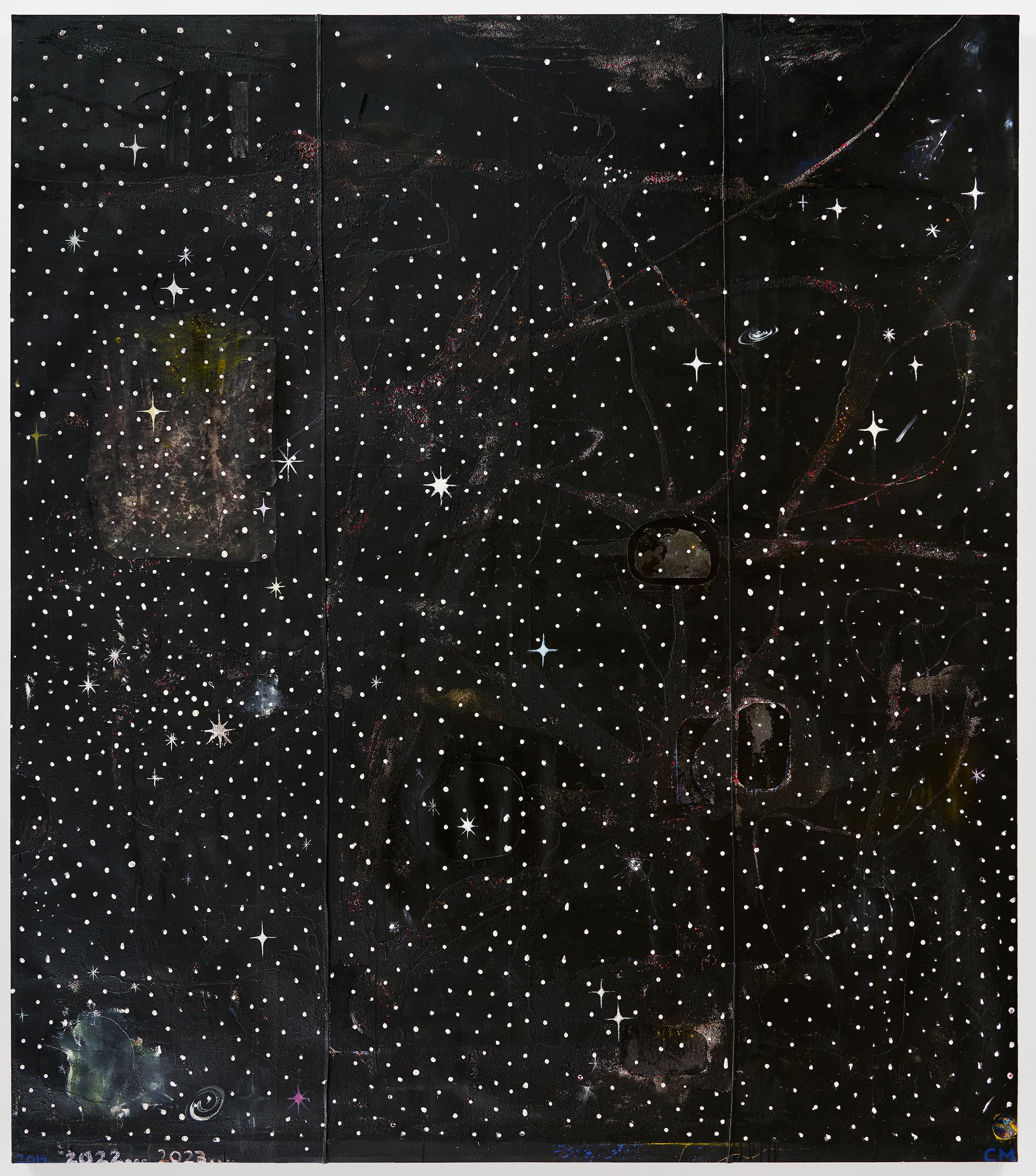
Chris Martin, Dark Matter, 2024. Oil, acrylic, collage, and glitter on canvas, 135 x 118 inches. Courtesy the artist and Timothy Taylor. © Chris Martin.
Word count: 1304
Paragraphs: 8
Timothy Taylor
January 16–February 22, 2025
New York
What is it that compels us to recognize the arrival of an artist who has finally reached his, her, or their hard-won unity of late? It may be because this artist has already achieved it long ago though we’ve failed to see it. Chris Martin, who recently turned seventy, comfortably belonged to either or both categories. Those who have followed the evolution of Martin’s work since the mid-1980s would readily recognize that the breadth of his ambition and endurance never failed to be apparent, even if it wasn’t always readily seen. As the writer Raymond Foye once wrote, “Martin’s career is a testament to perseverance, which in theological terms is defined as ‘continuance in a state of grace’.”
From the very start, it was apparent that Martin possessed again a remarkable energy and stamina that seemed to directly fuel his democratic caress of all things: Everyday ephemera, on the one hand, that referenced external life experiences within the context of the urban environment, including extracted reproductions, fragments from newspapers, magazines, album covers, and records, along with other material sources of past and present pop culture. On the other hand, elements that are purposefully selected as manifestations of an internal interest in modernist abstraction, alchemical symbols, and non-mimetic components of the image-sign. For example, Martin’s most identifiable “Seven Pointed Star” painting series, created from 1988 and 1992 onward—continues to transmit his other equally recognized numerological permutations: one to seven, which interrelates the seven metals, seven heavenly bodies, and seven organs of the body. In between there lies natural forms: trees, rivers, his landmark mushrooms, endless other vegetation and psychedelics. All in all, the demarcation that separates the heavenly body above and the earthen realm below has totally disappeared, creating a new kind of unity.
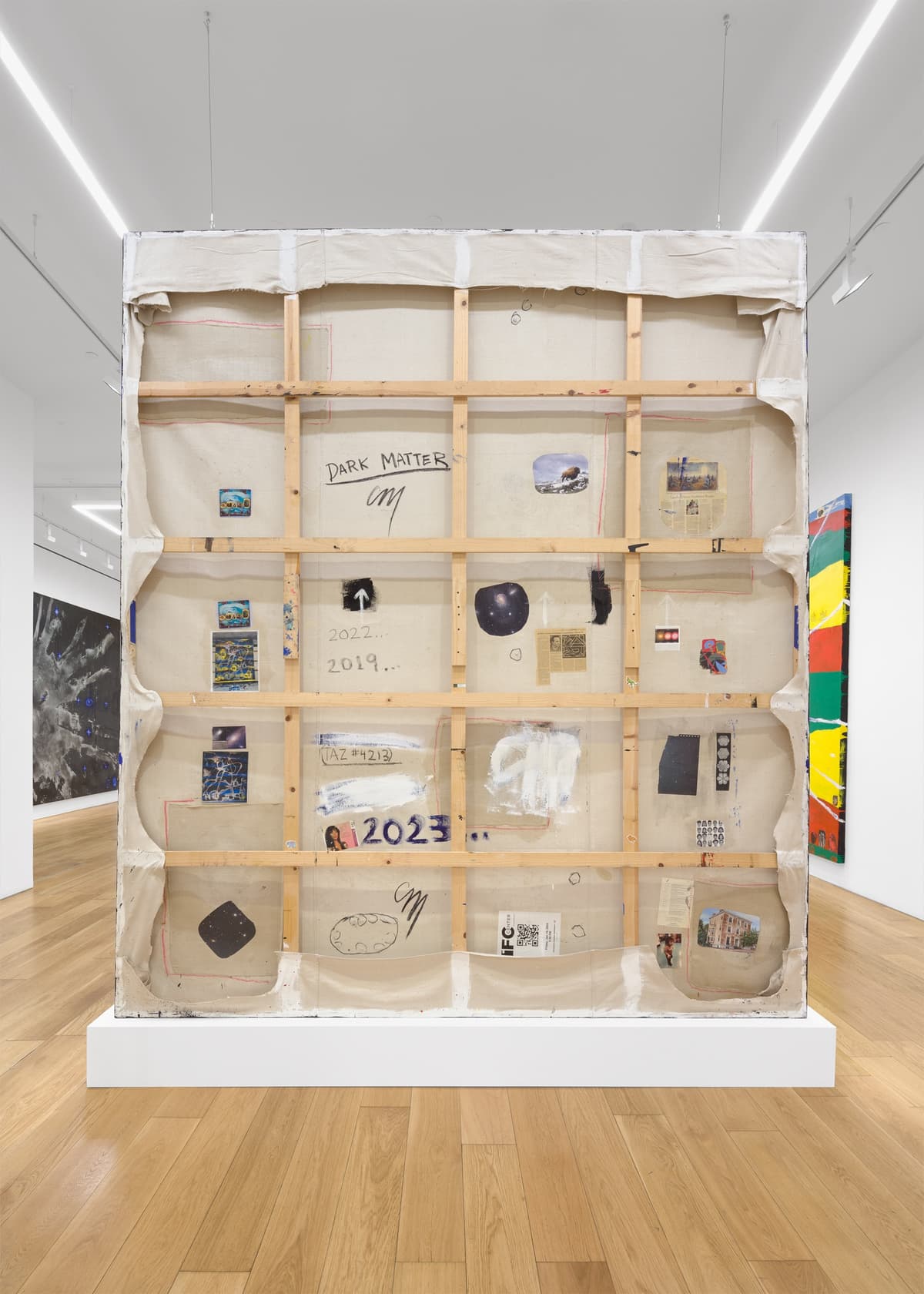
Installation view: Chris Martin: Speed of Light, Timothy Taylor, New York, 2024. Courtesy Timothy Taylor.
In his current one-person exhibit at Timothy Taylor gallery, as he has consistently insisted on being a painter of landscape, the clarity of Martin’s animistic view of nature has never been so visible and evidenced as it becomes invariably infused in different scales—small, medium, and large—in each of the six paintings on display. Upon entering, in Psychedelic Trance Dub (2024), what one sees below the somber, moon-lit landscape reveals Martin’s deep resonance with the dark vein of the American Romantic tradition, which has been kept subversively alive by the likes of Albert Pinkham Ryder, Ralph Albert Blakelock, Marsden Hartley, Arthur Dove, Bill Jensen, and Margrit Lewczuk, among others. Right above is a constellation of shimmering light radiating from an irregular allover pattern, standing for the whole picture’s unlikely pictorial synthesis. In keeping with the rhythm, as we enter the main gallery, Martin welcomes his viewers with the back of his monumental painting Dark Matter (2024), on which the anarchy of his unique invention of collage, with varieties of images patched together, confronts us: reproductions of his own work, newspaper clips of Al Held’s obituary from the New York Times (his one-time professor who inspired him to drop out from Yale undergrad and move to New York City to be an artist), among other things, along with handwritten words like “TAZ” (referring to the famous cult-classic written by Hakim Bey, published by Autonomedia in 1991, T.A.Z.: The Temporary Autonomous Zone, Ontological Anarchy, Poetic Terrorism). Here, one is surprised to see that what appears in the back of the work can be as interesting as the front. (This recalls how Ron Gorchov, on some occasions, would show the back of his large stack paintings, revealing the complex structures of his concave/convex saddle-like stretchers.) On its front, the accumulations of accretions built up from previous painted forms mixed in with his familiar use of glitter, expressive gestures, and collage elements of familiar and cryptic images, create a strangely unsavory yet sensuous patina dispersed across the canvas in the key of black. Here, one also notices his now-well-known spatial interventions, namely the way random parts of the painted surfaces get cut to be patched again, either from the front or back. At times these forms appear like applied bandages over the body’s wounds; other times they get made from behind as recesses. The irregularly painted white dots and shimmering stars across the surface readily evoke a night constellation over an otherwise densely dark terrain.

Chris Martin, Speed of Light, 2024. Acrylic, collage, and glitter on canvas, 135 x 236 inches; each panel: 135 x 118 inches. Courtesy the artist and Timothy Taylor. © Chris Martin.
As we’re standing in the middle of the space, we immediately notice the wonderful framing of the two monumental paintings Speed of Light (2024) on the left and Staring Into The Sun 748 Russell Hill Road (2024) on the right. I was overwhelmed by a sense of awe; for sublimity has its own seductive dominion as we all have occasionally experienced in confronting the spectacle of nature. Rarely have paintings in these large sizes achieved their true scales despite their intended monumentality. It’s fairly evident in the former: the dimension is measured 11 by 20 feet (135 by 236 inches), which should sufficiently qualify its size as being as enormously large as it indeed is, yet size is beholden to its exact measurement proportionally, whereas scale is a matter of our psychological responses to how the made image conveys itself to our mind and body, along with our five senses being receptively opened at the same time. This is to say that the way in which the image of an explosive death of a massive star (also known as a supernova) is located so ever-slightly off the central axis, depicting a night sky with such a personal and material specificity, leads us to suspect that Martin had deceptively painted with a consistency in his lightness of touch, imbued with greater speed of execution in deploying both pouring and painted gestures, probably with a large industrial broom that carried the wet paint across the surface. As a result, it evokes, in fact, quite an opposite effect, namely a sense of tremendous warmth and intimacy.

Chris Martin, Staring Into The Sun 748 Russell Hill Road, 2024. Acrylic, collage, sequins, and glitter on canvas, 135 x 236 inches; each panel: 135 x 118 inches. Courtesy the artist and Timothy Taylor. © Chris Martin.
The same can be said of the latter: while the size is identical, it’s the made image that was painted with great warmth and intimacy that precisely generates its monumental presence. The only difference here is that the surface has been made with endless layers of paint to embody countless revisions of previous images in relation to its composition. The image of a bursting sun, painted in bright white with sprinkles of glitters on the edges of its many rays, rising from, again, an ever-so slightly off-center landscape behind, which primarily is constructed with a simple network of irregular curving forms stacked over one another in blue, red, green, and yellow. All of which may appear, at first glance, to be accentuating the body in action, the image caught in constant motion, whereas it in fact slows down our viewing experience while gently providing the painting’s greater stability in the constellation of different sizes of small recesses, fluctuating mostly in the bottom half of the canvas, in all of which reproductions of various images can be seen as built in secret messages or arcane offerings. In all, they function as spatial anchorages or punctuations, hence pulling the gravity down near the painted green horizon line at the bottom edge of the painting, once again reminding us that it’s a painting of landscape.
Upon encountering his smallest canvas, Mushroom Cabin (2006–12, 17 ½ inches by 23 ½ inches), on a small wall in the same gallery, then a mid-sized canvas, Burst (2024–25), installed on its own in the small back space, one now feels reassured that Martin has achieved the unachievable: each of his paintings has its own scale according to its specific alchemy. However small or large each painting may be, the unlikely synthesis of intimacy and monumentality is infused seamlessly. From nature’s dark romanticism comes life’s vital exuberance. One comes away with a new perception of the artist himself: at once a fierce, solitary dreamer and an assiduous social being.
Phong H. Bui is the Publisher and Artistic Director of the Brooklyn Rail.