Peter Young: “Stick” Paintings, 1970
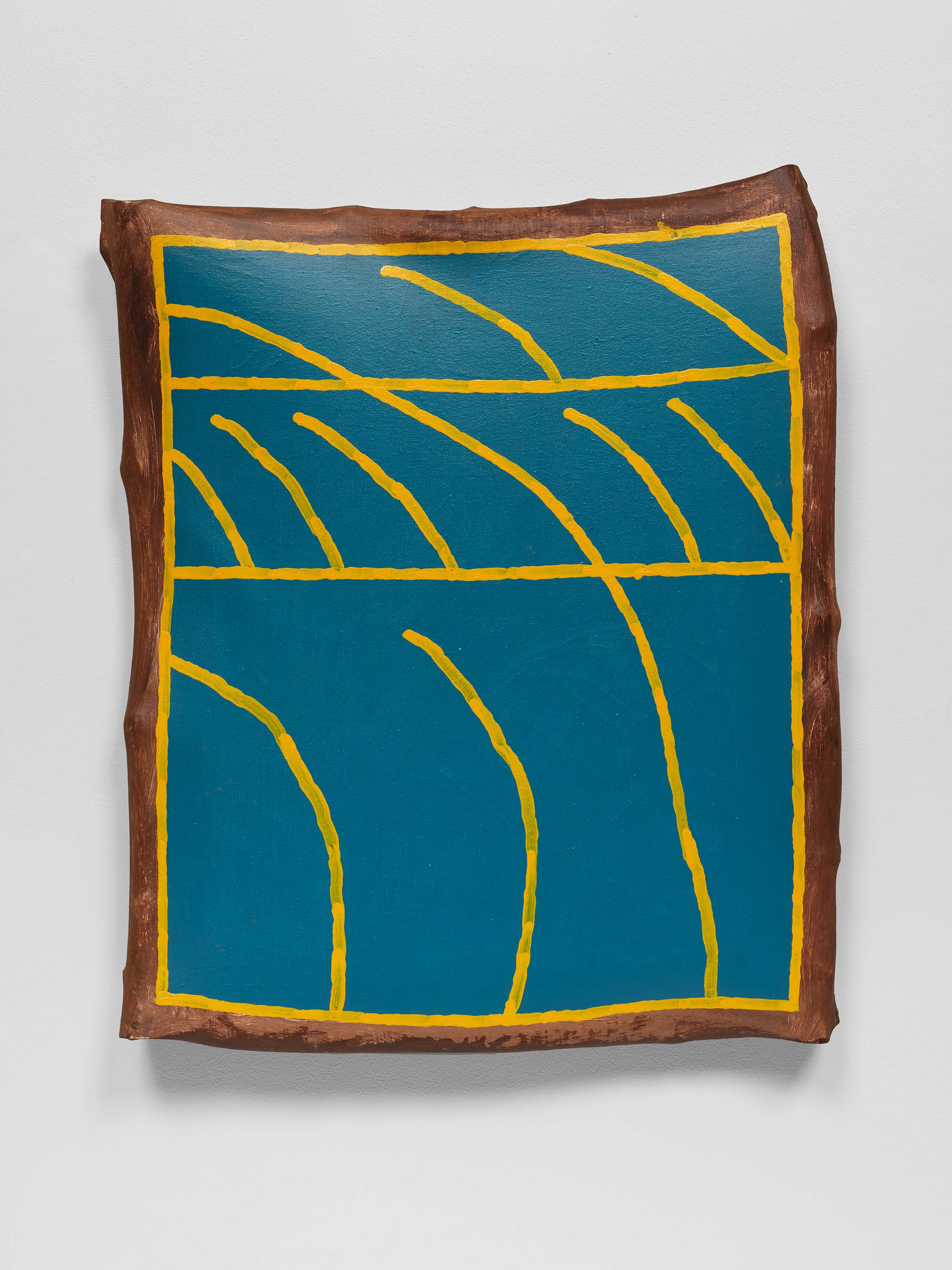
Peter Young, #5-1970, 1970. Acrylic on canvas stretched on ponderosa pine branches with white nylon twine, 28 x 24 inches. Courtesy of the artist and Craig Starr Gallery, New York. Photo: Thomas Barrett Photography.
Word count: 892
Paragraphs: 9
Craig Starr Gallery
November 7, 2024–February 8, 2025
New York
I must begin these too few remarks on Peter Young’s astonishing “Stick” paintings with praise for Craig Starr. Leave it to Starr to jump into the deep end with an artist he had not previously known, excavating over a dozen coveted examples from a series no one had seen assembled since 1971. Disrupting this normally hushed Upper East Side sanctum sanctorum, Young’s “Stick” paintings nearly dance off the walls. Their planar surfaces are warped, distorted into curvilinear waves as canvas is forced over and around irregularly formed stretcher bars of ponderosa pine branches, then bound by twists of clear and colored twine. Each of the eleven small works (they are generally two by two feet, give or take a few inches) bears a vibrant central image in continuous oscillation. Despite their nominal frontality, these shaped canvases jut into the viewer’s space, coming alive as physical presences animated by their tilting frames and the richness of the chroma they enclose. This exhibition is essential viewing: a rarely seen series of works by an even more rarely seen artist.
Young pretty much disappeared from the New York scene in 1969, at the height of his art-world visibility. He had been the subject of a cover story in Artforum (1971); his work had been collected by the Museum of Modern Art, the Solomon R. Guggenheim Museum, and the Whitney Museum of American Art; he had been selected for two Whitney Annuals (1967 and 1970) and the Corcoran Biennial (1969), had received prestigious awards (NEA, 1968, and Theodoron, 1969), and had been championed by the legendary gallerists Richard Bellamy and Leo Castelli, among other dealers in New York. Harried, hassled, and pursued, Young abandoned the pressures of collectors, museum exhibitions, and gallery shows for the wilds of other lands. An existential crisis in relation not only to the commercial art world but to his own artistic production catalyzed his move to the mountains of the Talamanca rainforest in Costa Rica; there he lived for six months among the Boruca, one of the few Indigenous tribes to maintain their culture and language in the face of Spanish colonization in the 1500s.
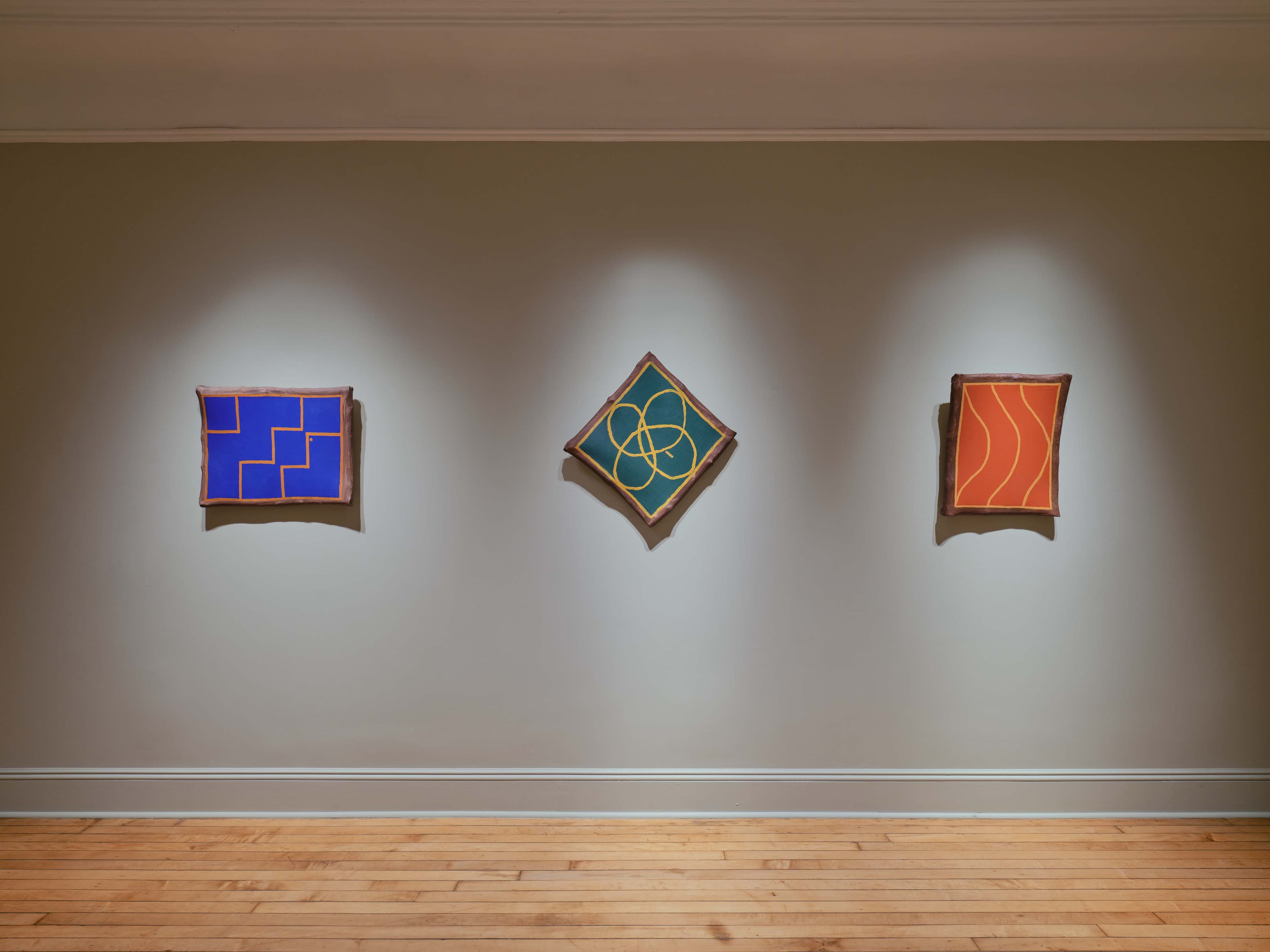
Installation view: Peter Young: “Stick” Paintings, 1970, Craig Starr Gallery, New York, 2024–25. Courtesy Craig Starr Gallery. Photo: Thomas Barrett Photography.
The Boruca offered Young not only a spiritual model based in mystic transcendence, animism, and a vibrant oral history but also a craft tradition from which to metabolize a new pictorial language. Culling elements from a memory of small, rounded, animal-skin shields made by the Native Americans of the Great Plains that he had seen in the home of the Venezuelan-born surrealist Luchita Hurtado, an early teacher and mentor, he was inspired to make “shields” of his own. Gathering branches from trees deep in the rainforest, Young made stretchers in a dozen or so rectilinear shapes, then, on the canvases laid over them, painted monochrome fields holding logos emblematic of the magical, protective power of the Plains shields. Leaving all but one with the Boruca, Young set out on a peripatetic journey through Spain, Morocco, and Mexico that led him to the mountain forests of Utah.
There, in a reprise of the originals, Young painted thirty-six “Stick” paintings, of which eleven are on view. He had worked in series throughout his early career, and these works are no exception: they have about them the focus of a single pared-down idea that characterizes his other series, elaborations of forms including pointillistic dot patterns, radiating curves, divided rectangles, and stacked or woven colored lines. The focus on process and a single throughline over several paintings suggests Young’s ties to the self-referential modernist milieu in which he began his practice.
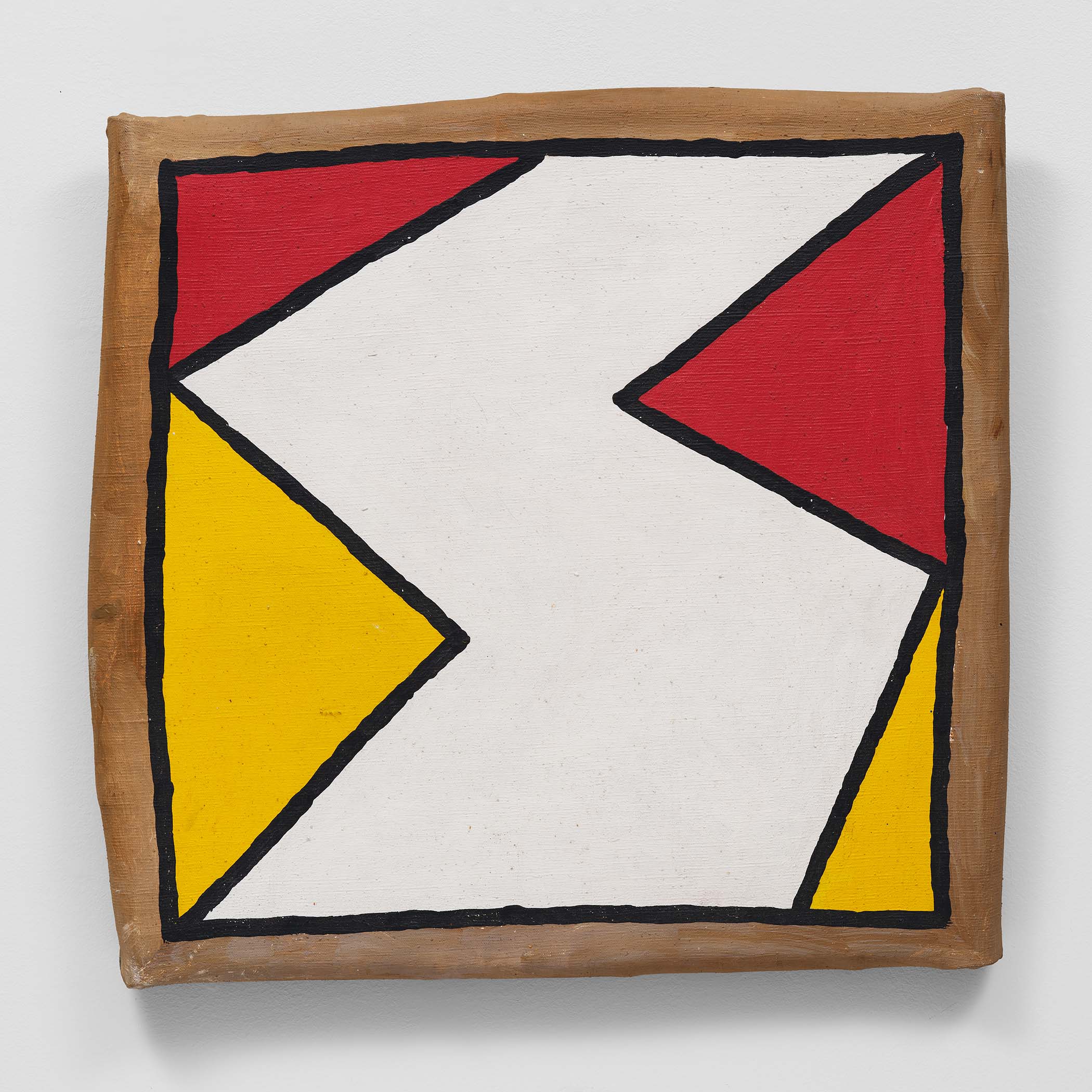
Peter Young, #36-1970, 1970. Acrylic on canvas stretched on ponderosa pine branches with beige nylon twine, 21 x 21 inches. Courtesy the artist and Craig Starr Gallery, New York. Photo: Thomas Barrett Photography.
The framing edge of each painting is marked by a loosely brushed brown mix of acrylic. conterminous with the physical bulges of the undulating branches in the stretchers, this thin strip both evokes their wood grain and underscores the works’ rectilinearity. The remaining rectangular surface is filled with a single field of intense color bearing a single image/sign, or what Young calls a “simple, pared-down symbol.”1 He fixes this sign centrally, electrifying the whole with curves or geometries in opposing elemental colors—red, black, yellow, white—in a nod to Plains peoples’ reference to the directions of the four winds: west (black), north (red), east (yellow), and south (white).
Young describes the central drawings as “linear arrangements” following a kind of “geometrical thinking.” Intertwined, radiating, curved, and crossed, their lines suggest spontaneous patterns based on naturally occurring contours, such as insect wings, hillsides, or newly sprouted leaves. They express “a kind of rhythm” that captured Young’s imagination, like “logos” or “symbols that vaguely stand for something.”2 Pitted against the painted outlines of the framing edges, these bursts of spontaneous graphemes, witty and piquant, play on the precise, hard angles of Minimalist geometries.
There is about this series the exuberance that comes with an easing of real-world pressures. They are painted with a sly wink, the mischievous virtuosity that only an art historically informed painter of paradox can bring off. Young can do it all. As Klaus Kertess wrote on the occasion of Young’s only monographic exhibition, at MoMA PS1 in 2007, this artist “conflates the hippie homemade, the tribal, and the formally acute with delectable insouciance.”3 Thanks to Starr’s acute vision, twenty years on we are able to agree.
- Peter Young, in Leslie Rothenberg, “An Interview with Peter Young,” September 2024. Available online at https://craigstarr-viewingroom.exhibit-e.art/viewing-room/an-interview-with-peter-young (accessed December 31, 2024).
- Ibid.
- Klaus Kertess, “Tribe of One,” in Peter Young: 1963–1977, exh. cat. (Long Island City, New York: MoMA PS1, 2007), 88.
Patricia L Lewy is an independent art writer, curator, and artists’ estate manager living in New York City.