David Smith: The Nature of Sculpture
Word count: 2314
Paragraphs: 12
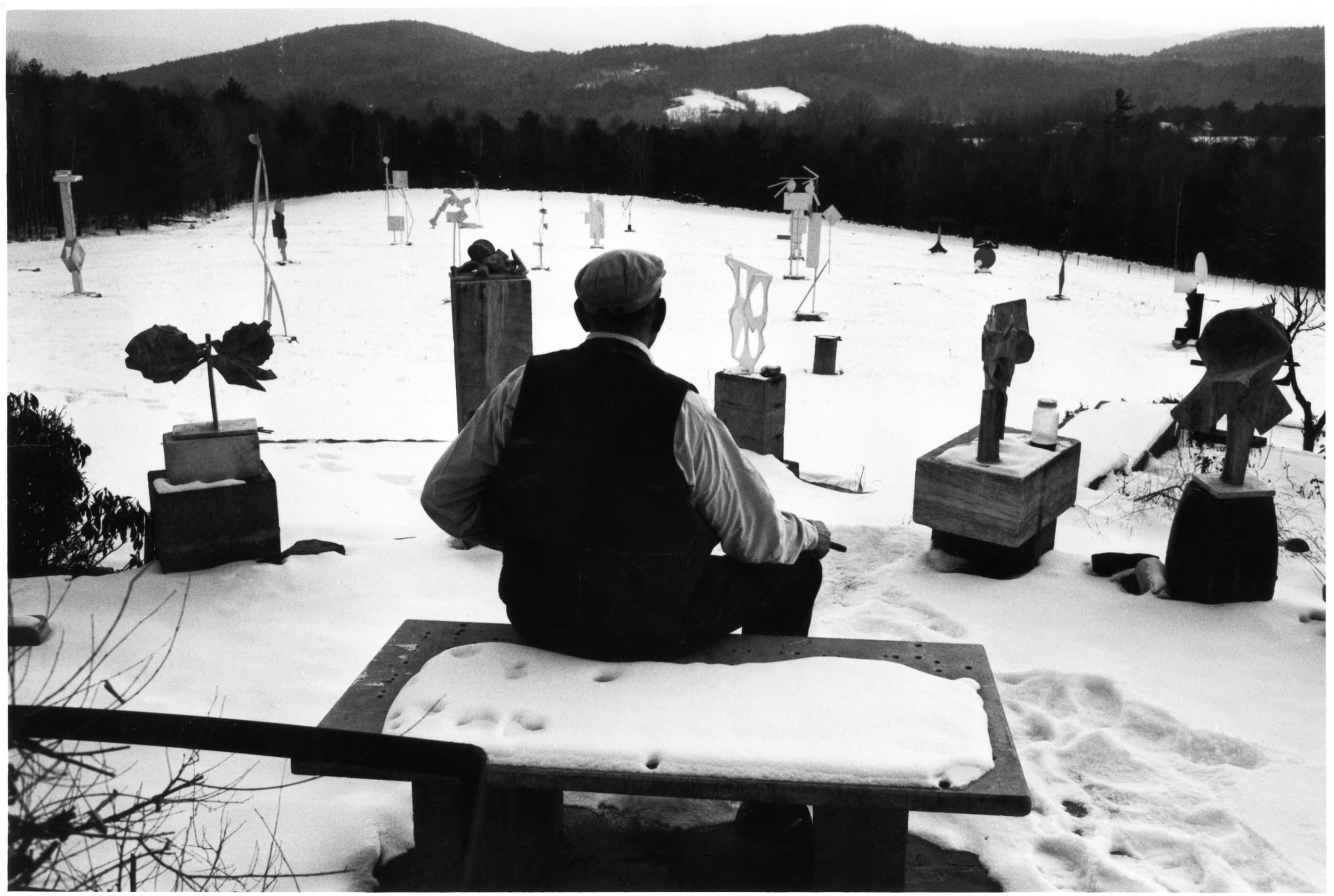
David Smith looking over the south field of his property at Bolton Landing, NY, 1963. Photo: Dan Budnik. ©2024 The Estate of Dan Budnik. All Rights Reserved.
Frederik Meijer Gardens & Sculpture Park
September 23, 2024–March 2, 2025
Grand Rapids, MI
After having spent a whole afternoon absorbing the extraordinary exhibition David Smith: The Nature of Sculpture, remarkably conceived and curated by Suzanne Ramljak at Frederik Meijer Gardens & Sculpture Park, I was delighted to be once again reminded of Smith’s early formation as a painter. And what we see in some of those early paintings, such as Untitled (1930) and Untitled (Virgin Island Landscape Coral) (ca. 1933), is not only the way in which Smith responded to both late nineteenth-century American painting and Synthetic Cubism, but also the way in which a kind of painterly scale runs throughout his work. In other words, the restraint of the painted images on the one hand evokes the alchemy of the sculptural impulse of disparate elements unified as potential biomorphic orchestration, and on the other hand it resists complete flatness and total abstraction.

David Smith, Untitled (Figure), 1932. Coral, steel, wood base, 2 9/16 x 1 11/16 x 15/16 in. Base: 1 1/2 x 1 13/16 x 1 13/16 in. © 2024 The Estate of David Smith / Licensed by VAGA at Artists Rights Society (ARS), NY. Courtesy The Estate of David Smith, NY. Photo: Jerry L Thompson.
Smith’s first sculptures, made of found objects such as corals, driftwoods, and shells, were done soon after his trip with his first wife/fellow artist Dorothy Dehner to the Caribbean Islands in 1931. In them one can clearly see the artist’s deep interests in Cubism, constructionism, and Surrealism, for example, in Untitled (Standing Figure) (1932), Untitled (1933), Construction (Lyndhaven) (1932–33) to Sea Form (1939), and Growing Forms (1939). Whatever Smith’s vision was that compelled him to become a sculptor, it must have been an intense and constant mediation between the internal conditions within himself as an artist, who trusted the direction of his work to make sense of his artistic growth, and the external circumstances that were occurring in his social and political surroundings. He built his first sculpture studio in Bolton Landing in upstate New York in 1932, then was exposed to the welded sculptures by Picasso and Gonzalez in Cahiers d’Art in the following year. And during his travels to Paris, Greece, London, and the USSR in 1935, he became acutely aware of the rise of fascism, which led to his politically inclined engagement thereafter. Smith’s continual pursuit of artistic maturity was a mixture of self-determination to reach his logical grasp of modernism’s formal inquiry and his emotional identification with the US, his native land, by associating with steel as his preferred material. “My materials were here, my thoughts were here, my birth was here, and whatever I could do had to be done here. I thoroughly gave up any idea of ever being an expatriate and I laid into my work very hard.” This reflects the kind of definitive American spirit that resided in Smith as it did with Pollock. Smith recognized how metal could liberate him from the long-accumulated history of association with traditional materials such as marble, bronze, and wood, while at the same time realizing metal in its economy of material alchemy as a perfect American industrial product. Pollock’s preference for enamel paint rather than traditional oil pigment was part of a similar material identification. This is to say that both metal and enamel paint are tough, durable substances, which naturally demand equal somatic actions that match their new and different processes, namely dripping for Pollock and welding for Smith.

David Smith, Steel Drawing II, 1945. Steel, paint, 24 1/2 x 25 1/8 x 8 9/16 in. © 2024 The Estate of David Smith / Licensed by VAGA at Artists Rights Society (ARS), NY. Courtesy The Estate of David Smith, NY. Photo: Ken Adlard.
Looking at the selection of works in this exhibition, I came to realize once again how the aura of American art had significantly changed forever with Smith in sculpture. Here, we remember Marsden Hartley, who, after having spent much of his life traveling far from his New England roots, had finally returned to his birthplace in Maine as he proclaimed, “The creative spirit is at home wherever that spirit finds its breath to draw. It is neither international nor national.” In 1955 Smith, working in the rustic setting of Bolton Landing, made forty sculptures, including those of anthropomorphic forms, personages, and abstracted animals in landscapes. He placed them around the rolling hills his large property, and they began to populate the surrounding natural environment in harmony with the sky above, and land and water below. In several works in the exhibition, such as Steel Drawing II (1945), we see the thinly, delicately yet precisely cut lines broaching a night constellation, framed by three edges, left, top, and bottom in rectilinear configuration countering the curved edge on the right, resembling a face in full profile. In addition to a cloud-like shape overlapping the top left edge, and inside the visual field, on which appears a frontal figure, painted red, standing erect, slightly elevated from the base, and spatially anchored off the center axis. Except for the dancing figure seen from the backside, the images are mirrored, suggesting a theatrical performance. The same can be said of Helmholtzian Landscape (1946), the constructed stage-like proscenium with painted abstract personages hanging in the middle as they are to be seen on both sides. This specific work perhaps indicates Smith’s interest in Hermann von Helmholtz’s color theories as well as his formulation of field theory, free energy in thermodynamics.

David Smith, Helmholtzian Landscape, 1946. Painted steel and wood, 18 1/4 x 19 x 7 1/2 inches; base: 2 1/4 x 19 x 4 1/2 inches. Photo: David Heald. The Kreeger Museum, Washington, DC. © 2024 The Estate of David Smith / Licensed by VAGA at Artists Rights Society (ARS), NY.
As one continues to walk through the exhibition, one notices various recurring permutations of archetypes, be it the clouds, birds, houses, trees or quasi-abstract motifs that resist being identified as readable images. Yet as functional things among things, they’re curiously interacting with each other in their fields of vision. In Construction with Cheese Clouds (1945), House in Landscape (1945), and The Forest (1950), each is invariably seen in different scales and greater fluidity in space, and lyricism in form that eventually culminated in one of the artist’s masterpieces, Hudson River Landscape (1951). Referred to as “drawing in space” or aerial drawing in metal, Hudson River Landscape was made as an accumulation of multiple views, experiences and perceptions over time and distance as the artist had experienced the passing glimpses of the landscape by looking out the window on the train commuting back and forth between Albany and New York.
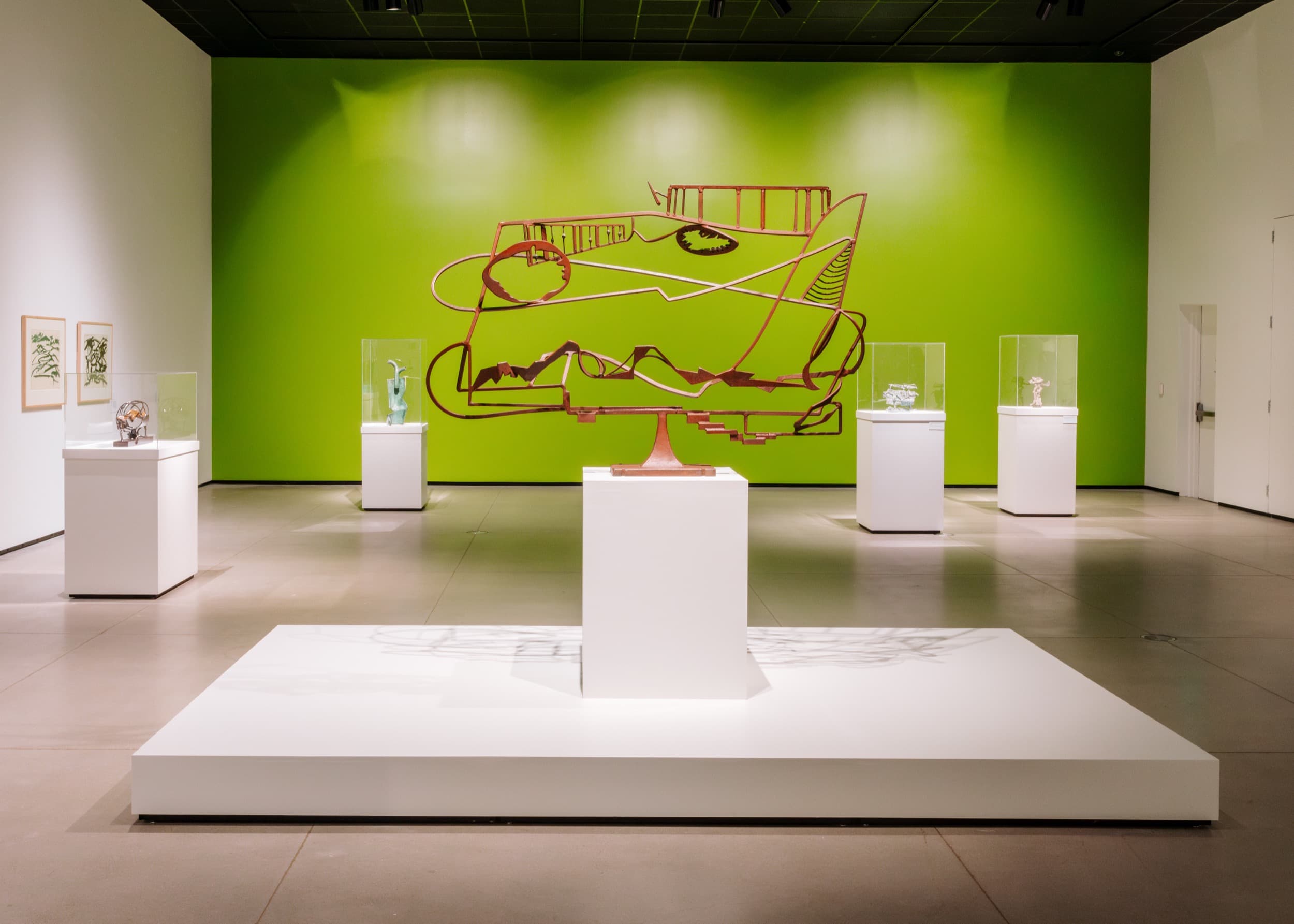
Installation view: David Smith, Hudson River Landscape, 1951. Welded painted steel and stainless steel, 48 3/4 x 72 1/8 x 17 5/16 in. © 2024 The Estate of David Smith / Licensed by VAGA at Artists Rights Society (ARS), NY. Courtesy The Estate of David Smith, NY.
Hudson River Landscape reminds us that American art is to some degree a mirror of the national character at the beginning of the nineteenth century, when the grandeur of the landscape with its waterways, mountains, and valleys provided prodigious views of a never-seen-before picturesque. This gave birth to the nation’s first true artistic fraternity, namely the grand style of the Hudson River School, whose artists, led by Thomas Cole, Frederic Edwin Church, and Albert Bierstadt, often painted with monumental-sized formats, akin to movie screens. By the end of the nineteenth century, however, this grandiose romantic tradition, which was broadly associated with the pragmatic, matter-of-fact, and extrovert-leaning aspect of the American temperament, had encountered a new and opposite kind of creation, based on a more personal, intimate view of nature that reflected a dark vein of American romanticism, exemplified in modest-sized pictures made by the likes of George Innes, William Morris Hunt, Ralph Blakelock, and Albert Pinkham Ryder, comparable to the dimensions of a human head, torso, or a window. In Smith’s sculpture, these two traditions are brought together with enormous force and conviction—the sublime and the intimate fused in an unprecedented way.
Smith greatly admired James Joyce’s exploration of stream-of-consciousness, and the ways in which it adapted various aspects of myth with inventive and cryptic uses of language. Joyce’s mélange of impenetrable symbols to create endless poetic associations of images gave Smith permission to create similarly complex layers of meaning, which were built right into his works’ process.
Another thrilling aspect of this exhibit was the way it focused on the artist’s unrelenting communion with both nature and the nature of his work—each inseparable from one another. Smith was constantly observant of how each of his sculptures punctuated and also coalesced with the surrounding landscape. And as early as 1945, Smith became a photographer of his own work, which he staged singularly or in groups, on and around the farm, down the road by Edgecomb Pond, and on Bolton Landing dock on Lake George. Being cognizant of how most of his sculptures appear as silhouettes against the platform of earth and sky, as they were so often cropped at the base, the elevation of the image is therefore unfettered. We feel that Smith’s eye as a photographer is distinctly different from the eye of a sculptor, hence his intimation of nature is amplified. From this perspective, Smith has reached his own Whitmanesque “I am large, I contain multitudes,” for his eyes are in the back of his head, his torso, his hands and feet, and perhaps the reverse is also true. His attentive awareness of the movement on earth below is well seen in the two drawings ΔΣ 11/23/51 (Old Snow) (1951) and ΔΣ 51/12/16 (New Snow) (1951), which correlate with the formation of the bird flights in the sky above, eloquently executed in the four ink drawings 10-1-55 (1955), ΔΣ L-1-56 (1956), 10-5-55 (1955), and Untitled (1955), as well as three exquisite sculptures Raven IV (1957), Raven V (1959), and Black Flock (Raven) (1960). Each embodies its own dynamism in speed and personality.

David Smith, Raven IV, 1957. Steel, 28 1/8 x 32 3/8 x 13 1/4 inches. Photo: Cathy Carver. Hirshhorn Museum and Sculpture Garden, Smithsonian Institution, Washington, DC, Gift of Joseph H. Hirshhorn, 1966. © 2024 The Estate of David Smith / Licensed by VAGA at Artists Rights Society (ARS), NY.
All the while, as Smith’s material arsenals grew alongside his welding mastery, he regarded steel as conveying both aesthetic and political realities. As Julio González said, “It is high time that this metal cease to be a murderer and the simple instrument of an overly mechanical science. Today, the door is opened wide to this material to be at last forged and hammered by the peaceful hands of artists.” This is to say that by being fully committed, by initially being a full-time steel worker with the status of a working man at Terminal Iron Works in Brooklyn in 1934, to becoming a master welder at American Locomotive Company (ALCO) in Schenectady, New York between 1943 and 1944—building automotives, tanks, munitions, and other military machineries as the US’s involvement in WWII intensified—Smith quickly discovered his social and political clarity through art. In having mastered metal, iron, steel, and welding, he knew that the materials and techniques he worked with could be made to serve with a higher purpose, namely, how to turn metal as a material of war, aggression, and coldness into a substance of pacification, benevolence, and warmth. It seems from this point onward that Smith’s sculptural syntax achieves a wonderment of productivity and invention. From the conception of utilizing farming tools, for example, in Untitled (Study for Agricola I) (1951), Agricola VIII (1952), Horizontal 9/4/52 (1952), Untitled (1954/57) to revisiting his early anthropomorphic configurations, seen in Liquid Landscape (1955), which as a whole extrapolates a sense of universal empathy insofar such parity among forms regarding harmony, counterbalance, tension, scale, proportion, symmetry, asymmetry, and so on, it all retains its pictorial unity and coherence. Elsewhere, Smith’s relentless exploration of whatever is apropos to his own cogent, yet agile perception was of density in relation to lightness, verticality to horizontality, semaphores of free associations to earth and sky, all possible translations of animals, erect human figures into effective composites of illusion were staggeringly aqueous. For example, Bull in Landscape (1957) has what appears to be the compressed horizontal density of a post-Cubist-like painting in three-dimensional form. And we see how Smith transmogrified the flat, compact geometric abstraction to both volumetric composition in Untitled (Rectangular Bronze Relief) (1956–57) and the exquisitely open of line plexus in Rose Garden (1956). One can see similarly how the restrained linearity in Lunar Arcs on One Leg (1956– 62) recalls Steel Drawing II, with its forever-suspension of the constellation above and the living organisms down below. And one is equally impressed by the majestic stateliness in Sentinel V (1959), Rosati Landing (1961), and Voltri VIII (1962), as well as by the sumptuous lyricism in Rebecca Circle (1961) and Dida’s Circle on a Fungus (1961). All belong to the same universe. All were made with the same frictional tension that lies between desire and the forbidden, self and other, attraction and repulsion, anima and animus, projection and internalization, among other parallels.
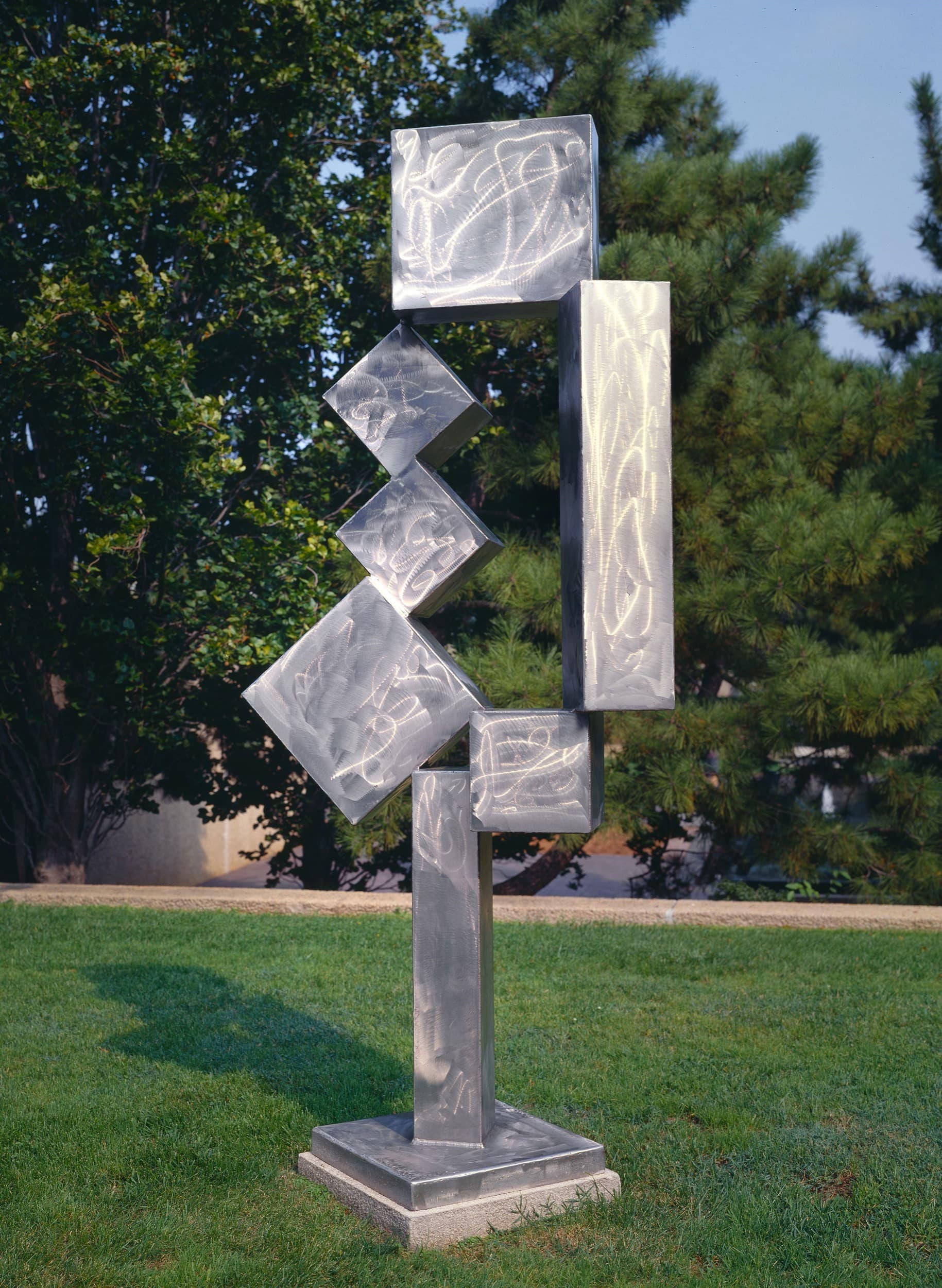
David Smith, Cubi XII, 1963. Stainless steel, 112 1/2 x 49 1/4 x 32 1/4 in. © 2024 The Estate of David Smith / Licensed by VAGA at Artists Rights Society (ARS), NY. Courtesy The Estate of David Smith, NY. Photo: Lee Stalsworth.
Finally, Smith, as well as being aware of his perpetual dualism as an industrial laborer and a farmer in equal terms as he was an artist, was also a connoisseur of various cultures. I’d add that the inclusion of Voltri VIII, Cubi XII (1963), and Primo Piano II (1962), installed in the outdoor garden, were indicative of the fearless exploration of the artist’s singular and unique ability to think freely in his own temporary autonomous zone, in between two and three dimensions, between music and dance. (These were was the subjects of Smith’s 2023 exhibition, Songs of the Horizon: David Smith, Music, and Dance, which was brilliantly organized by Dr. Jennifer Field, the executive director of the estate of David Smith, at the Hyde Collection in 2023.)
And above all, this exhibition led me to think of how Smith brought together the duality between art and life. In the most famous photograph of Smith, taken by Dan Budnik in 1963, of the artist sitting on a hilltop, looking down while contemplating his various made objects, scattered across the field, we feel it’s as though he’s dreaming of his own epiphany of cosmic totality. With unending self-inquiry of a non-intellectual concord with infinity, a sense of immensity to which the artist himself has happily surrendered, consumed by nature’s grandeur and perfection. He therefore is free from contingency and the chaos of accidental details in things. In knowing the nature of his sculptures, including weight, solidity, tactility, texture, spatial volumes, color, constancy, coherence, as well as countless fluctuating appearances, in this remarkable exhibit one comes away with the perception that Smith perceived the earth and sky in their non-differentiated entirety as co-extensive with the corporeality of himself as the creator of objects as living organisms that share a profound interconnectedness and unity with all things within the cosmos that exist, have existed, and will continue to exist.
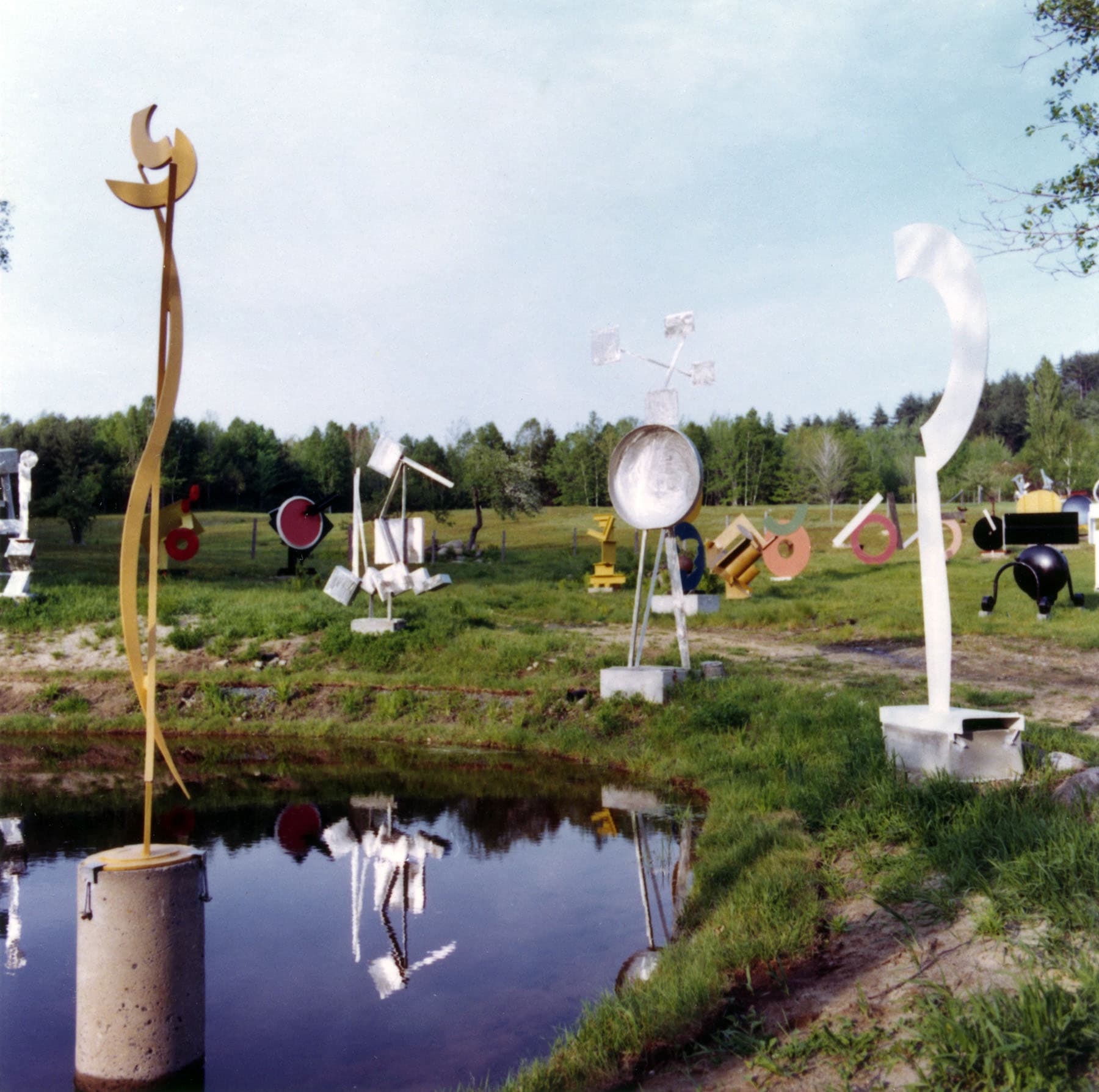
David Smith, Sculpture group, Bolton Landing, NY, 1964. The Estate of David Smith. © 2024 The Estate of David Smith / Licensed by VAGA at Artists Rights Society (ARS), NY.
Phong H. Bui is the Publisher and Artistic Director of the Brooklyn Rail.