Richard Serra at Gemini G.E.L.: Five Decades of Printmaking
Word count: 1055
Paragraphs: 8

Installation view: Richard Serra at Gemini G.E.L.: Five Decades of Printmaking, Gemini G.E.L. at Joni Moisant Weyl, New York, 2024. Courtesy Gemini G.E.L. at Joni Moisant Weyl.
The late, great Richard Serra (1938–2024) collaborated with the Los Angeles workshop, Gemini G.E.L., for fifty-two years, creating over 330 editions. Serra remained one of the most active artists with Gemini G.E.L., such that, in a 2009 oral history interview with Hunter Drohojowska-Philp for the Archives of American Art, Sidney Felsen (a co-founder of Gemini G.E.L.), remarked that “Richard Serra and John Baldessari are the most active artists as far as regularly producing something.” Working with the great (though oft under-recognized) Xavier Fumat (b. 1963), a master printmaker based in Los Angeles who, in 2000, took up the mantle of Serra’s Project Collaborator at Gemini G.E.L., Serra honed several unique lithographic, silkscreening, and aquatint processes. A sampling of each approach is on view in the exhibition, which evinces the teleology of Serra's defeasible, self-revising printmaking. It begins with early matte black lithographic sculptural studies featuring blotted edges—clearly grown out of Serra’s early molten lead “Splashings” series from 1968–69—and ends with sharply executed, coarse Stygian curvature silhouettes executed shortly before the artist’s death.

Installation view: Richard Serra at Gemini G.E.L.: Five Decades of Printmaking, Gemini G.E.L. at Joni Moisant Weyl, New York, 2024. Courtesy Gemini G.E.L. at Joni Moisant Weyl.
It was in the 1970s when Serra began working with Gemini, inaugurating his printmaking practice. The earliest works on view, Balance and Circuit (both 1972), attest to this moment. These lithographs of blotted, matte-black rectangular parcels divide the similarly rectangular pictorial field. Their sprayed edges recall Serra’s splashed lead sculptures, which Dave Hickey, in a 2005 essay, called “Tragic Mondrians” that found the “weightless, rectilinear utopian icons of early twentieth century abstraction … fallen to earth under the force of gravity and … caught in the process of disassembly or restoration.” During this period, Serra used aluminium plates and lithographic stones, which produced a smooth, flat, black, lustrous coat that he came to regard as “too refined,” preferring the textural mass that, in the 1980s, he achieved by combining screen-printing with hand-applied molten oil sticks with prints like Carnegie (1987). It is no coincidence that this turn toward rectilinear integrity shortly followed Serra’s coeval shift to the freestanding rectangular sweep, evidenced by his Cor-Ten steel public sculpture, St. John’s Rotary Arc (1980).

Installation view: Richard Serra at Gemini G.E.L.: Five Decades of Printmaking, Gemini G.E.L. at Joni Moisant Weyl, New York, 2024. Courtesy Gemini G.E.L. at Joni Moisant Weyl.
Beginning in December 1993, Serra began utilizing an etching technique that printmakers traditionally consider a mistake: corroding the copper plate’s wax “ground” with lengthy acid baths in ferric chloride that dissolved, or “bit,” through the exposed metal. Over the subsequent decades, Serra continued to etch deeper than he had before, silk-screening silhouette forms before running paint sticks along the surface to create oil markings. Despite exclusively working with black throughout his printmaking career—by melting oil sticks with crystallized silica rock—Serra achieved ever-complex lithic textures. One sees this development by comparing Transversal #1 (2004) with Double Rift V (2014) and the “Hitchcock” series (2024). In the former, the warped parallelogram’s face is dappled but mostly smooth, shimmering like crude oil. In the latter two incline forms, the oil stick and silica surfaces are coarse and pebble-toothed, their forms barely cradling light.
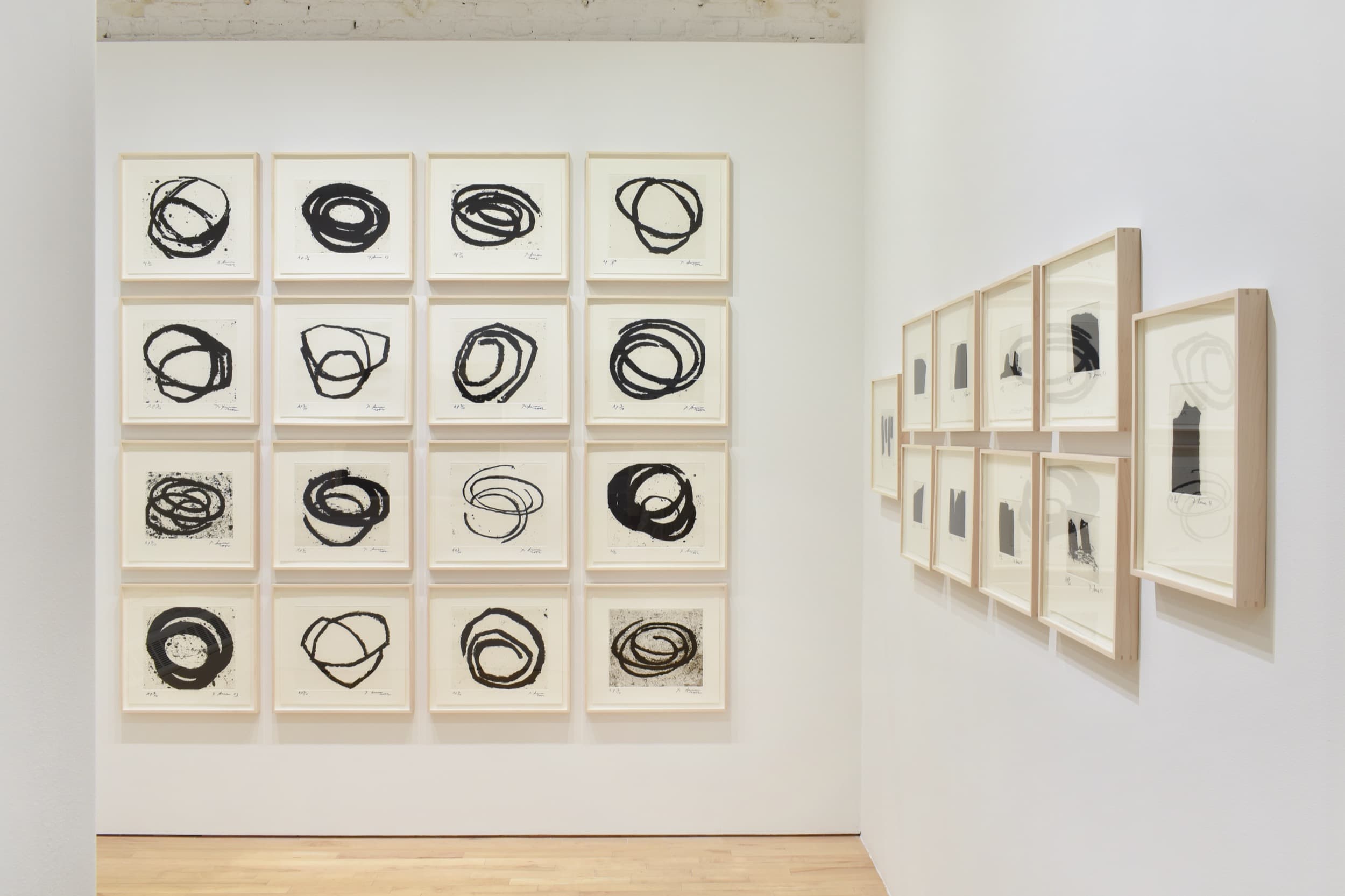
Installation view: Richard Serra at Gemini G.E.L.: Five Decades of Printmaking, Gemini G.E.L. at Joni Moisant Weyl, New York, 2024. Courtesy Gemini G.E.L. at Joni Moisant Weyl.
With these and other works from the last fifteen years of Serra’s printmaking career, such as Double Level II (2009), Horizontal Reversal I (2017), Equal I, and Equal V (both 2018), we see increasingly fewer errant marks or smudges on the paper. Where improprieties do occur, they are contained to two or three edges, always juxtaposed by a multiplicity of smooth planar faces. By roughing the surfaces rather than the edges, Serra’s structures come to dominate the paper’s smooth terrain.
Some of the works on view prefigure Serra’s gargantuan sculptural installations. Viewers familiar with them will appreciate these homologies. The central axis of Circuit (1972), for instance, with its rectangular walls suggests an oblique view of the inside of Wright's Triangle (1979–80). In the two-color etching, Xavier (2003)—whose title is an homage to Fumat—and T.E. Sparrows Point (1999), we are privy to a coiling, serpentine form reminiscent of Serra’s sculptures, Cycle (2010) and Junction (2011). In these last two prints, a splattered black corkscrew winds in and out of itself, repeatedly slipping in an ovular bow. As a study, it is an art-historically interesting draft; as a self-standing print, it is less captivating than, for instance, Paths and Edges #5 (2007), where the winding tendrils are collapsed into ringlet arcs observed from an aerial perspective.

Installation view: Richard Serra at Gemini G.E.L.: Five Decades of Printmaking, Gemini G.E.L. at Joni Moisant Weyl, New York, 2024. Courtesy Gemini G.E.L. at Joni Moisant Weyl.
Like A Drawing in Five Parts (2005), the “Paths and Edges” series’ nestled arcs are inspired by the sloping sand dunes of the San Francisco beaches where Serra grew up and the rippling Zen sand gardens of Kyoto. Given their source material, their wind embodies movement—here, their curling wind across the Mohachi paper below. The leitmotif of the collapsed arc also reoccurs in Between the Torus and the Sphere II and III (both 2006). Throughout this suite of works, the seven black arcs are always unevenly spaced. As tendril-like channels, they weave in and out of one another, with frothed droplets dotting the wide white cleaves separating the bands. These smudges are the by-product of dirty plates. In turn, the marked negative space functions less as an oppositional recess than as an even plane, running alongside the black curvature. This is unlike Serra’s later prints, where the imposed black forms dominate the paper’s negative space.
Serra’s early sculptural studies, like Circuit, Balance, and Screech (all 1972), merely virtually augur sculptural three-dimensionality. His late prints, synthesizing grainy silica stone forms with cleanly delineated, towering curvilinear and rectilinear edges, pursue a self-contained and thorough-going dimensionality of weighted texture. These late etchings tend to constrain the edges, with Serra’s structures less prone to bleeding and blotting out. It is not that Serra wholesale abandons the sprayed rectangle face but that he increasingly economizes it, rendering it constrained, judicious, and purposive—as in Backstop II (2021) where, of the superimposed rectangles’ four exterior faces, two are smudged by a slight spray, the other two edges cut and even-riven. Unlike Serra’s sculptural studies, these later works address, rather than remain beholden to, Serra’s sculptural leitmotifs of the curve and ellipse. Serra’s late prints expand his forms into what Hickey called the “vertical, curving swath of textured blackness” that “nearly obliterates the sheet upon which it is printed.” By creating roughly-textured but evenly cut forms that project from their supports, Serra’s swooping, cragged vertical and rectangular sheets narrow the difference between print and constituent materials—and thereby, between print and sculpture.
Ekin Erkan is a writer, curator, and researcher whose writing has appeared in the Journal of Value Inquiry, the International Journal of Philosophical Studies, and Hyperallergic, among others.