Give the Drummer Some
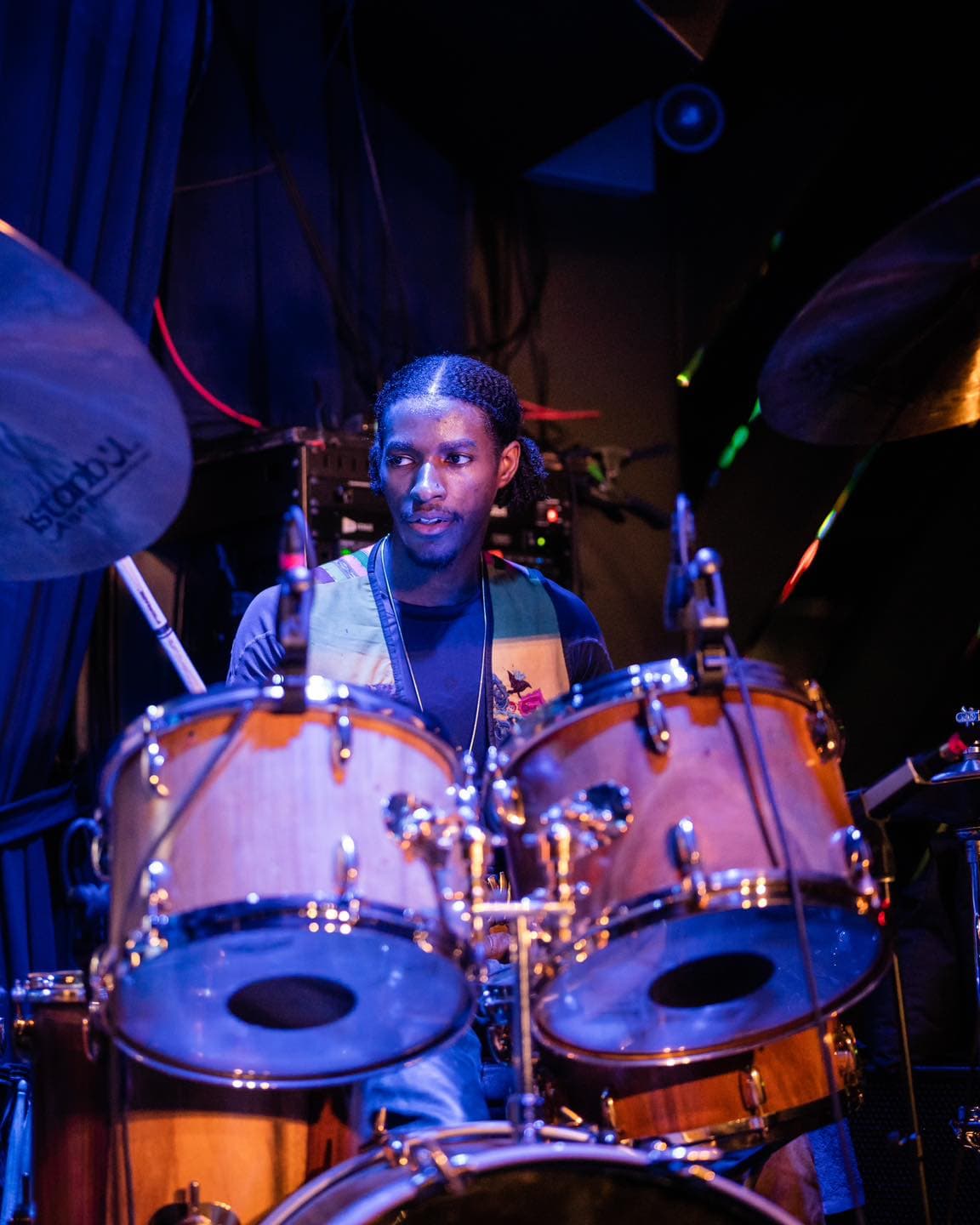
Kojo Roney. Courtesy the artist.
Word count: 1177
Paragraphs: 11
Growing up, a few directives were passed down by my parents that started as advice for specific situations but wound up having larger applicability. My father’s mantra was “Get an early start,” whether planning for a long drive or preparing to take on any significant task. My mother’s applied to cooking; her go-to was, “You can do anything with a hot oven.” Eventually this advice was pared down to a single four-word phrase—early start/hot oven—that continues to serve me well to this day.
I thought of that when considering the astonishing life and career of the drummer Max Roach, whose centennial is being celebrated with concerts, lectures, and a terrific documentary named after one of his solo percussion pieces, The Drum Also Waltzes. He certainly got an early start, sitting in with the Duke Ellington Orchestra at the age of eighteen. The drummer made his recording debut the next year with Coleman Hawkins, and played regularly with Charlie Parker and many others at Monroe’s Uptown House and later Minton’s Playhouse in Harlem, where bebop was just being born.
And he kept his oven hot with a precise, blistering technique that appeared effortless, but that was incredibly light and propulsive. He brought it to bear in a number of high-profile engagements, playing on Miles Davis’s Birth of the Cool and forming a mighty quintet with Clifford Brown. When Brown died in a car accident, Roach was nearly inconsolable, but eventually formed a new small group, with Sonny Rollins as a co-leader.
His career took a strong turn toward the political in the early 1960s, when he recorded We Insist! with his future wife Abbey Lincoln. He insisted thereafter that all his work be considered a part of the struggle for civil rights, telling Down Beat, “We American jazz musicians of African descent have proved beyond all doubt that we’re master musicians of our instruments. Now what we have to do is employ our skill to tell the dramatic story of our people and what we’ve been through.”
He continued to expand the boundaries of jazz, both musically and professionally: taking a professorship at the University of Massachusetts at Amherst, receiving a MacArthur “genius” grant, collaborating with his godson Fab Five Freddy on some early jazz/hip-hop amalgams, and forming the Double Quartet with his daughter Maxine, bringing improvised and scored music—jazz and classical—into the same orbit.
Of all his projects, one of the most fascinating is the all-percussion ensemble M’Boom. From his bebop days onward, Roach had gone far beyond any sort of traditional time-keeper role, making the drummer a full-fledged creative force in the music. With M’Boom, he brought percussion out front and let that stand on its own. In August, Jazzmobile and SummerStage organized a reimagining of M’Boom, with a concert at the amphitheater in Marcus Garvey Park that was a highlight of the summer season. The arrangements by Bobby Sanabria brought in horns and a bassist, but used them judiciously, still keeping the percussion instruments front and center.
The band tore into their repertoire, from the Omar Clay composition “Onomatopoeia,” which reveled in pure percussive sound, to the closer, “Epistrophy,” offering a completely reimagined take on this Thelonious Monk classic, highlighted by the playing of original M’Boom member, ninety-year-old Warren Smith, on the kettle drums. Everyone seemed to sense how special the occasion was, as M’Boom (pronounced various ways by MC’s and band members, but most commonly and poetically as Oom-Boom) set the crowd alight.
The evening had opened on a strong note with an ensemble led by drummer Kojo Roney. Talk about getting an early start: Roney began performing with his father Antoine around the age of eight, showing a strong technique and great feeling for the instrument. Now twenty, his playing skews heavily toward the style of Tony Williams—not the quicksilver young giant who Miles Davis called the creative spark of his 1960s quintet, but the machine-gun virtuoso from the phase that followed, the drummer’s originally reviled, later beloved Lifetime band. Hearing Roney lean hard into early fusion came as something of a surprise, and the crowd needed to adjust to it, but he won them over with the sheer exuberance of his playing. The tempos, and the temperature, never faltered.
Combining the flaming presence of a virtuosic upstart with a centennial tribute charting the long, extraordinary arc of Roach’s career seemed natural, even correct, and prompted thoughts of youth and age as they relate to music. Roach got such a young start, playing with his heroes while still in high school. His gift unfolded, as many do, when he was in his twenties, and he made his mark playing with two other very young men: not only the celebrated Clifford Brown but the less often mentioned Booker Little, who contributed so much in his short life and recorded two seminal albums with Roach, before passing on at only twenty-three of natural causes. The blazing start is the mark of ambitious, athletic young musicians, whose playing reflects the kind of energy that suggests it will never expire. Great artists like Roach take that initial explosion and learn to harness it. His constant experimentation and expansion of form took so many paths, and he seemed determined to exhaust and learn from his gift. The documentary makes clear that Roach could be a difficult man, focused to the point of being unyielding, and prone to anger. At the same time, he conveys tremendous respect for his music, and the mission behind it. Listening to it now, one is struck by the intensity and clarity of it, the sheer beauty of its lines. On “We Speak,” one of the collaborations between the Booker and Roach, with a stellar band featuring Eric Dolphy, the sinuous interplay is kept at a steady boil, yet remains oddly cool, a temperature-controlled feat.
Roach’s music continued to reach outward his entire life. With M’Boom, he realized his wish to put the full range of percussion on display, visually and sonically—not just the standard drum kit, but marimba, timpani, and assorted bells and gongs. And as much as the music grew in terms of range, it was always rooted in an essential understanding of the drum as a key to the music that has grown in this country and shown ongoing force around the world. Whether paying homage to his forebears Jo Jones and Big Sid Catlett, or providing the core of mid-century jazz alongside Art Blakey and Louis Hayes, or inspiring the likes of Jeff “Tain” Watts and Johnathan Blake, Roach was a powerful creative force. He conveyed a profound seriousness of purpose in his playing, and his bearing. Hearing Kojo Roney take such a fearless, powerful, self-determined approach to his playing, you can feel the gift reach across the ages. Here’s hoping his own playing continues to flourish in whatever direction his spirit takes him. It’s true that an early start and a hot oven get the project up and cooking, but it’s what the artist does with it that gives it the depth and density of flavor we seek.
Scott Gutterman has written about art and music for Artforum, GQ, the New Yorker, Vogue, and other publications. His most recent book is Sunlight on the River: Poems about Paintings, Paintings about Poems (Prestel, 2015). He is deputy director of Neue Galerie New York and lives in Brooklyn.