Ron Gorchov: Exploring the Near/Far Painterly Horizons of Modern Space
Word count: 858
Paragraphs: 8
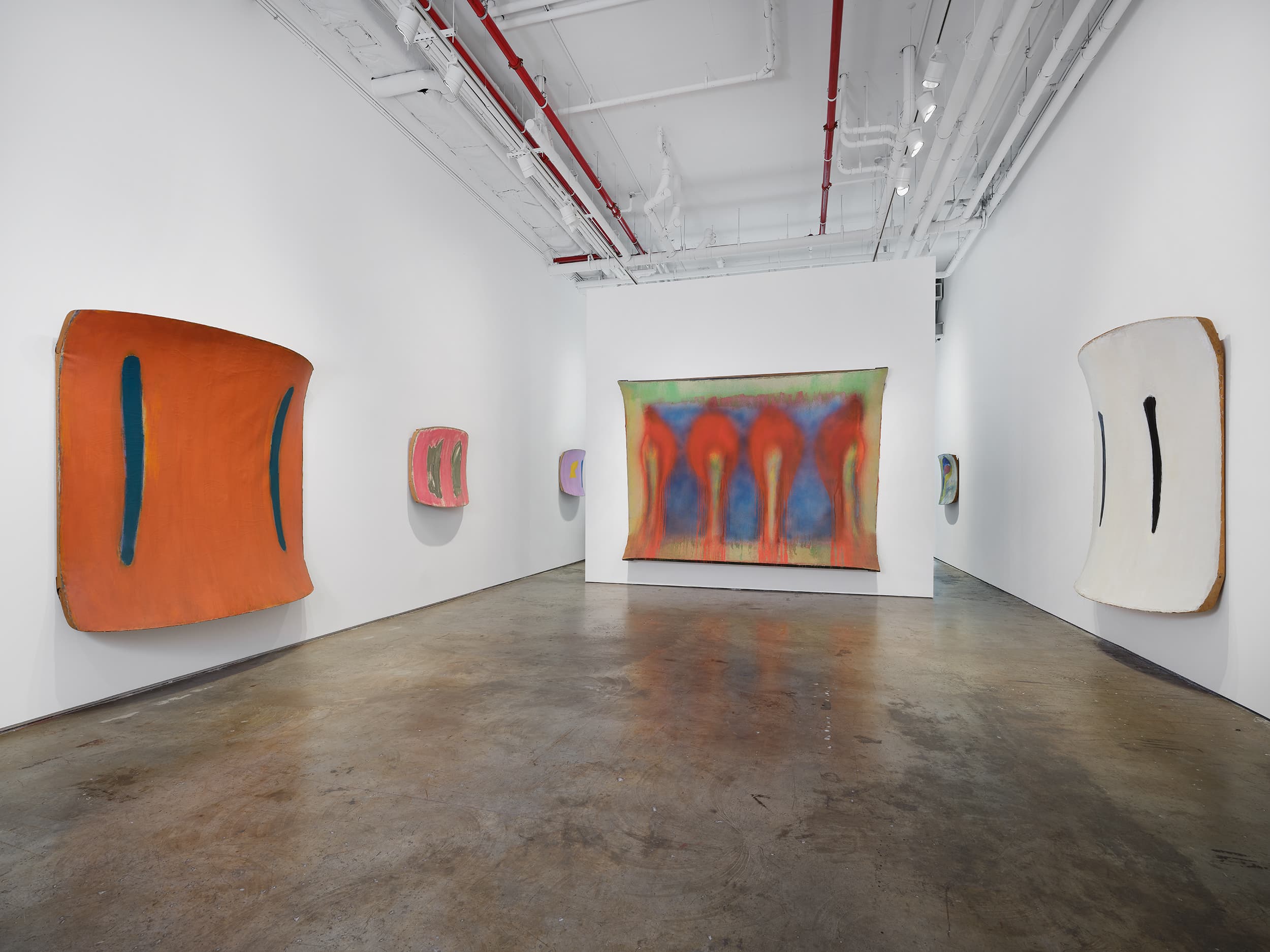
Installation view: Ron Gorchov: Exploring the Near/Far Painterly Horizons of Modern Space, Vito Schnabel Gallery, New York, 2024. Artworks © 2024; Estate of Ron Gorchov / Artists Rights Society (ARS), New York. Courtesy Vito Schnabel Gallery. Photo: Argenis Apolinario.
Vito Schnabel
September 5–October 19, 2024
New York
Vito Schnabel’s Ron Gorchov retrospective, curated by Robert Storr, Exploring the Near/Far Painterly Horizons of Modern Space, excavates works from the late artist’s studio, punctuating them with some of Gorchov’s most important saddle-shaped canvases. Although Gorchov’s works are not presented historically, the show is a monumental tour through his oeuvre, affirming that his name ought to resound alongside post-painterly abstractionists like Frank Stella, Ronald Davis, and Jules Olitski.
A 1960 letter from Gorchov can be found in the papers of the influential modernist painter and theorist John D. Graham. Gorchov, who was an ardent reader and acolyte of Graham’s System and Dialectics of Art (1937), writes that “other theories and knowledge give me an interesting but useless view of my life.…And now all you have taught me is beginning to come out in unexpected ways in my painting." In a later letter dated May 8, 1961, Gorchov remarks, “I do not find any writer who puts things as clearly and brilliantly as what you have spoken to me.” What, precisely, was it that Graham imparted to Gorchov? In a passage that also apparently interested Gorchov, Graham asks whether painting is, “a two-dimensional or a three-dimensional proposition?” He concludes that, by virtue of the structure of the canvas, painting is two-dimensional and that for this reason the painter ought to orient themselves towards this basic flatness. But Graham differs from other influential modernists like Clement Greenberg and Michael Fried in that he saw the telos of painting as oriented not only towards a medium-specific essence but also subject matter—for Graham, painting was a project of dissemblance, insofar as it could never truly reproduce reality.

Ron Gorchov, Mine, 1968–69. Acrylic on canvas, 106 x 144 1/2 x 12 inches. © 2024; Estate of Ron Gorchov / Artists Rights Society (ARS), New York. Courtesy Vito Schnabel Gallery. Photo: Argenis Apolinario.
Gorchov appreciated both the didactic facets of Graham’s text and its prognostications concerning an art of the future. In 1968 and 1969, Gorchov produced Mine, his first saddle painting featuring concave curves. Inspired by Buckminster Fuller and Frederick Kiesler’s geodesics, the work was the first incarnation of what Gorchov, in a 2017 interview with Hans Ulrich Obrist, terms the “tension device.” Yet the colossal work, on view in the current exhibition, displeased Gorchov and he notes to Phong Bui and Robert Storr in a 2006 interview that while Mine “had something I liked, but the structure was all wrong. I had to give the structure a form that I would want to draw into.” He would soon begin “drawing into” his saddles with lozenge-shaped pockets, apparently inspired by the void that appears when the forearm meets the torso in kouroi sculptures.

Ron Gorchov, Spice of Life II, 2017. Oil on linen, 71 1/2 x 102 x 14 1/2 inches. © 2024; Estate of Ron Gorchov / Artists Rights Society (ARS), New York. Courtesy Vito Schnabel Gallery. Photo: Argenis Apolinario.
In Gorchov’s late-career Spice of Life II (2017), Jocasta (2017), and Milniades (2018), these vertical contours reappear as irregular semi-symmetric pairs. These are, Gorchov remarks to Obrist, inspired by “Palladio and his idea of asymmetry, or where symmetry and asymmetry play.” They at times recall lintels, dolmens, caryatids, or wriggling amoeba. Their centered composition almost teeters on pareidolia. Yet Gorchov’s parallels are neither piled on nor are their forms set into illusionistic recession. Abetted by the virtual flatness of the applied paint, the corporeal shape of the bow is singularly emphasized throughout. Gorchov does not create the illusion of objects on a surface space—instead, the feeling of objecthood is intensified through the projecting materiality of his saddle-shaped canvas. In a 2011 interview with Ray Smith, Gorchov notes that his canvases “treat painting as an object.” Although the linen is stapled to the front of a curved wooden support beam with metal fasteners, Gorchov’s works—when viewed head-on—give the unified impression of floating reliquaries. The dual verticals facilitate this, directing our bodies, and then our gaze, towards the center. It is then that Gorchov’s soft and unpainted brown edges retreat from view, no longer framing but dissolving the margins of space.
Given Gorchov’s fervent appreciation of Graham, how is one to reconcile Gorchov’s lumbering warped saddles—weighty and three-dimensional, despite the flatly painted verticals and even striped coats—with his affinity for Graham’s traditional modernist narrative, oriented as it is towards “flatness”? Like Morris Louis’s “Unfurled paintings,” whose paint-soaked canvases are so saturated that the surface of the support and the painted picture plane unify, Gorchov’s saddles eschew trompe-l'œil pictorial illusionism. There are no objects set within the spatial foreground-background relay. Gorchov’s saddles are self-sufficient objects, imposing themselves upon the viewer’s space, bulbous and looming. There is no distinction between presence and essence in Gorchov’s works. They reconcile the classically modernist opposition between materiality and illusion by providing a fully embodied experience.

Installation view: Ron Gorchov: Exploring the Near/Far Painterly Horizons of Modern Space, Vito Schnabel Gallery, New York, 2024. Artworks © 2024; Estate of Ron Gorchov / Artists Rights Society (ARS), New York. Courtesy Vito Schnabel Gallery. Photo: Argenis Apolinario.
This is clarified, in particular, by Set (1971), Algol (2016), and Ascella (2017), each stacking bisected oblong fans into totemic towers, the constituent modules painted in uniform washes of rusted lime, flaxen yellow, midnight coal-blue, burnt-tangerine brick, or ground jasper. The lowest saddles show rivulet drips, indicating both Gorchov’s use of the spray gun and the presence of gravity, of material weight. Given their emphatic embodiment, viewing these works head-on provokes an experience that exceeds the power of our imagination, a more potent sensation of infinity than any work produced by Gorchov’s high modernist peers.
Ekin Erkan is a writer, curator, and researcher whose writing has appeared in the Journal of Value Inquiry, the International Journal of Philosophical Studies, and Hyperallergic, among others.