Anthony Cudahy: Fool’s gold and Fool’s errand
Word count: 734
Paragraphs: 8

Installation view: Anthony Cudahy: Fool’s gold, Hales Gallery, New York, 2024. Courtesy the artist and Hales Gallery.
Hales and GRIMM
September 6–October 19, 2024
New York
If it’s foolish to fall in love, consider me smitten. In a dazzling new body of work that pairs quotidian scenes of queer life fused with myriad symbolism referencing everything from the occult to Western art history, artist Anthony Cudahy’s parallel solo shows, Fool’s gold and Fool’s errand are, collectively, a mesmerizing meditation upon the nature of love. But make no mistake: the titular foolishness of Cudahy’s works is not defined by false hope and misadventure; rather, it is understood as a liberating force that resists the bonds of convention. And though they are exhibited at separate galleries—Cudahy is dizzyingly prodigious—the many works which make up Fool’s gold and Fool’s errand, when situated as a whole, evoke a rich narrative in which fantasy and the everyday conjure a very intimate and wondrously rich personal mythology.
As with Dusk and Dawn (with Perspective Machine) (all works 2024), the very act of looking—at others and the self—is a central theme running throughout Cudahy’s shows. Portraying two reclining male figures separated by a square frame encasing a wire grid, Dusk and Dawn calls to mind Albrecht Dürer’s sixteenth-century woodcut depicting the use of a “drawing grid.” But where Dürer’s grid was employed to achieve perspectival accuracy, Dusk and Dawn—like all of the works included at Hales and GRIMM—dispenses with representational congruity in favor of a dynamic expressionism, pairing loose brushstrokes with a propensity for reductive figuration.
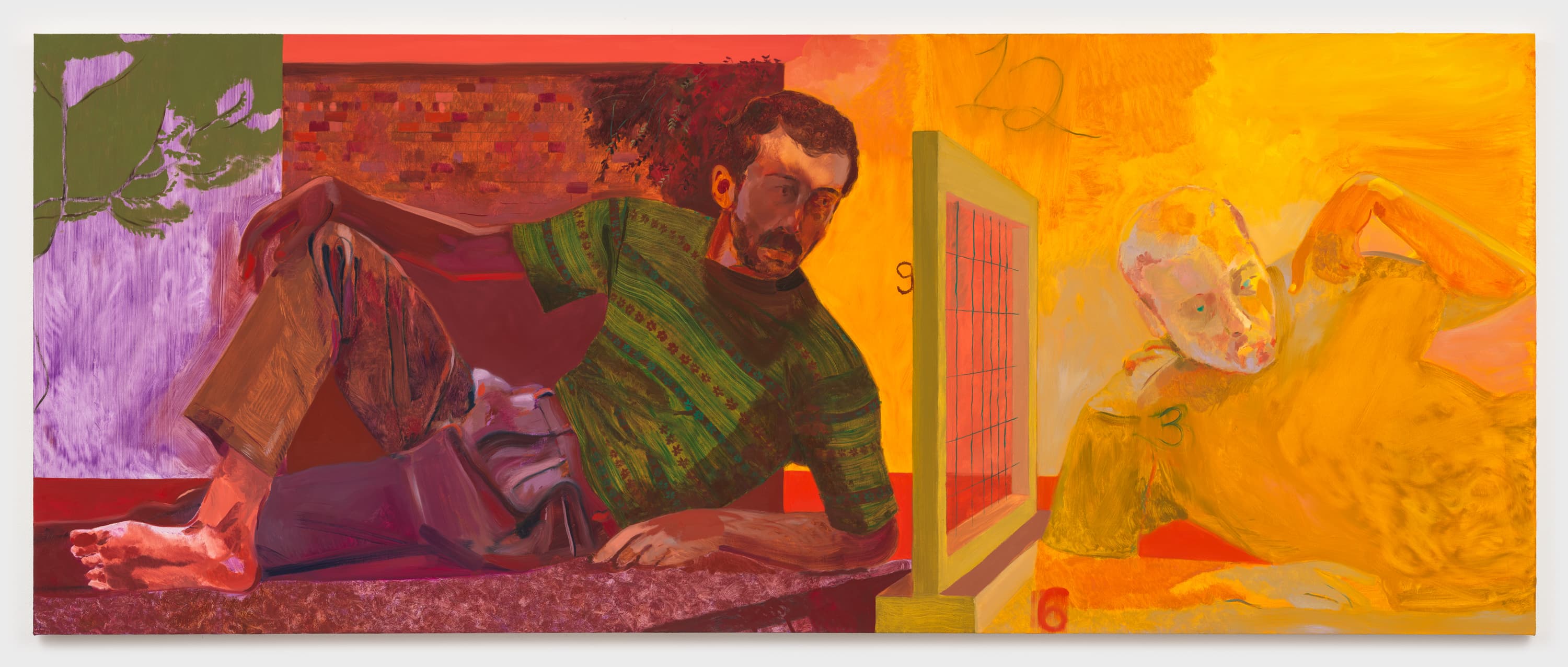
Anthony Cudahy, Dusk and Dawn (with Perspective Machine), 2024. Oil on linen, 48 x 120 x 1 1/8 inches. Courtesy the artist and Hales Gallery.
Importantly, Cudahy’s reference to Dürer’s drawing grid can be viewed as a subversive gesture, one in which the perspectival gaze and its attendant construction of Otherness is literally undone by the artist’s play with figuration and expressive style. Put another way, Cudahy’s queer world requires a new visual vocabulary to portray it. Thus, one can observe in the portrait Alex in Maine, or the detail study of sleeper’s head in The dreamer, Cudahy evincing a world that rejects representational verity—framed as it were by a normative, objectifying gaze—conjuring instead radical, more inclusive ways of seeing.
It is perhaps no surprise, then, that Cudahy incorporates occultic references throughout both shows. As queer radical scholar Arthur Evans argued in his pioneering 1978 text Witchcraft and the Gay Counterculture, pagan and esoteric practices offer sites of refuge and acceptance outside the dominant regimes of orthodoxy and religion, which have traditionally sought to marginalize and suppress queer communities. In the case of Dowsing (studio) and Alchemical, Cudahy makes explicit references to such hermetic practices. In the foreground of Dowsing, a large-scale oil painting, a central figure holds the namesake forked wooden wand, while behind him another man, similar in appearance, but naked, appears to regurgitate brown liquid into a muddy pool. A self-portrait of Cudahy hangs in the background, an omniscient observer to the rituals playing out. Portraying the studio as site of divination, Cudahy collocates his practice with soothsaying, his works weighted with the promise of revelation.
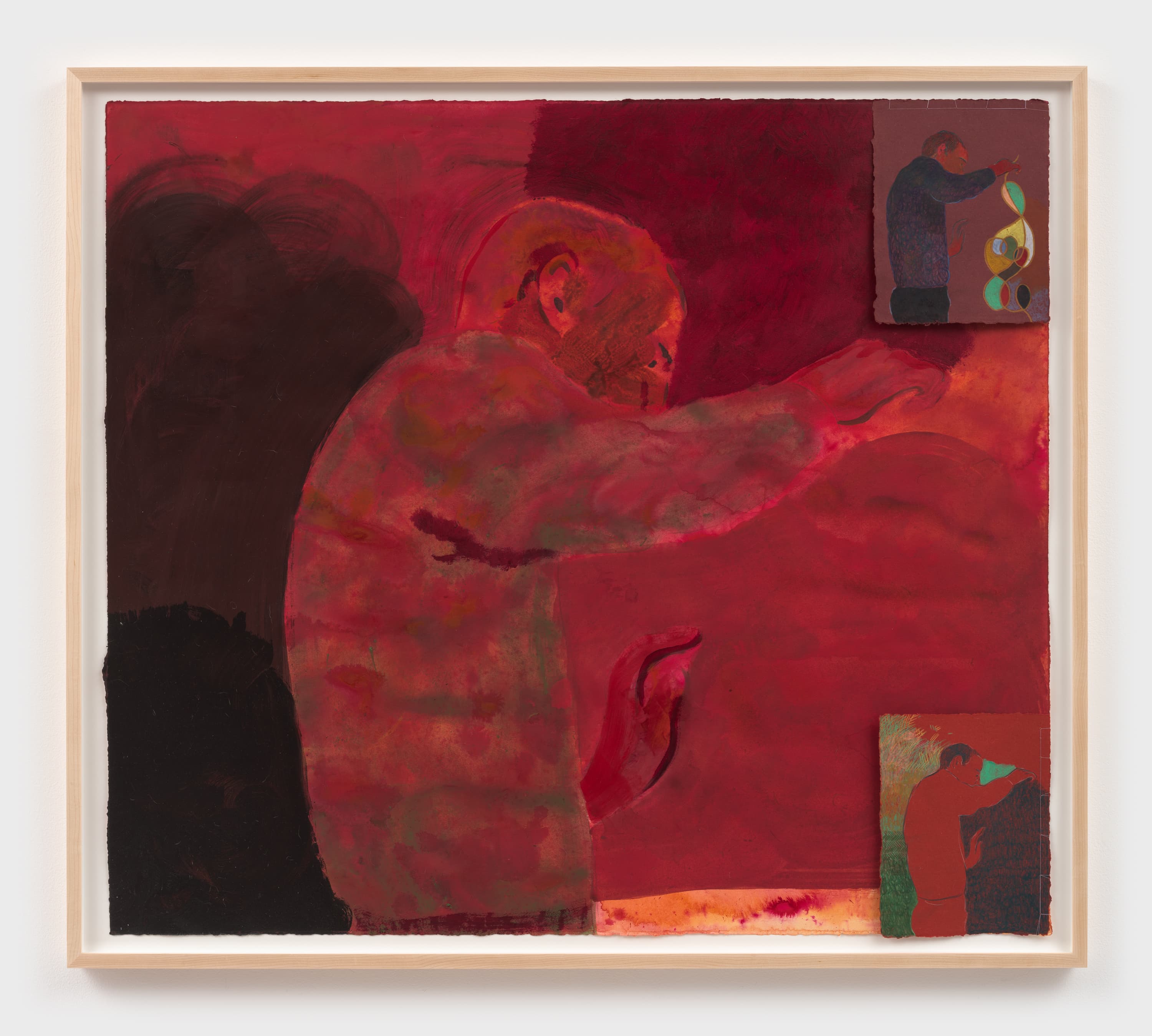
Anthony Cudahy, Alchemical, 2024. Acrylic, colored pencil, and thread on paper, 42 1/2 x 48 inches. Courtesy the artist and Hales Gallery.
Meanwhile, in Alchemical, a lone figure, expressively rendered in a watery acrylic wash of deep sanguine reds, holds his arms up as if conducting a secret ritual or casting a spell. Sewn into the image’s right side, two separate smaller drawings of the same figure appear, rendered in color pencil on color paper. In one of the drawings, abstract, balloon-like shapes of several colors float under the figure’s hands, calling to mind the occult-infused, geometrically abstract works of the Swedish spiritualist and artist Hilma af Klint.
And yet, for all the esoteric imagery and play with figuration, Cudahy’s most compelling images are perhaps those which conjure the wondrous from out of the unremarkable. Whether with Ian and Alex and its portrayal of two men on a couch in a scene of archetypal domesticity; Eternal Lovers, a study of two men in close embrace; The dreamer ii, an intimate depiction of a topless man asleep in bed with a pet dog; or Violet Sammy, a soulful portrait of a man’s face, Cudahy’s ability to elevate scenes of queer intimacy into glimpses of the sublime is perhaps his greatest feat. TV nights at home, the fleeting glimpse of a partner asleep, a long embrace. For Cudahy, these are the rewards that come with all of love’s follies. Sure, fools fall in love. But who wouldn’t happily play the fool to do so?
Joseph Akel is a New York-based freelance writer and editor. His non-fiction writing and criticism have appeared in the New York Times, the Paris Review, Frieze, and Vanity Fair, among others. Additionally, he has penned several artist monographs, most recently for artist Doug Aitken. Akel is currently working on his first novel. He holds a master’s degree in Art History from Oxford University.