ArtOctober 2024In Conversation
ROBERT LONGO with Amanda Gluibizzi

Portrait of Robert Longo, pencil on paper by Phong H. Bui.
Word count: 3895
Paragraphs: 54
Albertina
September 4, 2024–January 26, 2025
Vienna
Thaddaeus Ropac
October 9–November 20, 2024
London
Pace
October 9–November 9, 2024
London
Milwaukee Art Museum
October 25, 2024–February 23, 2025
This fall, the polymathic artist Robert Longo will see four different solo exhibitions open within a month of each other. At Vienna’s storied Albertina Museum, an institution known for its collection of works on paper and for its drawings in particular, Longo will install a selection of his massive charcoal-on-paper images, building a retrospective of this aspect of his oeuvre. Meanwhile, in London, Thaddaeus Ropac and Pace galleries will simultaneously display Searchers, exhibitions of both large and small-scale charcoals, a video presented at minute and monumental projections, and new Longo “Combines”—25-foot-long works, each of which incorporate drawing, painting, sculpture, video, and photography—titled Untitled (Pilgrim) and Untitled (Hunter). And later in the fall, he will open Robert Longo: The Acceleration of History at the Milwaukee Art Museum, an overview of the last ten years of his artistic production. Longo and I spoke in his studio in August 2024 before he traveled to Europe, in a conversation that ranged from his current shows to his beginnings as an artist, from how he finds and uses images gleaned from the internet to his desire to make work that is immediate—that “happens every time you see it.” This interview is drawn and edited from our exchange.
Installation view: Robert Longo, 2024, the Albertina Museum, Vienna. © The ALBERTINA Museum, Vienna.
Amanda Gluibizzi (Rail): Tell us about your upcoming museum shows and Searchers, at Thaddaeus Ropac and Pace in London, which will see you returning to your “Combine” format.
Robert Longo: Every one of my “Combines” has a photograph, sculpture, a painting, a video, and a drawing. It’s all based on Ways of Seeing (1972), John Berger’s book. With the “Combines,” the pieces are going backwards into my practice: they have all these different mediums in them, which is interesting, because in the studio, with the drawings, I have complete control. Each “Combine” has only one drawing in it, but the other components were fabricated outside the studio, which was insane. Originally, my “Combines” were built on the idea of montage. You’ve seen 2001: A Space Odyssey, right?
Rail: Yes.
Longo: You know the scene where the monkey throws the bone in the air, and it turns into a spaceship? If you just took those two frames out of the film, what would that look like? We’d see the bone and the spaceship; they were either a juxtaposition of images on top of each other or in sequence. I was very interested in Sergei Eisenstein and the whole idea of montage, how you don’t see merely one image at a time. And when you’re looking at an artwork, you’re also seeing the other viewers, the space in which it is installed, and its surroundings: there’s always something in relationship.
There is no narrative, but there’s an underlying structure that these new “Combines” are based upon, like the idea of the body. The “Combines” being shown at Pace and Thaddaeus Ropac are each composed of a head, a chest, a gut, genitals, and legs. And then installed on the wall opposite each “Combine” is a large-scale drawing: a wisteria at Ropac, a peony at Pace—very beautiful flowers that look quite aggressive. Each gallery also has a very small drawing of a hero, Alexei Navalny at Pace and Mahsa Amini at Ropac, based on images from the protests following their deaths. In the lower level of Pace there is going to be a film that’s a year’s project—which we started on July 4—where we pick international images off the internet and we turn them black and white, and we run them at 100 frames per second. The film is programmed to randomly pause for two seconds. At Pace, the film will encompass the entire wall, and meanwhile at Ropac the same video will be shown on a tiny monitor measuring seven inches.
Rail: Have you watched trial runs of the film at both projection sizes? What is the difference?
Longo: What’s funny is that I was shocked at how much information you can actually see in it. We can see it all, regardless of its rapid speed or small scale. And what was interesting—by starting on July 4—we started with fireworks, and there were also the elections in England and France, and the war in Gaza and the war in Ukraine, so it spans a wide range of images from this image storm that we live in. This is a manifestation of it. It doesn’t have sound, but it seems really loud to me. I think it’s actually quite beautiful. How to deal with all these images and try to mediate them? There’s the world, and then there’s the representation of the world. Somehow, I’m stuck in between.
Rail: You’ve mentioned in the past that you’ve looked at Hollis Frampton and Paul Sharits and that you worked for Sharits. Do you see this piece as an informational, image-based, flicker film?
Longo: When I think about my evolution as an artist, it begins in Buffalo when my friends and I started a kind of alternative art space called Hallwalls. At the same time in Buffalo, there was a great art museum with great Pop art and Abstract Expressionism in their collection. As part of SUNY Buffalo’s Department for Media Study, which Frampton helped develop, both Sharits and Frampton had the most incredible movie programs. I saw Eisenstein for the first time. I saw Triumph of the Will (1935) for the first time. I saw all this shit that had a huge influence on me. I’m dyslexic so I learned to read pictures; I didn’t read books. And both Cindy Sherman and I grew up on Long Island, and we both watched the same television.
In New York—the local station, not the major networks—they had a thing called the “Million Dollar Movie.” The theme song was from Gone with the Wind or something. But what would happen is that the same movie—like King Kong or Gone with the Wind—would be on three times a day, seven days a week. So, if you were home sick from school, cutting school, whatever: you’d get to watch the same movie twenty-five to thirty times. Both Cindy and I watched it. They were always black and white because we only had a black-and-white television. And I think that’s something that seriously shaped who we are as artists, for sure. I remember John Wayne movies and Douglas Sirk’s Imitation of Life… it was a great creative moment.
Rail: Speaking of John Wayne, are your shows named after his 1956 Western, The Searchers?
Longo: I curated a show many, many years ago of younger artists, and I called it Searchers. I’m not a big fan of John Wayne. I mean, I think the Republican Party is basically “John Wayne throwbacks.”
But the idea of “searchers”—I thought about that as being artists, because that’s what we are, and I wanted to reclaim that title because I felt like these shows are of work that’s new. I’m searching, I’m trying to figure out if I can go in a direction that is at once familiar and also new. One “Combine” is called Pilgrim, and the other is called Hunter (both 2024).

Robert Longo, Untitled (Pilgrim), 2024. Mixed Media, 5 parts. © Robert Longo / ARS, New York 2024. Courtesy Thaddaeus Ropac gallery, London · Paris · Salzburg · Seoul. Photo: Eva Herzog.
Rail: When you think about looking for things, then, when you hit upon an image, what do you first do with it? Do you click and save it, or something else?
Longo: In the beginning I was appropriating images and responding to images. Now I’ll think, for example, “I want to make drawings of tigers.” And I work with someone who searches the internet for images, and he finds me thousands of pictures of tigers, we buy the rights for them, and then we cut them up and try to make the perfect image. Our source images are usually highly altered to somehow become something else. I’m trying to make the perfect version of that image.
The idea of appropriation is a form of mediation. I don’t know if I am an “appropriationist.” I didn’t know I was a part of this “Pictures” thing until I met Douglas Crimp, but the idea of making pictures of pictures is really ingrained in my work. I’m interested in poetic imagery, but also I make images that I want to own. It’s about desire or possession. I see an image, I want to own it; if I want to own it, I want to make it the way I want it.

Robert Longo, Untitled (Hunter), 2024. Mixed Media, 5 parts. © Robert Longo / ARS, New York 2024. Courtesy the artist and Pace Gallery.
Rail: So how do you want it?
Longo: These images communicate something more than what you’re looking at. They’re not only representational images, because I think representation is highly abstract. I have a hard time with abstract art, because the problem is: Abstract Expressionists were so good, and they were so honest about their abstract art because they were dealing with the world after trying to destroy itself and trying to reject Europe. Now, most abstract art, to me, looks like representations of abstract art. Although I’m very, very jealous of people that make abstraction. I look at a Twombly or a Pollock, and fuck, it just looks so fun. It’s actually not fun to me. It’s fun to look at, but to make? I mean, I’m an artist. I’m not a mechanic, but at the same time, it is work.
That’s why I have assistants. These drawings are so labor intensive. They’re charcoal paintings more than they are drawings, made in the scale of paintings. The difference between these and painting is not so much the idea of paint, but rather that I don’t have to deal with the drying time.
Paint is like the original performance art, because you have to plan out how you can paint. Like, if I’m trying to paint an arm and a shirt, I have to wait until this paint dries and then paint the next thing. I love looking at Velázquez or Rembrandt, and seeing where they seam together, where they had to stop that day because that paint needed to dry.
I don’t have to deal with dry times, but I do have to plan out how to make a drawing, because it’s so labor intensive, and I had to figure out who… just like people have their favorite brushes, I have my favorite assistants. I know this guy’s good at this, this one’s good at that, and they give me the luxury to look, and I get to finish the works. Rembrandt and Rubens had over a hundred people in their studios, you know?
Rail: I always think about Rubens. You know, when you look at Rubens, you can see, “Oh, he did the hair, but then another person did the fur,” because fur and hair are different, right? And Jordaens did the skin tone of different people who weren’t important, and on and on and on.
Longo: People criticize art fairs, but to me, art fairs are a chance to put your work in front of a huge audience. The images of the war in Gaza are so gruesome, I could not mediate them. I couldn’t. So, I went backwards in history to another representation of war and carnage, the painting by Rubens, the Massacre of the Innocents (ca. 1610). For Basel this past summer, I made a big drawing based on the Massacre of the Innocents for Ropac and a big drawing based on Goya’s The Third of May 1808 (1814) for Pace. The figures in Goya’s painting look like Palestinians to me; there’s a mound behind them, it looks like rubble from Palestine. Here’s what’s weird: that idea that those who don’t know history tend to repeat it. I don’t think that’s true. I think those who know history tend to repeat it. I’m shocked at what’s going on in the world. I mean, I have kids that have grown up, and I worry what world we’re leaving behind. It’s disturbing.

Robert Longo, Untitled (After Rubens; The Massacre of the Innocents, c. 1610), 2024. Charcoal on mounted paper, 90 x 116 1/4 inches. © Robert Longo / ARS, New York 2024. Courtesy Thaddaeus Ropac gallery, London · Paris · Salzburg · Seoul.
Rail: I read a quote today that the Bourbon kings learned nothing from the past and forgot nothing, and that sounds exactly like what you’re talking about.
Longo: My job, I think, is to watch the world, and try to mediate it—to mediate these images of the image storm. But watching the Republican Convention, I realized: politics is basically fucking organized hate. It freaked me out. Watching that, you realize that human history is basically the story of domination, corruption, envy, and hate. As an artist, I emerged during the age of Reagan, the guy who said, “Let’s return to America’s traditional values.” Traditional values in America were like, owning slaves. What are you fucking talking about? I grew up as a hippie, and then the whole thing kind of fell apart when punk started happening. Carter felt like a moral free-for-all. He’s a great man, but when he was president, the country did not have an identity. When Reagan came to office, it was like someone had drawn a line in the sand, and folks had to take a position. Artists have to respond to the world we live in. Picasso said that art is like a weapon. It’s not meant to hang over the couch. It’s a weapon to use. I think what I make is beautiful. I make highly aggressive images out of this incredibly fragile charcoal dust. And I like that confusion between the two. I want to make things beautiful, because even if it’s a difficult image to look at, if it’s so beautiful, you have to look at it. I think you tend to dream in black and white, and I’m trying to make pictures that become memories. What’s interesting about art is that there’s seeing the art, and then there’s remembering the art, which is why I’m interested in how you remember the art.
Rail: When you think about looking at the art and the shows that you’re putting together, how do you get the works to talk to each other or to respond to each other across the room, or are you not interested in that?
Longo: An exhibition space is like walking through a movie, one gigantic montage. Not only do the images that are next to each speak to one another, but also the images that reflect into one another are in conversation. There’s an added drama.
When I go to museums, I go through first really fast, and then I go back and look more closely. As an artist, I think exhibitions are the last chance you have to control how people see your work before they go back to the collector’s home or whatever museum loaned the piece. I worked with Vito Acconci, and we often talked about the idea that space is a vehicle for meaning, so I’m very aware of where the works are in relation to one another. But the director at the Albertina, Klaus Albrecht Schröder, is a Dürer expert, so he has installed my Albertina Museum exhibition considering the work more formally than conceptually.
Rail: So maybe the Albertina will be more montage then, in that it’s more of a quick cut rather than a sequence.
Longo: The Albertina is a drawing collection, so it’s basically a drawing retrospective.
Rail: How do you feel about having to define your big drawings—which you’ve called drawings but you’ve also called paintings? How do you feel about having to say, “Yes, those are drawings.”?
Longo: Well, it’s always kind of humorous when I explain to somebody who doesn’t know my work that I make charcoal drawings; they think I’m making these tiny little things.
I chose working on drawings because when I moved to New York, and I was making videos and performances, I tried to get some video equipment from the state nonprofit, and I couldn’t get it. I was working at a place called the Kitchen, and Cindy was making photographs, and my other friend, Jack Goldstein, was making movies, these short movies. And I thought: drawing is this weird, bastard medium. It’s not quite high art. Drawing is so incredibly fundamental, it’s everything that exists in art, because drawing is a direct observation.
For an artist, the history of art is like a ladder. If you’re lucky enough as an artist, you can create a rung of the ladder. I’m stepping on my heroes. Maybe I can make a rung too so that someone could step on my picture. That’s the terms of the ultimate “I made it.”
Rail: One of the things that you’ve talked about with your attraction to Eisenstein was montage. He wrote that he wants to make a montage film that permits a still viewer to feel like they’re moving through a space. I’m curious about that with these huge drawings. Do you feel that you can create that movement for a person?
Longo: Yes, absolutely. Because of the large scale of my charcoal drawings, I realized what I’ve done is I’ve tried to make the audience feel as if they are moving through pictures. I’m cursed by the fact that I need to frame these drawings. They have to go behind plexiglass and will reflect things in the room. But I’ve come to like the reflections, because of the interactions that occur between the images.
Right now, the National Gallery in Washington has my drawings based on the Capitol, the White House, and the Supreme Court, and they have them installed in one room. I.M. Pei designed that building where there are no right angles. The walls slightly tip in, which is great, because it enables the pieces to all reflect in each other. As you’re looking at the Capitol, you can see the White House, or you can see the Supreme Court.

Robert Longo, The Rock (The Supreme Court of the United States– Split), 2018. Charcoal on mounted paper, 120 x 140 inches. © Robert Longo studio.
And I realized, when I did a lot of the rock videos in the 1980s, that I used a lot of dissolves. These dissolve like that. The first rock video I made, after I watched it, I realized I had made a three-minute version of Dziga Vertov’s Man with a Movie Camera (1929). It was almost exactly the same. It freaked me out. It was so bizarre. It was the same, almost image by image.
The first video I made, I literally tried to illustrate the song, and the leader of the band who had asked me to do the video saw it, and he said, “This sucks.” He said, “I want your art. I don’t want you to make a music video.” So, I threw it out, and I made this other version. And from that point on, I realized my knowledge of structuralist filmmaking; I used all those techniques. My rock videos would have seven hundred edits.
My favorite one is the World Saxophone Quartet with Bill T. Jones. Those guys didn’t want to do a rock video. And then after it was done, they were like, “Okay, if we ever do one again, you gotta do it.” Greatest moment.
Jones and I were good friends, and I said, “I’m doing this with these guys, and I want you in a suit and tie, and I want you to dance, and I will put on music.” And it’s just great. It’s in black and white and in color. I knew Bill would be great because I know how Bill moves, and I knew he would fit gesturally—similar to my “Men in the Cities” drawings, which were about making abstract symbols based on gestures.
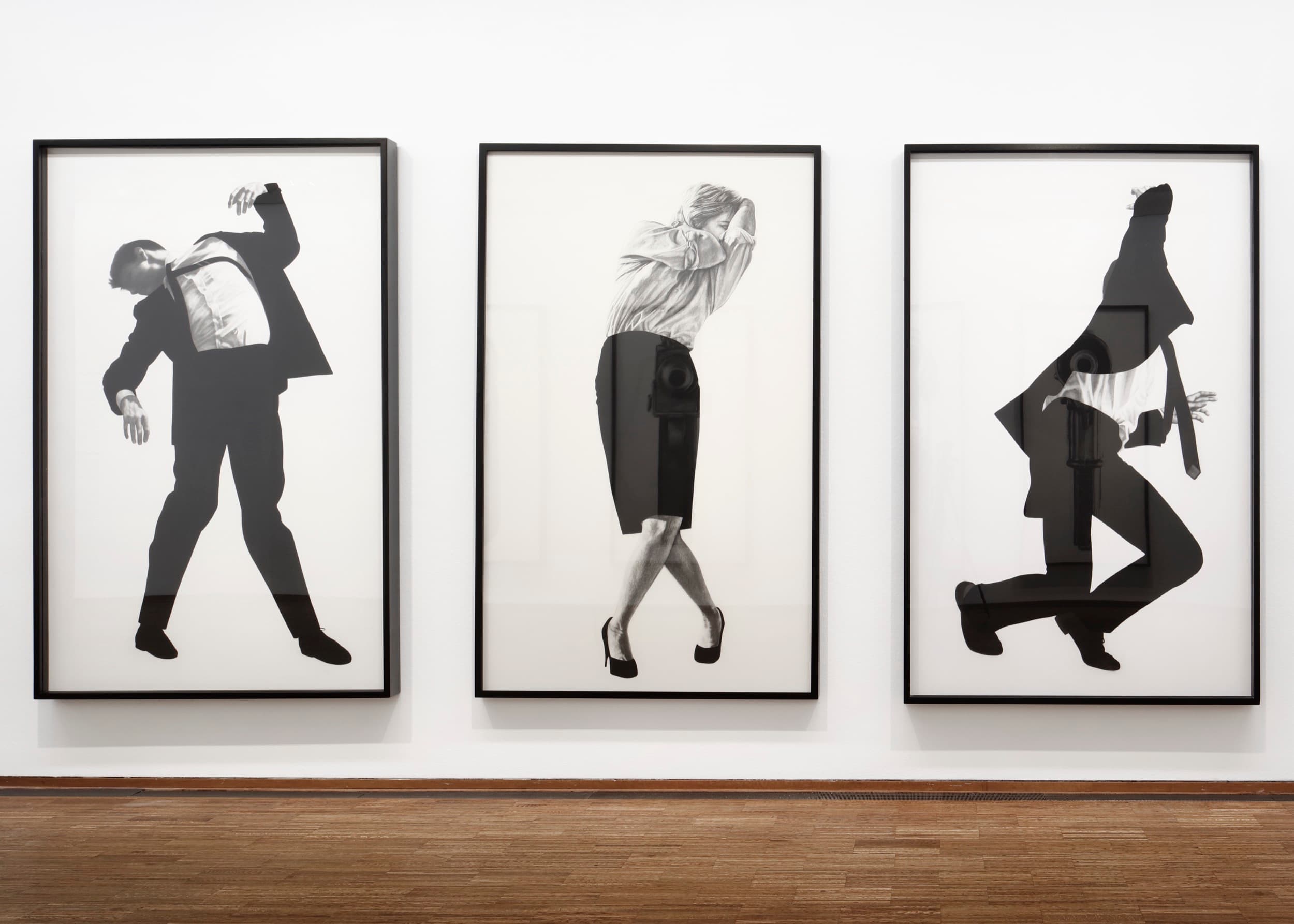
Rail: I’ve always felt like there was a profitable comparison to be made between the “Men in the Cities” and Giambologna sculptures, the torsion of them and the way they spiral up and up. I’m thinking of the image of Cindy Sherman, where she’s kind of covered, but also her legs are twisted around each other. That’s very Giambologna.

Robert Longo, Untitled (Cindy), from the series “Men in the Cities,” 1979–83. Charcoal and graphite on paper, 96 x 58 3/8 inches. © Robert Longo / ARS, New York 2024.
Longo: Yes, there’s a similarity to Giambologna’s The Abduction of the Sabine Women (ca. 1579–83) and Michaelangelo’s “unfinished” slave sculptures in the Accademia in Florence. When I made my “Men in the Cities,” I would make at least a triptych, maybe as many as seven. But I thought about Muybridge: I didn’t want to make a sequence. I wanted to make a rotation. So that drawing of Cindy was meant to be a pivotal point between a very frontal person, and Cindy kind of twists, and there’s the back of a person. They all had these rhythms. I thought of “Men in the Cities” like guitar chords of a punk rock song.
Rail: I guess you could kind of think about Raphael’s Three Graces (ca. 1505), too, right?
Longo: Well, that’s funny, because I made a Three Graces drawing—The Three Graces; Donetsk, Ukraine; March 14, 2022 (2022). “Men in the Cities” are images that happen every time you look at them. I wanted to continue that in these large-scale drawings where what is happening in the picture happens every time you see it. I realized that now I could fill the whole paper up. Before that, I wasn’t interested so much in making images that you looked at. I was more interested in a kind of visceral, physical experience. It’s fun to fill the whole thing.

Robert Longo, Untitled (Jules), from the series “Men in the Cities,” 1979–83. Charcoal and graphite on paper, 96 x 60 inches. © Robert Longo / ARS, New York 2024.
I have an idea of what I want to make; I make a lot of studies, see if I can translate that, and then I figure out how to make it. And I realized that art is history, of course, but there’s also the fact that you embed into that world of making. When you’re making a work—maybe thinking about a baseball game that I went to ten years ago, or this girl that I knew twenty years ago, or this pair of shoes that I wish I had—all that shit’s in the world. So, what happens when somebody sees that work? They’re not experiencing that image; they’re experiencing this human energy of making it. I think the images are easy to look at, but they’re compositionally quite complex, and I’m very interested in composition. Because the thing about art is it’s incredibly democratic: you don’t have to read it like a book where you have to start from the beginning to the end, or a movie where you watch it from the beginning to the end. Art, you can look at the corner over here, from here—you can look at it however the fuck you want to look at it. How many times have I seen my favorite movie? Maybe five times, ten times, maybe. How many times have I looked at my favorite painting? Fifty times?
Rail: I was thinking about how you said something in one of your interviews about how drawing is a molecular process, and so, of course, that’s not just that it’s absorbed into your body and your body into the drawing, but also that molecules are abstractions to us. They are these things that we know exist, but we can’t see with the naked eye.
Longo: Art is a form of understanding, like the way science is, and math is, and sociology is, but maybe it is a form of understanding that can hold all of this. Maybe it is one of the better ways to understand the world.
Amanda Gluibizzi is an art editor at the Rail. An art historian, she is the Co-Director of the New Foundation for Art History and the author of Art and Design in 1960s New York (2021, paperback 2025).