ArchitectureOctober 2024In Conversation
PETER ZUMTHOR with Nile Greenberg

Portrait of Peter Zumthor, pencil on paper by Phong H. Bui
Word count: 4662
Paragraphs: 79
Architect Peter Zumthor’s deliberate practice in Haldenstein, Switzerland is a hybrid of workshop, atelier, and school. Despite its remote location, the atelier is currently developing architectural projects for sites in Los Angeles, Antwerp, and Basel. Popular mythology portrays Zumthor’s practice as monastic or distant, but it’s an intensely cultural one—exemplified by the Kunsthaus Bregenz built in 1997. This kunsthaus has served as a critical site of contemporary art, thanks partially to the relationship artists cultivate with the building itself. Strength attracts strength.
The question of what makes for a strong museum remains important. As the concrete forms of LACMA emerge in Los Angeles, we discussed the relationship between art and architecture and the state of the encyclopedic museum.
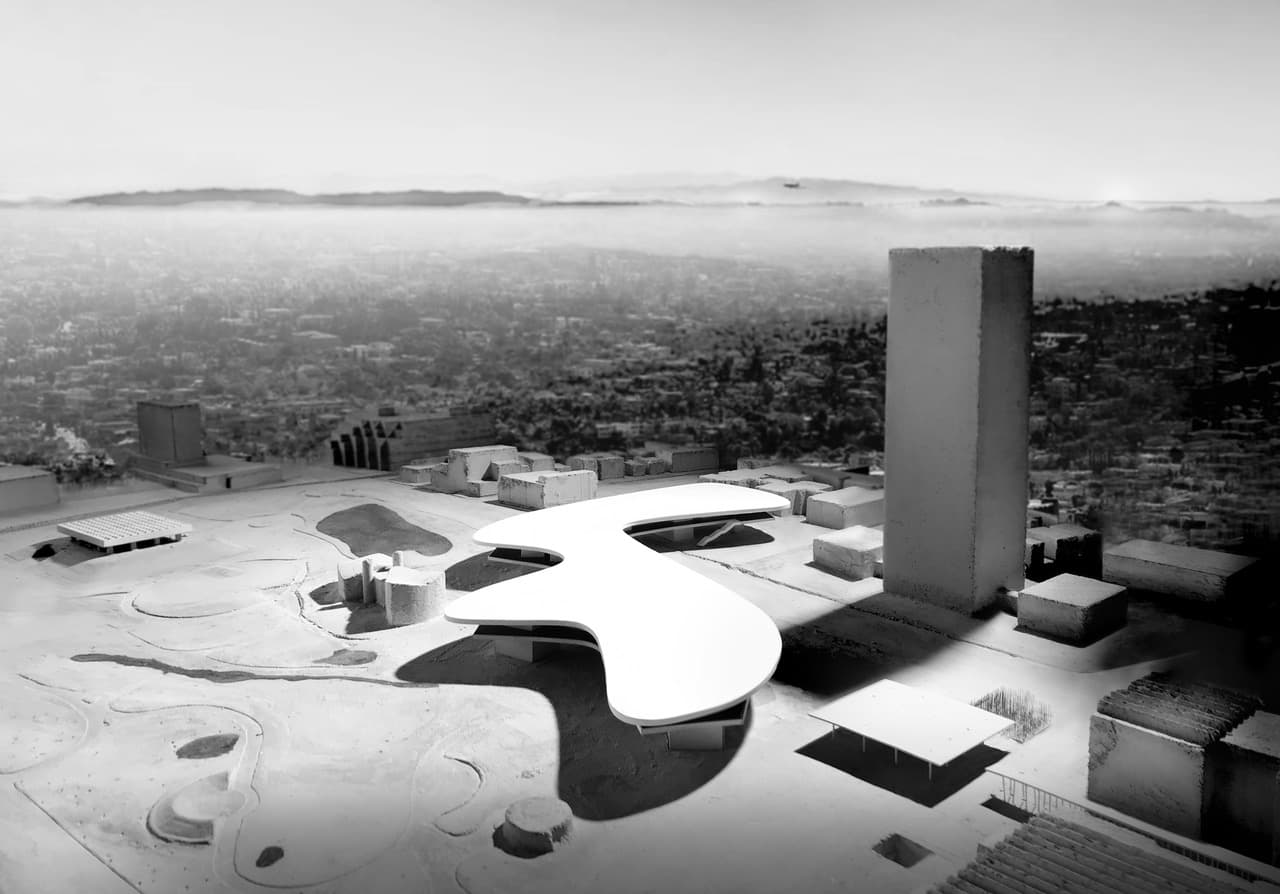
LACMA. Courtesy Atelier Peter Zumthor AG.
Nile Greenberg (Rail): When did you start working with artists directly, and how did that shape your view of architecture? Your earliest work didn’t have as much integration with art.
Peter Zumthor: I’ve never worked directly with artists. I respect art a lot and I have been influenced largely by the American art of the sixties and seventies, as well as by some German artists. But I was very much impressed by this new beginning, as you know, the American art in the sixties and seventies. I found it conceptual, clear, and radical, with the underlying ethos being “let’s start again.” I worked with Walter De Maria. It wasn’t so much a collaboration. But instead, I created work for him with a deep respect for his artwork. He didn’t say, “Let’s do something together.” It was not like that. Same with Louise Bourgeois. She said, “Do what you want, make something.” So that’s the best way to "collaborate" with artists, when they allow you to do your own thing and when they know you are the best when you do your own thing.
Rail: What do you think architecture’s role is in supporting art? Is it a container that houses art, an event space? I should specify that I’m referring to your buildings designed for art—museums. How does your architectural contribution support the arts?
Zumthor: Do I help the artist if I make a good museum? That’s an interesting question. What I immediately understand is that in making a museum I play a role in the way we look at art. I create a situation or place where we all can start to experience art and understand it. Maybe in my case, before art historians have explained it to me.
Rail: So there’s an attitude towards mediation, that architecture is creating some sort of scenario for us to engage with art. What’s your approach when conceptualizing a museum?
Zumthor: I want to present the art in an open way so that each person can experience it themselves. That’s my character, though. I’ve never liked people or teachers telling me what to do. Beginning with my father and all my subsequent teachers, I always found it difficult when teachers offer excessive explanations. I wanted to discover things for myself. And maybe this is a bit presumptuous, but this is the kind of experience I want to give to other people in a museum. That is: the possibility or occasion to discover things for themselves. It’s very personal. I’ve always felt bored when I had to go somewhere and take a tour. When tour guides over-explain the art, it seems to make the art disappear. So my approach is the opposite. I’m an art lover, and I want the art to be immediately and emotionally accessible to viewers.
Rail: Something that has stood out to me in your work is how incredibly precise it is. The French architect Henri Labrouste described “precision et liberte” [precision and liberty]. Precision in space allows for freedom of thought, which—I think—is very applicable for what you’re proposing to achieve in museums. To make something very, very precise and technically clear is to give freedom to its occupants. So my question is: how do you design a building for freedom, so that individuals may discover art for themselves?
Zumthor: I’m a big fan of George Kubler, an art historian from Yale who, in The Shape of Time (1962), made the observation that for certain problems in art, there are archetypal solutions reappearing all the time. He was theorizing on the perception of art. Art history is not about understanding art itself, but about understanding the history of artwork. But while understanding the history, it’s also good to understand the art itself, which would be more like a philosophy of art. So there’s a distinction between history and art and being able to intuitively respond to artwork. Art can touch us. There is sort of a spiritual dimension in art. Through my buildings I try to create a framework for artwork.
It’s especially complicated when dealing with an encyclopedic museum, which has a very huge collection. In an encyclopedic collection—itself an illusory Enlightenment idea—you have individual pieces that are supposed to be representative of each place and period, since it’s impossible to collect everything. Since encyclopedic collections only contain a small portion of work from each time and place, the work has to be so archetypically strong that it conveys to us something of that time and place it ostensibly represents. When I look at the cave paintings in Lascaux, France from about 20,000 years ago, I can feel something. I think there’s a deep spirituality in these works. We may not understand them, but they create a strong feeling and connect me to the past. I think much of the artwork in an encyclopedic collection can create these intense emotional responses. Because of this, I think it’s a really interesting project for an architect. It’s not a picture museum, it’s not a painting museum. It’s a museum of everything.
That’s my attitude, to take away the didactics of art history and let people respond to the artwork. Then it’s okay if people come in and make new didactics and give us new ways of understanding. I want to clear the way so that new connections can be made.
Rail: You’re talking explicitly about LACMA?
Zumthor: LACMA is the first and maybe the largest encyclopedic museum out there. So I’m speaking about my experience working with Michael Govan and conceptualizing this encyclopedic museum.
Rail: You’re describing works of art that are so strong that they don’t need a context anymore.
Zumthor: I didn’t say the work “doesn’t need”—I said that they can exist without contextual knowledge. They are strong enough to be understood and emanate something without context. They are, after all, alienated objects displaced from their original context.
Rail: That’s a nice contradiction with how you’ve described your work in the past, which is so rooted in a specific place.
Zumthor: My work is not alienated. But it’s not a contradiction. Conversely, my work feels a compassion for the alienated object.
Rail: Maybe this gets at different interpretations of art and architecture. But I want to segue and ask about your work in relation to nature. For instance, you’ve described Therme Vals as something like a quarry, or LACMA as a tar pit. I appreciate when you use these natural metaphors, but importantly, you don’t take it too literally. How does your work relate to nature?
Zumthor: Nature is much bigger than architecture. Nature can eliminate all architecture. I like to build with natural materials, which come from the earth. It could be steel or glass as they come from the earth. Let me give an example regarding nature and destruction. Take the Museum of Modern Art. It looks very good, very clean, maybe even a bit slick or sterile. But if you destroy it, all you’d have are plastic pipes. Now imagine a Gothic cathedral is destroyed. This would look wonderful still. The stone would be sculptural. I like to create buildings which can withstand the destruction test. I want the buildings to have integrity to their construction, and to create architectural bodies that are beautiful and sensuous. I understand that my buildings are not nature, but I would love if they became part of it in a way.
Rail: Often your buildings still look very architectural, despite using an abundance of natural materials.
Zumthor: When I build buildings I ask what people want out of their building, and then I work to come up with a good solution. I’m not a designer. I’m an architect. I create the archetypal, as the word “architecture” suggests.
Rail: I’m interested in your relationship with other architects. I’m not sure what your opinion would be on someone like Ludwig Mies van der Rohe. How do you relate to someone like that? And when you create architecture, do you reference other architects? Do images of specific architectural projects come to mind?
Zumthor: It’s wonderful to learn from architects like Mies—how he makes an open plan, et cetera. Of course, Mies is an icon of contemporary architecture, things cannot be better made than how he made them. Two or three months ago, I went for the first time to Chandigarh in India. And when I was there, I had tears in my eyes when I saw these buildings I have seen so many times in photos for the first time in real life. I have a feeling: when you look at the concrete, it has an incredible power and presence. It’s such a strong sculptural approach with concrete, and at the same time, completely functional.
We went to Le Corbusier’s High Court of Punjab and Haryana. A long row of courtrooms. The judges enter from the back. You don’t see them in front. There are hundreds of lawyers with their clients waiting. They all have these black robes and white shirts, and they are going up and down while the judges come in from the back so you don’t see.
Afterwards, we sat and talked somewhere, and someone asked me, “What question would you ask Le Corbusier?” [Laughs] I have seen his work—I have no question!
Rail: Sitting here, I know how you feel. Your work has such a strong voice. Do you like talking about your work, or would you prefer your work to speak for itself if that were possible?
Zumthor: I’m a passionate architect. In an honest, direct way, I like to talk about architecture. It’s beautiful, difficult, and everything.
Rail: In an interpersonal way, there is so much joy in talking about architecture.
Zumthor: If you do a building like in Chandigarh, or LACMA, now, as Michael Govan says, the last handmade big building in the US. We’ll never have something like this again, because the normal process is to build buildings like a car. You make a superstructure, then you put in all the piping, and then at the end, the designer cloaks everything and says okay. There’s a certain commercial coldness about big American or Japanese buildings, or European buildings in Frankfurt, which use this way of fabrication.
Example: there are great people who are building the formwork in LA. They understood and were so happy to do this work—really skilled. They had a high-level meeting to show me a mistake. They showed me the concrete over a door where it was all fucked up. They were able to mend it, but I said, “Listen, congratulations for your work. It’s great work, but shit happens. You are building a sculpture of concrete. Maybe you don’t know this, but sculptures are never mended.” This is great if you can go with your grandchild and say, “this didn’t work out,” and explain why, and be proud of it!
This is what I like about Chandigarh and the Indian people: you can see how they made the formwork. This is a quality. Most people know this is a quality if it were a private household. I hope not to lose this type of quality in architecture—it’s very important. We need to be one step ahead of this car industry style of production, which has a lot of logic in it, since you don’t need skilled labor onsite, and individual fabricators make everything offsite. But I hope that we will not lose these handmade buildings, and in building LACMA, I am prioritizing making a project that is handmade.
Rail: Because of LACMA, which is a huge project, I hope you’re going to create a new line of skilled craftspeople in Los Angeles!
Zumthor: Yes, that is my hope, too. I hope that people will see the project and understand its construction, and young architects and architecture students will feel inspired to work in this way. I hope architecture students see this and work this way. We architects should not give up.
Rail: I think that is how construction systems change.
Zumthor: All these workers are building it. They love it, they are so happy. They invited me to a barbecue to celebrate my birthday as an expression of their gratitude. You could feel that they like what they are doing—to be part of something historic. All of us from the architecture and construction trades are working together. It’s a communal process. Everybody brings his or her skill to make a beautiful whole.
Rail: Since I’m from North America—from New York in this case—I often feel it’s a struggle practicing architecture in the United States. It’s a struggle to build things that are real or whole. I think there is a dream that construction practices can change, and there are the resources to do it in some cases, but not the skill or labor at a large scale. So how were you able to build in such a way at such a large scale with LACMA?
Zumthor: We were lucky that the general contractor brought in good people to do the formwork and the concrete. But basically, it’s a matter of how the building process is organized. A big client often doesn’t want to carry the risk or responsibility for millions of dollars. So they find a general contractor early on who can carry the burden. From then, the client can go on vacation. But when working with a general contractor this way, there is no fluidity. If something is already planned, it cannot be changed. As an architect or builder, I have to find ways to work around this, letting certain things go while asking for other things. If the general contractor would hire top-notch fabricators who know how to make custom-made buildings from the beginning, my work as an architect would be much easier.
Rail: On Los Angeles: In your talk with Wim Wenders in your Dear To Me interview books, you were speaking about Hollywood. If you’re designing with memory in mind, Hollywood is very interesting because everyone has this connection to it through cinema. It’s ironic because Hollywood’s great export is that it has no place. In Hollywood, you can have the Alps, or the beach, the city, desert, or forest. You can recreate so many different climates within fifty kilometers of Downtown LA. How do you define LA as a context, in terms of the city’s cinematic collective memory?
Zumthor: In the eighties, I read Reyer Banham’s Los Angeles: The Architecture of Four Ecologies (1971), and as you probably know, I was invited to teach at SCI-Arc, which I really enjoyed. It was interesting that there was no real public space there. The most public space is if you drive on Wilshire for hours and you feel part of the arteries of the city. I find this very interesting. With LACMA, I wanted to create a public space. Michael Govan had already started this with Chris Burden at LACMA. I needed the help of Michael Govan to cross the street [draws a sketch of a soft, closed shape overlapping a grid of lines] and make a figure which goes over the LA grid. I needed his moral help to do this! This must do something to the city—like the Pan Am Building in New York—but somehow today the courage is lost. It must mean something to the city that there is a shape that is hard to understand crossing the road. The owner’s representative in charge of our project recently said to me, “Peter, I’ve now started to understand what this building is doing on all sides.”
Rail: I saw the first exhibition at LACMA of the design in 2013. But later, when I saw the new design, I finally thought, “Okay, now it’s really an LA building!”, because of its disregard of the grid and the city. Total freedom—that’s LA. When is LACMA expected to finish?
Zumthor: In about a year, one end will open. Some curators were critical of the spatial concept of the layout of the museum. But now since they can go and see the space for the first time, they start to like it. And they see the beauty of the handmade concrete body of the building—so I am told. But without Michael Govan, I couldn’t have arrived at this point. Have you ever met him?
Rail: No, I’ve never met him, but I would love to! I understand you’ve had a long relationship. You started working with him at Dia Beacon.
I have a question for you about teaching: how do you teach what you do? You were part of the founding of Mendrisio (the Academy of Architecture in Mendrisio, Switzerland, in the Ticino Region) where you structured a Fundamentals course. How do you teach young architects what you do?
Zumthor: It’s a very specific method—let me give you a specific example. I’m working with a former collaborator of mine doing a commission in the valley somewhere. There are about twenty-five women who do hand-weaving—they have like twenty-five looms there, it’s very beautiful. They want a new building.
So I brought a few young architects from the Atelier to help with this commission, and when we began working everyday, I instructed them not to speak, but just to listen. I presented my idea very clearly to the weavers, and then I would ask the young architects what they thought. If they liked it, I would go on. But if there is some doubt on one person’s part, I take it very seriously. There is a school method where the design is the result of one discussion. In school you think that if you have a good explanation for what you’re doing, then you are good. Good architecture is not just a good explanation, it’s all about emotions, that’s how we work here.
There’s actually a man who wrote a dissertation on how I taught at Mendrisio for my first six years. He discovered in the archives of the academy all of my assignments and interviewed former students. And what he concluded was that I didn’t teach a style. I got people to be very clear about what they want. My colleagues from the Ticino movement couldn’t believe certain student projects were made in my studio, because they thought since I have a style and attitude, that’s what I would be teaching. But that wasn’t the case. To me, teaching is helping people to arrive at a clear idea. I want to get to people to have a clear understanding of emotions. It’s not about whether or not everyone likes it. But about clarity.
At the Atelier, we are not discussing architecture. We are discussing emotions. If you don’t like something, I am not going to talk to you for ten minutes saying you should like it. Never! If you don’t like it, you don’t like it—there must be a reason. You have to give short answers. People who can help me, accept this method.
Rail: You are interested in people finding their own emotional connection to architecture, and I imagine other things in their life?
Zumthor: This is true, yes. I want students to be clear on what they want. At the Mendrisio Academy, in the first semester of the first year I offered a class. The assignment was to make a cube that is one material. This could be anything, it was not limited. I told the students that if it has something to do with them personally or biographically, I will give them an A plus. There was a girl who came with CD covers that she bound together to form a cube, or a guy who got up very early in the morning to cut fresh grass to form the cube. He had to invent a binding method with a thin wire to hold the grass together. It was still wet when he presented it to the class. He said it was important that it remained wet and had this specific smell.
Rail: Right now, we are sitting in a beautiful courtyard in a compound of buildings you’ve designed. You’ve gone through so much life here, raised your children here. I wonder about your emotional connection to this place, this architecture?
Zumthor: This has been an evolution [points to the chronological sequence of buildings within view]. I’m a foreigner here, because I’m from Basel, Switzerland. And in Switzerland it takes at least a generation to grow into the community. So I’m still, in a way, an outsider. This has to do with the fact that in Switzerland—and specifically in the German-speaking part—we are very proud of our dialects. So if I open my mouth, everybody immediately can tell after two or three sentences that I’m from Basel. Now, Haldenstein has become my home, and I feel great here. My children say it was a great place to grow up, even though they remind me that I didn’t have a lot of time for them. But they are happy that they always got to be around me working.
Rail: Have you always enjoyed working where you live?
Zumthor: I have never been in an architecture office except for six weeks. It was a bad experience. Here, I can always refine my own method of working. My education is custom-made. Living and working here is most of my experience as an architect.
Rail: Your practice has a very strong relationship to photography. What does photography mean to you?
Zumthor: My approach comes out of a problem. I never really liked the way architecture was photographed for publications. The more the photographer tries to capture the whole thing, the worse it gets. We resorted to working with artists, like Hans Danuser. I wanted photographs of my buildings to look like Hans Danuser photographs. So I asked him if he’d be interested in shooting my projects. He’d never shot architecture before, but agreed to it. It was a bit of a risk but I think it’s worked really well. The feeling was that the photographs had to be art in their own right, because photography is photography and buildings are buildings. So it had to be something more than just photographing a building. And that’s what Hans did. He created artwork that had a mystical feeling. And from those images I got a reputation of being a mystical or spiritual architect for the rest of my life.
Then later, I discovered Hélène Binet. She is less mystical, but there’s something highly artistic about how she does her work. She can show the whole thing in a detail. That’s what all good photographers do: reveal the whole through one small detail and you fill in the rest. I’m hoping to work with Hélène on my next book.
Rail: And it seems like in the design process you also use photography?
Zumthor: For the models we use photography. If we make a model and show it to the client they will inevitably say, “Aha, a model.” But if we show the client a photograph of the model—a good model, that is—even if you can tell it’s a model, the client will say “Is this real?”
Rail: A model is real!
Zumthor: There is this two-hundred-year–old idea that a photo depicts reality. Only recently has this idea been called into question again.

Hans Danuser, I, ST. BENEDICT CHAPEL, SUMVITG, 1988–92. 6 parts, I, II 1 – II 2, III, IV 1 – IV 2, Silver gelatine on baryta paper, 19 7/10 x 15 3/4 inches. Edition of 3 © [email protected].
Rail: In an interview with Hans Danuser in the book Seeing Zumthor, Danuser describes how at the time of his photos of your Chapel in the late 1980s, there was a desire for new images. Photography had peaked—its technical abilities were at an apex. Photography had to be reinvented for architecture. I think it’s useful that your buildings, which have a distinct architectural ethos where every material is so intentional, became the basis for this new photography.
Zumthor: That’s very interesting. Maybe it’s typical that strong things influence each other.
Rail: Photography is easily disseminated through books, and you’ve published very beautiful books. Do you see publishing these photographic books as part of your architectural practice?
Zumthor: There was the first blue book with Lars Müller. Then there’s the five volumes, and the book on Therme Vals. But that’s it.
Rail: Yes, but I suppose I’m thinking about how media works these days. For instance, when I was a student, I couldn’t afford the Therme Vals book, and so I had a photocopied low resolution PDF. These images are often circulated and transmitted in this way. Is it just by chance that photography became such a part of how people experience your work? Especially since so many of your projects are relatively inaccessible, since they are in small towns or not necessarily open to the public.
Zumthor: I’m glad to hear this. Also, I’ve noticed young people coming to Haldenstein to look at our projects, and I think it’s because of our books. We wanted to make good books, and we were critical about the process and very particular about presentation and materials. We didn’t want to make anything phony or artificial. It was rather a burden for everyone to do a publication, but I’m really happy that the books resonate with so many people.
Rail: It reminds me of some of the North American artists of the sixties and seventies who you are interested in—like Walter De Maria and Michael Heizer—who exclusively relied on photography to share their work.
Zumthor: They had to!
Rail: Have your photographs been influenced by these artists?
Zumthor: The first impression of American art was in the seventies or eighties in Schaffhausen, Switzerland. There were real things on show—Bruce Nauman and others—and I was completely taken. The work was such a liberation. I thought it was amazing.
Rail: Did other people around you understand that work as well?
Zumthor: A lot of us looked at these works as a sort of nourishment. If I’m honest, I thought that European architects were able to pick up on how powerful the work was more than American architects were able to.
Rail: You momentarily were working with Donald Judd. You were working with him on Kunsthaus Bregenz in Austria, what happened?
Zumthor: We got along really well. The director at the time came to me and said, “Would you want to make a small building with Donald Judd? Would you agree to that?” He wanted international attention, so he needed a big hero to help him with his building. So I agreed.
I told Donald Judd that I wanted to make an urbanistic statement there. I explained it to him, and while I was explaining the urbanistic idea for the building, I could already tell he was not interested at all. He waited until I was finished and said, “I have a building for you.” He took a building he couldn’t do in America and said, “Here is the building.” It took a bit of courage, but I told him I wanted to do my own building, and this wasn’t a problem for Judd. He decided to look for another place to build his project.
Rail: Did Judd have a chance to see your work?
Zumthor: He wasn’t interested. He did his own architecture, as you know. I had the feeling that he was not open to looking at other things. Okay, can I go?
Nile Greenberg is the editor of the Brooklyn Rail’s architecture section and operates the practice ANY in New York.